

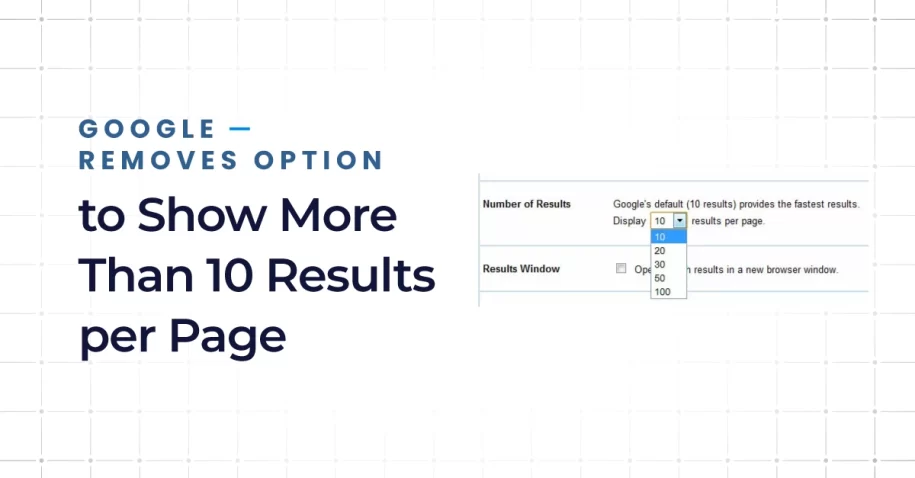
Google Removes Option to Show More Than 10 Results per Page
Google has officially removed the ability to view more than 10 search results per page, eliminating the long-standing &num=100 parameter that many SEO professionals and everyday users relied on. This change marks a notable shift in how we interact with the Google Search experience—impacting everything from rank tracking tools to overall search visibility. As the world of search evolves, understanding the impact of Google results changes is crucial for adapting your strategy and staying ahead.
Google Removes &num=100 Parameter
The results per page setting Google once offered in its search settings allowed users to customize how many results they’d see—typically between 10 and 100. By removing this functionality, Google removes the option to show more than 10 results per page. Here’s what to do becomes a question many marketers are now asking.
This update aligns with broader algorithm updates and a stronger push toward an AI search-driven experience. With features like AI overviews and a more dynamic interface, Google seems to be prioritizing personalization and predictive answers over showing 100 search results on one screen. For users, this might feel like a minor adjustment. For SEO professionals, however, it’s a major operational change.
The Technical Breakdown
Previously, appending “&num=100” to a Google Search URL allowed users and SEO tools to display up to 100 results on one page, facilitating easier rank tracking and performance analysis. Now, this parameter is ignored by Google, automatically reverting all searches to the standard 10 results per page.
This change disrupts many rank tracking tools and data aggregation platforms that depended on bulk SERP visibility. Since those systems can no longer fetch 100 results at once, their indexing speed, accuracy, and reporting frequency will need to be adjusted.
For businesses, it means your search engine reporting may look different. Metrics that relied on broad search results scanning might show smaller sample sizes or slower updates—especially across multiple pages.
Impact on Users and SEOs
For General Users (Browsing Experience)
For the average person, the change to Google search settings to 10 results will likely go unnoticed. Most users rarely go beyond the first few results pages, and with the rise of AI-generated snippets and AI overviews, information is being presented faster and more contextually than ever before. The convenience of pressing enter and getting direct answers outweighs scrolling through 100 results.
For SEO Professionals / Webmasters
For digital marketers and webmasters, the Google remove results per page update presents challenges. Keyword tracking, SERP analysis, and client reporting all depend on being able to see deeper into the Google search results. Now, rank tracking tools must adapt by scanning multiple requests instead of a single bulk query, increasing API usage and cost.
If your dashboards or scripts relied on the 100 results parameter, you’ll need to recalibrate your systems and potentially explore new SEO tools that can handle segmented queries more efficiently.
On Click-through, Page Ranking, Site Discovery
The impact of Google results change extends beyond convenience. With fewer results visible per page, competition for top spots intensifies. Businesses now have even more incentive to appear within the first 10 results, as fewer users venture into multiple pages of results.
This emphasizes the importance of strong online visibility and ongoing optimization. If your site isn’t ranking on page one, it’s time to reassess your search engine strategy and partner with experts who specialize in boosting performance through advanced SEO services.
What You Should Do
The first step is to rebaseline your SEO reports. Recognize that your number of results per query will now be capped at ten, requiring adjustments to data collection and performance tracking. Next, revisit your content strategy—focusing on improving quality, technical SEO, and E-E-A-T signals to strengthen your ranking potential.
Also, explore the implications of AI search and algorithm updates shaping the new SERP environment. As AI-generated summaries become the new “position zero,” optimizing for context, authority, and structured data becomes non-negotiable.
Finally, invest in long-term strategies that enhance your online visibility. Your brand must remain discoverable across platforms even when search landscapes shift.
Conclusion
Google’s decision to limit results pages to just 10 per view marks another milestone in its evolution toward AI-powered search experiences. While this might disrupt how businesses monitor rankings and performance, it’s also an opportunity to adapt, refine, and modernize your approach.
As google serp update trends continue, staying proactive with the right SEO tools, strategies, and partners will ensure your business thrives amid change. Embrace this shift, optimize smarter, and keep your brand visible where it matters most, the first page.
FAQ
Can I still get more than 10 results on a Google search page?
Answer – No, not through the settings menu. Google has permanently removed this option. The default is now 10 organic results per page. You may see more than 10 items total due to ads, “People Also Ask” boxes, and other SERP features, but the core organic results are capped.
How does only having 10 results per page affect SEO?
Answer – It increases the competition for the top spots. With only 10 organic positions visible before a user has to click “next,” ranking on the first page becomes even more critical. It also emphasizes the importance of capturing traffic from “Position 0” (Featured Snippets) and other SERP features that appear above the organic results.
Why did Google make this change?
Answer – The change is primarily due to the global adoption of continuous scrolling (infinite scroll), which loads results automatically. The manual setting became redundant and was retired to simplify the search experience and maintain performance consistency.
How does this change affect SEO and SERP analysis?
Answer – The removal complicates SERP data scraping and manual analysis for results beyond the initial 10, especially for deep dives past the second “page.” SEO professionals must now rely more heavily on proprietary tools and official APIs to gather high-volume ranking data.