

What Is Google’s AI Overview?
Definition & Origin
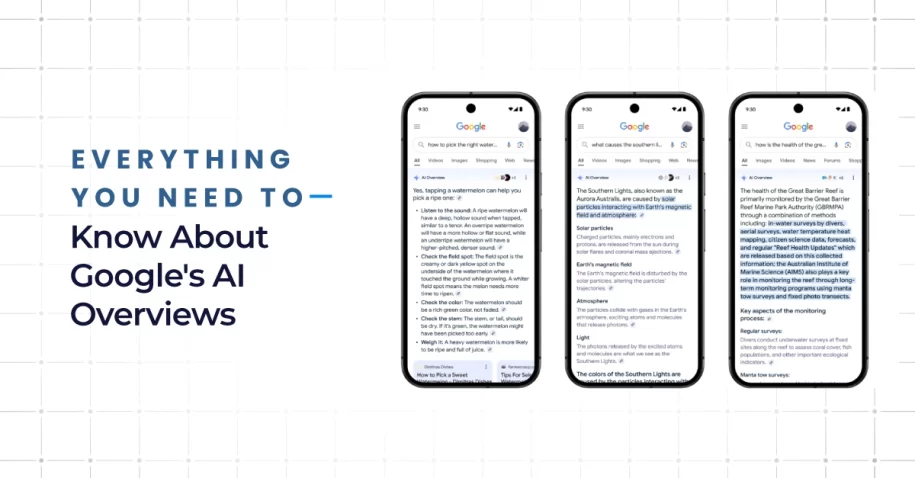
Google’s AI Overviews formerly known as Google SGE (Search Generative Experience) marks a new era of AI-powered search results. Built on generative AI and large language models (LLMs), this feature provides AI-generated summaries at the top of search results, offering users quick and comprehensive insights without requiring multiple clicks.
Launched initially as part of Google’s experimental SGE program, AI Overviews aims to revolutionize how people interact with Google Search by providing synthesized answers from multiple credible sources. Unlike snippets or featured results, AI Overviews utilize machine learning to comprehend the context behind a query, analyze thousands of data points in real-time, and deliver conversational, human-like summaries.
In essence, Google’s AI Overviews bridge the gap between traditional web searches and AI chat experiences, offering instant clarity for complex questions that once required browsing through several pages. This development represents a shift in the search landscape, empowering both users and businesses to navigate the digital world more efficiently.
How Is AI Overview Different from Traditional Google Search?
Traditional SEO focused heavily on keywords, backlinks, and ranking on the first page. AI Overviews, on the other hand, shift focus to contextual understanding and user intent. While traditional SEO results rely on indexed web pages and algorithms, AI Overviews are generated using LLMs that create responses from the best available content across the web.
This change has transformed user behavior, as people now receive instant answers within AI-powered search engines rather than scrolling through blue links. For businesses, this means content must be crafted not only for human readers but also for AI comprehension.
In comparing SGE vs traditional SEO, it’s clear that optimization strategies must evolve. The future belongs to those who master Google AI overview optimization, ensuring their content is discoverable, authoritative, and aligned with how generative AI search understands relevance.
The Role of Large Language Models (LLMs) in SGE
At the core of Google’s AI technology lies powerful large language models the same type of neural networks that drive advanced conversational agents. These models use deep learning and machine learning to predict language patterns and synthesize meaningful information from diverse sources.
LLMs allow AI Overviews to interpret the nuances of user queries, consider multiple perspectives, and create relevant results supported by verified data. They also help Google improve search quality raters’ assessments by adhering to principles of E-E-A-T Experience, Expertise, Authoritativeness, and Trustworthiness.
This integration enables AI-powered search to provide nuanced, contextualized, and safe answers, especially for Money or Your Life (MYOL) topics that impact users’ financial, health, or safety decisions.
The Impact of AI Overview on SEO and Organic Traffic
Will AI Overviews Steal My Clicks (Zero-Click Searches)?
One of the biggest concerns for businesses and marketers is whether AI Overviews will reduce website traffic. As AI-generated summaries answer more queries directly within search results, some fear an increase in “zero-click searches.”
However, Google’s goal isn’t to eliminate clicks it’s to enhance search experiences. Pages that offer depth, structure, and authoritative expertise are still prominently featured as cited sources in AI Overviews. This means your content can earn visibility even if users don’t click through, reinforcing your brand credibility.
By focusing on creating content for AI Overviews, businesses can still drive engagement through trusted exposure and brand mentions within these intelligent summaries. Optimization is no longer just about ranking it’s about relevance in AI-powered contexts.
New Opportunities: Conversational Search and Follow-Up Prompts
While some clicks may shift, AI Overviews open doors to new opportunities especially in conversational search. Users can now ask follow-up questions and refine their queries naturally, creating an ongoing dialogue with the search engine.
This conversational model transforms search from a one-time action into an interactive experience, giving brands multiple chances to appear as part of a user’s journey. With Google introducing follow-up prompts and contextual threads, businesses that produce well-structured, adaptive content stand to gain long-term visibility.
In other words, as google s ai overviews everything you need to know about it evolves, so too must your SEO approach one that embraces conversation, connection, and content clarity.
How to Optimize Content for AI Overviews
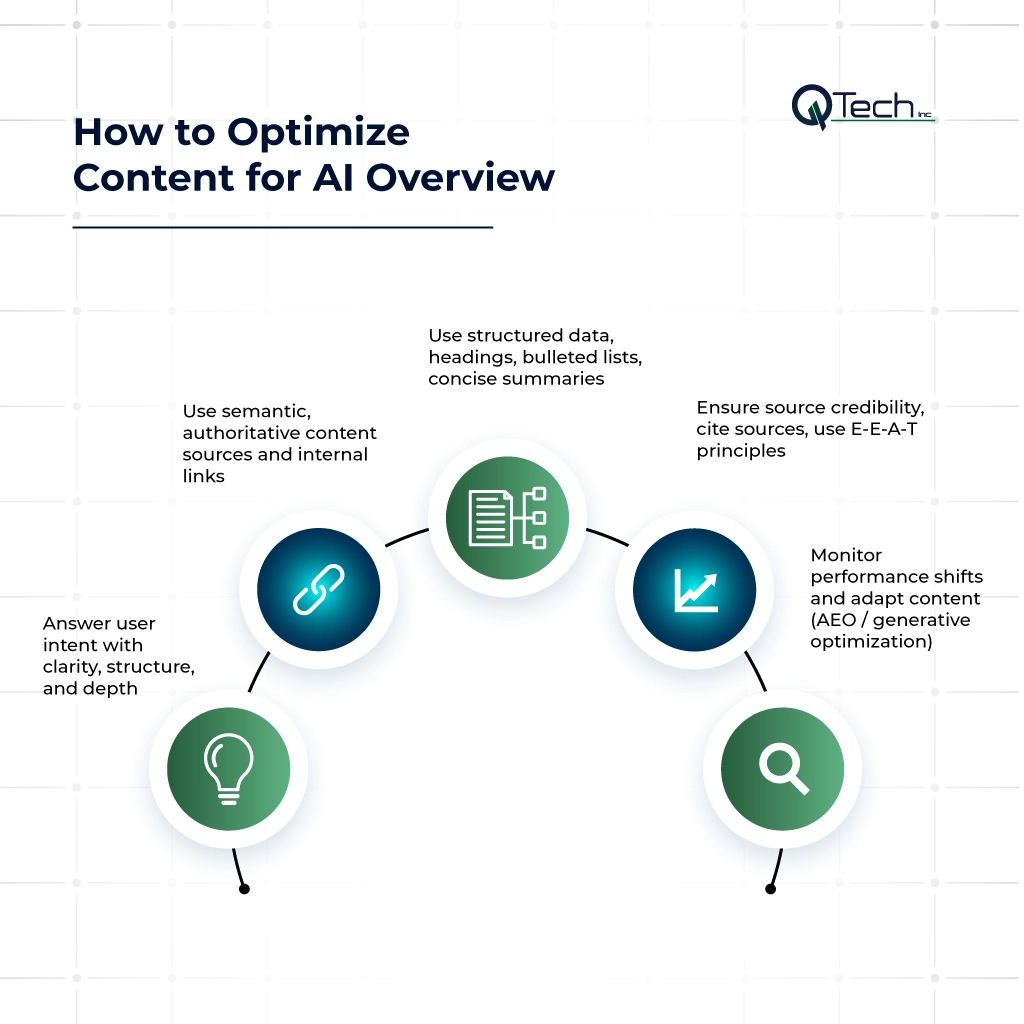
Answer User Intent with Clarity, Structure, and Depth
To appear in AI-powered search results, your content must directly satisfy user intent. This means answering questions comprehensively while maintaining focus and organization. Break down complex ideas into digestible explanations, use clear headings, and summarize key takeaways to help AI systems identify relevance and hierarchy.
The more precise your response, the more likely your content will be selected for AI-generated summaries. Think of each page as a potential knowledge asset ready to contribute to an intelligent overview.
Use Semantic, Authoritative Content Sources and Internal Links
Semantic structure matters. Google’s AI relies on contextual cues, related topics, and linked references to assess authority. Enhance your google ai overview optimization by referencing credible data, linking internally to relevant pages like SEO optimization, and citing authoritative sources.
The result is content that aligns naturally with AI overviews while boosting your internal link architecture and brand authority.
Use Structured Data, Headings, Bulleted Lists, Concise Summaries
Structured content helps AI-powered search engines extract key points accurately. Implement structured data markup, use bullet points, and craft concise summaries at the start or end of sections.
These signals make it easier for AI-powered search systems to identify your expertise and include it in ai generated summaries. Visual clarity supports both human readers and machine comprehension.
Ensure Source Credibility, Cite Sources, Use E-E-A-T Principles
In a world where AI can generate content quickly, trust becomes your greatest differentiator. Google evaluates sites using E-E-A-T principles, Experience, Expertise, Authoritativeness, and Trustworthiness.
To stand out, demonstrate real-world experience, provide verifiable data, and maintain transparent authorship. For “Money or Your Life” topics, accuracy is crucial Google’s algorithms heavily favor trustworthy, expert-backed content.
Building trust isn’t just ethical; it’s strategic for long-term success in generative AI search.
Monitor Performance Shifts and Adapt Content (AEO / Generative Optimization)
Optimization doesn’t end with publication. Businesses must regularly track performance metrics, engagement trends, and ranking shifts as AI Overviews evolve.
Adopting an AEO (Answer Engine Optimization) strategy ensures content stays visible across generative search systems. Continuously refine your approach, analyze what’s being surfaced in AI summaries, and align your digital strategy to the strategy for AI search era.
Being proactive rather than reactive keeps your brand competitive in this fast-changing search landscape.
The Future of AI Overviews & Generative Search
Expansion into More Queries, Languages & Regions
Google’s AI is rapidly scaling. AI Overviews are expanding beyond English-language queries, reaching users globally. Over time, these summaries will appear for more complex questions, industries, and local search scenarios.
This expansion presents opportunities for multilingual and regionally tailored content strategies, allowing businesses to reach audiences previously outside their organic range.
Integration of Multimedia, Video & Images in AI Summaries (Multimodality)
The next wave of AI-powered search engines will go beyond text. Multimodal AI systems those that integrate text, image, and video inputs are shaping the future of Google’s AI Overview vs Gemini, where visual media enhances contextual understanding.
Soon, users will see AI-generated summaries enriched with dynamic visuals, making results more engaging and informative. Brands that leverage multimedia assets early will naturally align with these evolving ranking signals.
The Role of GEO (Generative Engine Optimization) and Upcoming SEO Shifts
The rise of GEO (Generative Engine Optimization) signals a transformation of SEO as we know it. Instead of optimizing for search engines alone, businesses must now optimize for AI engines that interpret meaning, tone, and trustworthiness.
In this context, sge vs traditional seo becomes a defining discussion. While traditional SEO still matters for structure and crawlability, GEO focuses on semantic depth, brand authority, and the ability to provide relevant results across AI-powered search experiences.
Companies that adapt to this hybrid model balancing human storytelling with algorithmic understanding will define the future of organic results.
Conclusion
Google’s AI Overviews mark a pivotal moment in the evolution of search engines. By merging machine learning, generative AI, and real-time insights, Google is redefining how users access information. For businesses, this transformation is both a challenge and an opportunity a call to elevate content strategy and embrace smarter optimization.
Success in this new landscape depends on clarity, trust, and adaptability. Brands that invest in structured data, demonstrate E-E-A-T, and align with the principles of AI-powered search will thrive as visibility increasingly depends on intelligent systems rather than manual clicks.
The age of AI Overviews is here, and those who evolve with it will not only remain relevant but lead the way in a generative future.
FAQ
What is the main purpose of Google AI Overview?
Answer – The main purpose of AI Overview is to give users a comprehensive, AI-generated summary directly on the Search Engine Results Page (SERP) for complex or conversational queries, reducing the need to open multiple links.
Will SGE replace traditional 10 blue links in Google Search?
Answer – No. Google positions AI Overview as an enhancement, not a replacement. The AI-generated section appears at the top, while traditional organic results still display below it, often with the AI Overview citing those same top-ranking sources.
How is AI Overview different from featured snippets?
Answer – A featured snippet extracts a single answer from one webpage, whereas AI Overview generates a new, multi-source summary that synthesizes reasoning, insights, and links to its cited sources. It’s a conversational, multi-paragraph explanation, not just a short fact.
Will AI Overviews reduce organic traffic?
Answer – Possibly, for some queries. Users may find complete answers within the AI Overview itself. However, being referenced or cited in these summaries still enhances visibility, trust, and authority. SEOs should optimize content to appear as reliable sources for AI-generated results.