


Why B2B Marketing Requires a Different Playbook
Unlike B2C marketing, which often targets individuals with emotional appeals, B2B marketing requires logic-driven strategies that build trust and long-term relationships with organizations. B2B companies sell complex products or services that involve multiple stakeholders and lengthy sales cycles. Each decision maker must see the clear value and ROI before committing.
That’s why your B2B marketing strategy should focus on personalization, authority building, and consistent value delivery. Instead of impulsive purchases, B2B buyers are guided by pain points, data, and measurable results. Businesses that understand this distinction can create campaigns that resonate deeply with their audience and grow their market presence effectively.
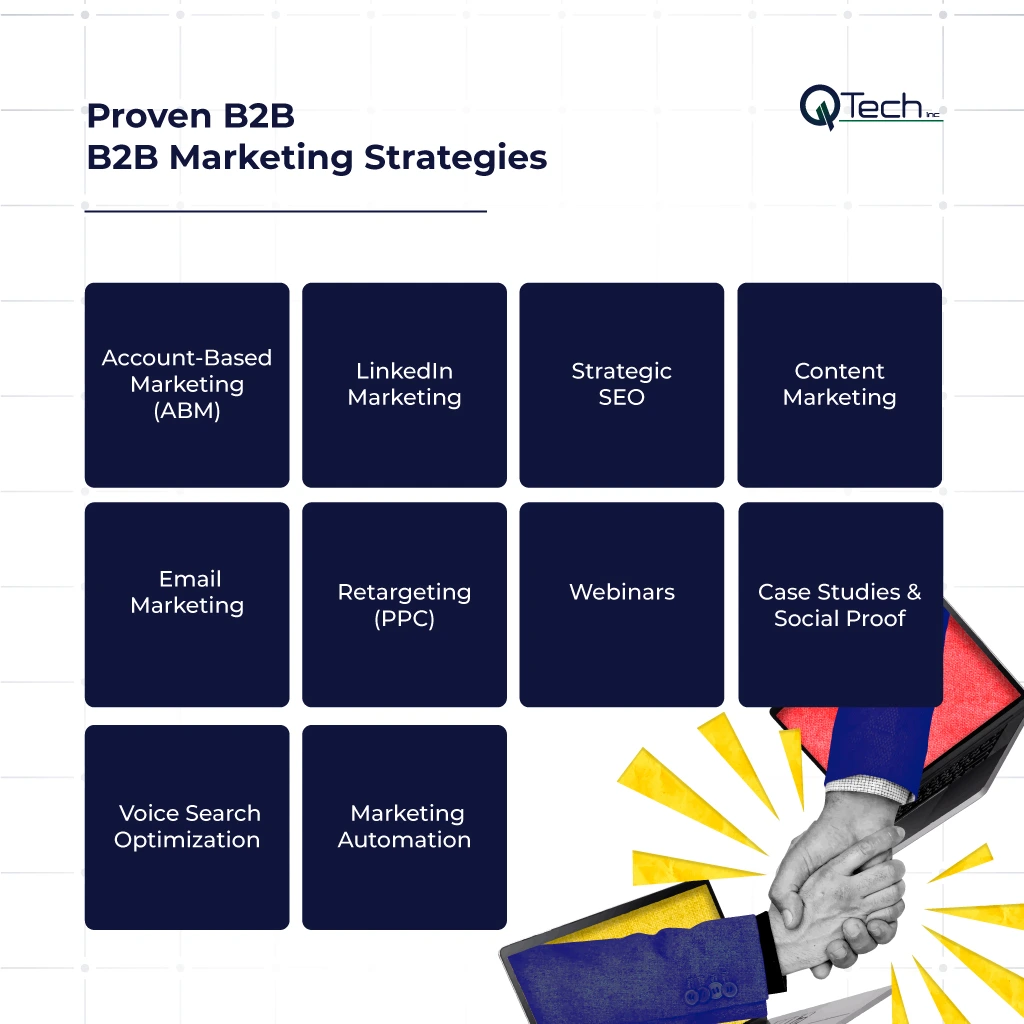
The 10 Proven B2B Digital Marketing Strategies
- Account-Based Marketing (ABM)
- LinkedIn Marketing
- Strategic SEO
- Content Marketing
- Email Marketing
- Retargeting (PPC)
- Webinars
- Case Studies & Social Proof
- Voice Search Optimization
- Marketing Automation
1. Account-Based Marketing (ABM): The Precision Approach
Account-Based Marketing (ABM) has become a cornerstone for digital marketing strategies for B2B. This method aligns marketing and sales teams to target specific accounts with personalized campaigns. Instead of chasing broad audiences, ABM focuses on high-value prospects, those most likely to convert and become long-term partners.
ABM uses data insights and customized content to address the pain points of key decision makers, creating a sense of exclusivity and relevance. Tools like HubSpot, Salesforce, or Marketo help manage personalized outreach and track engagement metrics, ensuring that every interaction drives measurable results.
When done effectively, ABM becomes more than just a marketing tactic; it’s a precision tool for how to generate B2B leads and strengthening client relationships that drive revenue.
2. LinkedIn Marketing & Sales Navigator Prospecting
For B2B brands, LinkedIn remains the most powerful social network to connect with professionals and generate leads. Using LinkedIn Marketing for B2B, companies can leverage organic content, thought leadership posts, and targeted LinkedIn Ads to reach their ideal audience.
LinkedIn’s Sales Navigator further enhances this process, allowing you to segment prospects based on company size, role, or industry. By combining valuable B2B content with strategic outreach, businesses can spark meaningful conversations that convert to qualified leads.
Effective use of social media in this space isn’t about vanity metrics; it’s about relationship building. When your audience perceives your brand as an industry authority, your credibility and visibility naturally increase.
3. Strategic SEO for High-Intent B2B Keywords
Unlike consumer searches, B2B SEO strategies focus on intent-driven queries that target professionals seeking solutions for their companies. Optimizing your site for search engines involves more than keyword stuffing; it’s about understanding search intent and tailoring your content to match business needs.
For instance, decision makers searching “enterprise cybersecurity software” or “managed IT for healthcare” are closer to a purchasing decision. Focusing on long-tail and high-value phrases ensures that your product or service appears at the right time, to the right audience.
Implementing strong technical SEO, optimizing landing pages, and integrating analytics can dramatically increase inbound lead generation.
4. Content Marketing That Addresses the Buyer’s Journey
Content marketing remains one of the most powerful digital marketing strategies to grow your B2B business. From blog posts and infographics to eBooks and whitepapers, every piece of B2B content marketing should be designed to educate, engage, and convert.
The key is alignment with the buyer’s journey:
- Awareness Stage: Address industry challenges and educate prospects.
- Consideration Stage: Present solutions through webinars and case studies.
- Decision Stage: Showcase client success and ROI-driven results.
By strategically mapping out content for each stage, businesses ensure they remain relevant from discovery to conversion. This consistency helps build trust with your audience and positions your company as a go-to resource in your niche.
5. Email Marketing Nurturing Sequences
Despite the rise of automation and social platforms, email marketing remains one of the highest ROI channels for B2B lead nurturing. Personalized email sequences help maintain relationships with prospects and existing customers, ensuring that you remain top-of-mind even after initial contact.
Effective B2B email marketing involves segmenting contacts based on behavior, interest, or lead score. Automated follow-ups ensure timely engagement, while educational content—like newsletters, eBooks, or webinar invites continues adding value.
By integrating marketing automation tools, you can streamline these processes and focus on meaningful interactions that lead to conversions.
6. Retargeting (PPC) to Re-engage Warm Leads
Visitors who interact with your website but don’t convert represent untapped potential. Retargeting campaigns, especially through platforms like Google Ads or LinkedIn, allow you to reconnect with these leads by showing them relevant ads tailored to their interests.
Sponsored content and display campaigns remind users about your brand, helping them progress further along the decision-making path. This approach is one of the most effective B2B lead generation tactics, as it nurtures familiarity and increases conversion rates.
When paired with compelling offers or insightful case studies, retargeting becomes a subtle yet powerful way to grow your B2B business online.
7. Webinars for Lead Generation and Authority Building
Webinars are a trusted tool for B2B marketing planning. They provide real-time interaction, showcase your expertise, and address specific client pain points, all while generating qualified leads. By offering practical insights or showcasing your product or service in action, you establish authority and credibility.
Post-webinar nurturing, such as thank-you emails and exclusive offers, helps keep engagement strong. When executed strategically, webinars double as educational content and b2b lead generation tactics, helping your brand stand out as an expert in your field.
8. Case Studies & Social Proof as Your #1 Sales Tool
In the B2B world, case studies are one of the most persuasive forms of content. They provide tangible proof that your company delivers measurable results. Decision makers love data—showing them real-world outcomes helps eliminate risk from their buying decision.
Highlight how your B2B company’s clients improved efficiency, reduced costs, or achieved specific goals using your services. Pairing case studies with sponsored content and video testimonials strengthens your credibility.
When presented effectively, case studies do more than tell stories; they convert prospects into customers and amplify your B2B marketing strategy.
9. Optimizing for Voice Search in a B2B Context
As technology evolves, search engines increasingly rely on voice-based queries. B2B marketers must adapt by optimizing for conversational language and long-tail phrases that match how professionals ask questions verbally.
For example, “What are the best cybersecurity solutions for hospitals?” or “How can I improve remote IT security?” reflect real-world search intent. Optimizing FAQ pages and blog content for these phrases ensures your brand stays ahead in organic rankings.
Voice optimization not only improves visibility but also helps build trust with audiences who value fast, accurate, and conversational answers.
10. Marketing Automation to Scale Your Efforts
To maximize efficiency and scalability, implementing marketing automation is essential. It allows your team to manage campaigns, analyze performance, and nurture leads automatically—freeing up time for strategy and innovation.
Automation platforms can trigger personalized email campaigns, retarget ads, assign lead scores, and track customer journeys. When used strategically, automation transforms repetitive processes into streamlined systems that deliver results faster.
For B2B brands looking to scale sustainably, automation is the backbone of consistency and growth.
Measuring Success: Key B2B Marketing KPIs to Track
Without measurement, no B2B marketing strategy can improve. Tracking performance indicators such as website traffic, conversion rates, engagement metrics, and lead quality helps assess what’s working.
Important KPIs include:
- Cost per Lead (CPL): Understand the efficiency of your campaigns.
- Conversion Rate: Measure how well you move prospects through the funnel.
- Lead Quality & Score: Determine which prospects are most likely to convert.
- ROI by Channel: Identify which tactics provide the best returns.
By consistently monitoring these data points, B2B marketers can refine their tactics, adjust budgets, and optimize campaigns to maximize growth.
Conclusion & How Q-Tech Inc. Can Help You Execute These Strategies
In today’s fast-paced digital environment, digital marketing strategies to grow your B2B business require precision, consistency, and creativity. From content marketing and email automation to LinkedIn prospecting and SEO optimization, every touchpoint should aim to build trust and drive measurable impact.
Q-Tech Inc. specializes in helping B2B companies thrive through tailored digital marketing solutions. Whether you need help with B2B digital marketing services, advanced SEO, or strategic social media marketing for B2B, our team provides the expertise to help you reach new markets and achieve long-term success.
It’s time to take your business beyond conventional marketing. Implement these ten proven tactics today and start creating meaningful connections that convert.
FAQ
Q: What makes digital marketing for B2B different from B2C?
A: B2B marketing differs in buyer behaviour (longer cycles, multiple decision-makers), higher transaction values, need for trust and authority, and the importance of pipeline and relationship metrics rather than just direct consumer conversions.
Q: How can B2B companies measure digital marketing success?
A: Key metrics include cost per lead (CPL), lead to opportunity conversion rate, pipeline generated, return on marketing investment (ROMI), average deal size uplift, and customer lifetime value (CLV). Tracking across channels is also essential.
Q: What role does content marketing play in B2B digital strategy?
A: Content marketing is critical in B2B because decision-makers research heavily. High-value content such as white papers, research reports, case studies and webinars establish trust, capture audience intent, and generate qualified leads.
Q: Is LinkedIn still relevant for B2B digital marketing?
A: Yes. LinkedIn remains a top channel for B2B due to its professional audience, targeting capabilities, and content formats suited to decision-makers. Sponsored content, InMail, thought-leadership posts and employee advocacy are highly effective.
Q: How can smaller B2B businesses compete with larger firms in digital marketing?
A: Smaller B2B firms can compete by focusing on niche segments, being highly targeted (account lists, verticals), using content and automation to scale, leveraging partnerships, and optimising budget across channels rather than trying to match large-scale ad spend.