
Small and medium businesses (SMBs) today thrive on visibility, efficiency, and connection. The path to success is no longer just about having a product or service; it’s about having a strong digital foundation. Google’s digital ecosystem for SMBs brings together powerful digital tools that help small business owners establish an online presence, manage operations, and attract their target audience.
This complete network of products from Search and Ads to YouTube and Analytics empowers businesses to grow smarter, faster, and more efficiently. In this guide, we’ll explore how the Google digital ecosystem for SMB operates, its key components, and practical strategies to leverage it for measurable growth.
What Is Google’s Digital Ecosystem?
Definition
Google’s digital ecosystem: the complete guide for SMBs starts with understanding what this ecosystem is. At its core, the Google ecosystem is a connected suite of applications and platforms that help small businesses build credibility, reach customers, and streamline communication. These digital tools — like Google Search, Google Business Profile, Google Ads, and Google Analytics — work together to help you manage your business in one cohesive environment.
How the various Google services interconnect
The strength of this ecosystem lies in its integration. A business can verify its listing on Google Maps, run Google Ads, track engagement with Google Analytics, and store marketing materials in Google Drive, all seamlessly.
Each service enhances the other. For instance, when your business profile is optimized, it helps your business be found in local search, improves organic visibility on Google, and enhances your ad performance across platforms. This interconnectivity ensures that small business owners have real-time insights and can make data-driven decisions.
Why this matters for small and medium businesses
For SMBs, time and budget are often limited. The key components of the Google ecosystem are designed to maximize results while minimizing complexity. Whether you’re running a restaurant, retail store, or tech company, these management tools allow you to compete with larger enterprises.
By using AI tools and automation features, businesses can handle everything from customer inquiries to ad targeting in real time. This not only accelerates your digital transformation but also allows you to focus on growth rather than micromanaging every process.
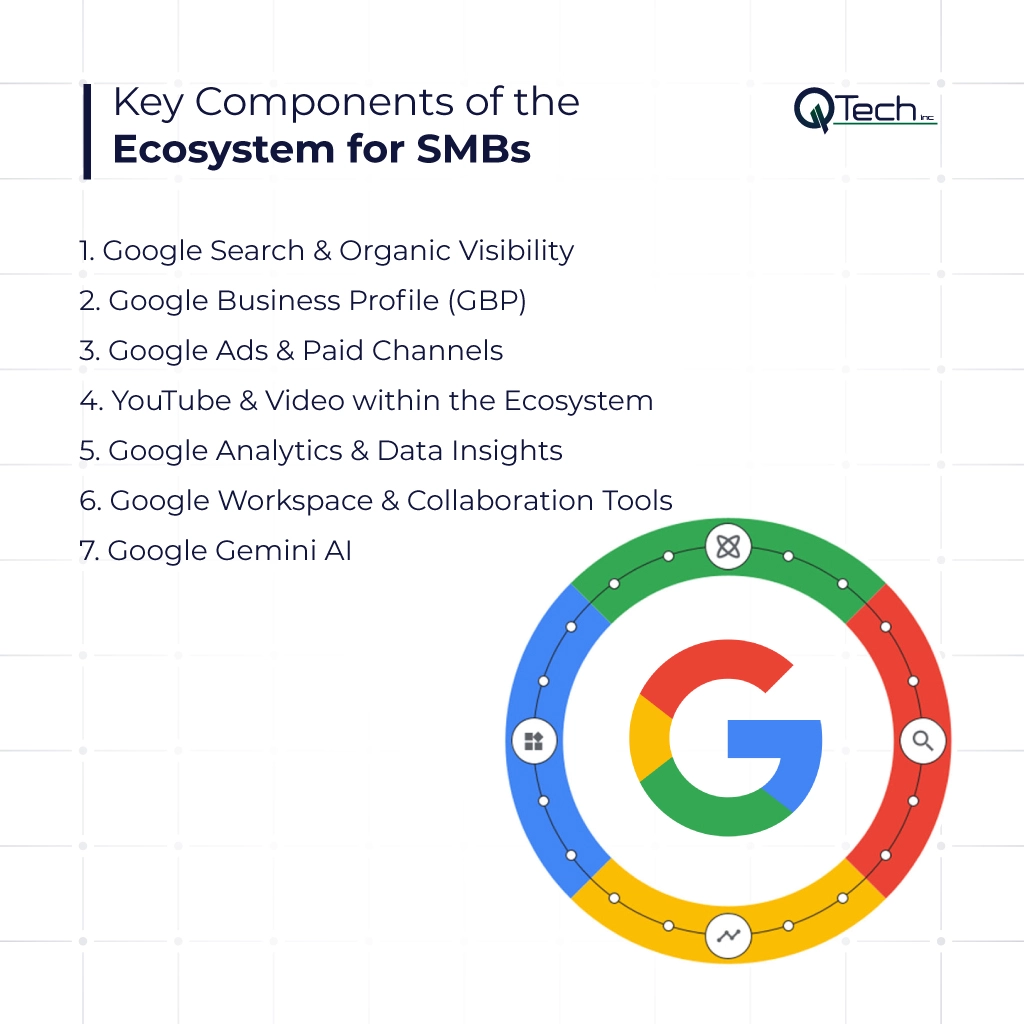
Key Components of the Ecosystem for SMBs
- Google Search & Organic Visibility
- Google Business Profile (GBP)
- Google Ads & Paid Channels
- YouTube & Video within the Ecosystem
- Google Analytics & Data Insights
- Google Workspace & Collaboration Tools
- Google Gemini AI
Google Search & Organic Visibility
At the heart of any online business is Google Search. Ranking higher means being discovered by the right people at the right time. By optimizing your website and connecting it to Google Search Console, SMBs can boost their visibility and drive organic traffic.
Google Business Profile (GBP)
The Google Business Profile (formerly Google My Business) is one of the most powerful free tools for small business owners. By claiming and optimizing your GBP, you can display your phone number, location, reviews, and service details. When customers search for your products or services, your listing appears directly on Google Maps and Search. This makes it easier for customers to find your business, engage with you, and leave feedback.
Google Ads & Paid Channels
Running Google Ads — often referred to as “good ads” when executed properly — allows you to reach customers ready to buy. These paid campaigns can target users by demographics, interests, and search terms. When combined with organic SEO, Google Ads can dramatically increase your online presence and conversion rates.
YouTube & Video within the Ecosystem
YouTube, another major component of the Google ecosystem, is a game-changer for brand visibility. With over 2 billion active users, YouTube gives small businesses the ability to tell their stories through video, connect emotionally with viewers, and build brand authority. By creating optimized video content and linking it with your Google Business Profile and Ads, you can expand your digital reach exponentially.
Google Analytics & Data Insights
Understanding customer behavior is essential for SMB success. Google Analytics tracks how users find and interact with your website. It shows which campaigns work, which pages perform best, and where visitors drop off. These insights allow small businesses to adjust their strategies in real time and stay ahead of competitors.
Google Workspace & Collaboration Tools
Collaboration is key for growing teams. Google Workspace, including Gmail, Google Drive, Docs, Sheets, and Meet, helps your team communicate, share files, and collaborate efficiently. These tools form the operational backbone for many SMBs, providing secure and scalable solutions for business communication and data management.
How the Ecosystem Works Together for SMB Growth
Combine GBP, Search, Ads, and Reviews
The real magic happens when you integrate all these tools. For example, your Google Business Profile improves your credibility, while Google Search and Google Ads bring traffic to your site. Reviews enhance trust, creating a loop of visibility and validation that fuels long-term growth.
Map the full “near me” to conversion journey
Modern consumers often start their buying journey with a “near me” search. A potential customer might discover your business via Google Maps, click on your website, and then convert after watching a YouTube video or reading reviews. By connecting each touchpoint, SMBs can visualize the entire customer journey — from awareness to conversion — within Google’s ecosystem.
Use data insights to improve campaigns
By combining Google Analytics with Google Ads and Search Console, small businesses can access a powerful management tool for optimizing their campaigns. With real-time insights, you can adjust ad spend, improve click-through rates, and make smarter marketing decisions. This synergy is the foundation of a successful digital transformation strategy.
Practical Strategies for SMBs to Leverage the Google Ecosystem
Optimize your Google Business Profile
Start by claiming and verifying your business profile. Add accurate information — such as your phone number, location, hours, and photos. Post regular updates, respond to reviews, and use messaging features to engage customers. Verified businesses are more likely to appear in local search results and gain trust from users.
Make your site SEO and mobile-friendly
A responsive and optimized website strengthens your visibility across Google Search and Google Ads. Ensuring your site is mobile-friendly, loads quickly, and uses local SEO best practices will help your target audience find you easily.
Post optimized videos on YouTube
Videos are one of the most effective ways to connect with potential customers. Create educational or behind-the-scenes videos, optimize titles and descriptions with keywords, and link them to your Google Business Profile. This improves both your search ranking and customer engagement.
Connect Ads, Analytics, and Search Console
Integrating Google Ads, Google Analytics, and Search Console helps you view performance holistically. It gives you a clear picture of what drives traffic, conversions, and ROI — ensuring that every dollar you spend has a measurable impact.
Track, refine, and measure performance
Success in the digital world requires continuous improvement. Monitor your data in real time, adjust your strategies, and refine your campaigns based on performance insights. SMBs that consistently analyze and adapt thrive in competitive markets.
Conclusion & How Q-Tech Inc. Helps SMBs Succeed on Google
Harnessing Google’s digital ecosystem can transform how small businesses operate, connect, and grow. From managing customer interactions to analyzing marketing data, every tool contributes to a smarter, more connected business model.
But mastering all these platforms takes time and expertise. That’s where we comes in. Our digital marketing services for SMBs help you navigate Google’s tools strategically — aligning Search, Ads, YouTube, and Analytics to create measurable growth.
Whether you’re looking to boost visibility, enhance collaboration, or accelerate your digital transformation, Q-Tech Inc. is your trusted partner in mastering Google’s world of opportunities.
FAQ
Q: What is the difference between Google Workspace and a free Gmail account?
A: The key difference is professionalism and control. Google Workspace is a paid, professional service that lets you use your own business domain (e.g., yourname@yourcompany.com), offers enhanced security and admin controls, provides guaranteed uptime, and removes ads. A free Gmail account is for personal use and uses the @gmail.com domain, which looks less professional for business communications.
Q: Is Google Business Profile really free?
A: Yes, creating and managing a Google Business Profile is completely free. It is one of the most powerful and cost-effective marketing tools available to local businesses. It allows you to appear in local search results and Google Maps, display your hours and contact info, collect customer reviews, and post updates—all at no charge.
Q: How does the Gemini AI fit into the Google Workspace ecosystem for SMBs?
A: Gemini integrates directly into Workspace apps (Docs, Gmail) to act as an AI assistant. It helps SMBs draft emails, summarize documents, analyze data in Sheets, and generate basic code, boosting team productivity and content creation.
Q: How does YouTube fit into the Google ecosystem for SMBs?
A: YouTube is part of the Google ecosystem and is the second largest search engine. Publishing video content helps your business show up in YouTube search, enhances Google search visibility (video results), and feeds into remarketing or ad campaigns. For SMBs, video builds credibility, improves reach and leverages Google’s infrastructure.
Q: What metrics should SMBs track within the Google ecosystem?
A: Key metrics include organic search traffic, GBP discovery/completion actions (calls, directions, website clicks), YouTube views/engagement, ad conversion cost and ROAS, cross-channel attribution via Analytics (e.g., multi-channel funnels) and local review growth. Tracking across the ecosystem shows how components work together.