

Introduction – Why Understanding Google’s Ranking Factors Matters in 2026
For businesses competing online, visibility is no longer just about having a website. It is about building a digital presence that Google can understand, users can trust, and your target audience can rely on when making decisions.
In 2026, Google ranking factors continue to reward websites that combine strong content, sound technical structure, authority, and positive user experience. Google states that its automated ranking systems evaluate many signals across billions of pages to deliver useful search results quickly. That is why this guide focuses on the fundamentals that still matter most.
The businesses that win in Google search are not chasing shortcuts. They are building assets. Strong SEO requires content strategy, technical seo optimization, page speed optimization, authority building, and continuous measurement through tools like Google Search Console.
When these pieces work together, your website becomes easier for a search engine to crawl, easier for users to navigate, and more likely to earn meaningful traffic. These seo ranking factors 2026 are not isolated tasks; they are connected signals that shape how your website performs.
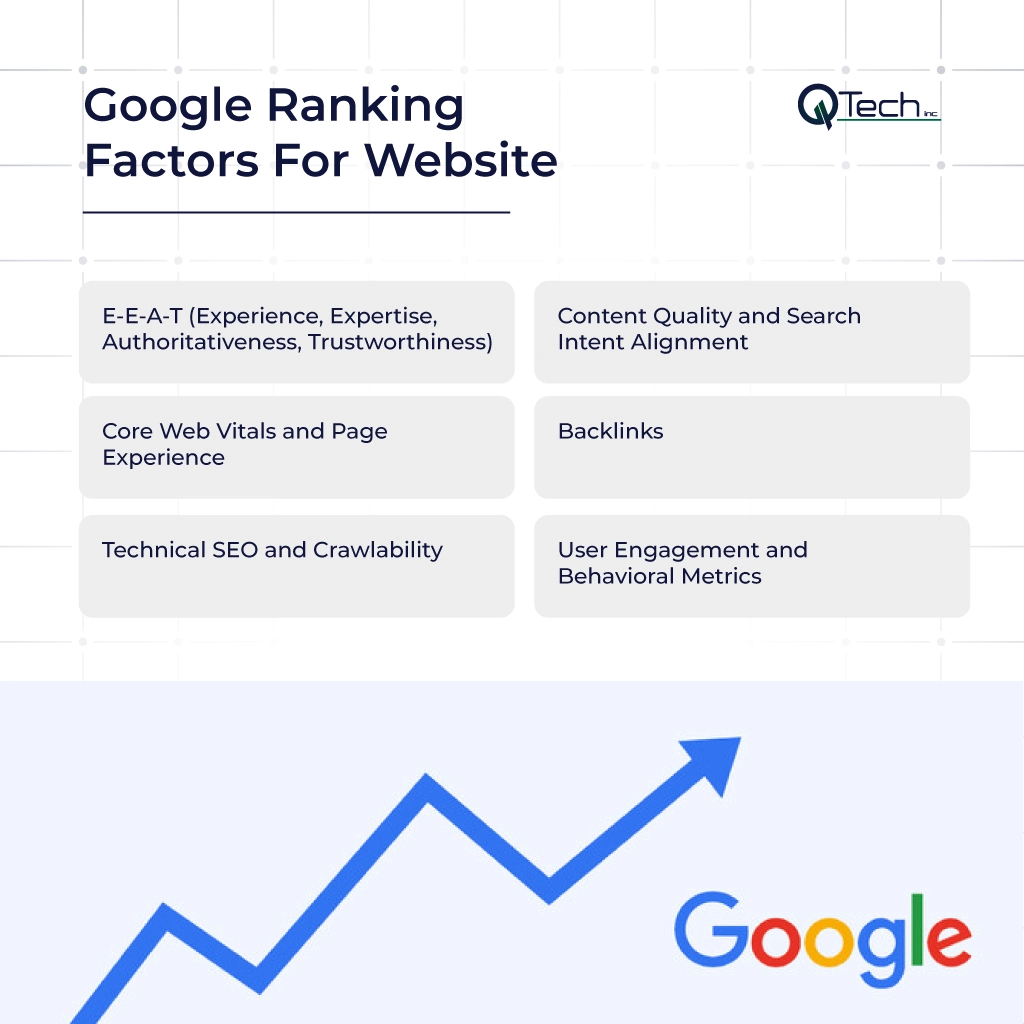
Google Ranking Factors For Website
- E-E-A-T (Experience, Expertise, Authoritativeness, Trustworthiness)
- Content Quality and Search Intent Alignment
- Core Web Vitals and Page Experience
- Strong Backlinks
- Technical SEO and Crawlability
- User Engagement and Behavioral Metrics
Ranking Factor #1: E-E-A-T (Experience, Expertise, Authoritativeness, Trustworthiness)
E-E-A-T stands for Experience, Expertise, Authoritativeness, and Trustworthiness. It is one of the most important frameworks for understanding how Google evaluates quality, especially in competitive or sensitive industries. Google explains that its systems aim to prioritize helpful content that demonstrates experience, expertise, authoritativeness, and trustworthiness after identifying relevant content.
What E-E-A-T means and why it’s now a ranking threshold
E-E-A-T is not just a checklist for blog writers. It is a standard for credibility. A page about cybersecurity, healthcare, finance, legal services, or “money or your life” topics must show that the information is reliable, accurate, and created by people who understand the subject matter.
The search quality rater guidelines also emphasize that trust is central to E-E-A-T, because an untrustworthy page has low E-E-A-T even if it appears experienced or authoritative. For businesses, this means e-e-a-t ranking improvements begin with transparency.
Backlinks and brand mentions: the highest-impact E-E-A-T signal
High-quality backlinks and credible brand mentions help reinforce authority because they show that other trusted websites recognize your business. Google confirms that links help determine page relevance and help Google discover new pages. A backlink from a respected local publication, business association, vendor, partner, or industry resource can send a stronger signal than dozens of weak directory links. Quality matters more than quantity.
How to strengthen your E-E-A-T (author bios, citations, transparent content)
To strengthen E-E-A-T, include detailed author bios, clear service pages, updated contact information, client proof, case studies, citations, and original insights. Businesses should avoid vague claims and instead publish content that demonstrates real experience.
For example, an IT company should explain how it solves network, cybersecurity, cloud, and help desk challenges. A digital marketing firm should show strategy, process, analytics, and outcomes. Transparency builds trust with both users and search quality raters.
Ranking Factor #2: Content Quality and Search Intent Alignment
Content quality remains one of the strongest search engine ranking factors because Google wants to serve pages that answer the user’s query clearly and completely. Google’s helpful content guidance states that ranking systems prioritize helpful, reliable information created for people, not content made mainly to manipulate search rankings.
Why “helpful, people-first content” outperforms keyword-stuffed pages
Keyword stuffing is easy to spot and rarely useful. People-first content explains the topic, answers natural questions, and guides the reader toward the next best step. A business can use AI tools to generate content ideas, but the final article should include human judgment, brand knowledge, expert review, and practical examples. Creating content without insight may fill a page, but it rarely earns trust.
Matching search intent – the foundation of every ranking page
Search intent is the reason behind a query. A user searching “what are Core Web Vitals” needs education. A user searching “technical SEO agency near me” may be ready to speak with a provider.
Each page should match the user’s intent with the right format, depth, and call to action. When your content aligns with search intent, users stay longer, engage more, and are more likely to convert.
Content depth and topical authority – covering subjects comprehensively
Google ranking strength improves when a website covers a topic in depth. A single blog post may explain the basics, but a strong content ecosystem includes service pages, FAQs, guides, case studies, and related articles. This means connecting with website development, SEO, analytics, automation, content strategy, and performance tracking. The more complete the content architecture, the easier it becomes for Google and users to understand your expertise.
Ranking Factor #3: Core Web Vitals and Page Experience
Core Web Vitals are performance signals that measure real-world user experience for loading performance, interactivity, and visual stability. Google recommends that site owners achieve strong Core Web Vitals for Search success and a better user experience.
Largest Contentful Paint (LCP) – loading performance
Largest Contentful Paint measures how quickly the largest visible content element loads. Google recommends an LCP of 2.5 seconds or faster. Slow pages create friction, especially on mobile devices, where users expect immediate results. Improving LCP may involve compressing images, reducing server response time, using caching, and removing render-blocking scripts.
Interaction to Next Paint (INP) – responsiveness (replaces FID)
Interaction to Next Paint measures how responsive a page feels after a user clicks, taps, or types. INP replaced First Input Delay as a Core Web Vitals responsiveness metric in March 2024. A page may look fast but still feel sluggish if buttons, menus, or forms respond slowly. Good responsiveness supports better user confidence and smoother conversions.
Cumulative Layout Shift (CLS) – visual stability
Cumulative Layout Shift measures whether page elements move unexpectedly while the page loads. Google recommends a CLS score below 0.1. Visual instability frustrates users because they may click the wrong button or lose their place while reading. Fixing CLS often requires defined image dimensions, stable ad placements, careful font loading, and clean design structure.
How performance improvements translate into organic traffic and conversions
Core web vitals metrics are not just technical numbers. They affect how people experience your brand. Better page speed, smoother interactions, and stronger page experience can reduce bounce rates and support more form submissions, calls, and bookings. Google notes that strong Core Web Vitals alone do not guarantee top rankings, but they align with what ranking systems seek to reward.
Ranking Factor #4: Backlinks (Quality Over Quantity)
Backlinks remain important because they help establish relevance, authority, and discovery. However, the modern standard is not “more links at any cost.” The better strategy is earning links from relevant, trustworthy websites that make sense for your industry, location, and audience.
Why relevant, trustworthy referring domains still matter in 2026
A backlink from a credible source can strengthen your visibility because it connects your website to a larger web of trust. For local businesses, these sources may include chambers of commerce, nonprofit partners, vendors, schools, community organizations, media outlets, and industry publications. A good backlink should look natural because it is earned through value.
How backlinks reinforce E-E-A-T and authority signals
Backlinks support E-E-A-T because they show that other organizations are willing to reference your expertise. If your company publishes useful cybersecurity guidance and a school, law firm, or business partner references it, that link reinforces credibility. Over time, these signals help search engines and users recognize your website as a reliable resource.
Strategies for earning links (not buying them)
The best link-building strategies begin with assets worth sharing. Publish original research, practical guides, checklists, case studies, local business resources, and thought leadership.
Join relevant associations, collaborate with partners, sponsor community initiatives, and contribute expert quotes when appropriate. Avoid buying links or using spammy schemes. Sustainable authority comes from reputation, not shortcuts.
Ranking Factor #5: Technical SEO and Crawlability
Technical SEO helps Google discover, crawl, render, understand, and index your website. Google’s SEO starter guide explains that SEO helps search engines understand your content and helps users decide whether to visit your site. Without a strong technical foundation, even excellent content can underperform.
Semantic SEO: Optimizing for Entities, Not Just Keywords
Semantic SEO focuses on meaning. Instead of repeating keywords, your website should clarify entities, relationships, services, industries, locations, and expertise. For example, a page about Digital Marketing Services should naturally connect SEO, website design, analytics, content strategy, social media, and conversion optimization. This helps Google understand not just what words are on the page, but what the page is truly about.
Key technical must-haves – crawlability, indexability, HTTPS, structured data
Technical essentials include clean URL structure, HTTPS, internal linking, schema markup, image alt text, canonical tags, and a properly submitted XML sitemap.
Google explains that sitemaps help search engines crawl a site more efficiently by identifying important pages and files. Google also provides crawling and indexing documentation that covers robots.txt, canonicalization, metadata, JavaScript, mobile optimization, and sitemap management.
The role of mobile-first indexing
A mobile-friendly website is no longer optional. Google uses the mobile version of a site’s content for indexing and ranking, which is known as mobile-first indexing.
This means your mobile-friendly version should include the same important content, metadata, structured data, images, and internal links as the desktop version.
Ranking Factor #6: User Engagement and Behavioral Metrics
User engagement is not about manipulating analytics. It is about creating a website that satisfies the visitor. When users click on search results and quickly leave, that may suggest the page did not meet expectations. When they read, explore, click, call, submit a form, or visit related pages, your website is doing its job.
Strong engagement starts with clarity. Each page should have a focused headline, a helpful introduction, a logical structure, strong internal links, readable formatting, a fast load time, and a relevant call to action. Businesses should monitor performance in the search console, review queries, analyze click-through rates, and identify pages that attract impressions but fail to earn clicks. These insights help refine titles, meta descriptions, content depth, and conversion pathways.
Conclusion – Sustainable SEO Means Mastering the Fundamentals And Q-Tech Inc. Can Help
Google ranking success in 2026 is not built on one ranking factor. It is built on the combined strength of credibility, helpful content, technical structure, Core Web Vitals, backlinks, mobile usability, and user engagement. The most effective SEO strategies do not chase every algorithm rumor. They focus on the fundamentals that consistently help users and search engines.
For businesses looking to improve digital visibility, Q-Tech Inc. can help connect strategy with execution. From content planning and technical SEO to website development, analytics, and conversion optimization, we help businesses build a stronger digital foundation. Sustainable SEO is not about quick fixes. It is about creating a website that earns trust, performs well, and supports long-term growth.
FAQ
Q: What does “assetizing” digital marketing mean?
A: Assetizing means turning your marketing activities into long-term, owned assets that continue to generate value – like an email list, evergreen content, customer data, or a branded search presence. Instead of renting attention (ads, social media), you build equity you control.
Q: Can SEO really be considered a financial asset?
A: Yes. In modern business valuation, “Organic Traffic Value” is a measurable metric. If your website receives 100k visitors monthly for keywords that would cost $10 per click in Google Ads, your SEO asset is effectively saving the company $1M/month. This “saved cost” adds directly to the bottom-line value of the business.
Q: How do I start assetizing if my budget is small?
A: Start with one asset: build an email list. Use a free lead magnet (e.g., checklist, template) and a low-cost email platform. Then create one evergreen blog post answering a key customer question. These small assets compound over time without ongoing ad spend.
Q: What’s the difference between assetized content and regular content?
A: Regular content is often timely (news, sales announcements). Assetized content is evergreen – it answers a question that customers will search for years from now. It’s optimized for SEO, internally linked, and updated occasionally, not rewritten from scratch.
FAQ
Q: What does E-E-A-T stand for and why is it important for SEO?
A: E-E-A-T stands for Experience, Expertise, Authoritativeness, and Trustworthiness. In 2026, Google treats E-E-A-T as a ranking threshold, not just a bonus factor. Research shows backlinks and brand mentions score a ranking impact of 10, author credentials 8, and transparent content 6. A 2026 ranking analysis confirmed that topical authority now accounts for about 13% of algorithm weight. E-E-A-T has become a core focus in Google’s March 2026 update, with experience signals — original photos, case studies, and verifiable author credentials — now directly influencing rankings.
Q: Do Core Web Vitals really affect Google rankings?
A: Yes. Core Web Vitals became official ranking factors in 2021 and have gained weight with each subsequent update. 2026 data shows that pages ranking in the top positions are significantly more likely to pass Core Web Vitals thresholds than those ranking lower. When two pages have similar content quality and authority, the faster, more stable experience usually wins the higher ranking. Sites that improve their Web Vitals commonly see organic traffic gains in the 10-20% range and conversion lifts exceeding 15-30%. Google’s LCP benchmark is 2.5 seconds, with performance dropping measurably around 2.3 seconds.
Q: What are the Core Web Vitals metrics and their target values?
A: Largest Contentful Paint (LCP) measures loading speed – target under 2.5 seconds. Interaction to Next Paint (INP) measures responsiveness – target under 200 milliseconds. Cumulative Layout Shift (CLS) measures visual stability – target under 0.1.
Q: How does Google use backlinks for ranking?
A: Backlinks remain a foundational trust indicator. A 2026 expert survey showed backlinks and brand mentions carry the highest ranking impact score among E-E-A-T signals (10 out of 10). It’s not just link count – quality and relevance of referring domains matter most. In competitive markets, links still play a major role, though in low-competition spaces, a page can sometimes rank without many links.
Q: How much weight does content freshness have for Google rankings?
A: Freshness signals are most impactful for queries where timeliness matters, such as news, trends, or product releases. Google’s 2025 algorithm shifts also show consistent publication of high-quality content strengthens domain authority over time. E-A-T takes priority for static informational content, but for queries with intent towards recent information, freshness can be a deciding factor.