
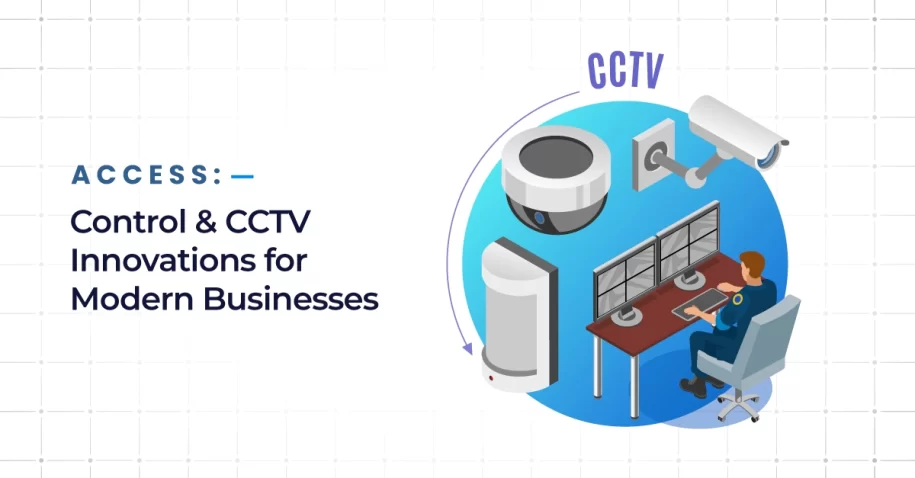
Modern businesses can no longer rely on simple locks, badges, and basic security cameras to protect their people and data. As threats evolve and workplaces become more connected, access control solutions and advanced CCTV systems are transforming into intelligent, data-driven layers of protection. In this guide, we explore access control and AI-powered CCTV innovations for modern businesses and how Q-Tech Inc. helps organizations turn security into a strategic advantage.
Why Security Innovation Matters for Modern Enterprises
The Changing Threat Landscape
Today’s threat landscape is a blend of physical and digital risks. Unauthorized visitors, insider threats, and social engineering attacks intersect with ransomware, network intrusions, and IoT vulnerabilities. That means a door swipe or a camera feed is rarely “just” physical security anymore. Modern security operations must correlate who is entering spaces, what devices they use, and how those activities align with business policies—often in real time.
Convergence of Physical & Cyber Security
The line between physical and cyber security has blurred. Access control technology, surveillance systems, and corporate networks now share data across the same infrastructure. A compromised badge system can become a gateway into sensitive applications, while a cyberattack can disable critical security system components. Forward-thinking enterprises are investing in unified platforms, IoT security, and AI-driven monitoring to ensure physical and digital defenses work together, not in silos.
Key Innovations in Access Control
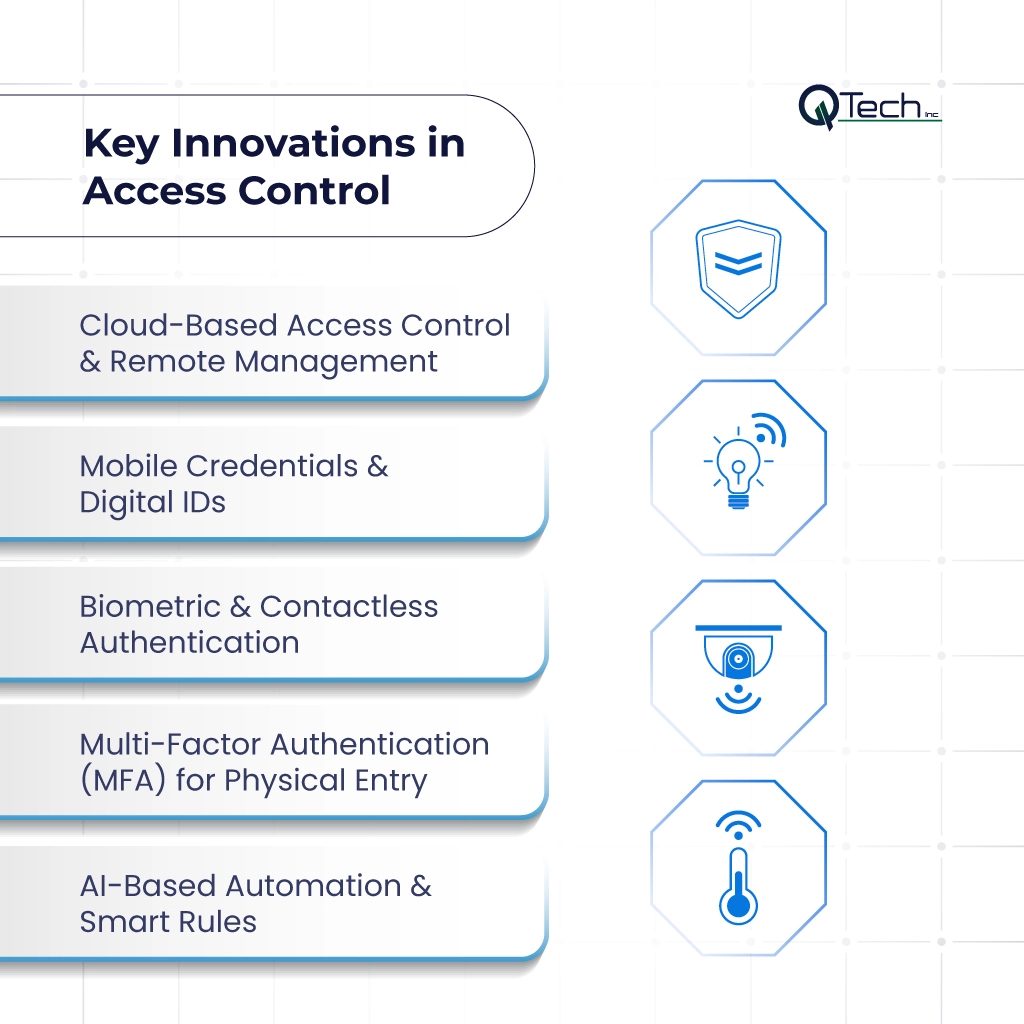
- Cloud-Based Access Control & Remote Management
- Mobile Credentials & Digital IDs
- Biometric & Contactless Authentication
- Multi-Factor Authentication (MFA) for Physical Entry
- AI-Based Automation & Smart Rules
Cloud-Based Access Control & Remote Management
Traditional on-prem controllers are giving way to cloud-based access control systems that centralize policies across multiple locations. With cloud-based access control, security teams can adjust permissions, review logs, and lock down doors remotely from a single dashboard. This architecture supports hybrid workplaces, reduces reliance on local hardware, and simplifies updates and scaling as the organization grows.
Mobile Credentials & Digital IDs
Plastic badges and key fobs are being replaced by mobile credential access control. Employees can use their smartphones or wearables as secure digital IDs, enabling mobile access to offices, labs, or warehouses. This approach improves user experience while giving administrators granular control over granting access—revoking or updating credentials instantly if a device is lost, stolen, or an employee leaves the company.
Biometric & Contactless Authentication
Biometric authentication is no longer science fiction—it is a daily reality in many enterprises. Fingerprint, iris, and facial recognition readers reduce the risk of shared or stolen credentials. Combined with contactless readers, businesses enhance both hygiene and security at doors and turnstiles. These biometric access control trends help ensure that the person using the credential is truly the person authorized to enter.
Multi-Factor Authentication (MFA) for Physical Entry
Security leaders are extending MFA concepts from VPNs and applications to physical access points. High-risk areas such as data centers, executive suites, or R&D labs now require a combination of card, PIN, and biometric authentication. This layered approach ensures that a lost card alone cannot unlock sensitive areas, aligning physical access control with modern cybersecurity best practices.
AI-Based Automation & Smart Rules
New access control innovations leverage AI-powered engines to detect anomalies and enforce dynamic policies. Systems can identify unusual access patterns—such as late-night entries by users who normally work days—and trigger alerts or temporary restrictions. AI-driven rules can also adjust access based on role changes, department moves, or risk scores, reducing manual work for administrators and improving overall governance of access control solutions.
Cutting-Edge CCTV Innovations
AI & Machine Learning for Video Analytics
CCTV cameras have evolved from passive recording devices into intelligent sensors. AI video and machine learning models now analyze live feeds, detecting motion, loitering, objects left behind, or perimeter breaches without human monitoring every frame. These advanced video analytics help security teams focus on true risks instead of staring at screens, and they create a rich dataset for post-incident investigations.
High-Definition & 4K+ Surveillance
Modern CCTV systems often support high-definition and 4K+ resolutions, providing clear, detailed footage that can identify faces, license plates, and small objects. These high-quality streams enhance evidentiary value while supporting more accurate AI analytics. When combined with smart storage policies, organizations can retain critical footage without overwhelming their infrastructure.
Edge Computing & On-Device Analytics
Instead of sending every frame to a central server, many surveillance systems now perform processing at the edge—on the camera itself or on local gateways. This reduces bandwidth, lowers latency, and allows real-time detection even if the network is congested. Edge-based AI analytics can flag events instantly, trigger alarms, or integrate with access control technology to lock doors or notify guards.
Cloud-Integrated CCTV & Remote Monitoring
Cloud-Integrated CCTV platforms make it easier to manage distributed camera fleets, centralize storage, and provide secure access to authorized stakeholders. With Cloud-Integrated CCTV, security leaders can review incidents from anywhere, share clips securely, and scale retention as needed. This model underpins remote monitoring CCTV for enterprises that operate across multiple sites, branches, and regions.
Advanced Sensors: Thermal Imaging, Behavioral Detection
Beyond standard visible light feeds, organizations now deploy thermal imaging cameras to detect temperature anomalies, perimeter breaches in low visibility, or hotspots in critical infrastructure. Some solutions combine thermal imaging with behavioral detection analytics to identify unusual movements or crowd patterns. These CCTV innovations help businesses detect risks earlier and respond faster, improving safety and compliance.
Emerging Trends & Future Directions
AI-Driven Access Control & Predictive Security
The next generation of access control solutions is proactive rather than reactive. AI-driven engines will forecast risks by correlating access logs, HR data, and environmental sensors. Predictive models might recommend additional verification for specific users or times, helping businesses prevent incidents instead of merely documenting them.
Deep Learning + Blockchain for Secure Access Control
Deep learning models are being explored to improve identity verification and anomaly detection, while blockchain offers tamper-resistant audit trails. Combining these technologies can strengthen access control technology by ensuring records of who entered which area, and when, are both accurate and immutable. This is particularly valuable in regulated industries where compliance audits demand verifiable histories.
Remote Guarding & Human-Machine Hybrid Monitoring
Even the smartest AI-powered tools cannot completely replace human judgment. Many organizations are shifting toward hybrid models where AI analytics filter events and remote operators review and respond. Remote guarding allows a small, skilled team to oversee many locations, using cctv cameras, loudspeakers, and integrated security system controls to deter incidents in progress.
Attire-Based Anomaly Detection in CCTV using YOLOv8
One cutting-edge application of AI-powered CCTV analytics is attire-based anomaly detection using YOLOv8 and related models. Systems can flag individuals wearing restricted clothing (such as unauthorized uniforms or a lack of required safety gear) in controlled zones. This capability supports both safety and security operations, ensuring compliance with dress codes, PPE requirements, and access policies.
Business Benefits of These Innovations
Improved Security Posture & Reduced Risk
By unifying advanced access control and CCTV systems, businesses can dramatically strengthen their security posture. Intelligent surveillance systems, combined with robust access control, reduce the likelihood of theft, vandalism, and unauthorized entry. When incidents do occur, clear video evidence and precise access logs simplify investigations and insurance claims.
Scalability & Flexibility for Hybrid Workplaces
As organizations embrace hybrid work, mobile access becomes crucial. Employees, contractors, and visitors come and go at varied times and locations. Cloud-based access control, mobile credential access control, and remote management ensure that granting access is flexible while still tightly controlled. Enterprises can onboard new staff, open new sites, or reconfigure spaces without costly hardware overhauls.
Operational Efficiency & Cost Savings
Modern access control innovations and AI-enhanced CCTV reduce manual tasks and unnecessary guard coverage. Automated alerts, centralized dashboards, and integrated workflows save time for both security and facilities teams. Over time, these efficiencies can lower labor costs, reduce downtime, and improve the overall ROI of security cameras, CCTV systems, and related infrastructure investments.
Challenges & Best Practices for Implementation
Data Privacy & Biometric Compliance
With biometric authentication and facial recognition comes a heightened responsibility to protect sensitive personal data. Businesses must align with local and international privacy regulations, implement transparent consent processes, and secure biometric templates both in transit and at rest. Documented policies, retention limits, and regular audits are essential for responsible deployment.
Integration with Legacy Systems
Many organizations still rely on older hardware and software, making integration a key challenge. Successful projects start with a clear inventory of existing access control solutions and surveillance systems, followed by a roadmap for phased upgrades. Open standards, APIs, and vendor-neutral platforms help bridge the gap between legacy and next-generation security systems.
Cybersecurity for Access & Surveillance Systems
Every connected door controller, camera, or NVR is a potential attack surface. Best practices include network segmentation, strong authentication, firmware patching, and continuous monitoring. Tying physical security to broader cybersecurity and IoT security programs helps ensure that access control, ai video platforms, and CCTV cameras are protected against intrusion and misuse.
Conclusion: Securing Modern Businesses with Q-Tech Inc.’s Expertise
Access control and AI-powered CCTV innovations for modern businesses are reshaping how organizations think about safety, compliance, and operational resilience. From cloud-based access control and edge analytics to attire-based anomaly detection and blockchain-backed audit trails, the possibilities are expanding quickly. Navigating this landscape requires a partner who understands both IT services and real-world security challenges.
Q-Tech Inc. helps businesses design, deploy, and manage modern access control solutions and surveillance systems tailored to their environments. Whether you are upgrading existing CCTV systems, rolling out cloud-based access control systems, or exploring advanced AI analytics and thermal imaging, our team can guide you at every step. By aligning technology, processes, and people, we turn security from a cost center into a powerful enabler of trust, continuity, and growth for your organization.
FAQ
Q: What is the difference between traditional and modern access control systems?
A: Traditional access control relies on physical keys or basic proximity cards that are easily lost, duplicated, or stolen. Modern access control is digital and centralized, using mobile credentials, biometrics, or cloud-based management. This allows for instant granting/revoking of access, detailed audit trails, remote management, and integration with other security systems like CCTV, providing much greater security and flexibility.
Q: How does AI improve CCTV security?
A: AI transforms CCTV from a passive recording device into an active security tool. Instead of just recording footage for later review, AI-powered video analytics can: detect unusual behavior (like loitering or object removal), classify objects (person vs. vehicle), count people, read license plates, and send real-time alerts to security personnel. This proactive approach helps prevent incidents rather than just documenting them after the fact.
Q: What privacy and security challenges come with biometric access and AI CCTV?
A: Using biometrics raises data privacy concerns and regulatory compliance issues (e.g., GDPR). AI-powered CCTV systems collect sensitive personal data, so businesses must ensure encryption, secure storage, and proper user consent. Integration into existing legacy systems and ensuring cybersecurity for connected devices are also common challenges.
Q: Can AI help access control systems predict security incidents?
A: Yes — AI-integrated access control can analyze access logs and behavior patterns, trigger automated workflows, and enforce rules. For example, when an unusual access attempt is detected, the system could lock doors, alert security teams, or initiate a lockdown, enhancing proactive threat management.