

In the vast universe of digital marketing, content is the gravitational force that keeps brands in orbit around their audience. But how much content is just right? Creating too much can exhaust your team and dilute your message, while focusing solely on perfecting every piece may result in inconsistent publishing and lost momentum. This delicate balance is what we call the Goldilocks zone the sweet spot where your efforts are not too much, not too little, but just right.
Understanding the Content Goldilocks Principle
Just like the habitable zone in our solar system—the perfect distance from the sun that allows life on Earth to thrive—your brand’s content must exist in its own “habitable” range. Too far toward quantity, and your message becomes thin content pages that fail to engage. Too close to perfectionism, and you risk inconsistency and invisibility.
The Goldilocks zone content concept helps content marketers and teams find that ideal rhythm where effort meets return, creating sustainable growth and a positive impact on both your audience and your bottom line.
Too Much Quantity: The Risk of Content Fluff and Dilution
When brands chase volume, quality often takes a back seat. Pushing out large pieces of content just to meet publishing quotas can lead to thin content SEO issues, where search engines like Google downgrade your visibility due to low-value pages or doorway pages. Instead of boosting rankings, this overload creates digital noise, reducing engagement and eroding trust. Like adding too many planets to a system, the result is instability—an imbalance that can cause your marketing ecosystem to spin out of control.
Too Much Quality: The Pitfall of Inconsistent Publishing
On the flip side, hyper-focusing on perfection can paralyze production. Striving for high quality at all costs can limit your ability to stay consistent. This happens when every blog post is treated like a research paper—meticulously edited, overanalyzed, and endlessly delayed. The result? Missed opportunities to connect with audiences in real-time and diminished visibility in search engine results. Content excellence matters, but it must coexist with consistency to sustain audience engagement.
Factors That Influence the Optimal Balance
Finding your brand’s Goldilocks zone isn’t a one-size-fits-all process. It depends on internal and external factors that shape your ability to produce effective content.
Your niche, competition & search demand
If your niche has fierce competition or rapidly changing trends, publishing frequently can help your brand remain relevant. Understanding search intent within your market ensures every post contributes meaningfully rather than adding clutter.
Domain authority & existing content footprint
Brands with strong domain authority can afford to focus on EEAT content—expertise, experience, authoritativeness, and trustworthiness—over sheer quantity. For newer sites, more frequent posting can accelerate indexing and growth. Conducting a content audit regularly helps identify gaps and avoid redundancy.
Resources, budget & team capacity
Not every business has a large content team. The availability of writers, editors, designers, and team members directly affects your output. Using tools like Google Sheets and calendar view can help manage content calendar planning, allocate resources, and prevent burnout while maintaining quality.
Audience expectations and content consumption habits
Understanding your audience’s habits—how often they read, share, or comment—guides your frequency. If your community prefers in-depth articles, prioritize fewer, longer pieces of content. If they engage more on social media, increase frequency but streamline production through automation tools that help schedule posts efficiently.
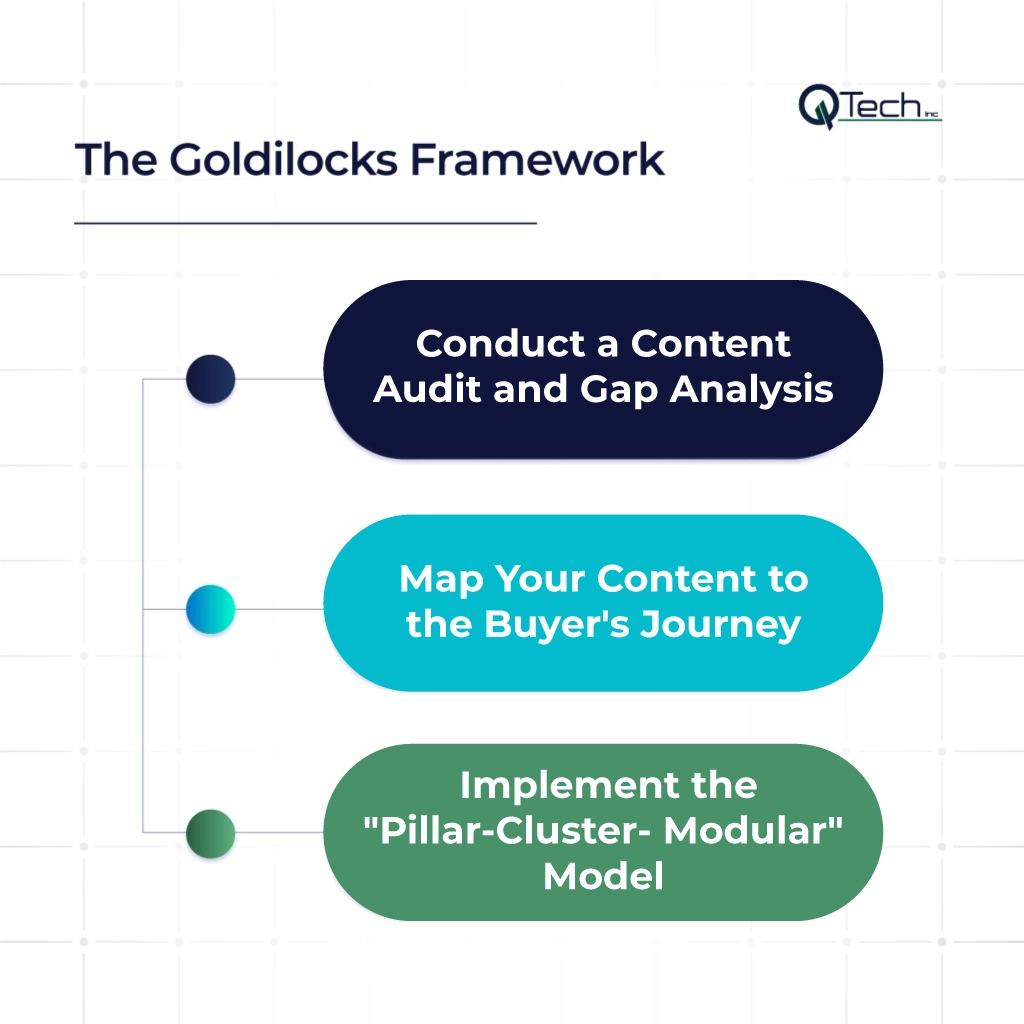
The Goldilocks Framework: A 3-Step System for Finding Your Balance
Balancing quality and quantity requires structure, not guesswork. Our proven 3-step content strategy helps brands align purpose with performance.
Step 1: Conduct a Content Audit and Gap Analysis
Start by reviewing your existing library. A content audit uncovers which posts drive engagement and which fall flat. Look for thin content pages that can be expanded or merged, and identify missing topics aligned with audience needs. This helps refine your approach and strengthen your digital footprint.
Step 2: Map Your Content to the Buyer’s Journey
Next, organize topics based on where your customers are in their journey—from awareness to decision. Every blog post should serve a function: attract, educate, or convert. Aligning topics with each stage ensures that no effort is wasted and every asset plays a role in your marketing funnel.
Step 3: Implement the “Pillar-Cluster-Modular” Model
In this structure, cornerstone content serves as the “pillar,” while smaller, related articles form clusters that link back to it. Think of it like planets orbiting a star—each supporting the other in a stable Goldilocks zone. This modular approach allows flexibility, improves SEO, and supports sustainable content marketing growth over time.
Strategies to Find & Maintain That Balanced Zone
Once you’ve found your balance, maintaining it requires consistent processes and creative agility.
Content pillar + cluster approach (longer cores + shorter support pieces)
Create foundational content that dives deep into your key topics, supported by smaller updates or FAQs. This strategy builds authority while maintaining a steady publishing cadence.
Editorial calendar with mix: high-effort / cornerstone content + lighter, topical posts
Use tools like drag and drop planners or calendar view dashboards to organize production. Blend timeless cornerstone pieces with quick-turnaround updates to maximize reach without exhausting resources.
Reuse, repurpose & update existing content
Turn webinars into blog posts, podcasts into summaries, and articles into videos for social media management. Repurposing multiplies your output and reduces environmental and digital impact, making your content ecosystem as efficient as nature’s recycling systems.
Use content templates, frameworks & process optimization
Templates and frameworks streamline production, especially when managing multiple team members. They keep branding consistent and help new contributors adapt quickly, ensuring that each piece aligns with your larger vision.
Testing & iteration: experiment with frequency, formats, lengths
The goldilocks zone content isn’t static. It shifts as your brand evolves. Regular testing—whether through A/B analysis, social polls, or user metrics—helps refine what works best. Use analytics and SEO content optimization tools to understand audience behavior and adapt accordingly.
Conclusion: How Q-Tech Inc. Can Help You Strike the Right Content Balance
Finding your Goldilocks zone between content quantity vs quality takes expertise, insight, and the right tools. Q-Tech Inc. helps businesses achieve balance through tailored content strategy, smart automation, and expert SEO support. With a focus on sustainable content marketing, we empowers brands to produce meaningful content that delivers a positive impact—not just for algorithms, but for real people.
In the end, your content should function like a thriving ecosystem: adaptable, balanced, and full of life. When you find that perfect balance—the digital equivalent of the habitable zone—your brand’s message shines bright, nurturing growth and inspiring trust across every platform, from your website to social media.
FAQ
What is more important for SEO: content quantity or quality?
Answer – Quality always comes first. Without quality, publishing more content just adds noise—low-value pages that Google ignores. Once you establish a foundation of authoritative, well-written content, adding quantity helps you cover topics more comprehensively and shows search engines your site is active and relevant. They work best together, but quality is the prerequisite for effective quantity.
How often should I publish new blog posts?
Answer – There’s no universal rule. The right frequency is whatever you can sustain while maintaining quality. For most businesses, 1–2 high-quality posts per week is a realistic “sweet spot.” This cadence keeps your content fresh and consistent without sacrificing depth or accuracy.
What is the ‘Pillar-Cluster’ content model?
Answer – The Pillar-Cluster model organizes content strategically to build topical authority. A Pillar Page is a comprehensive, in-depth guide covering a broad topic (e.g., “The Complete Guide to Content Marketing”). Supporting Cluster Pages focus on related subtopics (e.g., “How to Write a Blog Post,” “Best SEO Tools”) and link back to the pillar. This internal linking structure helps search engines understand your site’s expertise and boosts rankings across the topic cluster.
How long should a blog post be?
Answer – A blog post should be as long as needed to fully answer the user’s query—and no longer. Longer posts often perform better because they’re more complete, not because of word count alone. A simple how-to might be 800 words, while an in-depth guide could reach 3,000+ words. The focus should always be on usefulness and completeness, not length.