


The world of digital marketing continues to evolve at an unprecedented rate. In 2023, one of the key elements driving website traffic is the effective implementation of voice search optimization techniques. So, how can businesses adapt and thrive in this new landscape? Let’s delve into the effective strategies for voice search optimization in 2023.
Understanding Voice Search Ranking Factors for 2023: A Deeper Look
Voice search is fundamentally changing the SEO landscape, with the focus shifting from keyword-based queries to more conversational, natural language. As a result, it’s essential for businesses to understand and optimize for the ranking factors that influence voice search results.
Mobile Compatibility: Since voice searches primarily occur on mobile devices, Google uses mobile-first indexing to rank websites. Ensuring that your website is mobile-friendly is a crucial voice search ranking factor in 2023.
Page Load Speed: Quick loading time is paramount in the world of SEO and even more so for voice searches. Users who rely on voice search want answers instantly, making load time a significant ranking factor.
Conversational Keywords and Long-Tail Phrases: With voice searches, users tend to phrase their searches in a conversational manner. They use more words, and the phrases are typically longer. So, incorporating long-tail keywords and phrases that mirror natural language patterns in your content is a smart move.
Local SEO: Many voice searches are local in nature. Users often look for businesses or services near them. Therefore, optimizing for local SEO is an important voice search ranking factor.
Schema Markup: Schema markup helps search engines understand your content’s context better. In voice search, it can help your content appear in relevant voice search results.
Structured Data and Rich Snippets: Rich snippets and structured data improve the user experience by providing more precise answers to queries. For voice search optimization, structured data can help you stand out in voice search results.
HTTPS Protocol: Websites using the HTTPS protocol are considered more secure, and thus, are preferred by search engines. It’s a minor ranking factor but worth considering for an overall SEO strategy.
Featured Snippets: Many voice search results are derived from featured snippets. These are the answers that Google provides at the top of its search results. Ensuring your content is designed to land in the featured snippets can improve your voice search visibility.
Understanding and effectively implementing these voice search ranking factors can significantly improve your website’s visibility in voice search results, drive more traffic, and ultimately, increase conversions.
Voice Search and Local SEO: The Crucial Connection
Local SEO is increasingly becoming a central aspect of digital marketing strategies, particularly with the rise of voice search. Many voice searches are inherently local – “Where’s the nearest pizza place?” or “What’s the best coffee shop near me?” Thus, understanding how voice search ties into local SEO is vital for businesses, especially for those operating on a local level.
Conversational Tone and Long-Tail Keywords: When users perform voice searches, they tend to use a more conversational tone and longer phrases. This behavior necessitates a shift from traditional keyword-focused content towards content that answers questions directly. For local businesses, incorporating long-tail keywords that are relevant to their local area and services can help capture more local voice search traffic.
Google My Business Optimization: One of the primary tools for local SEO is Google My Business. Keeping your listing updated with accurate information (like your business address, hours, and phone number) is essential, as voice search users often seek this information.
Positive Online Reviews: Many voice search devices prioritize businesses with higher online review scores in their results. Therefore, encouraging satisfied customers to leave positive reviews can significantly impact your local SEO and voice search ranking.
Mobile-Friendly Websites: Most voice searches happen on mobile devices. Therefore, having a mobile-friendly website that loads quickly and provides a great user experience is a critical factor for local SEO and voice search.
Structured Data Markup: By adding structured data markup to your website, you provide search engines with additional information about your business, such as your products or services, your location, and your hours. This information can make your website more relevant to local and voice searches.
Local Content: Creating content that is relevant to your local area can also help you rank better in local and voice searches. This could include blog posts about local events, a page dedicated to the local services you offer, or any other content that is specifically relevant to your local area.
Voice Search and Local SEO for E-Commerce: For e-commerce businesses, local SEO strategies can include offering in-store pickup options, promoting local events, and optimizing product pages for local keywords.
Voice Search Optimization for E-commerce Websites: A Comprehensive Guide
In an era where online shopping is increasingly popular, optimizing e-commerce websites for voice search is becoming a necessity. Here are some tips and tricks to help e-commerce businesses stay competitive:
Mobile Optimization: Since most voice searches occur on mobile devices, it’s crucial that your e-commerce website is mobile-friendly.
FAQs and Conversational Content: Users often phrase voice searches in the form of questions. By creating FAQ pages or incorporating questions and answers into your content, you can capture these voice search queries. Also, the content should be written in a conversational tone, reflecting the way users speak.
Long-Tail Keywords: Voice search queries tend to be longer and more specific compared to text searches. Incorporating long-tail keywords that match these queries can help boost your site’s voice search visibility.
Schema Markup: Adding schema markup to your site can help search engines understand your content better and make it more likely to appear in voice search results. For e-commerce sites, this could include markups for products, ratings, prices, and availability.
Optimize for Local Searches: If your e-commerce business also has physical stores, optimizing for local searches is important. This includes updating your Google My Business listing and using location-specific keywords.
Structured Data and Rich Snippets: Implementing structured data and creating rich snippets can provide more detailed information to search engines, increasing the chances of your content being picked up for voice search. This could include product information, reviews, or prices.
Use High-Quality Images: For voice-enabled devices with screens, high-quality images can greatly improve the user experience. Ensure that all product images are high-quality, and use descriptive file names and alt text.
Optimizing Product Descriptions: Voice searches are often specific, so it’s crucial to provide detailed and precise product descriptions. This can make your products more likely to show up in specific voice searches.
User Reviews and Ratings: Encouraging customer reviews and ratings not only provides social proof to potential customers but can also help your products show up in voice search results.
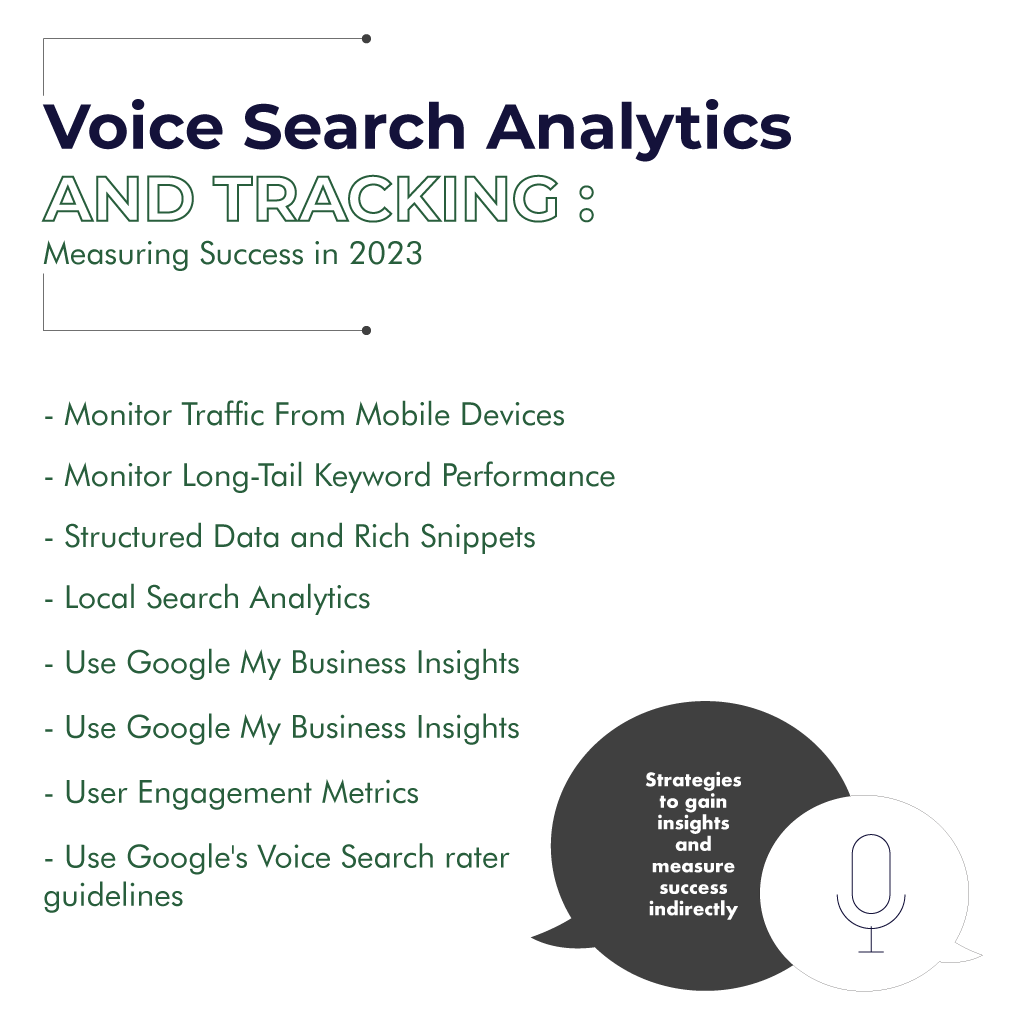
Voice Search Analytics and Tracking: Measuring Success in 2023
With voice search gaining traction, understanding how to measure the success of your voice search optimization efforts is crucial. Unfortunately, voice search analytics is still largely uncharted territory. As of my knowledge cutoff in 2023, major platforms like Google Analytics do not offer specific tools to measure voice search traffic separately. But there are strategies to gain insights and measure success indirectly:
Monitor Traffic From Mobile Devices: Given that a significant portion of voice searches come from mobile devices, monitoring your mobile traffic can provide some insight into your voice search performance. An increase in mobile traffic could be an indicator of successful voice search optimization.
Monitor Long-Tail Keyword Performance: Voice searches often use more natural language and longer phrases. Tracking the performance of your long-tail keywords can help gauge your success in voice search optimization. Utilizing analytical instruments such as Google Search Console is highly advisable for this purpose.
Structured Data and Rich Snippets: Given that a significant percentage of voice search results come from featured snippets, monitoring the performance of your structured data and rich snippets can also provide insights. One may efficiently monitor these metrics by employing the ‘Search Appearance’ feature in Google Search Console.
Local Search Analytics: For businesses focusing on local SEO, monitoring local search performance can give an indication of voice search success, as many voice searches are local in nature.
Use Google My Business Insights: If you’re a local business, Google My Business Insights can provide useful information about how customers are finding you. For example, you can see how many customers found you via a direct search (typing in your business name) versus a discovery search (searching for a category, product, or service).
User Engagement Metrics: User engagement metrics like bounce rate, time on site, and pages per session can provide insights into the quality of the traffic you’re getting. If these metrics improve after implementing voice search optimization, it could be a sign that you’re attracting more relevant traffic.
Use Google’s Voice Search rater guidelines: Google’s rater guidelines can provide a framework for understanding what Google is looking for in a high-quality voice search result.
Until more specific voice search analytics tools become available, these indirect methods can help businesses measure their voice search optimization efforts. By using these strategies, businesses can gain insights, adjust their tactics, and ensure they’re staying competitive in the evolving landscape of voice search.
Now, let’s answer some common questions on the topic:
- What are the best SEO strategies for 2023?
The best SEO strategies in 2023 include optimizing for mobile devices, focusing on voice search optimization, and improving local SEO for better visibility.
- What are the effective keyword strategies in 2023?
Effective keyword strategies in 2023 should focus on long-tail keywords and natural language phrases that users might use during voice searches as well as keyword research.
- How to improve local SEO in 2023?
To improve local SEO in 2023, businesses need to optimize their websites for mobile devices, voice assistants, and voice searches. It’s also crucial to keep business listings updated and focus on getting positive online reviews as well as generating content for voice searches.
- Is it true that ‘Voice Search is the future of SEO’?
Yes, with the rise of smart speakers and voice-activated devices, voice search is indeed becoming a significant part of SEO. It’s crucial for businesses to adapt their strategies to this changing landscape as well as implement a clear process for voice search keyword research.
- What are some of the top voice search trends and tips for effective optimization in 2023?
In 2023, key voice search trends include a shift towards conversational, long-tail keywords, a focus on mobile optimization, increased use of schema markups, and an emphasis on local SEO. Tips for optimization involve understanding user intent, creating engaging, relevant content, enhancing website speed, and leveraging structured data for better visibility.
- How does voice search and long-tail keywords influence optimization?
Long-tail keywords play a significant role in voice search optimization. Voice searches are typically conversational and use longer phrases compared to text searches. Integrating these longer, more specific keywords into your content can align with user search queries and improve your site’s visibility in voice search results.
In conclusion, the successful implementation of voice search optimization techniques is vital to driving website traffic and staying ahead in 2023. Always remember, a good SEO strategy focuses not just on current trends but also anticipates future shifts in the digital landscape.