
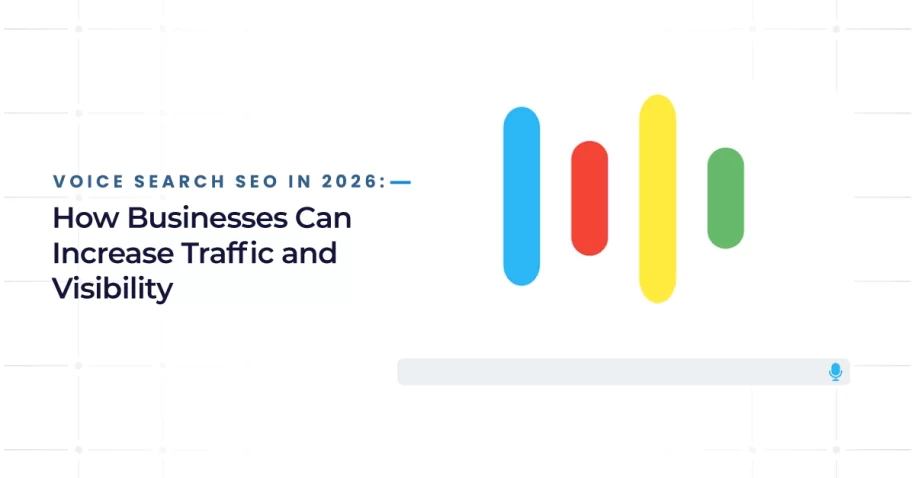
Introduction – Why Voice Search Is No Longer Optional in 2026
Voice search is no longer a future trend. It is now part of how customers find businesses, compare services, ask quick questions, and make decisions in real time. For businesses, this means websites must do more than rank for typed keywords. They must be optimized for voice, natural language, mobile use, local intent, and AI-powered answers.
1.8 billion daily voice searches worldwide – a 34% increase vs. 2025
Industry data estimates that voice searches now reach 1.8 billion per day worldwide, with reported growth of 34% compared with 2025. That shift matters because voice users often want immediate answers, nearby services, and direct recommendations rather than long lists of search results.
71% of consumers now prefer voice over typing for on-the-go queries
Voice is especially useful when people are driving, walking, multitasking, or using mobile devices. Recent voice search data also reports that 71% of users prefer using voice assistants over typing for queries, which makes voice search seo strategies essential for businesses that want to stay visible.
Conversational SEO Strategies
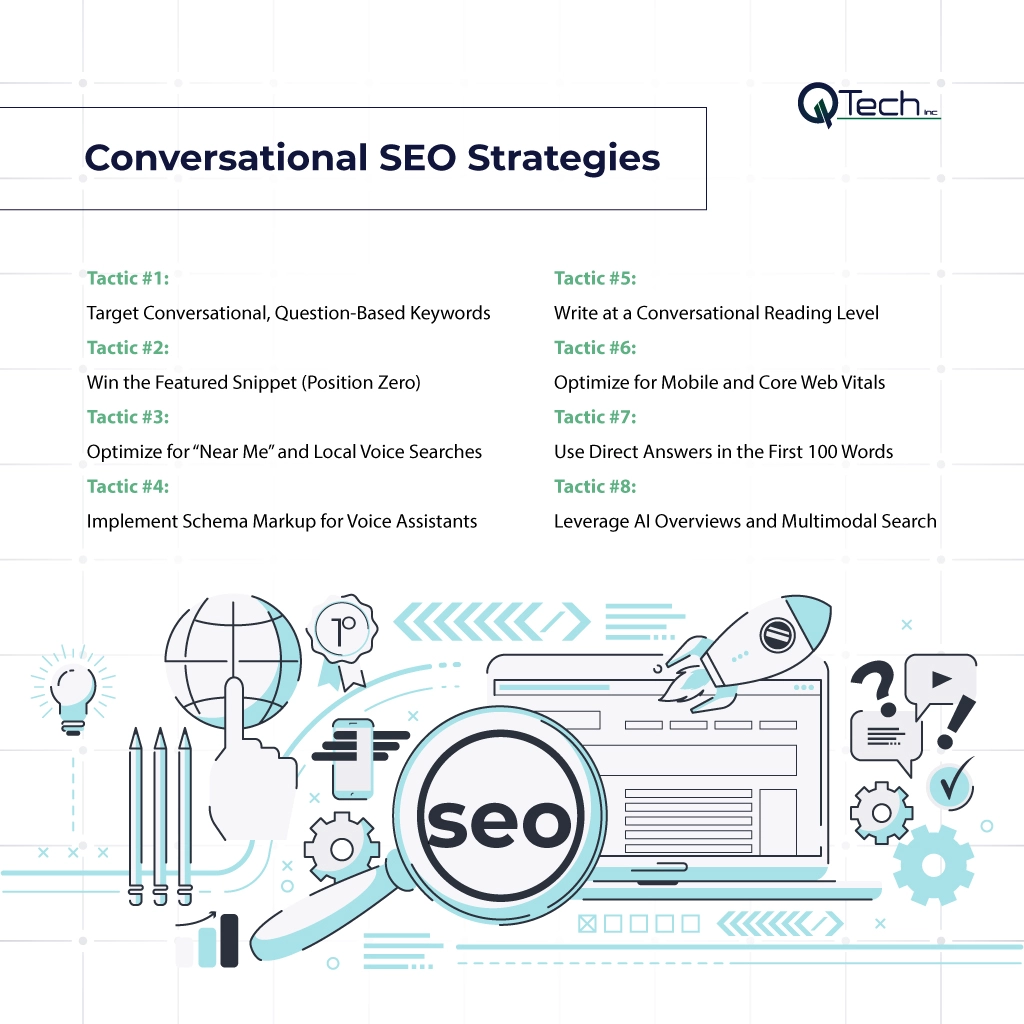
Tactic #1: Target Conversational, Question-Based Keywords
Voice search starts with how people speak. Instead of typing “IT support Miami,” a user may ask, “Who offers reliable IT support near me?” This is where keyword research must evolve. Businesses should study search intent, monthly searches, difficulty scores, and each long tail keyword that reflects real customer questions.
How to find “who, what, where, when, why, how” questions
Use tools such as Google Keyword Planner, Search Console data, customer emails, sales calls, and keyword suggestion platforms to build a keyword list around question-based searches. A strong question-based content strategy helps your website answer the exact voice search query a customer may ask before they ever reach your site.
Turn FAQ pages into voice-ready content
FAQ pages are ideal for conversational seo because they match how users ask questions. Each answer should be short, specific, and useful. When creating content, avoid vague explanations. Write answers that clearly explain what the service is, who it helps, where it is available, and what step the user should take next.
Tactic #2: Win the Featured Snippet (Position Zero)
Featured snippet optimization is critical because voice assistants often pull from concise answers near the top of search results. Google explains that AI features and traditional search still rely on foundational SEO best practices, indexed pages, helpful content, and eligible snippets.
How to structure content for snippet extraction
Structuring content matters. Use clear headings, direct answers, short paragraphs, ordered steps, and simple definitions. Search engines need to understand the main idea quickly. If a page hides the answer too deeply, it becomes harder for search systems and AI assistants to extract a useful response.
Direct answers: keep them 29–60 words, first 1–2 sentences
A strong direct answer should appear in the first one or two sentences under a heading. Keep it brief, helpful, and complete. For example: “Voice search optimization helps businesses appear when customers use spoken queries through smartphones, smart speakers, or AI assistants.” Then expand with supporting details.
Tactic #3: Optimize for “Near Me” and Local Voice Searches
Many voice searches have local intent. A customer may ask, “Where can I find a digital marketing company near me?” or “Who provides cybersecurity services in Miami?” For local businesses, search optimization must connect website content, maps visibility, service pages, and accurate business information.
Complete Google Business Profile
A complete Google Business Profile helps customers understand what your business does, where it is located, when it is open, and how to contact you. Google states that complete and accurate business information is more likely to show in local search results.
NAP consistency and service-area pages
NAP means name, address, and phone number. Keep all phone numbers, addresses, and business details consistent across your website, Google Business Profile, directories, and social media profiles. Service-area pages should also explain where you work and which services are available in each location.
Tactic #4: Implement Schema Markup for Voice Assistants
Schema markup helps search engines understand your content. It does not replace good writing, but it gives your pages a stronger technical foundation. Google states that structured data helps it understand page content and display richer search result features when eligible.
FAQPage, HowTo, Speakable, and LocalBusiness schemas
FAQPage, HowTo, Speakable, and LocalBusiness schemas can support answer engine optimization by clarifying questions, steps, service details, and business information. Google’s Speakable documentation explains that speakable markup identifies sections of a page suited for text-to-speech playback.
How structured data directly helps AI Engines
AI engines need clean signals. Schema markup helps connect your services, location, reviews, answers, and business details to a machine-readable structure. For businesses working on seo strategies in 2026, structured data is no longer just technical SEO. It supports AI visibility, local discovery, and voice-ready answers.
Tactic #5: Write at a Conversational Reading Level
Voice search works best when the content sounds human. A user does not ask a voice assistant a stiff corporate phrase. They ask a natural question. Your website should answer in the same way: clear, confident, and helpful without sounding robotic.
Short sentences, plain language, and scannable answers
Use short sentences. Break up large blocks of text. Explain one idea per paragraph. This makes the page easier for people to read and easier for search engines to understand. Natural language improves the experience for both users and AI-powered systems.
Tactic #6: Optimize for Mobile and Core Web Vitals
Most voice searches happen on mobile devices, so your website must load quickly and display cleanly on smaller screens. Google’s ranking systems consider many signals to present relevant and useful results, which makes technical quality part of the larger visibility picture.
Voice searches happen on mobile – ensure fast, responsive design
A responsive website should make buttons easy to tap, text easy to read, and forms simple to complete. If someone asks for a service by voice and lands on a slow or confusing page, they may leave before contacting your business.
Page speed as a ranking factor for voice
Voice users expect fast answers. Compress images, reduce unnecessary scripts, improve hosting performance, and keep pages clean. A faster site supports search optimization, improves conversions, and creates a better experience for customers who are ready to call, book, or request information.
Tactic #7: Use Direct Answers in the First 100 Words
AI assistants often favor pages that answer quickly. This does not mean your content should be thin. It means every page should start with a clear answer before expanding into details, benefits, proof, and next steps.
Why AI assistants “skip” pages that delay the answer
If your page takes too long to explain the main idea, an AI assistant may choose a clearer source. Answer engine optimization rewards content that is direct, well-organized, and useful from the beginning. The goal is to make the answer easy to find and easy to trust.
The “direct answer block” technique for voice citation
Use a direct answer block below important headings. Start with a 40–60 word answer, then add supporting context. This technique helps with voice search optimization, featured snippets, AI Overviews, and user experience because the reader gets value immediately.
Tactic #8: Leverage AI Overviews and Multimodal Search
Search is becoming more conversational and multimodal. Google says AI Overviews help users get a quick snapshot of information with links to explore further, and Google’s 2026 Search updates introduced a more AI-powered Search experience across desktop and mobile.
Google’s March 2026 multimodal update – voice, image, video indexing
For accuracy, businesses should view this as part of the broader 2026 multimodal search shift rather than only one isolated update. Users increasingly search with text, voice, images, and video context. That means content marketing must include optimized written content, visual assets, and spoken-word media.
Optimize audio and video for spoken-word matching
Videos, podcasts, and short-form clips should include clear titles, transcripts, captions, and descriptions. When audio and video are optimized for voice, search engines can better understand what is being said. This supports visibility across traditional search, AI search, and multimodal discovery.
How Q-Tech Inc. Helps Miami Businesses Capture Voice Search Traffic
Q-Tech Inc. helps businesses improve digital visibility through SEO, content strategy, website optimization, local search, analytics, and voice search optimization. Our team connects technical SEO with human-centered content so your website can answer real customer questions, support conversions, and compete in modern search.
For businesses that want stronger, we build strategies that align keyword research, local SEO, content marketing, website performance, social media, and AI-ready content. The goal is not just more traffic. The goal is better-qualified traffic that can turn into leads.
Conclusion – Voice Search Is Not a Trend, It’s the New Default
Businesses that invest in conversational content, local SEO, schema markup, fast mobile pages, and direct answers will be better prepared for how customers search today.
Voice search is not about replacing traditional SEO. It is about improving it. When your website is clear, fast, structured, and helpful, it becomes easier for people, search engines, and AI assistants to understand your value. That is how businesses can compete in the next era of search.
FAQ
Q: Why is voice search optimization important for my business in 2026?
A: Voice search is no longer a niche. Globally, there are 1.8 billion voice searches per day, and 71% of consumers prefer voice over typing for on-the-go queries. With over 8.4 billion voice assistants in use worldwide – more than the human population – optimizing for voice means reaching customers exactly when they ask for you by name or category. Businesses that optimize for voice see a significant boost in micro-moment conversions, capturing ready-to-buy customers.
Q: What’s the difference between voice search and traditional typed search?
A: The main difference is in how people phrase queries. Voice searches average 29 words compared to just 3–4 words for typed searches. Voice queries are conversational, question-based, and often include local intent (e.g., “Where can I find the best pizza near me that’s open late?”). Typed searches are shorter and more fragmented. Optimizing for voice means targeting natural-language questions, not just short keywords.
Q: How do I get my content to appear in voice search results?
A: Focus on three core elements: conversational question-based keywords, featured snippets (Position Zero), and complete local SEO (especially Google Business Profile). Structure your content so the direct answer appears in the first 100 words, keep answers under 60 words, and use schema markup like FAQPage, HowTo, and Speakable to help voice assistants identify and read your answer aloud. Voice assistants typically select a single spoken result – make sure it’s yours.
Q: How does schema markup help with voice search?
A: Schema markup (structured data) is the language that voice assistants and search engines use to extract specific information from your pages. FAQPage schema tells Google exactly which questions your page answers – and what the answers are. HowTo schema helps with step-by-step instructions, and Speakable schema flags content as “safe to read aloud” for voice assistants. Without schema, you’re making it harder for AI to find and cite your content.