

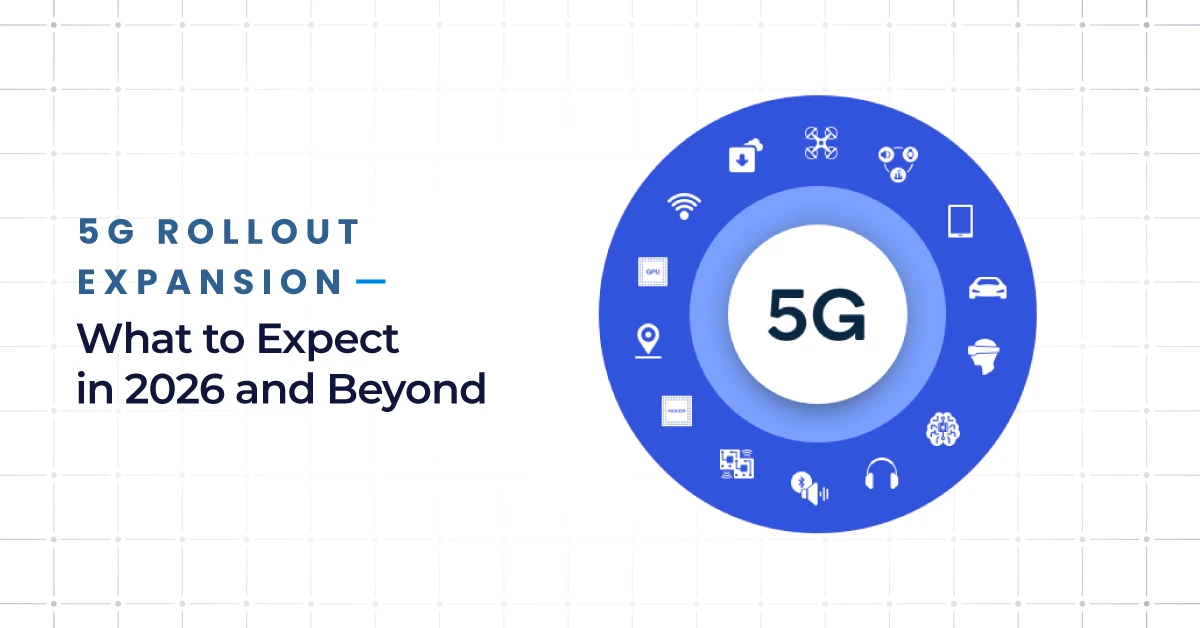
Where We Are Now with 5G Rollout
The global rollout of 5G networks has made steady progress since its early commercial deployments in 2019. Today, 5G technology is available in major metropolitan areas worldwide, offering faster connections and improved reliability over traditional 4G networks.
While the rollout is still uneven across regions, adoption continues to grow as carriers strengthen infrastructure and prepare for the next major stages of deployment. Businesses now depend on 5g connectivity for everything from cloud services to mobile broadband use cases, and this foundation will support the coming 5g expansion technology expected in 2026.
Despite advances, many organizations still operate in hybrid environments that rely on 4G networks, wi fi, and localized infrastructure. As industries push for higher performance, demand is rising for faster, more energy-efficient, and more scalable mobile networks. This evolution is setting the stage for the 5G rollout expansion, what to expect in 2026 and beyond, where new capabilities will unlock transformative opportunities across industries.
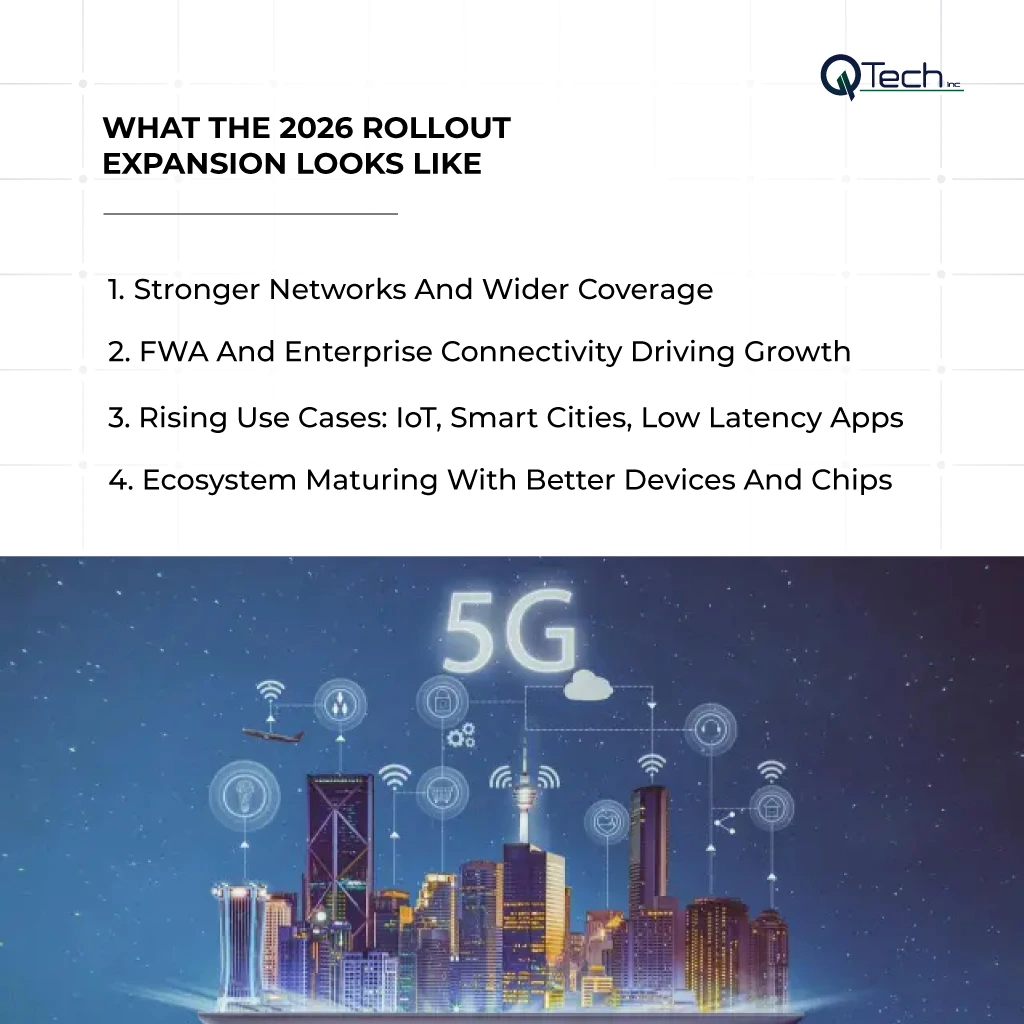
What the 2026 Rollout Expansion Looks Like
Stronger networks and wider coverage
By 2026, the expansion of 5g networks will focus heavily on widening coverage, especially in suburban and underserved rural regions. Carriers are preparing to enhance radio frequencies, deploy more small cells, and optimize spectrum usage to deliver high-speed performance that is multiple times faster than 4G. This phase of the 5G rollout in 2026 will bring improved reliability and lower latency, supporting real-time operations critical for business and enterprise environments.
The 5G expansion future will also involve better integration of mobile networks with edge computing and cloud platforms. As networks become denser and more robust, user experiences will continue to improve across digital platforms, streaming, video conferencing, and intelligent applications. Stronger and more stable infrastructure will lay the groundwork for more advanced industrial use cases.
FWA and enterprise connectivity driving growth
Fixed Wireless Access (FWA) is projected to be a major driver of the next wave of 5G expansion technology. FWA allows homes and businesses to access high-speed internet delivered through 5G signals instead of traditional fiber or cable. As carriers enhance tower capabilities and connect more communities, FWA will play a crucial role in bridging gaps in rural broadband and enhancing connectivity for remote offices.
Enterprise adoption will accelerate as industries look for alternatives to wired connections. FWA solutions paired with private 5G networks will support manufacturing, logistics hubs, hospitals, and distributed offices that require reliable, secure, and flexible network architectures. This technology shift opens doors for enhanced supply chains, automation, and new digital workflows.
Rising use cases: IoT, smart cities, low-latency apps
One of the most significant transformations arriving with the next phase of the rollout involves the expansion of Internet of Things IoT ecosystems. As devices grow more interconnected, businesses will rely on IoT solutions that require fast, stable, and secure connections. Enhanced IoT connectivity will support everything from remote monitoring to fleet tracking, predictive maintenance, and robotics.
Smart cities will also benefit from advanced 5G IoT applications, such as intelligent traffic systems, energy-efficient infrastructure, and automated public safety responses. Low-latency apps used in healthcare, gaming, education, and emergency services will become more responsive as networks evolve. Because 5G networks operate faster and more reliably than many traditional wi fi systems, organizations can build technologically richer environments with fewer bottlenecks.
Ecosystem maturing with better devices and chips
The global device ecosystem is also rapidly evolving as manufacturers prepare for the next wave of 5G adoption. By 2026, smartphones, industrial sensors, wearables, laptops, and smart home devices will incorporate more advanced chipsets optimized for 5g technology. These improvements will enhance battery efficiency, reduce heat, and deliver higher computing performance.
As the ecosystem matures, businesses will have access to new tools that unlock the benefits of 5G for businesses, from improved collaboration to intelligent automation. This growing device landscape will support advanced AI models, real-time analytics, and large-scale mobility strategies that previously required significant wired infrastructure.
Business & Technology Implications
Prepare for edge, slicing, and new networks
As 5G expands, businesses must prepare for advancements like network slicing and edge computing. Network slicing allows providers to create custom virtual networks on the same physical infrastructure, offering dedicated performance for specialized use cases. This capability is essential for industries managing mission-critical data, autonomous systems, and large-scale IoT networks.
How providers are gearing up for 2026
Telecom providers are making major investments in new towers, antennas, fiber backbones, and radio frequencies to support the upcoming phase of deployment. Many carriers are also upgrading infrastructure to reduce energy use and increase efficiency across urban and rural landscapes. With the demand for more bandwidth and lower latency rising across sectors like healthcare, education, logistics, and manufacturing, providers are accelerating expansions and forming new partnerships to meet expectations.
These improvements will support an environment where private 5G networks become more accessible, giving enterprises dedicated control over their connectivity. Faster and more reliable service will power autonomous systems, robotics, and remote operations at scale.
Economic growth and new revenue paths
The 2026 5G expansion future is poised to unlock significant economic value. Businesses in retail, transportation, hospitality, and professional services will be able to streamline operations and improve customer experiences through intelligent systems and automation. The benefits of 5G will also open new revenue opportunities through enhanced digital services, remote work capabilities, and advanced analytics.
As industries adopt integrated 5G and IoT systems, supply chains will become more transparent, efficient, and resilient. Enhanced connectivity will reinvent how companies manage logistics, inventory, and workforce coordination.
Key Challenges and How to Address Them
High costs and rural rollout hurdles
While the advancements ahead are promising, the rollout faces notable challenges. One of the most discussed 5G key challenges is the high cost of deploying new antennas, small cells, and fiber backhaul in remote and rural areas. The complexities of installing infrastructure across difficult terrain slow down deployment and increase expenses for providers.
Governments and private organizations will need to collaborate to fund expansion initiatives and create incentives for broader adoption. Strategic partnerships will be essential for delivering advanced connectivity to underserved populations.
Struggles to monetize 5G use cases
Another challenge involves monetizing large-scale 5G deployments. While consumers benefit from faster speeds, the most transformative use cases have yet to reach widespread adoption. Industries are still exploring how to integrate autonomous systems, robotics, and predictive analytics into their workflows at scale.
To overcome this hurdle, businesses must adopt long-term strategies that focus on modernization, automation, and advanced digitization. As adoption grows, the ecosystem will naturally strengthen, creating clearer paths for sustainable revenue models.
Planning for 5G-Advanced and beyond
As organizations prepare for 2026, it’s important to consider what comes after. The next phase—5G-Advanced—will introduce even lower latency, improved AI-driven network management, and stronger IoT capabilities. Companies that take proactive steps today will be better positioned to adopt future innovations without major disruptions.
Investing in scalable infrastructure, cloud systems, and modern security frameworks will be essential for staying competitive and agile in an evolving technological landscape.
Conclusion & How Businesses and Organizations Can Prepare
The 5G rollout expansion, what to expect in 2026 and beyond, marks a major turning point for businesses and global digital infrastructure. With wider coverage, improved devices, new enterprise capabilities, and the rise of intelligent systems, organizations have unprecedented opportunities to enhance operations and deliver superior customer experiences.
To prepare, businesses should evaluate their current infrastructure, integrate cloud and edge solutions, and consider transitioning to private 5G networks for specialized needs. Partnering with experienced technology providers can help organizations navigate complexities, strengthen security, and position themselves for long-term success.
As 5G continues to expand, the companies that invest early will be the ones best equipped to innovate, scale, and lead in a digitally driven future.
FAQ
Q: What is the difference between current 5G and 5G Standalone (SA)?
A: Current 5G (Non-Standalone or NSA) uses a 5G radio network but relies on the existing 4G LTE core for control functions. 5G Standalone (SA) has a completely new, cloud-native 5G core network. This is crucial because SA unlocks advanced features like network slicing, ultra-low latency, and massive IoT connectivity that are not fully possible with NSA architecture. The expansion through 2026 will focus heavily on deploying SA networks.
Q: What are the real benefits of 5G for businesses?
A: Beyond faster smart-phones, the real business benefits of 5G expansion include:
- Operational Efficiency: Enabling massive IoT sensor networks for predictive maintenance and asset tracking.
- New Products/Services: Powering AR/VR experiences, real-time remote control of machinery, and autonomous logistics.
- Flexibility: Private 5G networks give enterprises complete control over their wireless infrastructure.
- Reliability: Ultra-reliable low-latency communication (URLLC) for critical applications in manufacturing and healthcare.
Q: Is 5G rollout expansion only relevant for telcos or for all businesses?
A: While telecom operators lead the infrastructure rollout, 5G expansion impacts all businesses — from manufacturing, logistics, healthcare and retail — by enabling connectivity-driven services, IoT deployments, faster mobile experiences, and new business models. Organisations should plan accordingly.