

Introduction: The Urgency of Digital Transformation in 2026
In 2026, technology is no longer a support function sitting quietly in the background. It shapes how companies serve customers, manage teams, protect data, and compete in crowded markets. That is why your business needs a digital transformation audit in 2026. Businesses that pause to evaluate their systems, strategies, and digital initiatives are better positioned to adapt, strengthen business models, and build a lasting competitive advantage through smarter use of digital technology.
What Is a Digital Transformation Audit?
Definition
A digital transformation audit is a structured review of how a business uses technology across operations, marketing, security, and customer engagement. It is broader than a standard technology audit because it does not stop at hardware or software. It also examines workflows, data use, and long-term readiness. In many cases, it functions as an it audit for businesses, an infrastructure audit, and a business digital maturity model assessment all in one.
Purpose
The purpose of a digital transformation audit is to identify potential gaps that limit growth and performance. It helps leaders understand whether current systems support future goals, whether teams are relying on inefficient ad hoc processes, and whether the company is progressing through a useful maturity assessment. By comparing findings against modern digital maturity models, businesses can see where they stand and what to improve next in the broader audit process.
Why Businesses Need a Digital Transformation Audit
Identify Technology Gaps
Address the top technology challenges businesses face early on. A proper audit surfaces outdated software, disconnected platforms, weak integrations, and network issues before they turn into costly operational bottlenecks. It also shows whether the company is prepared for growth through an IT infrastructure audit checklist or a cloud migration readiness assessment, instead of making rushed decisions under pressure.
Improve Operational Efficiency
When teams rely on duplicate entry, manual approvals, and scattered files, productivity suffers. A digital transformation audit highlights where business process optimization can reduce waste and improve operational efficiency. It also uncovers where AI automation for business processes can replace repetitive work, reduce errors, and give staff more time to focus on strategic work rather than routine administrative tasks.
Enhance Customer Experience
Customers judge a business by how easy it is to interact with it online and offline. Slow websites, broken forms, delayed responses, and disconnected communication channels all damage the customer journey. An audit helps companies examine each touchpoint and improve customer experiences by aligning systems, messaging, and support tools. The result is a smoother experience that builds trust and increases retention.
Strengthen Cybersecurity and Data Protection
Security can no longer be treated as a separate conversation. Every digital improvement depends on strong protection of systems, users, and data. A digital transformation audit includes a cybersecurity audit for the business so leaders can uncover weak access controls, outdated software, poor backup practices, and risky vendor dependencies. This makes it easier to reduce exposure before a security issue turns into downtime, loss, or reputational damage.
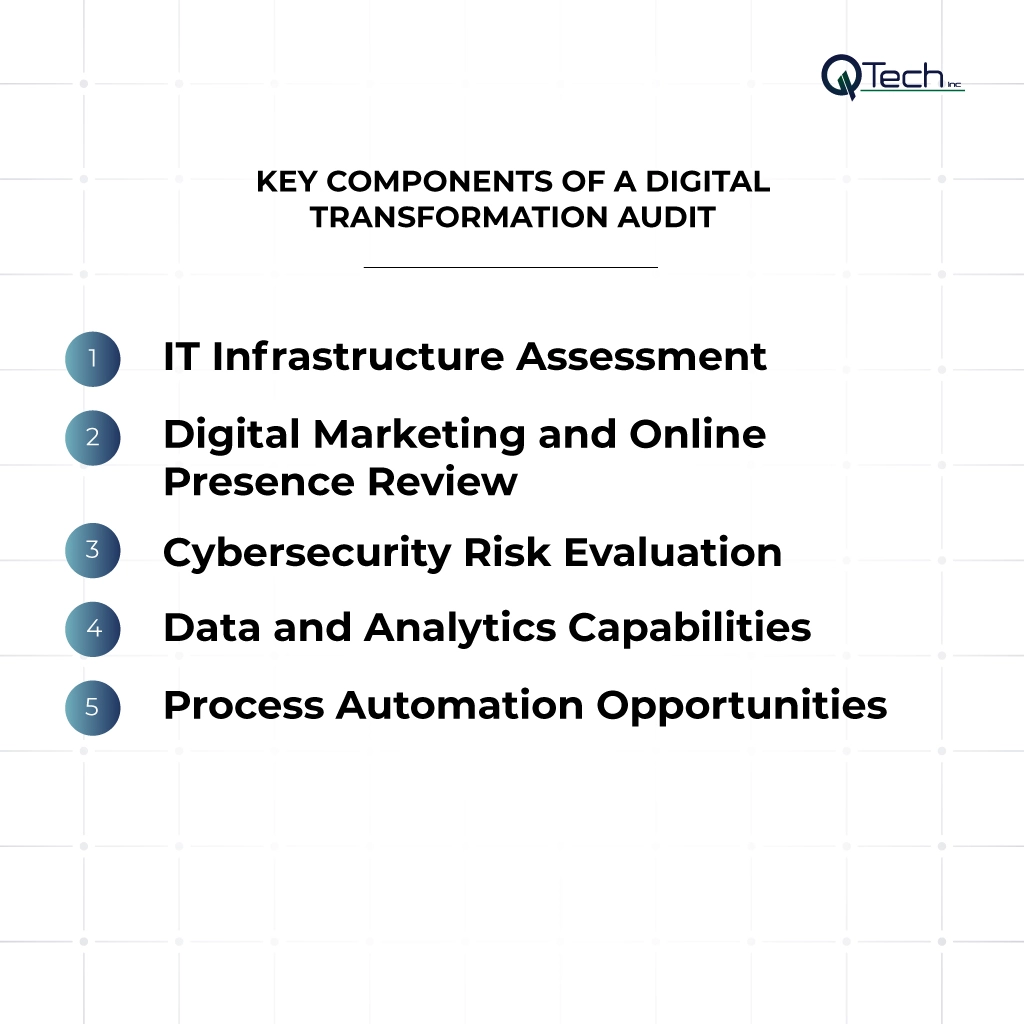
Key Components of a Digital Transformation Audit
- IT Infrastructure Assessment
- Digital Marketing and Online Presence Review
- Cybersecurity Risk Evaluation
- Data and Analytics Capabilities
- Process Automation Opportunities
IT Infrastructure Assessment
A strong audit begins with infrastructure. This means reviewing networks, endpoints, cloud systems, servers, storage, licenses, and connectivity. An effective IT infrastructure audit checklist should examine performance, redundancy, security, scalability, and compatibility with current business needs. Without that foundation, digital initiatives can quickly stall. Working with dedicated IT support in Miami ensures your underlying infrastructure remains resilient, fully patched, and equipped to support continuous business operations
Digital Marketing and Online Presence Review
Digital growth also depends on visibility and engagement. That is why an audit should include a review of website performance, search visibility, lead capture, content quality, analytics, and conversion paths. Businesses that combine IT insight with digital marketing strategy are in a stronger position to improve brand reach and turn traffic into measurable business outcomes.
Cybersecurity Risk Evaluation
A cybersecurity review should go beyond antivirus and passwords. It should assess user access, endpoint protection, patching, email security, backups, vendor exposure, and incident response readiness. If a company is planning expansion, remote work improvements, or migration to the cloud, the audit should also include a cloud migration assessment so that security risks are addressed before any migration strategy moves forward.
Data and Analytics Capabilities
A modern business needs accurate information it can trust. An audit should review where data lives, how it moves between systems, and whether leaders can access meaningful reports in real time. Good analytics support better forecasting, faster decisions, and stronger accountability. Weak analytics, by contrast, leave teams guessing and make it difficult to measure performance across departments.
Process Automation Opportunities
Automation is one of the clearest areas where businesses can unlock value. A digital transformation audit can reveal where workflows are delayed by manual handoffs, inconsistent approvals, or fragmented tools. Incorporating automated workflows into a structured 2026 IT planning checklist helps companies streamline business processes, eliminate operational bottlenecks, and scale effectively.
Signs Your Business Needs a Digital Audit
Declining Performance or ROI
If revenue growth has slowed, campaigns are underperforming, or technology spending keeps rising without clear returns, it may be time for a closer review. Declining ROI often signals that tools, processes, and priorities are no longer aligned. Partnering with an expert provider for managed IT services in Miami helps realign your tech stack, bridge performance gaps, and maximize your technology investment.
Outdated Systems and Tools
When teams are still working around limitations instead of working through efficient systems, the warning signs are clear. Legacy software, disconnected platforms, and weak integration make growth harder. Businesses facing those issues often need better migration planning, smarter migration to the cloud decisions, and a realistic migration strategy instead of patching old systems one fix at a time.
Poor Customer Experience
Missed inquiries, slow response times, confusing websites, and inconsistent messaging often point to deeper operational issues. If customers are dropping off before they convert, or if service feels fragmented after the sale, the problem may not be the team alone. It may be the digital systems behind the experience.
Security Vulnerabilities
Repeated login issues, unpatched devices, incomplete backups, and unclear permissions are all signs that risk is building. Security weaknesses are especially dangerous when companies grow quickly, add remote staff, or connect more tools without governance. A digital transformation audit helps surface those vulnerabilities before they become expensive problems.
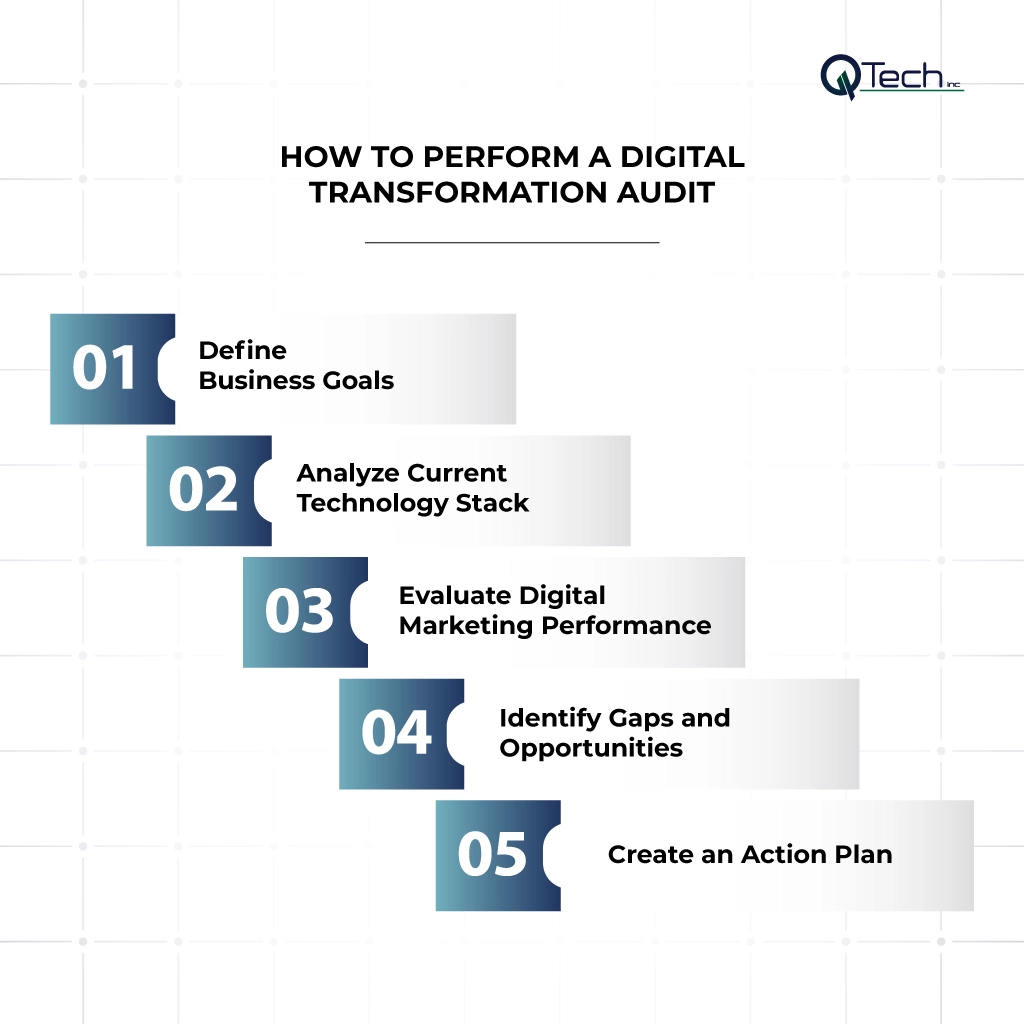
How to Perform a Digital Transformation Audit
- Step 1: Define Business Goals
- Step 2: Analyze Current Technology Stack
- Step 3: Evaluate Digital Marketing Performance
- Step 4: Identify Gaps and Opportunities
- Step 5: Create an Action Plan
Step 1: Define Business Goals
Start by defining what success looks like. The audit should reflect the goals of leadership, sales, operations, and other business units. Whether the focus is efficiency, growth, security, or customer retention, the audit must tie digital initiatives back to measurable business outcomes rather than abstract technical improvements.
Step 2: Analyze Current Technology Stack
Next, evaluate your full technology environment including software, networks, cloud tools, and end-user systems. Much like scheduling routine IT health checks, using an audit checklist helps document dependencies, uncover overlaps, and mitigate operational risks early. This is where many companies uncover redundant tools, unsupported systems, and avoidable friction across daily operations.
Step 3: Evaluate Digital Marketing Performance
A complete audit should also review digital visibility and lead generation. Website speed, SEO, conversions, content, forms, and campaign performance all influence growth. This step helps businesses connect technology decisions with the customer journey and understand whether their digital presence is truly supporting revenue goals.
Step 4: Identify Gaps and Opportunities
Once the findings are documented, the next step is to identify potential areas for improvement. This includes workflow inefficiencies, security risks, automation opportunities, weak reporting, and cloud migration readiness assessment issues. Comparing the business against a business digital maturity model helps leadership prioritize what matters most.
Step 5: Create an Action Plan
The final step is turning insight into action. A strong plan should rank initiatives by risk, value, cost, and timeline. It should define owners, milestones, and measurable outcomes. Most importantly, it should replace reactive, ad hoc decision-making with a clear roadmap the business can follow with confidence.
Benefits of Digital Transformation Audit
Increased Efficiency and Productivity
A well-executed audit gives businesses a clearer path to streamlined operations. By removing friction, reducing duplication, and improving handoffs, teams can work faster with fewer errors. That creates a stronger operating foundation without simply asking employees to do more with less.
Better Decision-Making with Data
When data is organized and visible, leaders can make smarter decisions faster. Strong reporting improves forecasting, helps teams respond in real time, and supports more confident planning. It also allows businesses to measure progress instead of relying on assumptions.
Improved ROI from Marketing and IT
Technology and marketing investments deliver better results when they support the same goals. An audit clarifies where spend is working, where it is underperforming, and where better alignment is needed. That leads to more efficient budgets and stronger returns across both functions.
Scalable Business Growth
Growth is easier when systems are built to support it. A digital transformation audit helps companies scale with intention by improving infrastructure, clarifying priorities, and building repeatable processes. It prepares the business not only for current demands, but for future expansion as well.
Conclusion: Transform Your Business with a Strategic Audit With Q-Tech Inc.
Digital change is no longer optional, but guesswork should never drive it. A strategic digital transformation audit gives your business the clarity to improve systems, strengthen security, support customers, and invest where results matter most. If your company wants to move forward with confidence in 2026, Q-Tech Inc. can help you evaluate your environment, uncover opportunities, and build a smarter path toward sustainable digital growth.
FAQ
Q: Why does my business need a digital transformation audit in 2026?
A: In 2026, businesses that have not audited their digital capabilities face compounding competitive risk. AI-powered competitors are automating manual processes, cloud-native businesses operate at lower costs, and customers increasingly expect seamless digital interactions. An audit reveals whether your technology stack, cybersecurity posture, and digital marketing capabilities are sufficient to compete — or whether silent inefficiencies are costing you revenue, time, and talent. It is the equivalent of a financial audit, but for your technology investments.
Q: What is digital maturity and how do I measure it?
A: Digital maturity is a measure of how effectively an organisation uses digital technology to drive business performance. It is typically assessed across five stages: Digital Novice (manual processes, minimal technology adoption), Digital Explorer (basic digitisation underway), Digital Player (functional digital capabilities in place), Digital Transformer (integrated digital strategy delivering measurable outcomes), and Digitally Resilient (continuous innovation with technology as a competitive advantage). Assessment uses a scorecard covering technology, processes, data usage, culture, and leadership alignment.
Q: What is cloud migration readiness and how do I assess it?
A: Cloud migration readiness is an assessment of whether a business’s current infrastructure, data, security posture, and team capabilities support a successful move to cloud-based services. Key readiness indicators include: the percentage of applications that are cloud-compatible, data classification and sensitivity (determining what can move to shared cloud vs private cloud), internet bandwidth adequacy for cloud workloads, current vendor contracts and their cloud provisions, and staff familiarity with cloud-based tools. A readiness assessment should precede any cloud migration project — moving without it is one of the most common causes of migration failure.
Q: How does a digital transformation audit differ from an IT audit?
A: An IT audit is a technical review focused on system security, compliance, and operational performance — it assesses whether technology systems are functioning correctly and securely. A digital transformation audit is broader — it assesses not just whether technology works, but whether the right technology is being used, whether processes are optimally digitised, whether the business is capturing value from its data, and whether digital capabilities support strategic growth objectives. IT audits look backward at compliance; digital transformation audits look forward at competitive capability