


In today’s interconnected world, data moves faster than ever — across offices, cloud platforms, and personal devices. Yet, every click, connection, and transfer introduces risk. Protecting your network isn’t just an IT task; it’s a business imperative.
Understanding the role of firewalls, VPNs, and IDS in network protection is the foundation of a resilient cybersecurity strategy. These technologies form a multi-layered defense that shields your network resources from potential threats, ensuring data integrity, availability, and confidentiality.
What Are Firewalls, VPNs & IDS?
Before diving deeper, it’s essential to understand what these systems are and how they work together. A firewall acts as a digital gatekeeper, filtering network traffic based on predefined security measures. A Virtual Private Network (VPN) creates a secure tunnel between users and the company’s internal systems, encrypting communication to prevent eavesdropping. Finally, an Intrusion Detection System (IDS) continuously monitors suspicious activities within the network, identifying and alerting administrators to any breaches that slip through other defenses.
Together, these technologies create a layered network security system—firewalls prevent unauthorized access, VPNs ensure secure connectivity, and IDS solutions detect and respond to intrusions. This holistic model helps organizations stay vigilant in a constantly evolving digital threat landscape.
Understanding Network Security’s First Line of Defense: The Firewall
What is a Firewall and How Does It Work?
A firewall is one of the most critical network security fundamentals. But what is a firewall, exactly? Simply put, it’s a device or software designed to monitor and control incoming and outgoing data packets based on a set of rules. Acting as a boundary between trusted and untrusted network segments, it filters traffic at various layers, from the application layer to the network layer.
Firewalls enforce security measures by evaluating every connection attempt and determining whether to allow or block it. This firewall configuration process ensures only legitimate traffic passes through, minimizing exposure to potential threats and unauthorized access attempts.
The Different Types of Firewalls
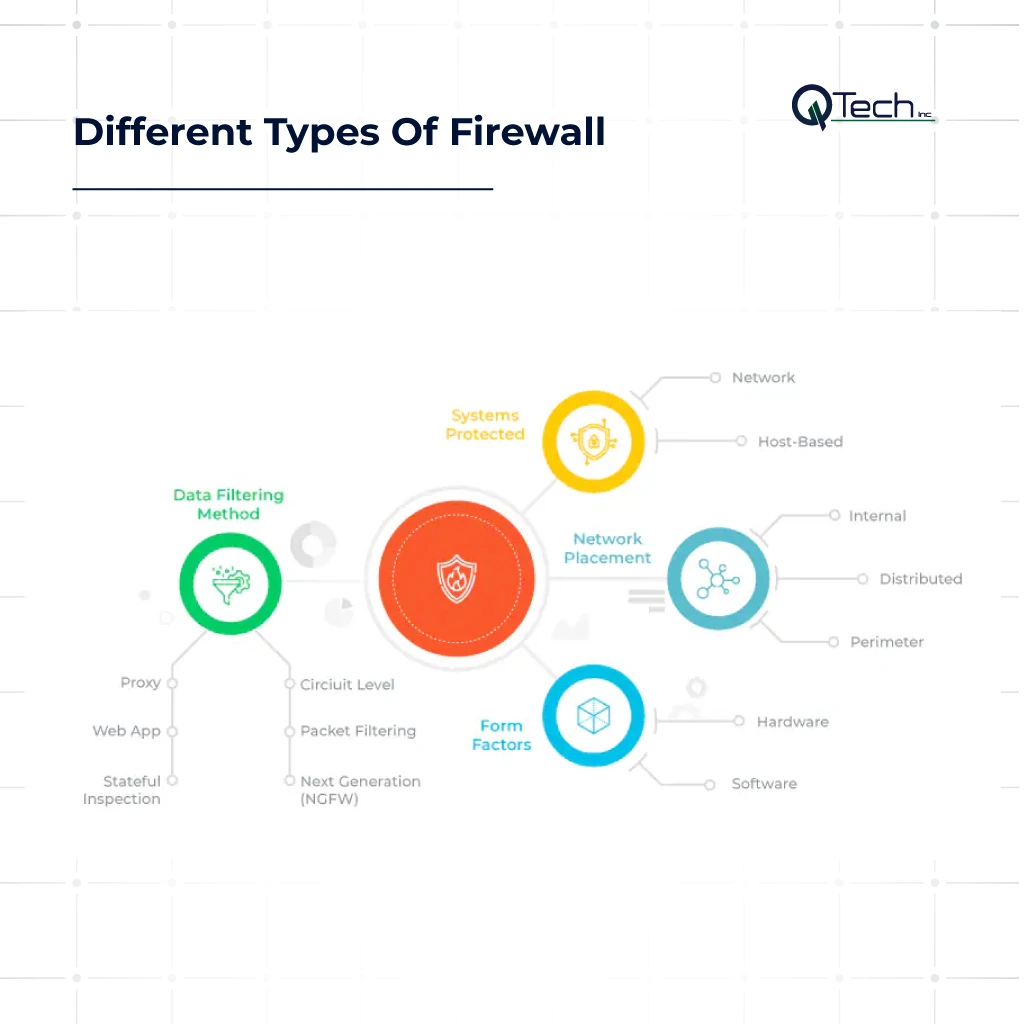
There are several types of firewalls, each suited to different organizational needs. The packet filtering firewall inspects data packets based on header information, such as source and destination IP addresses. Proxy firewalls operate at the application layer, analyzing traffic more deeply and masking internal network addresses to enhance privacy.
Modern networks often use stateful inspection and next-generation firewalls (NGFWs) that integrate advanced intrusion prevention systems (IPS) and deep packet inspection. These technologies analyze the behavior of traffic to identify anomalies, making firewalls more adaptive and proactive against evolving cyber threats.
Securing the Connection: The Role of a Virtual Private Network (VPN)
How Does a VPN Provide Secure Remote Access?
A VPN is indispensable for today’s mobile and hybrid workforce. As remote work grows, employees must securely access company resources from different locations. This is where VPN services come into play. A VPN establishes a secure connection between a user’s device and the organization’s internal network, safeguarding data exchanged over public or unsecured Wi-Fi networks.
This technology ensures that sensitive information, whether financial data or customer credentials, remains protected during transmission. When integrated properly, VPNs not only enhance network protection but also facilitate secure cloud connectivity for businesses using remote applications and storage solutions.
VPN Tunneling, Encryption, and Privacy: The Core Mechanics
To understand how VPN works, it helps to visualize them as a secure tunnel for data packets traveling across the internet. VPN tunneling protocols (like OpenVPN, L2TP, or IPSec) encrypt data end-to-end, making it indecipherable to hackers or third parties.
This vpn encryption protects against eavesdropping and man-in-the-middle attacks. For example, if cybercriminals intercept your data on a public network, they’ll see only unreadable information. Effective vpn services not only protect privacy but also ensure compliance with data protection laws.
Monitoring and Alerting: The Intrusion Detection System (IDS)
IDS vs. IPS: What Is the Difference in Network Security?
An Intrusion Detection System (IDS) acts as the eyes and ears of your network, continuously monitoring network traffic for signs of malicious behavior. However, it’s often paired with an Intrusion Prevention System (IPS) — together, referred to as IDS and IPS — for a more robust defense.
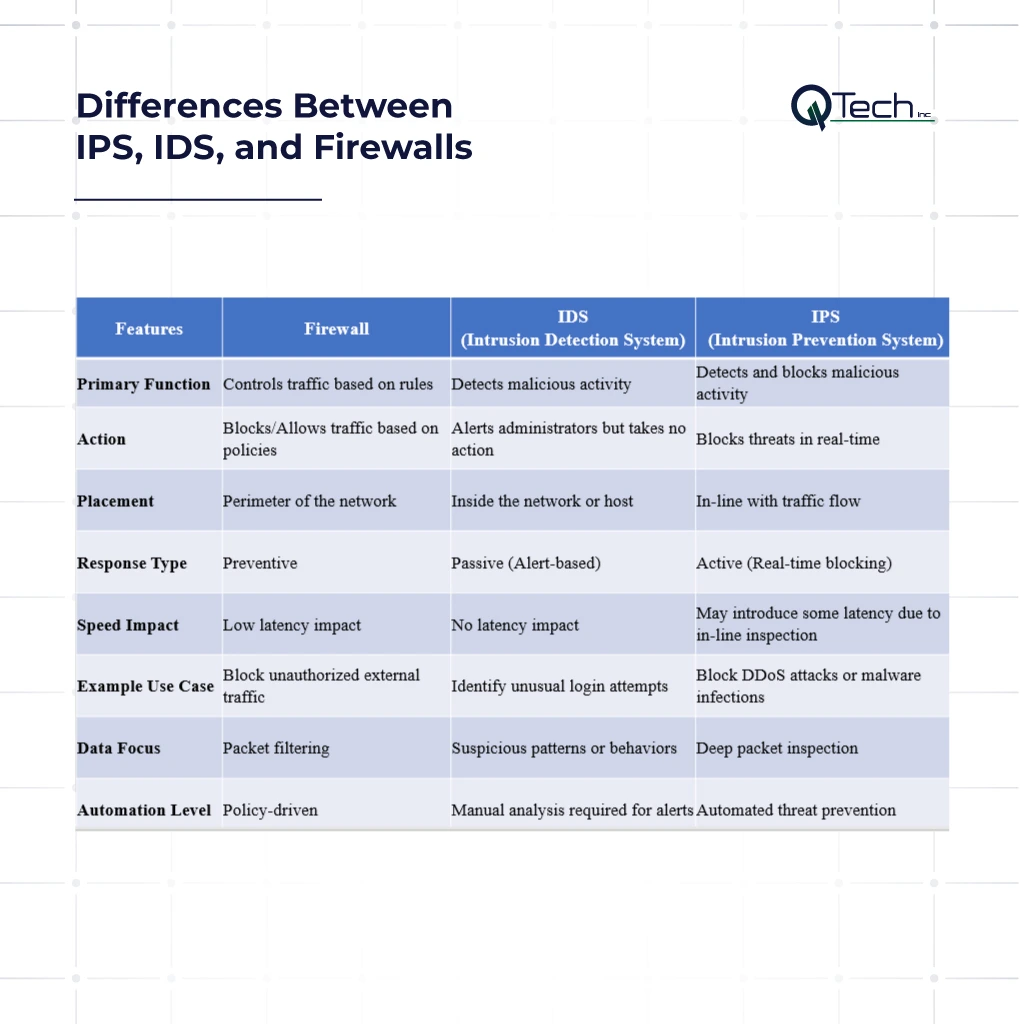
The difference lies in their actions: an IDS detects and alerts administrators to intrusions, while an IPS prevents them by blocking malicious traffic in real time. Understanding this ids vs ips vs firewall distinction helps organizations deploy the right balance of detection, prevention, and access control.
Signature-Based vs. Anomaly-Based IDS Detection
IDS solutions typically use two main detection methods: signature-based and anomaly-based. Signature-based systems rely on known threat patterns, similar to antivirus software. In contrast, anomaly-based IDS leverages machine learning to identify deviations from normal network traffic behavior.
Both techniques are essential to network intrusion detection systems. Signature-based detection provides precision for known threats, while anomaly-based detection helps identify zero-day attacks or insider misuse. Combined, these systems form an intelligent defense layer that enhances overall network protection.
Head-to-Head Comparison: A Functional AnalysisFirewall vs. VPN: Gatekeeper vs. Secure Courier
A firewall and VPN serve distinct but complementary purposes. Think of a firewall as a gatekeeper controlling who can enter or leave the network, while a VPN acts as a secure courier that transports your data safely through public spaces. Firewalls manage firewall configuration rules to block unwanted access, whereas VPNs rely on vpn encryption to protect data in transit.
Firewall vs. IDS: Prevention vs. Detection
When comparing firewall vs IDS, the key difference lies in timing. Firewalls focus on preventing unauthorized access, whereas IDS systems specialize in detecting suspicious activity after it occurs. Together, they provide both proactive and reactive layers of defense, ensuring network intrusion detection and response mechanisms are always active.
VPN vs. IDS: Securing Transit vs. Monitoring for Threats
A VPN secures communication through secure tunnel encryption, but it doesn’t actively inspect or analyze the traffic. An IDS, however, monitors network traffic to spot malicious patterns, even within encrypted sessions. By using both tools, businesses can protect remote users and detect internal threats that might bypass perimeter defenses.
Best Practices & Optimization Tips
Principle of Least Privilege & Rule Review
Every access rule or policy should align with the principle of least privilege — granting users only the permissions necessary for their roles. Regularly reviewing firewall configuration rules helps eliminate outdated entries that could expose network segments to unnecessary risk.
Logging, Alert Tuning, and Periodic Audits
Strong cybersecurity depends on visibility. Logging all network activities enables early detection of suspicious activities and misconfigurations. Organizations should fine-tune IDS alerts to reduce false positives and perform periodic audits to ensure compliance and accuracy.
Combine IDS Alerts with Firewall Actions & Incident Response
Integrating intrusion detection system IDS alerts with firewall actions creates a synchronized response strategy. When IDS identifies potential threats, firewalls can automatically adjust to block malicious IPs or protocols. This cooperation between ids systems and intrusion prevention systems enhances both network intrusion detection and prevention.
Use VPN for Remote Access with Proper Endpoint Controls
A VPN is only as secure as the device connecting through it. Implement endpoint security policies that enforce authentication, malware scanning, and encryption standards. Using vpn services with multi-factor authentication (MFA) ensures that only authorized users gain access to sensitive network resources.
Updating Firmware, Patching, and Threat Intelligence Feeds
Staying ahead of cybercriminals requires constant updates. Regularly patching systems, updating firewall and IDS firmware, and subscribing to threat intelligence feeds help organizations anticipate and neutralize emerging vulnerabilities. This proactive approach keeps network security aligned with modern security measures.
Conclusion: How Q-Tech Inc. Can Help Build & Harden Network Defenses
Building a strong cybersecurity posture requires more than just tools — it demands expertise, strategy, and continuous vigilance. Firewalls, VPNs, and IDS each serve vital roles, but their real power lies in how they work together to protect every layer of your infrastructure.
Our team of IT and digital specialists helps businesses implement comprehensive network protection strategies that combine cutting-edge firewall configuration, vpn encryption, and network intrusion detection systems. We design solutions tailored to your industry, ensuring your network resources remain secure while supporting productivity and innovation.
In a world where cyber threats evolve daily, staying protected means staying proactive. With our expertise, you gain the confidence of knowing your digital environment is guarded by professionals who understand both technology and business. Secure your network, empower your teams, and safeguard your growth — because your data deserves nothing less.
FAQ
What is the main difference between a firewall and an IDS?
Answer – The main difference is prevention vs. detection. A firewall is a preventative control that actively blocks or allows traffic based on rules. An IDS (Intrusion Detection System) is a detective control that monitors network traffic for suspicious patterns and sends alerts but doesn’t block traffic itself. A firewall acts like a bouncer, while an IDS acts like a security camera.
Do I still need a firewall if I have a VPN?
Answer – Yes, absolutely. They serve different purposes. A VPN encrypts your connection to protect data in transit, while a firewall controls what traffic is allowed in or out of the network. You need the VPN to connect securely and the firewall to protect the network once connected. They are complementary, not interchangeable.
Can an IDS block attacks?
Answer – A traditional IDS only monitors and alerts. Its evolved version, the Intrusion Prevention System (IPS), can actively block or terminate malicious connections. Many modern systems combine IDS and IPS functions into a single solution.
Is a VPN enough to secure my remote workers?
Answer – No. A VPN only secures the connection, not the entire environment. You still need:
- A firewall to control what users can access.
- An IDS/IPS to detect and stop threats over the VPN.
- Endpoint protection (antivirus, EDR) on user devices.
A VPN provides access, not comprehensive security.
What is a Next-Generation Firewall (NGFW)?
Answer – A Next-Generation Firewall builds on traditional firewalls by adding application-level inspection, intrusion prevention, and deep packet inspection. It can identify specific applications (like Facebook or Skype) and enforce policies based on the application, user, and content, giving granular, intelligent control over network traffic.