


Choosing the right payment gateway is one of the most important decisions any business can make when launching or upgrading its online store. A payment gateway doesn’t just handle transactions; it builds trust, protects your customers’ data, and keeps your business running smoothly.
With so many options available, from Stripe to PayPal to Square, the challenge lies in knowing how to choose the right payment gateway for your website. This guide will walk you through the essentials, comparing top providers, and helping you make the decision that supports your long-term growth and customer satisfaction.
What Is a Payment Gateway & Why Does It Matter
Definition
A payment gateway is an online payment processor that authorizes, encrypts, and securely transfers payment data between your customer, your website, and your bank account. Think of it as the digital equivalent of a point-of-sale terminal in a retail store. Without one, you can’t accept credit card payments online.
Role
The role of a payment gateway is to provide a payment solution that makes accepting payments seamless. It not only verifies customer details but also ensures data security standard PCI compliance, keeping transactions safe from fraud or breaches. For businesses, it’s the bridge that connects your e-commerce platform with your merchant account, enabling smooth payment processing while protecting both revenue and reputation.
How Payment Gateway Works In E-Commerce
When a customer enters their card details on your website, the payment gateway encrypts this data and sends it through secure networks for verification. Once the issuing bank confirms the transaction, the funds are transferred to your merchant account. The entire process takes seconds, but behind the scenes, it involves multiple payment processors, fraud checks, and security measures that ensure compliance with the security standard PCI DSS.
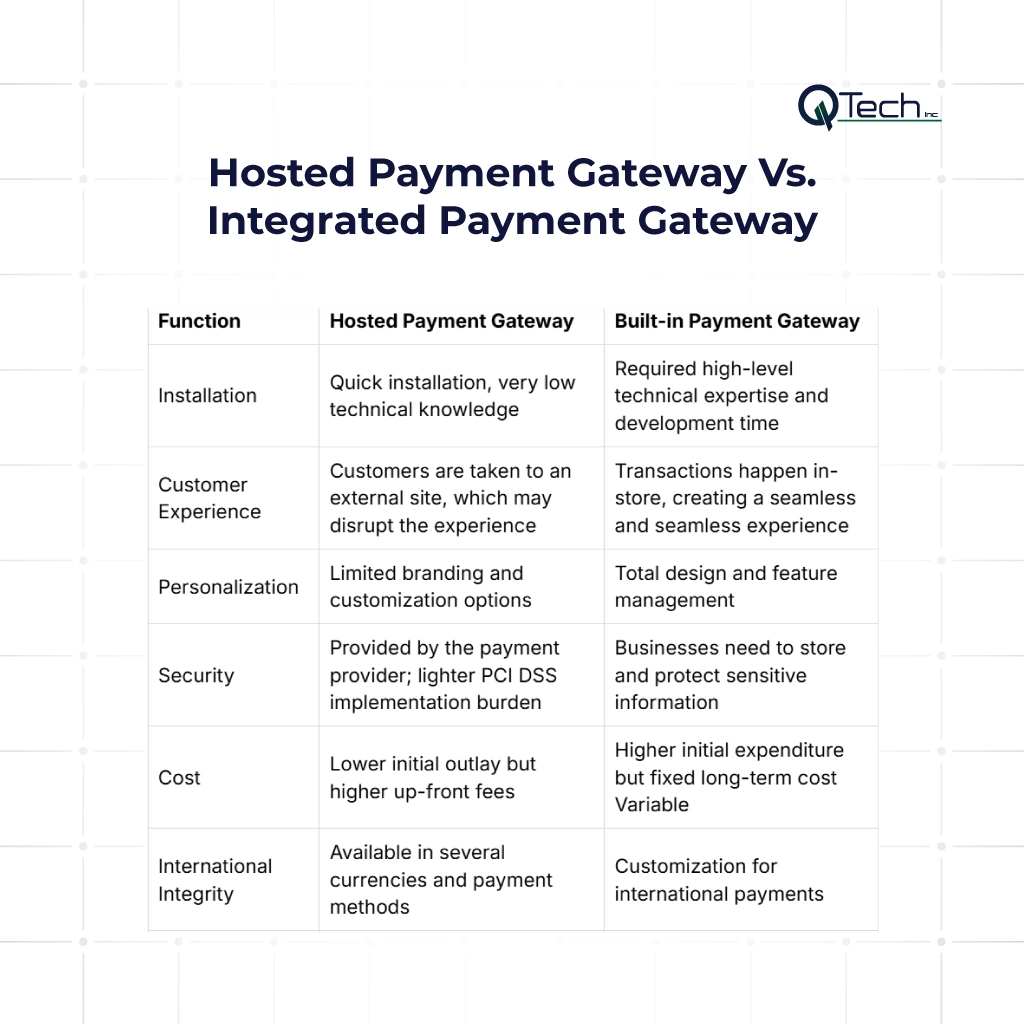
Understand the Two Main Types: Hosted vs. Integrated
Hosted Payment Gateways
A hosted payment gateway redirects customers to a third-party site, such as PayPal, to complete the payment. These are quick to set up and often include built-in fraud protection and customer support. However, they take customers away from your secure site, which may affect conversion rates.
Integrated Payment Gateways
Integrated gateways allow payments to be processed directly on your website. They typically require developer expertise but provide a smoother, branded checkout experience. If you want maximum control, flexibility, and better insights into cash flow, an integrated gateway like Stripe might be the better choice.
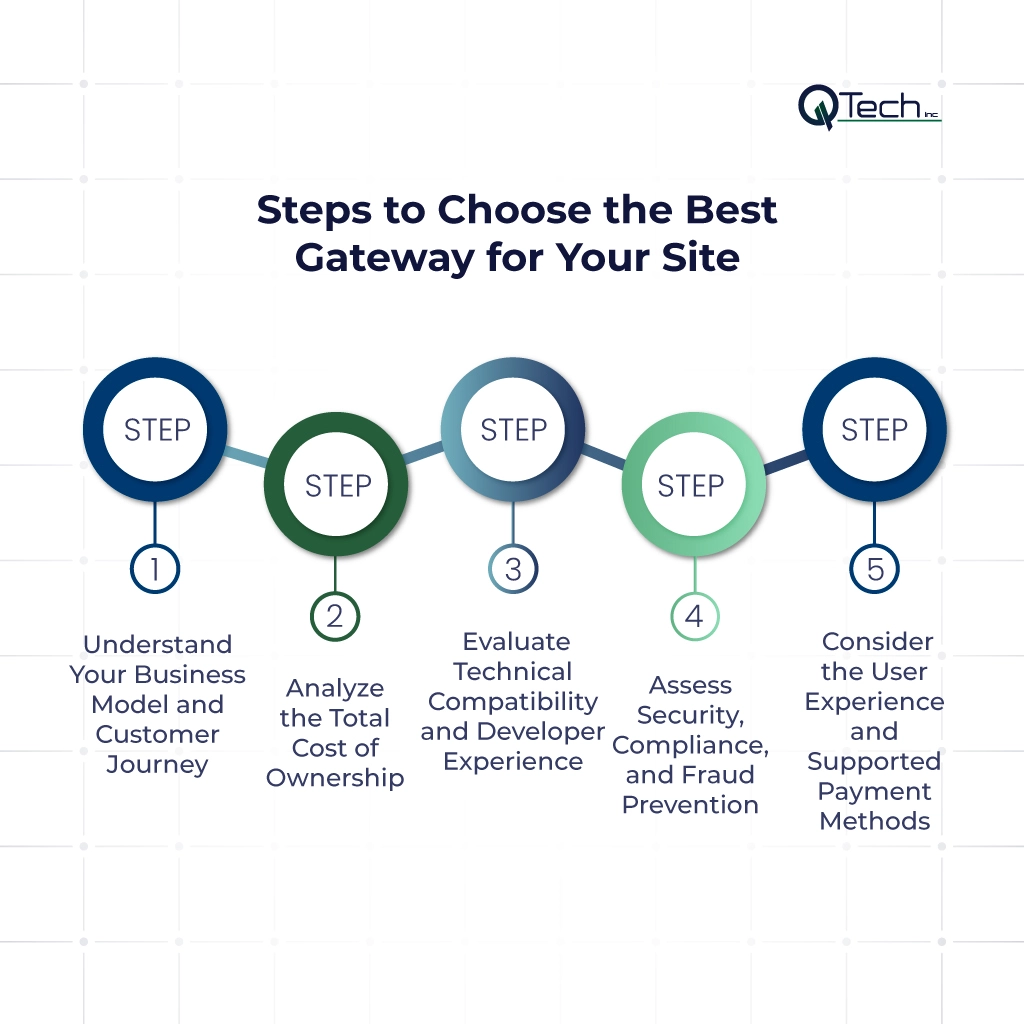
Steps to Choose the Best Gateway for Your Site
Selecting the right provider involves more than comparing transaction fees. It’s about balancing cost, compatibility, compliance, and customer experience.
- Step 1: Understand Your Business Model and Customer Journey
- Step 2: Analyze the Total Cost of Ownership
- Step 3: Evaluate Technical Compatibility and Developer Experience
- Step 4: Assess Security, Compliance, and Fraud Prevention
- Step 5: Consider the User Experience and Supported Payment Methods
Step 1: Understand Your Business Model and Customer Journey
E-commerce vs. SaaS vs. Marketplace: Different Needs
An online store selling products has very different needs from a SaaS company offering subscriptions or a marketplace handling multiple sellers. E-commerce requires gateways that support international transactions, while SaaS companies prioritize recurring billing. Marketplaces often need split payments and more advanced payment methods.
One-Time Payments vs. Subscriptions: Critical Differences
Businesses relying on one-time sales need a gateway with low processing fees and fast payouts. Subscription-based businesses require flexible billing APIs to manage recurring online payments without interrupting service. Understanding your customer journey is the first step in choosing the right solution.
Step 2: Analyze the Total Cost of Ownership (Beyond Just Transaction Fees)
Decoding Fee Structures: Transaction %, Flat Fees, Monthly Costs
Most gateways charge a small percentage plus a flat fee per transaction. But looking only at transaction fees can be misleading. Monthly subscription costs, payout delays, and minimum usage requirements all affect profitability. Calculating your payment processing expenses upfront is critical.
Hidden Costs: Setup Fees, Chargeback Fees, International Fees
Beyond visible charges, some gateways impose hidden fees for account setup, international transactions, or chargebacks. These can erode profit margins quickly. Understanding the full landscape of e-commerce payment gateway fees ensures your solution doesn’t create unexpected costs later.
Step 3: Evaluate Technical Compatibility and Developer Experience
API Quality, Documentation, and SDK Availability
A gateway with strong APIs, clear documentation, and robust SDKs makes life easier for developers. It reduces integration headaches and ensures your system scales as your business grows. Stripe is often praised for this strength, especially among tech-driven startups.
Platform Integration: Shopify, WooCommerce, Custom Builds
Your gateway must work seamlessly with your existing e-commerce platform. For example, Shopify integrates easily with Stripe, while WooCommerce users might prefer PayPal or Square. If you’re running a custom build, look for a gateway with flexible APIs and reliable sandbox environments.
Step 4: Assess Security, Compliance, and Fraud Prevention
PCI DSS Compliance: Who Handles What?
Every business that accepts credit cards must comply with PCI DSS standards. Depending on your gateway, responsibility for compliance may fall on the provider or on your team. A hosted solution usually manages DSS compliance for you, while an integrated one may require you to implement parts of the data security standard PCI.
Built-in Fraud Detection Tools and Features
Strong fraud protection is non-negotiable. Features like velocity checks, device fingerprinting, and machine-learning fraud detection protect you from costly chargebacks. Pair these with reliable monitoring support to ensure threats are caught early.
Step 5: Consider the User Experience and Supported Payment Methods
Redirect vs. Embedded Checkout: Conversion Rate Impact
Redirect checkouts may be secure, but risk losing customers mid-purchase. Embedded checkouts keep users on your secure site, improving trust and conversion rates. Evaluating this trade-off is key to maximizing sales.
Digital Wallets, Buy Now Pay Later, and Local Payment Methods
Customers expect flexibility when paying online. From credit card payments to Apple Pay, Google Pay, and Buy Now Pay Later solutions, your gateway must support diverse payment methods. Offering local payment types also builds trust with international buyers.
Payment Gateway Comparison: Top Contenders at a Glance
Stripe: The Developer’s Choice for Flexibility
Stripe offers powerful APIs, strong developer support, and excellent recurring billing tools. It’s a favorite among SaaS companies and tech startups. If you’ve compared Stripe vs PayPal, Stripe usually wins for businesses needing customization and developer control.
PayPal: The Trusted Name for Consumer Familiarity
PayPal remains one of the most recognized online payment processors. Customers trust it, making checkout faster and reducing cart abandonment. However, PayPal’s processing fees can be higher, especially for international payments.
Square: The All-in-One Solution for Retail & Online
Square is ideal for businesses that operate both online and in-person. Its hardware integrates with its gateway, making it perfect for retailers who want a single system for managing cash flow, inventory, and payments.
Adyen: The Enterprise-Grade Global Platform
Adyen caters to large enterprises with complex needs. It supports dozens of currencies and offers advanced security measures. For global businesses, it provides scalable payment solutions with advanced reporting and compliance features.
Conclusion: How Q-Tech Inc. Can Help You Select & Integrate Secure Payment Gateways
Choosing the right payment gateway for your website isn’t just about cost; it’s about aligning with your business goals, ensuring compliance, and building customer trust. From navigating PCI DSS compliance to comparing leading payment processors, the right partner can make all the difference.
At Q-Tech Inc., we help businesses select, integrate, and manage secure gateways while optimizing the entire customer journey. Whether you need a secure site, advanced fraud protection, or continuous monitoring support, our team ensures your gateway enhances both security and user experience. With the right payment solution, your business can accept payments confidently, reduce risks, and grow sustainably.
FAQ
How much does a payment gateway typically cost for a small business?
Answer – Costs typically range from 1.5% to 3.5% per transaction, plus a small flat fee (e.g., $0.30). Small businesses may also incur low monthly fees ($10–$30) or specific charges for PCI compliance or chargebacks. Pricing often depends on your monthly sales volume and the type of card used.
How important is PCI compliance when choosing a payment gateway?
Answer – It’s crucial. PCI DSS (Payment Card Industry Data Security Standard) is mandatory. The best gateways are Level 1 PCI compliant and offer tools that reduce your own compliance burden (like hosted payment pages or tokenization), meaning you handle less sensitive data directly.
Can I change payment gateways later if I’m not happy?
Answer – Yes, but it can be technically complex. You’ll need to:
- Migrate customer payment data (often requiring re-onboarding)
- Update your website’s integration and APIs
- Re-test your entire checkout flow
It’s much better to make a careful choice upfront to avoid the hassle and potential loss of recurring revenue from saved payment methods.
Is Stripe or PayPal better for a new e-commerce website?
Answer – Stripe is generally preferred by developers and larger e-commerce sites for its highly customizable APIs, robust international support, and integrated checkout. PayPal is often favored by beginners and small businesses for its simplicity, fast setup, and high brand recognition/trust with consumers.