

In the competitive world of service-based industries, success depends on more than just great customer service; it requires seamless integration between technology and marketing. As businesses grow and processes evolve, the line between IT and digital marketing becomes increasingly blurred. When both teams operate in sync, companies can unlock powerful efficiencies, drive innovation, and deliver exceptional experiences to their prospective customers. This is the essence of marketing IT synergy, where digital tools, data, and strategy converge to form a unified growth engine.
By combining robust IT infrastructure with intelligent digital marketing, service-based companies gain the ability to scale operations, personalize customer interactions, and optimize performance at every touchpoint. Whether through marketing automation for services, CRM integration for service businesses, or an AI marketing strategy, synergy is what transforms everyday marketing into a strategic advantage.
Why is Digital Marketing and IT Synergy Critical for Service-Based Business Success?
In a typical service business, marketing and IT often work independently. Marketers focus on engagement, while IT ensures systems run smoothly. But this separation can limit growth. When these two departments collaborate, businesses can align technology and messaging, creating a consistent and data-driven approach to customer engagement.
Modern customers expect seamless digital experiences. From website visits to automated email campaigns, each interaction relies on technology that functions flawlessly. This alignment improves campaign efficiency, accelerates data insights, and streamlines the sales process, allowing businesses to convert potential clients more effectively.
For small and medium-sized companies, integrated systems and shared data reduce manual work, boost productivity, and strengthen decision-making. Ultimately, the partnership between marketing and IT isn’t optional; it’s a critical component of every service business growth strategy.
Pillar 1: Shared Goals & KPIs
Collaboration begins with shared goals. When marketing and IT define mutual success metrics, they work together toward the same outcome instead of parallel objectives.
Moving from “Website Uptime” to “Lead Conversion Rate”
Traditionally, IT teams focus on uptime and stability, while marketing teams measure lead generation and brand awareness. However, a high-performing website that never crashes means little if it doesn’t convert visitors into leads. Aligning these perspectives transforms technical metrics into growth-oriented goals. By shifting from simple performance metrics to customer-focused results, service-based companies ensure technology directly supports marketing success.
Jointly Owned Metrics: Cost Per Lead, Customer Lifetime Value
When both departments share responsibility for metrics like cost per lead (CPL) and customer lifetime value (CLV), collaboration naturally follows. IT ensures the systems and data pipelines are reliable, while marketing interprets the data to optimize campaigns. This joint accountability fosters transparency and drives continuous improvement, ensuring every tool and strategy serves a measurable purpose in achieving sustainable growth.
Pillar 2: Integrated Technology Stack
For true synergy, service-based businesses must adopt an integrated technology stack that connects tools across departments.
How Your CRM, CMS, and Analytics Must Work Together
Your CRM platform, content management system (CMS), and analytics tools must share data seamlessly. When these systems are isolated, valuable customer insights remain hidden. Integration enables marketing teams to personalize content and IT teams to maintain system reliability.
A unified CRM system helps track customer interactions from the first touchpoint to post-sale follow-ups. This creates a 360-degree view of the customer journey, allowing both teams to make informed decisions and improve retention. The result is a smoother sales process and stronger engagement through more relevant email campaigns and content marketing strategies.
The Role of APIs and Automation Platforms (Zapier, Make.com)
Integration is further enhanced through APIs and marketing automation platforms like Zapier and Make.com. These tools synchronize data between apps, automate workflows, and eliminate manual data entry errors. IT teams configure and maintain the connections, while marketing uses the outputs to refine targeting and streamline communications.
This combination allows for advanced data integration, ensuring business processes remain efficient while giving marketers real-time access to actionable insights. The automation of lead nurturing, task assignments, and follow-ups ensures no opportunity slips through the cracks.
Pillar 3: Data & Analytics Alignment
Data is the foundation of effective collaboration. When IT and marketing operate on the same datasets, decision-making becomes faster, smarter, and more strategic.
Implementing UTM Tracking and Conversion Pipelines
With consistent UTM tracking and well-defined conversion pipelines, marketing teams can pinpoint exactly where their leads originate and how they behave. IT’s role is to ensure that tracking codes are properly implemented, data is flowing correctly, and privacy standards are upheld.
Together, these teams can identify which channels produce the most qualified leads and which parts of the funnel need optimization. This clarity transforms raw data into actionable insights that drive optimizing digital marketing with technology.
Creating Shared Dashboards for Real-Time Performance
Shared dashboards bridge the communication gap between departments. Platforms like Google Data Studio or Power BI help visualize key metrics—traffic sources, conversions, and engagement rates—in real time.
These dashboards empower both teams to take swift action when performance drops or spikes occur. IT ensures secure data connections and system uptime, while marketing interprets trends and adjusts campaigns. The outcome is a culture of agility, where both sides rely on real-time data to improve strategy and execution.
Pillar 4: Content & SEO Collaboration
While marketing creates the strategy, IT ensures that strategy performs. Together, they form the foundation of sustainable online growth.
IT Implements Technical SEO, Marketing Provides Strategy
Search engine optimization requires a perfect blend of creativity and technology. Marketing develops keyword strategies and content plans, while IT handles backend optimizations like schema markup, speed, and mobile performance.
This collaboration ensures websites are not only engaging but also technically sound—fast, secure, and optimized for crawlability. When both departments align, organic reach improves, and prospective customers find content that truly meets their needs.
Collaborating on Website Architecture for User Journey and Crawlability
The way a website is structured can either enhance or hinder the customer journey. Marketing focuses on storytelling and conversion paths, while IT ensures smooth navigation and strong site architecture. Together, they design a digital environment that balances aesthetics with performance.
This alignment also boosts SEO performance, as well-organized sites are easier for search engines to crawl and index. The result is a cohesive experience that turns visitors into loyal clients.
Pillar 5: Security & Performance
Even the best marketing campaigns will fail if the website can’t handle traffic or protect customer data. This is where IT plays a vital role in maintaining reliability and trust.
Marketing Drives Traffic, IT Ensures the Site Can Handle It
When marketing launches a new social media campaign or product promotion, IT must ensure servers and hosting environments can scale. High traffic volumes shouldn’t cause slowdowns or downtime. A strong partnership between departments guarantees that performance remains consistent, even during peak campaigns.
For service-based businesses, partnering with an experienced provider for managed IT support & integrations ensures that infrastructure keeps up with growth while marketing efforts flourish.
Balancing Lead Capture Forms with Data Protection (GDPR/CCPA)
Lead generation often relies on form submissions, but collecting customer data requires responsibility. IT ensures that all data collection processes comply with privacy regulations such as GDPR and CCPA.
Meanwhile, marketing designs forms that capture the right amount of information without overwhelming users. Together, they balance lead acquisition with protection—building trust while maintaining compliance.
Best Practices & Governance for Sustained Synergy
For synergy to last, collaboration must be structured through best practices, clear roles, and consistent communication.
Clear Ownership & Cross-Functional Teams
Both departments should define who owns which systems, tools, and metrics. Cross-functional teams foster mutual respect and a shared sense of accountability.
Documentation, Change Management, Version Control
Proper documentation of workflows and systems prevents confusion during updates or personnel changes. IT manages version control and backup protocols, while marketing ensures content continuity.
Regular Syncs, Joint Planning Sessions
Consistent meetings help align priorities. These sessions provide space to review data, discuss upcoming campaigns, and identify system improvements.
Performance Dashboards Shared Across Marketing & IT
Transparency builds trust. Shared dashboards allow both sides to review progress, analyze outcomes, and adjust strategies. This joint visibility turns collaboration into a habit, not a reaction.
Conclusion: How Q-Tech Inc. Enables Digital Marketing + IT Synergy for Service Businesses
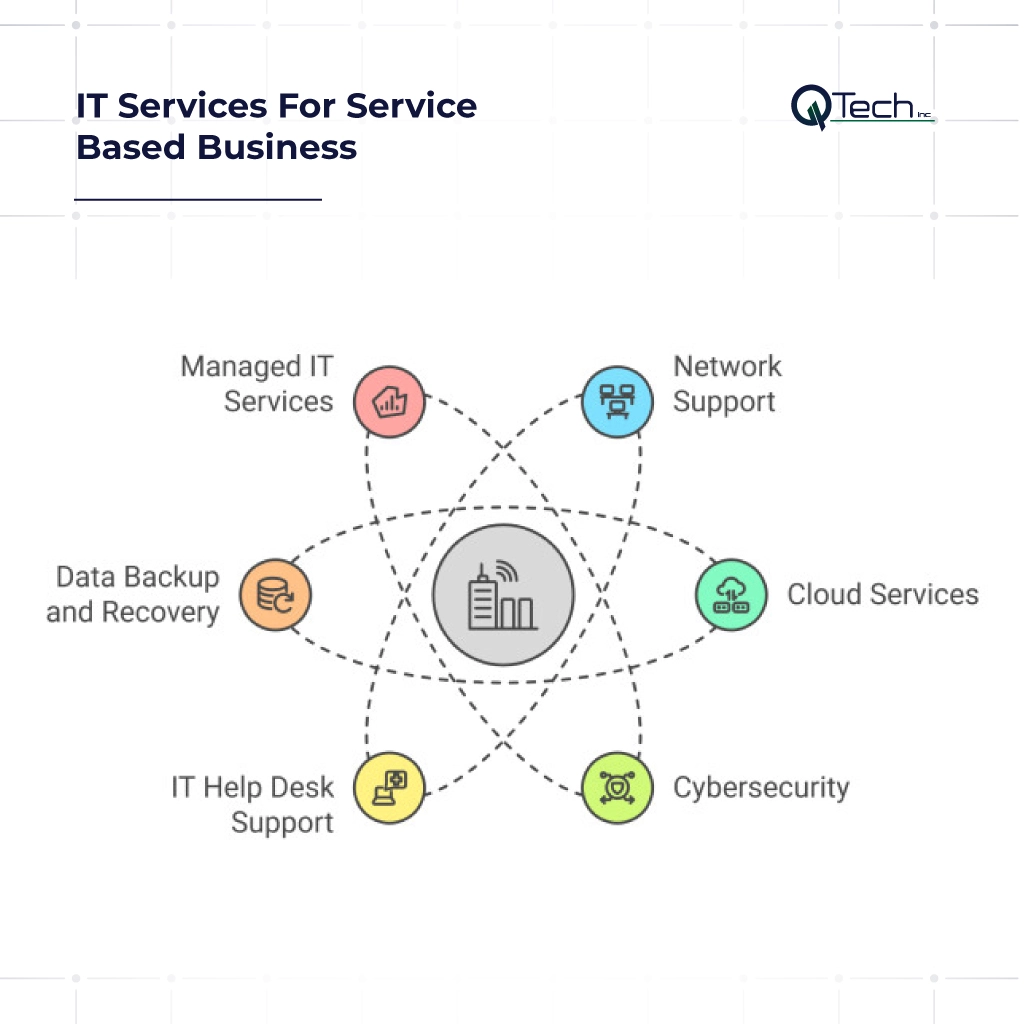
At Q-Tech Inc., we believe that digital success is achieved when marketing creativity meets technological excellence. Our team helps service-based businesses integrate tools, automate business processes, and align data systems for better visibility and efficiency.
Through services for service based businesses and expert-managed IT support, we ensures that every client benefits from cohesive systems that drive growth. From CRM software integration to marketing automation tools, we empower businesses to streamline their marketing and sales alignment, strengthen customer interactions, and unlock long-term scalability.
The future of service business success lies in partnership not just between companies and clients, but between departments. When IT and marketing collaborate, they create more than digital campaigns they build intelligent ecosystems designed for innovation, resilience, and growth.
FAQ
Why is marketing and IT alignment important for a service business?
Answer – For service businesses, the entire customer journey—from the first website visit to the signed contract—is digital. Marketing drives awareness and leads, while IT builds and maintains the systems that capture, nurture, and convert those leads. Without alignment, leads slip through the cracks, data becomes inconsistent, and scalability suffers.
What is a shared KPI example for marketing and IT?
Answer – A strong shared KPI is the Marketing Qualified Lead (MQL) to Sales Qualified Lead (SQL) Conversion Rate. Marketing ensures the quality of MQLs, while IT ensures the technical infrastructure (forms, CRM, integrations) works seamlessly to hand them off to sales. Both teams share responsibility for improving this conversion rate.
What tools help bridge the gap between marketing and IT?
Answer – Essential tools include:
- Project Management: Asana, Jira
- CRM & Marketing Automation: HubSpot, Salesforce
- Analytics & Visualization: Google Looker Studio, Tableau
- Communication: Slack, Microsoft Teams
- Integration Platforms: Zapier, Make.com
How can AI-powered marketing tools be supported by the IT department?
Answer – IT ensures that AI marketing tools operate on a clean, compliant, and integrated data foundation. This includes managing data governance, system integrations (e.g., syncing CRMs with AI personalization tools), and maintaining security and scalability as new technologies are adopted.