

Why Automation Is Critical for Real Estate Today
The real estate industry is undergoing one of the most transformative shifts in its history. As PropTech trends continue to evolve, real estate automation has emerged as a key driver of efficiency, accuracy, and client satisfaction. From automated property valuations to AI-driven analytics, automation is redefining how real estate professionals manage listings, communicate with clients, and close deals.
In today’s competitive landscape, firms that adopt automation gain a significant edge. They’re able to streamline workflows, reduce costs, and make smarter decisions through data insights—all while enhancing the customer experience. Whether it’s an agent scheduling a showing through virtual tour technology or a developer analyzing building performance through smart buildings, automation helps ensure that operations run smoothly and in real time.
For modern real estate businesses, automation is no longer a luxury; it’s a necessity for staying ahead. By leveraging property technology that integrates AI in real estate, blockchain, and IoT systems, companies can adapt faster to market shifts, enhance transparency, and boost overall profitability.
Key Trends in Real Estate
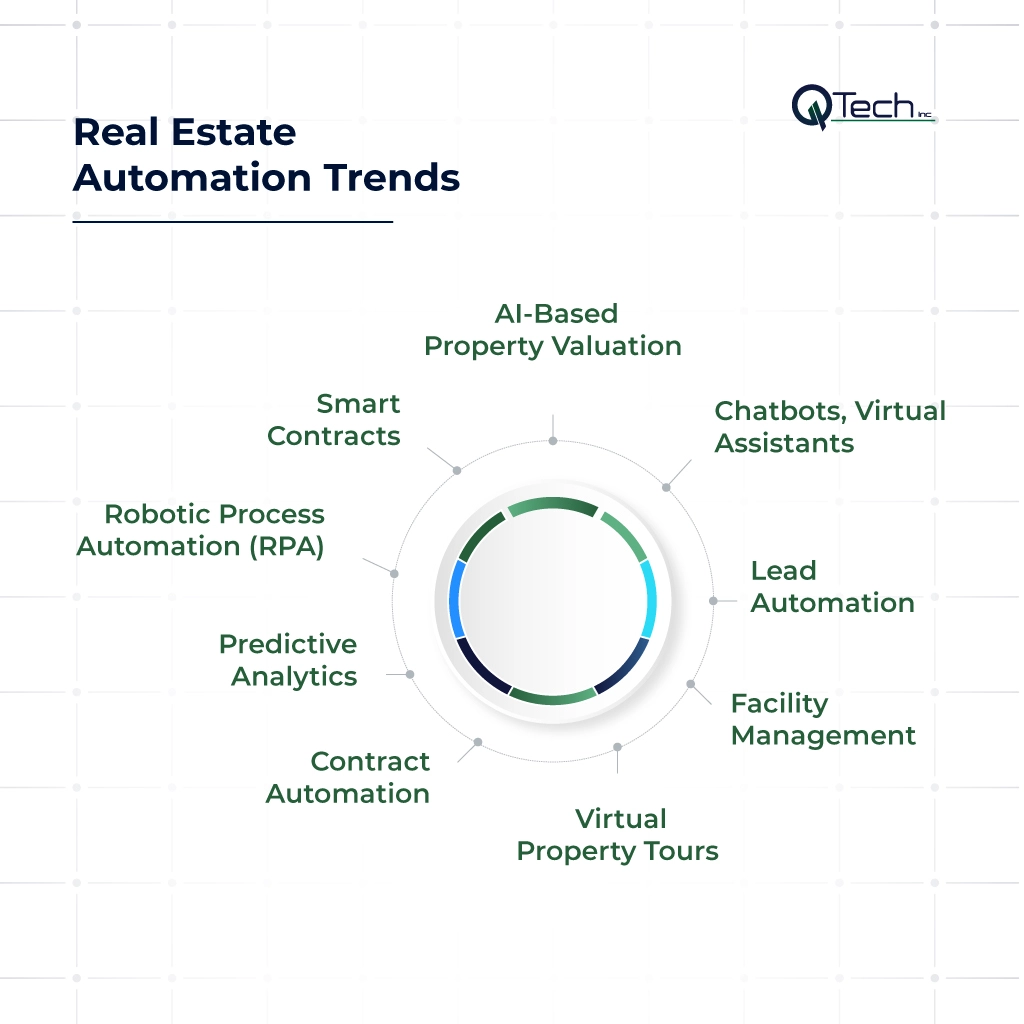
The following automation trends represent the leading real estate technology trends reshaping the industry and transforming how properties are marketed, managed, and sold.
- AI-Based Property Valuation
- Chatbots, Virtual Assistants
- Lead Automation
- Facility Management
- Virtual Property Tours
- Contract Automation
- Predictive Analytics
- Robotic Process Automation (RPA)
- Smart Contracts
AI-Based Property Valuation
Traditional property appraisals often rely on manual comparisons and limited data sets. Today, automated valuation models (AVMs) use AI in real estate to analyze vast amounts of data, including comparable sales, neighborhood trends, and even floor plans. These AI-powered tools improve accuracy and eliminate human error, helping both buyers and sellers make informed decisions faster.
Financial institutions also benefit from these models, which allow for faster mortgage approvals and better risk assessment. This level of automation ensures valuations are consistent, unbiased, and reflective of real-time market conditions, accelerating transactions across the entire real estate industry.
Chatbots & Virtual Assistants
The rise of chatbots for real estate has revolutionized client communication. These digital assistants can answer inquiries 24/7, schedule showings, and qualify leads all without human intervention. When combined with real estate CRM automation, chatbots provide personalized customer experiences by tracking preferences and previous interactions.
For real estate professionals, this means less time spent on repetitive tasks and more time nurturing serious buyers. As these virtual assistants evolve, they’ll integrate deeper with social media, management systems, and property databases to create seamless customer journeys that mirror the efficiency of leading e-commerce platforms.
Lead Automation
Effective lead generation is critical to a firm’s success. Automation tools powered by AI can now capture, score, and route leads automatically, ensuring that every potential client is followed up with in record time. Integrated management systems help agents see which leads are most promising and which require more nurturing.
By automating these workflows, real estate businesses can dramatically improve conversion rates and maintain consistent communication throughout the sales cycle.
Facility Management
Modern property management systems leverage IoT sensors, smart buildings, and data analytics to monitor utilities, security, and occupancy in real time. Automated alerts notify managers when maintenance is required, optimizing energy efficiency and minimizing downtime.
Automation also supports compliance tracking, vendor coordination, and tenant engagement, giving managers complete visibility across all facilities. To learn more about how automation enhances property operations.
Virtual Property Tours
The adoption of virtual tour software and virtual tour technology has transformed property marketing. Clients can now explore properties remotely using 3D imaging and augmented reality (AR). This innovation allows potential buyers to view multiple listings without leaving home, accelerating decision-making and reducing time-to-sale.
By embedding this technology into websites and CRMs, real estate professionals can track engagement metrics, understand client preferences, and personalize follow-ups. These digital experiences also support cross-border sales, making global property transactions more accessible than ever.
Contract Automation
Manual contract processing is both time-consuming and prone to errors. Through automation, conditions are met faster and documentation becomes tamper-proof. Tools that use smart contracts for real estate can trigger payments, transfer ownership, or validate milestones automatically once criteria are satisfied.
These digital agreements, built on distributed ledgers, are part of the larger blockchain technology movement transforming financial institutions and the real estate industry alike. The transparency of these systems ensures every action is traceable and secure, creating trust between all parties involved.
Predictive Analytics
Predictive analytics leverages AI in real estate to anticipate market movements, rental yields, and investment potential. By integrating property technology with cloud support for real estate firms, companies can analyze thousands of data points to forecast demand, identify growth areas, and adjust marketing strategies accordingly.
This proactive approach helps developers and investors reduce risk and seize new opportunities before competitors do.
Robotic Process Automation (RPA)
RPA streamlines repetitive back-office operations such as data entry, document processing, and payment reconciliation. These bots work across legacy and modern systems, ensuring management systems stay synchronized without manual oversight.
By freeing up human resources, organizations can allocate more energy toward customer-facing initiatives and strategic planning—further accelerating digital transformation across real estate businesses.
Smart Contracts
The foundation of modern blockchain-based automation lies in smart contracts in real estate. Using types of blockchains like public, private, or consortium, these contracts ensure actions are executed automatically when predefined conditions are met.
With private key encryption, all transactions remain secure and transparent. This innovation also allows integration with digital currencies like Bitcoin blockchain, enabling faster, low-cost cross-border payments. Together, distributed ledgers and smart contracts eliminate intermediaries, providing a secure infrastructure for high-value real estate transactions.
Challenges & Considerations When Adopting Automation in Real Estate
While automation offers tremendous potential, it also introduces unique challenges that organizations must prepare to address.
Data Privacy, Regulatory Compliance, Mis-Valuations & Bias in AI Models
AI-driven tools depend on large volumes of sensitive data. Safeguarding client information while adhering to privacy regulations such as GDPR is essential. Additionally, biases in AI algorithms can lead to inaccurate valuations or unfair pricing. Real estate professionals must regularly audit these systems to ensure transparency and ethical practices.
Integration with Legacy Systems & Interoperability
Many firms still rely on outdated software that doesn’t easily integrate with modern automation tools. This creates bottlenecks and limits scalability. Partnering with IT experts who understand property management infrastructure and cloud services is crucial for a seamless transition.
Change Management: Training Staff & Educating Clients/Customers
Automation adoption requires cultural as well as technical shifts. Employees need training to use new platforms effectively, while clients must be educated on digital processes like virtual tour technology and smart contracts. Successful implementation depends on communication, patience, and strategic leadership.
Cost vs ROI & Scaling Automation Across Portfolios
Initial automation investments can be substantial, especially when integrating IoT sensors or AI-driven analytics. However, when measured against long-term savings, efficiency gains, and client satisfaction, ROI becomes evident. The key lies in scaling carefully, starting small, proving results, and expanding incrementally.
How Real Estate Firms Can Prepare for These Automation Trends
Preparation is essential for ensuring that automation initiatives deliver measurable impact.
Auditing Current Processes, Pain Points & Opportunities
Begin by mapping out workflows that consume the most time or resources. Identify where automation could improve efficiency, such as lead generation, client onboarding, or maintenance scheduling. Understanding these bottlenecks creates a roadmap for future automation efforts.
Choosing the Right Tools / Vendors & Piloting 1–2 Automation Initiatives
Not all platforms are built the same. Choose vendors with proven experience in property technology and PropTech trends. Launch pilot programs in specific departments to gather feedback and measure outcomes before full-scale deployment.
Setting Up Infrastructure (Data Pipelines, IoT, Cloud Services)
Modern automation relies heavily on robust infrastructure. Invest in secure cloud support for real estate firms and reliable IoT ecosystems to collect and process data efficiently. Strong pipelines ensure real-time insights, while scalable systems allow organizations to grow without downtime.
Monitoring, Metrics & Feedback Loops
Once automation is in place, establish KPIs and feedback loops to track performance. Monitor operational efficiency, customer satisfaction, and data accuracy regularly. Continuous improvement ensures automation remains aligned with business goals and evolving market conditions.
Conclusion: How Q-Tech Inc. Helps Real Estate Businesses Automate & Scale
At Q-Tech Inc., we understand that automation is more than just technology; it’s about transformation. Our tailored IT solutions empower real estate businesses to enhance efficiency, boost performance, and achieve long-term scalability.
From AI in real estate systems to secure blockchain technology and smart facility monitoring we provide the expertise to design, deploy, and manage next-generation automation tools. Whether your goal is to streamline property management, enhance client engagement, or implement smart contracts, our team ensures that every integration is seamless and sustainable.
As real estate automation trends top technologies reshaping the industry, partnering with us means positioning your firm for success in a digital-first future. The time to embrace automation is now because the real estate leaders of tomorrow are building smarter, faster, and more connected systems today.
FAQ
How is AI being used in real estate today?
Answer – AI is currently used in real estate for lead scoring and prioritization, automated valuation models (AVMs), personalized marketing, and chatbots. It analyzes vast amounts of data to predict which leads are most likely to convert, estimate property values with increasing accuracy, and deliver tailored content to potential buyers, freeing up agents for high-value tasks.
What is the best way to automate real estate lead generation?
Answer – The most effective automation combines AI-powered chatbots on your website to capture and qualify leads 24/7 with CRM-triggered email and SMS nurture sequences. This system works passively to engage visitors, qualify their interest level, and keep your brand top-of-mind until they’re ready to speak with an agent.
Will automation replace real estate agents?
Answer – No, automation will not replace agents; it will augment them. Automation handles repetitive, time-consuming tasks (scheduling, initial lead qualification, follow-up emails), allowing agents to focus on what they do best: building relationships, providing expert negotiation, and offering personalized advice that technology cannot replicate.
Can virtual tours and staging really increase property inquiries or sales?
Answer – Yes. They enhance buyer engagement by allowing prospective buyers to imagine themselves in the space, which often increases inquiry rates and speeds decision times. Many PropTech sources show significant boosts when using VR/AR and virtual staging.