
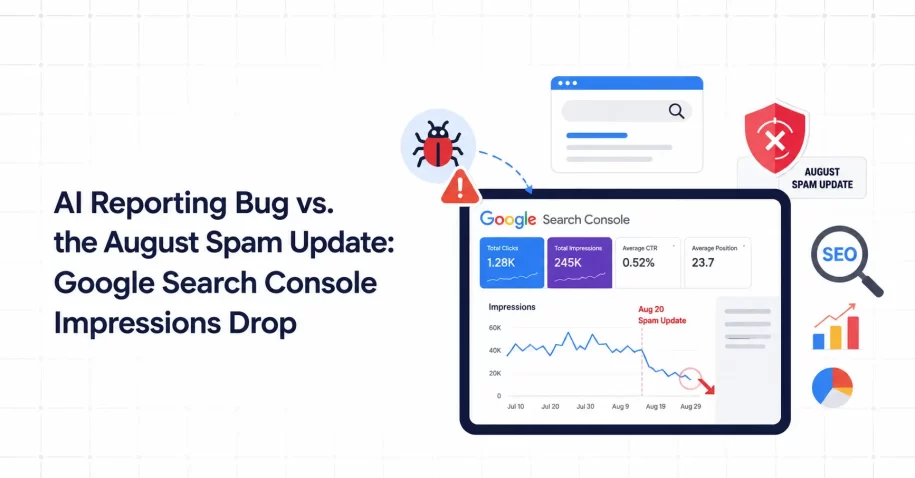
If your Google Search Console impressions suddenly dropped in mid-August 2026, it’s likely tied to a confirmed Google logging error — not a real loss in search visibility — but a separate, genuine ranking update rolled out just one day later, which means the two need to be evaluated separately before you change anything. Google confirmed a logging error affected its Generative AI performance reporting in Search from August 13 through August 17, 2026, causing reported impressions to appear lower than they actually were. Then, on August 18, Google began rolling out the August 2026 spam update globally. One of these events affected what you see in your reporting. The other can affect what Google’s systems actually show users. Confusing the two can lead a business to make the wrong SEO decisions — this guide breaks down exactly how to tell them apart.
Key Takeaways
- Google confirmed a logging error affecting Generative AI impressions in Search Console from August 13–17, 2026 — the issue affected reporting data, not actual search performance.
- A separate Google Discover reporting issue also occurred on August 13, 2026.
- Google began rolling out the August 2026 spam update on August 18, applying it globally and across all languages.
- A Search Console reporting error and a Google spam update are not the same thing — one affects what you see in your reporting, the other can affect Google’s actual ranking systems.
- Businesses should avoid making major SEO decisions based exclusively on Generative AI impression data from August 13–17.
- Compare Search Console changes against actual traffic, conversions, leads, and rankings before assuming performance has declined.
- Traditional SEO fundamentals remain important for visibility in Google’s AI Overviews and AI Mode — Google says its generative AI Search features continue to rely on its core Search ranking and quality systems.
- Businesses should keep prioritizing original, useful, expert-led content rather than chasing every new AI optimization tactic.
- The bigger opportunity now is broader than “ranking on Google” — it’s overall search and AI visibility across a growing number of surfaces.
What Is Google’s Generative AI Performance Report?
Google Search is changing. People are no longer interacting exclusively with a traditional list of blue links — Google is increasingly incorporating generative AI into Search through experiences like AI Overviews and AI Mode. In response, Google Search Console has started providing more information about how websites perform specifically within these generative AI search experiences.
For businesses, this reporting answers a newer, more specific question: is our company appearing when Google uses AI to answer someone’s question? That question matters more than it used to, because a customer can now discover a business without following the traditional path of search → click result → visit website. Instead, Google may generate an answer directly, drawing on several sources and providing supporting links for users who want to dig deeper. Google explains that its generative AI features use core Search systems to retrieve relevant, current webpages from its index before generating a response — which means understanding impressions and visibility inside AI-powered Search is becoming a genuine part of evaluating digital performance. It also explains why, when this data suddenly appears to collapse, businesses understandably pay close attention.
What Caused the Google Search Console Impressions Drop in August 2026?
Google has already provided an official explanation for at least part of the recent decline: a logging error caused decreased impressions in the Generative AI performance report in Search between August 13 and August 17, 2026, and Google states the issue affected data logging only. In practical terms, Google’s reporting system failed to record some impressions correctly — it does not mean every website showing a decline actually lost that same amount of real Google Search visibility.
A separate issue also affected Google Discover on August 13, with Google reporting decreased clicks and impressions within the Discover performance report, along with decreased reported Generative AI impressions for eligible properties. If you’re reviewing performance around these specific dates, context matters — a graph going down does not automatically mean your SEO went down.
Q-Tech Expert Insight: Why We Don’t Diagnose SEO From One Graph
At Q-Tech Inc,, one of the most important principles we apply when reviewing SEO performance is simple: a metric is a signal, not automatically an explanation. When something suddenly changes inside Search Console, we don’t immediately start rewriting pages, removing content, or changing an SEO strategy — we investigate the surrounding data first.
When evaluating a sudden impressions decline, we consistently compare:
- Search impressions
- Organic clicks
- Website sessions
- Keyword visibility
- Lead activity
- Form submissions
- Phone calls
- Conversion performance
- Changes by page
- Changes by query
- Changes by device
- Changes by date
That comparison is what determines whether we’re looking at a genuine performance change or simply a reporting anomaly.
What we observed during the affected reporting period:
Our review approach identified situations where reported Generative AI visibility moved sharply downward while the corresponding business conversion activity did not show the same decline. That kind of mismatch is exactly what prompts us to investigate the reporting environment before assuming organic performance has actually collapsed. Across the client accounts we reviewed, reported Generative AI impressions declined by approximately 33%, while recorded conversions remained stable.
This is also why experienced SEO analysis requires real interpretation, not just dashboard access. If Search Console suddenly shows a 30%, 40%, or larger movement, the first question shouldn’t automatically be “what do we need to change” — it should be “is this change real, and what other data supports it.” That distinction can save a business from making unnecessary changes to pages that were actually performing perfectly well.
Google Search Console Reporting Error vs. Google Spam Update
These two events happened close together in August 2026, but they are fundamentally different in what they mean for your business.
| Search Console Reporting Error | Google Spam Update | |
| What is it? | A problem with how performance data is logged or displayed | A change to Google’s systems for identifying and addressing search spam |
| August 2026 timing | Generative AI Search data affected Aug 13–17 | Rollout began Aug 18 |
| Can it make impressions appear lower? | Yes | Potentially, if actual search visibility changes |
| Does it automatically mean rankings declined? | No | No, but some sites may see ranking changes |
| Does it affect actual website performance? | Google says this issue affected data logging only | It can affect actual search visibility |
| Should you immediately change SEO strategy? | No | Usually not from one or two days of data — evaluate the pattern first |
| What should you monitor? | Traffic, conversions, rankings, and unaffected reporting periods | Rankings, traffic, conversions, affected pages, and longer-term trends |
| Best response | Document the anomaly and interpret the affected dates cautiously | Monitor performance and review content/SEO practices if meaningful declines persist |
The most important takeaway: a reporting bug changes what you see. A ranking update can change what users see. Confusing the two can lead to the wrong SEO decisions.
Google Released the August 2026 Spam Update
Immediately following the affected AI reporting period, Google announced another major Search development: the August 2026 spam update began rolling out on August 18, 2026. Google says the update applies globally, applies across all languages, and may take several days to complete — details Google posted on its official incident dashboard.
Unlike the Search Console reporting error, this update involves Google’s actual ranking systems, which means businesses need to clearly distinguish between an artificial reporting decline and a real change in organic visibility. Because the two events happened so close together, evaluating search performance without that context could easily become confusing.
Does the August 2026 Spam Update Mean AI Content Is Bad?
No. Businesses shouldn’t interpret the spam update as a signal that using AI for content creation is inherently bad. The actual concern is content created primarily to manipulate search rankings or generative AI responses, rather than genuinely helping the user. Google’s current guidance continues to emphasize useful, original, people-first content, and specifically encourages site owners to bring unique perspectives and first-hand experience into their content rather than simply reproducing information that already exists elsewhere.
That distinction matters in practice. Consider two different approaches:
Approach A: A company uses AI to generate 300 nearly identical articles targeting every possible keyword variation, with no added expertise, research, examples, or genuinely useful original information.
Approach B: A company uses AI to help organize an article built from real customer questions, internal expertise, original analysis, company data, professional observations, case examples, first-hand experience, and input from actual subject matter experts.
These are fundamentally different content strategies. AI can genuinely help accelerate research, organization, editing, and production — but it shouldn’t become a substitute for having something meaningful to say in the first place.
Is Traditional SEO Still Important for AI Overviews?
Yes. This is one of the biggest misconceptions currently circulating around AI search. Some businesses have started assuming traditional SEO has disappeared and needs to be entirely replaced with “AI SEO.” Google’s own guidance says otherwise — Google states that its existing SEO best practices continue to be relevant because generative AI experiences in Search are built directly on its core Search ranking and quality systems.
That means the fundamentals still matter: crawlability, indexing, website architecture, technical SEO, page experience, helpful content, authority, expertise, internal linking, search intent, and original information. Google also notes that pages generally need to be indexed and eligible to appear in standard Search before they’re eligible to appear in generative AI Search experiences at all. For a deeper breakdown of exactly where these strategies overlap and where they genuinely differ, read Q-Tech’s AI SEO vs Traditional SEO guide.
The important shift here isn’t from “SEO” to “no SEO” — it’s from optimizing for a single type of search result toward understanding a broader ecosystem of search experiences.
What About AEO, GEO and New AI Optimization Tactics?
You may also hear terms like AEO (Answer Engine Optimization) and GEO (Generative Engine Optimization). These frameworks can be genuinely useful for thinking through how people increasingly search through AI-assisted interfaces — but businesses should be careful about treating every new tactic as an entirely separate discipline from SEO itself.
Google’s own position here is worth noting directly: Google says that, from its perspective, optimizing for generative AI Search is still fundamentally part of optimizing the overall search experience — and therefore remains SEO. Google also says businesses don’t need several commonly promoted “AI SEO hacks” simply to appear within its generative Search experiences. Specifically, Google says businesses don’t need to:
- Create special llms.txt files specifically for Google Search
- Break every article into unnaturally small content chunks
- Rewrite content solely for AI systems
- Create countless variations of essentially the same article
- Add special schema exclusively for generative AI visibility
Google’s systems are designed to understand meaning and context, not to depend exclusively on exact keyword matching. That brings the discussion back to something much more sustainable: create content genuinely worth finding.
What Should Businesses Do Right Now?
If you’ve experienced a Google Search Console impressions drop in 2026 — particularly around August 13–17 — here’s how we recommend approaching it.
1. Treat August 13–17 Generative AI Data Carefully
Google has already confirmed this reporting period contains affected Generative AI impression data. Don’t use those dates alone to determine whether your AI search visibility actually increased or decreased.
2. Separate the Reporting Bug From the Spam Update
These are two separate events. The AI Overviews reporting bug affects data interpretation. The August 2026 spam update involves Google’s actual ranking systems. If visibility changes continue beyond the affected reporting dates, additional investigation becomes genuinely important.
3. Don’t Make SEO Decisions From One Metric
Look for corroborating evidence. If impressions fall, ask: did traffic fall too? Did clicks fall? Did leads fall? Did conversions fall? Did rankings change? Were specific pages affected? Did the change begin abruptly? A single unusual graph shouldn’t determine an entire SEO strategy.
4. Monitor Performance Over a Larger Window
Algorithm updates can create real volatility. Rather than reacting to every daily movement, evaluate trends across a meaningful window and compare them against historical performance. The goal is identifying genuine patterns, not reacting to noise.
5. Audit Content for Genuine Value
Ask a simple question: would we still want this page on our website if Google didn’t exist? If the answer is no, it’s worth revisiting. Strong content should help educate a potential customer, answer an important question, explain a complicated decision, demonstrate real expertise, reduce confusion, support a sales conversation, or provide information competitors aren’t providing — all things that are much harder to replace with generic AI-generated content.
6. Strengthen First-Hand Expertise
Google specifically encourages unique points of view and first-hand experience within content. That means looking internally for material like lessons from completed projects, expert commentary, anonymized customer observations, original research, internal data, frequently asked sales questions, mistakes you’ve helped customers avoid, and industry changes your team has genuinely seen firsthand. This is exactly the kind of content that becomes difficult for competitors — or AI — to simply reproduce.
7. Review the Technical Foundation
Even excellent content can struggle if Google can’t properly crawl, understand, or index the website. Technical SEO remains part of Google’s own recommendations for generative AI search visibility, so businesses should keep monitoring indexing, crawlability, mobile performance, website speed, site architecture, internal links, duplicate content, broken pages, metadata, and structured data where appropriate.
Q-Tech Inc.’s Perspective: Search Optimization Is Becoming Visibility Optimization
For years, companies asked one primary SEO question: what position are we on Google? That question is becoming incomplete. A prospective customer might now discover a company through a traditional organic result, Google Maps, an AI Overview, Google AI Mode, Google Discover, a featured result, a video, a social media result, a review website, an industry publication, or another generative AI platform entirely. The customer’s journey isn’t linear anymore, and that means modern SEO shouldn’t focus solely on moving one webpage from position five to position three.
Businesses increasingly need to think about their overall digital authority and discoverability: can search engines understand who you are? Can AI systems find useful information about your company? Does your website clearly demonstrate expertise? Are other credible sources discussing your business? Does your content answer the questions customers actually ask? Does your brand provide original information worth referencing? Can someone move easily from learning about you to becoming a lead? That’s a considerably bigger strategic conversation than rankings alone.
Don’t Let One Graph Determine Your Strategy
The Google Search Console impressions drop in August 2026 is a useful reminder that dashboards need context. Google confirmed that Generative AI impression reporting was affected by a logging error from August 13–17. Then, on August 18, the August 2026 spam update began rolling out across Google’s actual search systems. Those two events can produce similar-looking graphs — but they mean very different things.
Before changing your SEO strategy because something suddenly looks wrong: verify the data, check the timeline, compare multiple metrics, and understand what Google actually changed. Then make the decision. That’s the difference between reacting to a dashboard and building an actual search strategy.
Need Help Understanding Your Google Search Performance?
If you’ve noticed unusual changes in Search Console, organic traffic, rankings, or AI search visibility, Q-Tech Inc. can help determine what’s actually happening before any unnecessary changes get made. Our approach looks beyond a single report — we evaluate your website’s technical SEO, content performance, search visibility, conversions, and emerging AI search opportunities together, to understand where your digital presence is genuinely performing and where the real opportunities may be hiding. Search is changing, and your strategy should evolve with it — without abandoning the fundamentals that still work. Explore Q-Tech Inc.’s SEO services for Miami businesses or learn more about the evolving relationship between AI SEO and traditional SEO.