

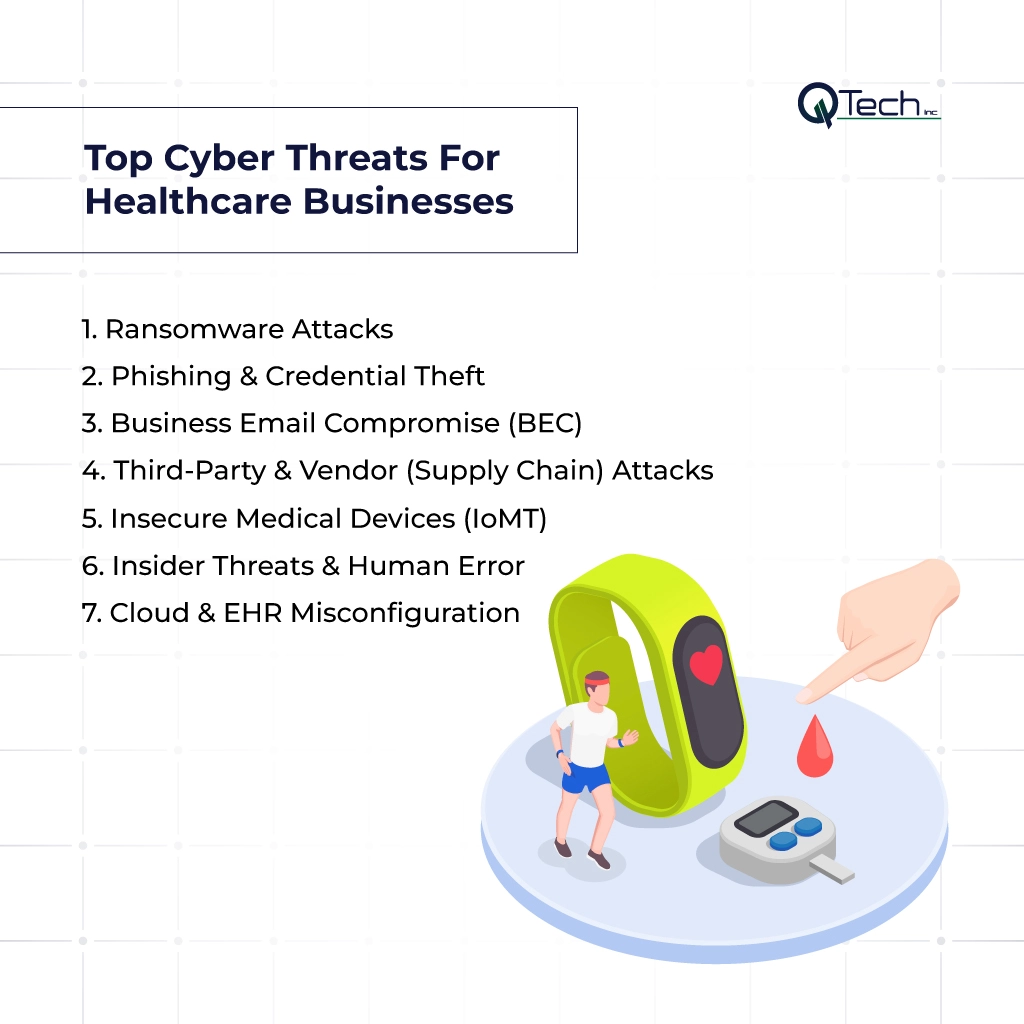
The top cyber threats targeting healthcare businesses in 2026 are ransomware, phishing and credential theft, business email compromise, third-party and vendor attacks, insecure medical devices, insider threats and human error, and cloud or EHR misconfiguration — and these are the threats Q-Tech has consistently observed while managing cybersecurity for healthcare clients across Miami and South Florida. Healthcare is built on trust. Patients share insurance records, prescriptions, lab results, billing information, and private medical histories because they expect providers to protect them. In 2026, that trust depends on more than quality care — it depends on strong cybersecurity, and these threats aren’t limited to large hospital systems. Private practices, specialty clinics, dental offices, behavioral health providers, labs, billing companies, and healthcare vendors are all real targets.
For healthcare leaders, cybersecurity is no longer only an IT concern — it’s a patient safety, compliance, financial, and business continuity issue. Understanding the most common healthcare cybersecurity threats is the first step toward building a genuinely stronger defense.
Key Takeaways
- Healthcare is the most targeted industry for cyberattacks largely because providers can’t simply shut systems down for maintenance the way other industries can — attackers use that operational urgency as leverage.
- Patient data is more valuable to criminals than a credit card number, since medical records are detailed, permanent, and difficult or impossible to replace once compromised.
- Seven threats account for most of the real risk we see in healthcare environments: ransomware, phishing/credential theft, BEC, vendor attacks, insecure medical devices, insider error, and cloud/EHR misconfiguration.
- A healthcare data breach’s real cost extends well past the initial incident — downtime, forensics, legal review, patient notifications, HIPAA reporting, and regulatory penalties can all follow.
- Cybersecurity failures in healthcare move quickly from screens and servers to actual patient safety — delayed care, missed medication histories, and rescheduled procedures are real downstream effects.
- The strongest defense is layered — no single tool stops every threat, and the strategy needs to combine people, process, policy, and technology together.
Why Is Healthcare the Most Targeted Industry for Cyberattacks?
Healthcare businesses are attractive targets because they hold genuinely valuable data and operate under constant operational pressure. A retail company may be able to shut a system down briefly for maintenance. A healthcare organisation often cannot — appointments, prescriptions, imaging, lab orders, insurance authorisations, and patient communications all need to continue, even when systems are unstable.
This urgency gives criminals real leverage. If a provider loses access to scheduling, EHR, billing, or diagnostic systems, the business may feel forced to act quickly just to restore basic function. That pressure is exactly why healthcare ransomware attacks remain a major concern across the sector heading into 2026, rather than a threat that’s faded with better awareness.
Quick Reference: Top 7 Cyber Threats Facing Healthcare Businesses in 2026
| Threat | Core Risk |
| Ransomware | Locks systems and halts care delivery until resolved |
| Phishing & Credential Theft | Gives attackers legitimate-looking account access |
| Business Email Compromise | Triggers fraudulent payments through impersonation |
| Third-Party & Vendor Attacks | Exposes data through a partner’s weak security |
| Insecure Medical Devices (IoMT) | Creates a hidden entry point through connected care equipment |
| Insider Threats & Human Error | Exposes data through mistakes, not just malicious intent |
| Cloud & EHR Misconfiguration | Leaves data exposed through incorrect access settings |
Note on this table: this list reflects both broader healthcare cybersecurity research and threats Q-Tech has consistently observed managing security for healthcare clients across Miami and South Florida. The specific risk level for each threat still depends on your practice type, systems, and vendor relationships.
The Real Cost of a Healthcare Data Breach in 2026
A healthcare data breach creates financial losses that extend well past the first alert. There may be downtime, forensic investigations, legal review, patient notifications, HIPAA reporting, credit monitoring, public relations support, staff overtime, lost appointments, delayed claims, and possible regulatory penalties — all stacking on top of each other over weeks or months.
A breach also damages confidence in ways that outlast the technical fix. Patients may genuinely wonder whether their sensitive information is safe going forward, and business partners may require stronger controls before renewing a contract or coverage.
Why Patient Data Is More Valuable
Patient data is valuable to criminals because it’s detailed, permanent, and genuinely useful for fraud. A stolen credit card can be cancelled in minutes. A medical record cannot be replaced once it’s out. Healthcare data may include Social Security numbers, birth dates, addresses, insurance IDs, diagnoses, prescriptions, and payment information — all in one place.
Criminals use this information for identity theft, insurance fraud, false claims, targeted phishing campaigns, and extortion. This is exactly why cyber threats against healthcare businesses often focus on stealing data before disrupting systems at all — even when files aren’t encrypted, criminals may still threaten to publish or sell private records for leverage.
Top 7 Cyber Threats Facing Healthcare Businesses Right Now
These are the seven threats we’ve consistently observed while managing cybersecurity for healthcare clients across Miami and South Florida. Attackers targeting this sector have become more selective and more practical over time — looking specifically for weak passwords, unpatched systems, exposed remote access, vulnerable vendors, and staff who are overwhelmed by daily clinical and administrative demands.
1. Ransomware Attacks
Ransomware remains one of the most disruptive cyber threats in healthcare. Attackers may encrypt files, lock access to systems, steal records, or threaten to expose data entirely. For a medical practice, ransomware can stop appointments, delay billing, block prescription workflows, and limit access to patient histories all at once. The best defense includes tested backups, endpoint protection, patching, multi-factor authentication, network segmentation, and a documented incident response plan.
2. Phishing & Credential Theft
Phishing targets healthcare employees using messages that look urgent, routine, or familiar. A staff member may receive an email that appears to come from a lab, an insurer, a patient portal, a delivery service, an executive, or a software vendor. One click can lead to stolen credentials, malware, or unauthorized access.
Credential theft is especially dangerous because attackers can then log in like legitimate users. Once inside, they may read email, reset passwords, access cloud files, redirect payments, or search directly for patient information. MFA, email filtering, training, and real-time sign-in alerts all meaningfully reduce this risk.
3. Business Email Compromise (BEC)
Business Email Compromise is a more targeted form of fraud. Instead of sending broad, generic phishing attempts, criminals study the organisation first and impersonate a trusted person — a doctor, office manager, finance contact, vendor, or executive.
In healthcare, BEC can lead to fraudulent wire transfers, redirected payments, fake invoice approvals, and exposure of sensitive information. Because these emails may contain no obvious malware at all, staff need clear, enforced approval procedures for payment changes, bank updates, and urgent requests — procedures that don’t bend under pressure or seniority.
4. Third-Party & Vendor (Supply Chain) Attacks
Healthcare businesses depend heavily on vendors for billing, EHR hosting, claims processing, scheduling, imaging, payment systems, marketing platforms, and IT support. A third-party attack can create major damage even when the provider’s own systems are never directly breached.
Vendor risk management should include business associate agreements, security reviews, access controls, audit logs, backup expectations, and clear breach notification procedures — confirmed before a vendor ever reaches sensitive systems, not after an incident has already occurred.
5. Insecure Medical Devices (IoMT)
The Internet of Medical Things connects medical devices to networks and care platforms. This can genuinely improve monitoring and efficiency, but it also introduces real cybersecurity risk. Devices may run outdated software, use weak default passwords, lack encryption, or remain connected well after they should have been replaced.
Medical devices should be inventoried, segmented from general office networks, patched where possible, and monitored for unusual behavior. A device that supports patient care should never become a hidden doorway into the broader healthcare system.
6. Insider Threats & Human Error
Not every breach begins with a criminal hacker. Some begin with mistakes, shortcuts, weak training, or access rights that extended further than they should have. An employee may send records to the wrong recipient, store files in an unsecured folder, click a malicious link, or reuse the same password across multiple tools.
Intentional insider threats are genuinely less common, but they still matter and need planning for. Strong onboarding, offboarding, least-privilege access, audit logs, and role-based permissions all reduce this category of risk considerably. Our breakdown of common mistakes employees make in cybersecurity training covers specific, recurring patterns worth building directly into a healthcare staff training programme.
7. Cloud & EHR Misconfiguration
Cloud platforms and EHR systems can be genuinely secure, but only when they’re configured correctly from the start. Misconfigured sharing settings, weak administrator accounts, inactive user accounts, missing audit logs, and poorly managed integrations can all expose healthcare data without any obvious breach ever occurring.
Healthcare businesses should regularly review user access, administrator privileges, file-sharing rules, backup settings, retention policies, and connected applications — on a defined schedule, not only after something looks wrong.
How These Attacks Impact Patient Safety, Not Just Data
Cybersecurity in healthcare is different from most other industries because the technology itself is directly tied to actual patient care. When systems fail, the impact moves quickly from screens and servers to patients, staff, and families. Patient safety depends on accurate data, timely access, reliable communications, and stable day-to-day operations — all of which a cyberattack can disrupt simultaneously.
A cyberattack can force teams into manual processes almost overnight — handwritten notes, delayed prescriptions, slower insurance verification, unavailable lab results, longer wait times, or rescheduled procedures. That added pressure genuinely increases the chance of a clinical mistake, not just an administrative one.
Delayed Care and Disrupted Operations
Delayed care is one of the most serious outcomes of a healthcare cybersecurity incident. If clinicians can’t access records, they may not see medication histories, allergies, test results, or prior diagnoses when they need them most. If scheduling systems go down, patients may miss appointments or face longer delays. If billing and claims tools are unavailable, the organisation may face real cash-flow problems that eventually affect staffing and supplies too. Every healthcare business should know specifically how it will continue essential operations if email, EHR, phones, internet, billing, or vendor portals go unavailable.
Reputational and Legal Fallout
A breach can lead to HIPAA investigations, patient notification requirements, lawsuits, cyber insurance claims, and contract reviews with partners. It can also genuinely change how patients view the practice going forward — healthcare is deeply personal, and patients reasonably expect their privacy to be protected without exception. Understanding where cyber insurance fits into this picture matters here specifically — our guide to cyber insurance covers what a policy typically does and doesn’t cover when a healthcare incident actually occurs.
A clear incident response plan, accurate communication, and well-documented safeguards help a healthcare organisation respond with real confidence instead of confusion when something does go wrong.
How Healthcare Businesses Can Defend Against These Threats?
The strongest healthcare cybersecurity strategy is layered — no single tool stops every threat on its own. Genuine protection comes from combining people, process, policy, and technology into one practical, working security programme. For the fuller framework these defenses sit within, our guide to the key components of a robust cybersecurity strategy and our corporate cybersecurity strategies guide both cover how these pieces connect for any organisation, healthcare included.
Healthcare leaders don’t need to become cybersecurity engineers themselves. They do need to be able to ask: What systems hold sensitive information? Who actually has access? What happens if a vendor goes down? Are backups genuinely tested? Are devices monitored? Are alerts reviewed in real time, or just logged and ignored?
Conduct Regular Risk Assessments
A risk assessment helps identify weaknesses before criminals find them first. It should review hardware, software, users, vendors, remote access, cloud systems, EHR settings, backups, policies, and physical security together, as one connected picture. For healthcare businesses specifically, this isn’t just best practice — it directly supports compliance and gives leadership a clearer, honest view of their actual cybersecurity posture. A genuinely useful assessment should end with prioritised, actionable next steps, not just a list of findings.
Implement 24/7 Threat Monitoring
Cyber attackers don’t follow office hours. A suspicious login at 2:00 a.m., an unusual file transfer, or malware activity on a workstation may be the very first sign of an active attack. Without continuous monitoring, those early signals can be missed entirely until the damage is already done. 24/7 monitoring helps detect threats early and supports a genuinely faster response — early detection is frequently the difference between a blocked attempt and a full-scale breach.
Secure Endpoints and Medical Devices
Workstations, laptops, tablets, servers, and medical devices should all be protected as part of one unified security strategy, not managed separately. Endpoint protection, patch management, encryption, access controls, and a current device inventory are all essential pieces of that. Segmentation, vendor coordination, lifecycle planning, and ongoing monitoring can reduce exposure meaningfully while still preserving the clinical workflows patient care actually depends on.
Train Staff to Spot Phishing and Social Engineering
Employees are often the genuine first line of defense in a healthcare environment. Training should teach staff how to identify phishing emails, suspicious links, unusual payment requests, fake login pages, and pressure-based social engineering tactics specifically. Short, regular refreshers, simulated phishing attempts, clear reporting steps, and visible leadership support all help turn awareness into actual daily behavior, rather than a once-a-year training checkbox.
Partner With a HIPAA-Compliant Cybersecurity Provider
Most healthcare businesses genuinely don’t have the internal time or dedicated staff to manage every cybersecurity requirement alone, and trying to stretch existing staff to cover it tends to leave real gaps. A specialised partner can help assess risk, secure systems, monitor threats, improve documentation, and support incident response — built around how a healthcare environment actually operates day to day.
How Q-Tech Inc. Protects Healthcare Businesses From Cyber Threats
Healthcare businesses face a genuinely serious challenge heading into 2026. Ransomware, phishing, credential theft, BEC, vendor attacks, insecure medical devices, insider risk, and cloud misconfiguration are no longer rare, occasional events — they’re daily risks in a connected care environment, and we see this pattern consistently across the healthcare clients we support.
The good news is that healthcare organisations can meaningfully reduce this risk with the right plan in place. Regular assessments, stronger access controls, tested backups, endpoint protection, 24/7 monitoring, staff training, vendor oversight, and clear incident response procedures together make a measurable difference.
Q-Tech provides cybersecurity services in Miami in Miami, designed around the specific realities of healthcare environments rather than a generic business template. For broader day-to-day technology support alongside security, our managed IT services for healthcare help keep the systems healthcare providers depend on running reliably every day. Whether your business is a private practice, specialty clinic, healthcare vendor, or growing medical organisation, Q-Tech can help you move from reactive IT support to genuinely proactive protection.
Conclusion
Cybersecurity in healthcare isn’t just about avoiding data breaches — it’s about protecting people, preserving trust, and making sure care can continue when it matters most. The seven threats covered here — ransomware, phishing, BEC, vendor attacks, insecure medical devices, insider risk, and cloud misconfiguration — represent daily, ongoing risk in any connected healthcare environment, not rare exceptions. With regular assessments, layered defenses, and a provider who understands how healthcare actually operates day to day, these risks become genuinely manageable rather than inevitable.