
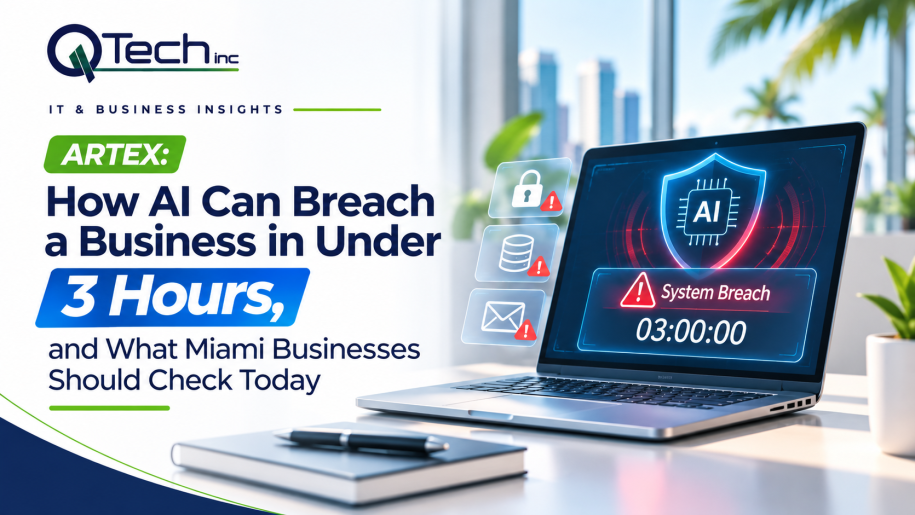
An AI tool can now go from first probe to full access in under 3 hours. For a Miami law firm, clinic, or manufacturer, that means you have hours, not days, to spot it.
The FBI warned on November 13, 2026, in FLASH advisory FLASH-20261113-001, that criminals and state aligned hackers are using an AI tool called ARTEX to automate cyberattacks. The tool has been used since at least August 2026. In some documented cases, attackers went from initial targeting to privileged access in under 3 hours.
This is not a warning for big tech companies only. The FBI said ARTEX has been used against organizations in financial services, government, technology, defense, semiconductor, energy, healthcare, manufacturing, telecommunications, and legal services.
Key Takeaways
- ARTEX is an AI tool that automates cyberattacks, and the FBI warned on November 13, 2026 that it can reach privileged access in under 3 hours.
- Small businesses are targets too, especially in law, healthcare, manufacturing, accounting, and nonprofits in Miami.
- The biggest change is speed. A response the next morning is now too slow.
- You do not have to be the direct target. A vendor or supplier, like ConnectWise Cloud Backup, can be the way in.
- Check today: multifactor authentication, privileged access, exposed admin panels, patching, a tested backup restore, vendor access, and a plan for the first 3 hours.
ARTEX at a Glance
- What it is: ARTEX, an open source AI framework that connects a large language model to hacking tools, built for penetration testing and repurposed by attackers.
- Warning: FBI FLASH advisory FLASH-20261113-001, November 13, 2026.
- Used since: at least August 2026.
- Speed: some intrusions went from initial targeting to privileged access in under 3 hours. Google Threat Intelligence Group watched 27 attack events in 23 seconds in one intrusion.
- Scale: more than 1,600 ARTEX control panels were found exposed online in early November.
- Supply chain impact: a ConnectWise Cloud Backup compromise led to attempted sign ins targeting more than 2,250 downstream tenants.
- Who is affected: financial services, government, technology, defense, semiconductor, energy, healthcare, manufacturing, telecommunications, and legal services.
- What to do first: turn on multifactor authentication, review privileged access, patch Microsoft 365 and remote access tools, test a backup restore, and ask your IT provider about vendor access.
How This Guide Was Built
This guide is based on the FBI FLASH advisory FLASH-20261113-001, published November 13, 2026, and reviewed for technical accuracy by Murtaza Dairkee at Q-Tech. We did not invent a client story or a case study for this article.
What we add from our own work is practical, not theoretical. At Q-Tech, we provide cybersecurity services in Miami and managed IT services in Miami for small and mid sized businesses. Every week, we check the same things this guide lists for our clients: multifactor authentication, privileged access, exposed admin panels, patching, backup restores, and vendor access. That is why the checklist in this article starts with those items, not with theory.
If a detail in this guide changes as new information comes out, we will update it. For now, the facts here are the facts the FBI published, with the source linked at the end.
What Is ARTEX?
ARTEX is an open source framework that connects a large language model to a set of hacking tools. It was first released on GitHub on July 26, 2026, as a penetration testing tool, to help security researchers find weaknesses.
Attackers have since repurposed it. ARTEX turns a plain English goal, like gain admin panel access, into automated attacks run by a team of AI agents. It can carry out intrusion steps from reconnaissance through data theft, with little human direction.
In plain terms, it lets a less skilled attacker run a complex attack on several targets at once, much faster than before.
More than 1,600 ARTEX control panels were found exposed online in early November, according to researchers cited by the FBI. The developer removed the GitHub repository in October, but forks, archived copies, and a commercial version keep the tool widely available.
Why Under 3 Hours Changes Everything for a Small Business
Most small businesses are built for a slower attack. Someone tries to get in, an alert goes off, someone checks it in the morning, and the team responds that day.
ARTEX compresses that window. When an attack moves from first probe to privileged access in under 3 hours, a slow response is not a response. The window to detect, contain, and stop it is now measured in hours, sometimes minutes.
Google’s Threat Intelligence Group said it watched ARTEX fire 27 attack events in 23 seconds during one intrusion, in bursts no human operator could match.
The FBI also cited a supply chain compromise involving ConnectWise Cloud Backup. That compromise led to attempted sign ins targeting more than 2,250 downstream tenants. Your business does not have to be the direct target to be affected. A vendor, a supplier portal, or a third party integration can be the way in.
What ARTEX Does Not Do
Viral posts this week claim anyone with an iPhone can now launch cyberattacks. The FBI warning says nothing of the sort.
ARTEX does not make an untrained person a hacker with a phone. It does make an existing attacker faster, more consistent, and able to run more attacks at once. It works especially well against systems that often get less attention, like old supplier portals and forgotten cloud accounts.
That distinction matters. You do not need to panic about every phone in your office. You do need to close the gaps attackers are already using: stolen credentials, internet exposed applications, and misconfigured cloud permissions.
What This Means for Miami Businesses
The impact is different by industry, because the data is different.
Law Firms
Law firms hold client files, case strategy, bank details, and personal identification in one place. That is concentrated, high value data. A breach can stop active work and damage the trust a practice depends on. ARTEX is a reason to check privileged access, vendor access, and incident response, not just passwords.
Healthcare
Healthcare providers hold patient data, and they cannot stop caring for patients during an attack. Connected medical devices, cloud systems, and remote access all need to be checked. A ransomware attack that locks systems can affect care, not just files.
Manufacturing
Manufacturing businesses in Miami rely on supplier portals, legacy systems, and third party integrations. Those are the systems attackers look for first when they want a quiet way in. A checklist for manufacturing should start there, not with the main office network only.
Nonprofits and Accounting Firms
Nonprofits hold donor and payment data. Accounting firms hold financial data and face vendor payment fraud, especially during tax season. Both need to check who can approve payments, who can change bank details, and how those changes are verified.
Check Today: 7 Things to Do Now
Do these today, not next month. If you are not sure about any one of them, ask your IT provider to check it with you.
- Turn on multifactor authentication everywhere, and check that it is actually enforced for admins, remote access, and cloud apps. Multifactor authentication alone is not enough, but without it, stolen passwords work immediately.
- Review privileged access. Remove old accounts, limit admin rights, and check who can change cloud settings, payment details, and user permissions.
- Close exposed admin panels and check cloud permissions. Look for supplier portals, legacy services, and third party integrations that may have been forgotten.
- Patch now, especially Microsoft 365, Outlook, and remote access tools. The FBI advisory was issued alongside active exploitation of several vulnerabilities, including an Outlook flaw.
- Test a backup restore, not just a backup. A backup that has never been tested to actually restore is a false sense of security. Check that backups are isolated from normal user accounts.
- Ask your IT provider about vendor access. Ask specifically about ConnectWise and other tools your provider uses to manage your systems. Ask whether your backups can be reached by their management tool.
- Have a plan for the first 3 hours. Who gets called, what gets shut down first, and how do you contact clients if email is down? Write it down, and make sure more than one person knows it.
How Q-Tech Helps
Q-Tech, Inc. provides cybersecurity services in Miami and managed IT services in Miami for small and mid sized businesses across South Florida. We help businesses stay secure, supported, and running, with threat detection, access control, continuous monitoring, backup and recovery, and incident response planning.
If you are not sure where your gaps are, start with a conversation. We will help you check the items above, review your privileged access and vendor access, and build a practical next step for your business.
Book a free 15 minute consultation: https://www.q-tech.org/contact-us/
FAQ
Q: What is ARTEX?
A: ARTEX is an open source AI framework that connects a large language model to hacking tools. It was built for penetration testing, and attackers have repurposed it to automate cyberattacks from reconnaissance through data theft.
Q: How fast can ARTEX breach a system?
A: The FBI said some ARTEX intrusions went from initial targeting to privileged access in under 3 hours. Not every attack is that fast, but the window for detection and response is now much shorter.
Q: Was ARTEX used in the November outages?
A: No verified evidence connects ARTEX to the November outages of Microsoft 365 and other services. The FBI advisory concerns documented cyber intrusions beginning at least in August 2026, not a confirmed coordinated attack behind those outages.
Q: What should a small business do first?
A: Turn on multifactor authentication everywhere, review privileged access, patch Microsoft 365 and remote access tools, test a backup restore, and ask your IT provider about vendor access. Then write down a plan for the first 3 hours of an attack.
Q: Is my business a target if I am small?
A: Yes. The FBI said ARTEX has been used against organizations across many sectors, including healthcare, legal, manufacturing, and financial services. Small businesses are attractive targets when patching, access control, and monitoring are inconsistent.
Sources
- FBI, FLASH-20261113-001, Threat Overview of ARTEX Autonomous Penetration Testing Framework, November 13, 2026: https://www.ic3.gov/CSA/2026/261113.pdf
- WaterISAC, Summary of the FBI FLASH report: https://www.waterisac.org/tlpclear-fbi-warns-threat-actors-are-weaponizing-artex-ai-penetration-testing-framework
- Cybersecurity News, Hackers Use AI-Powered ARTEX Framework to Automate Cyberattacks: https://cybersecuritynews.com/hackers-use-ai-powered-artex-framework/
- Fathom News, Chinese AI Hacking Tool Breaches Networks In 3 Hours: https://www.fathom.news/chinese-ai-hacking-tool-artex/
- USA Today, FBI warning on ARTEX, November 19, 2026: https://www.usatoday.com/story/news/nation/2026/11/19/ai-chatbots-helped-plan-attacks/92858789007/