
What Does AI Transformation in Creative Fields Look Like?
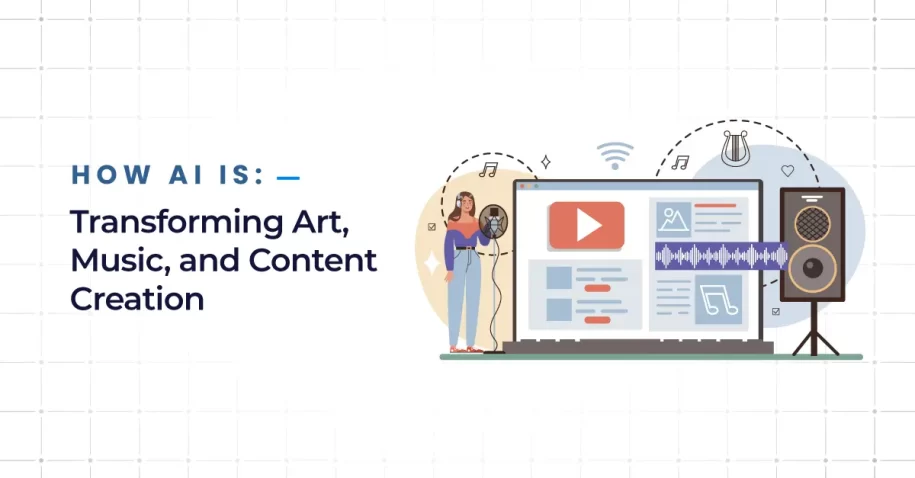
Artificial intelligence is reshaping how artists, musicians, marketers, and content creators work. Instead of replacing human creativity, AI technologies are expanding what’s possible—helping people generate content faster, experiment with new forms of expression, and scale production in ways that traditional workflows can’t match. Businesses are using these advancements to refine their creative process, reach audiences more efficiently, and rethink how they tell stories. This shift explains how generative AI is transforming art, music, and content creation, creating new opportunities for innovation and growth.
AI in art: Generative imagery, style-transfer, text-to-image tools
AI-powered platforms can now turn written ideas into visuals instantly, giving designers and artists a new canvas for experimentation. Tools using generative AI art enable creators to produce concepts, color palettes, and compositions faster than ever. Style-transfer models apply artistic techniques to images, while text-to-image engines let users generate detailed artwork with a few words.
This technology supports human creativity by removing technical barriers and helping teams brainstorm more freely. In digital marketing, these tools also make it easier to produce assets for ads, websites, and graphic design projects.
AI in music: AI-composed songs, voice-cloning, audio generation
The music industry is experiencing one of the most dramatic shifts. With ai music generators, artists use platforms that create harmonies, beat patterns, and even full vocal tracks. Voice-cloning can replicate tones and styles, supporting musicians in producing demos, concept tracks, or background audio without needing a full studio.
For businesses, these tools make it easier to develop branded sound effects, promotional audio, or social media clips. This merging of AI art and music gives creators a way to experiment with genres, create unique soundscapes, and explore how AI music can enhance storytelling.
AI in content creation: text, video, graphics, workflows amplified by AI
AI content creation tools can write scripts, craft marketing copy, outline stories, and shape ideas in minutes. Advanced models generate blog posts, articles, captions, and structured content that teams can refine and personalize. Video platforms now automate editing, transitions, and voiceovers, while image tools streamline everything from color correction to layout.
These improvements let businesses produce AI content more consistently across websites, social media, and advertising. By combining automation with human insight, creators save time while still maintaining authenticity.
Art of the Prompt: How to Communicate with AI
Using AI effectively depends on communicating clearly with the system. This is where prompt engineering for AI becomes essential. A well-written or effective prompt can dramatically improve the quality of the output. Think of it as giving directions to a very fast and highly literal assistant.
The more specific your goals, tone, and desired outcomes, the better the results. Many professionals now act as modern prompt engineers, guiding tools to create artwork, scripts, or product ideas that align with brand identity. Learning how to shape prompts is such an important skill that many teams even invest in a generative AI content creation course to improve internal efficiency and fine-tune AI-powered workflows.
Key Tools & Platforms Powering the Creative AI Shift
The rapid growth of artificial intelligence in creative fields comes from the rise of new, accessible tools. These platforms allow both experts and beginners to push boundaries, explore bold ideas, and transform the way they design or communicate.
Generative image-trim tools: Stable Diffusion, Midjourney, DALL-E
Visual creators use platforms like Stable Diffusion, Midjourney, and DALL-E to generate content from written descriptions. These solutions improve brainstorming, make concept development faster, and help brands explore new visual directions. They also support teams that need to test multiple ideas before committing to a final design.
Music-AI platforms: Suno, Udio, MusicLM
Tools such as Suno, Udio, and MusicLM act as modern music generators, giving creators the ability to craft entire songs or soundtracks. These systems help artists experiment with styles they normally wouldn’t explore, opening new pathways for AI music and sound design.
AI writing and video-creation tools: GPT-4, Claude, Adobe Sensei, Canva Magic Studio
Advanced AI writing tools like GPT-4 and Claude help businesses write blogs, scripts, and presentations with speed. Video platforms such as Adobe Sensei and Canva Magic Studio automate editing, animations, and transitions. These tools support professionals who need to create high-quality visuals or compelling narratives consistently, especially across social media.
Implementation Strategy: How Creative Professionals & Businesses Can Embrace AI
Adopting AI is less about replacing people and more about helping them work smarter. When AI becomes part of your creative operations, it enables better decision-making, improves quality, and accelerates the time it takes to bring ideas to life.
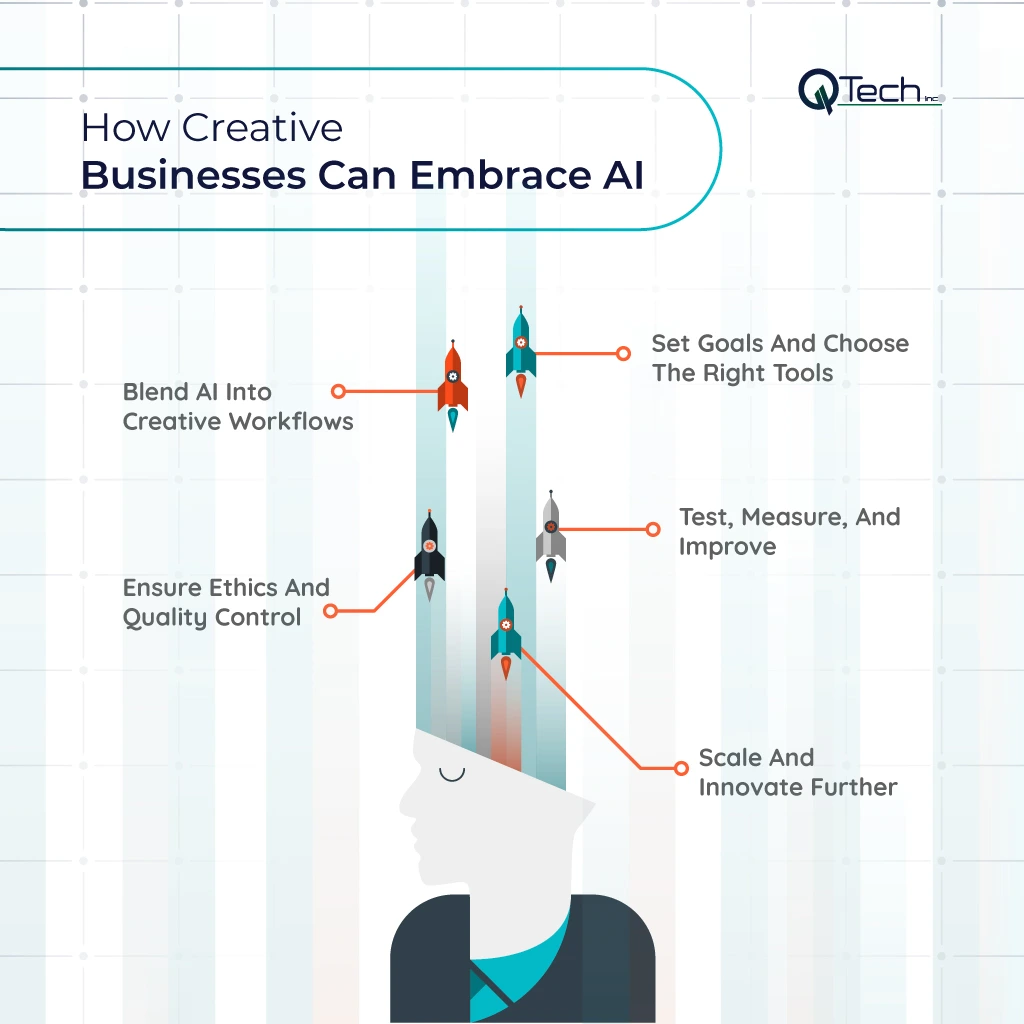
Step 1: Set goals and choose the right tools
Start by defining the specific problems you want AI to solve. Whether improving speed, boosting design quality, expanding content output, or experimenting with new media, goals dictate which AI technologies you should select.
Step 2: Blend AI into creative workflows
AI becomes most powerful when integrated throughout the process. Writers, designers, and marketers can use AI to outline concepts, generate drafts, or produce variations. The result is a more efficient creative process that amplifies human strengths.
Step 3: Ensure ethics and quality control
Creators must consider authenticity, ownership, and ethical considerations when using AI. Human review remains essential to protect brand identity and ensure content reflects real values. Good quality control preserves trust and supports long-term success.
Step 4: Test, measure, and improve
Once AI is part of your workflow, test results and gather feedback. Analyze performance metrics across web pages, campaigns, and social platforms. This helps refine prompts, adjust styles, and improve future outputs.
Step 5: Scale and innovate further
The final step is using AI to innovate. As your team becomes more comfortable, expand usage across departments—marketing, design, communication, and product development. Scaling AI allows businesses to stay competitive and explore how AI is changing creativity on a broader level.
Conclusion & How Q-Tech Inc. Powers Your AI Transformation
AI is not replacing the artist, musician, or writer; it is strengthening them. Its role is to support human creativity, generate faster ideas, reduce repetitive tasks, and help companies grow with more consistent output. As businesses explore AI content creation, they unlock new ways to communicate, design, and engage audiences.
Q-Tech Inc. helps organizations navigate this shift with expert guidance and modern digital solutions. Through our AI-driven digital marketing services we help brands build smarter content strategies, improve creative quality, and scale production.
Our professional graphic design services bring visual ideas to life and ensure every asset aligns with your brand identity. With the right combination of technology, strategy, and creativity, your business can embrace the future with confidence.
AI is changing every part of art, music, content creation, and design—and we ensures you stay ahead by integrating innovation into every campaign, platform, and message.
FAQ
How is AI used to create art?
Answer – AI creates art through generative models, primarily Diffusion Models and GANs. Users provide a text description (a ‘prompt’), and the AI, which has been trained on millions of image-text pairs, generates a new image that matches the description. It doesn’t copy and paste but synthesizes a novel image based on learned patterns of what words like ‘watercolor,’ ‘cyberpunk,’ or ‘portrait’ visually represent.
Is AI music generation original and copyrightable?
Answer – The copyright status of AI-generated music and art is legally complex and often depends on the jurisdiction and the level of human creative intervention used. Generally, content created purely by a machine without significant human direction may not be copyrightable.
Will AI replace human content writers and graphic designers?
Answer – Most experts believe AI will augment rather than replace human creatives. AI handles repetitive tasks (drafting, image resizing), allowing humans to focus on higher-level strategic thinking, client communication, establishing brand voice, and ensuring legal/ethical compliance.
How can I start creating with AI?
Answer – Starting is easier than ever. For art, you can begin with free tiers on platforms like DALL-E or Bing Image Creator. For writing, ChatGPT and Claude offer free, powerful options. For music, tools like Soundraw have accessible interfaces. The key is to start experimenting with writing clear, descriptive prompts and iterating based on the results. Many online communities and tutorials are dedicated to ‘prompt engineering’ to help you improve.