
Digital marketing moves fast, but blockchain technology is quietly reshaping the rules of the game. For brands competing in a noisy, data-saturated world, blockchain in digital marketing offers something rare: verified truth. It provides marketers with clearer visibility into where ads run, how data is handled, and which actions actually originated from their target audience.
As more web3 projects and platforms mature, businesses that understand the ways blockchain technology is revolutionizing digital marketing will be better positioned to outpace traditional advertising models and stand out in an increasingly competitive web3 market.
What Makes Blockchain Unique for Marketing
At its core, blockchain is a distributed, tamper-resistant ledger where transactions are recorded transparently and securely. For marketers, that means more than hype. It unlocks blockchain and transparency, and trust across every digital ad, click, and customer interaction.
Instead of relying on a handful of middlemen and opaque reports, you gain access to blockchain-based records that update almost in real time. This creates a foundation for decentralized advertising platforms, stronger data protection, and more honest decentralized advertisement ecosystems where brands, publishers, and users can finally see what is really happening behind each campaign.
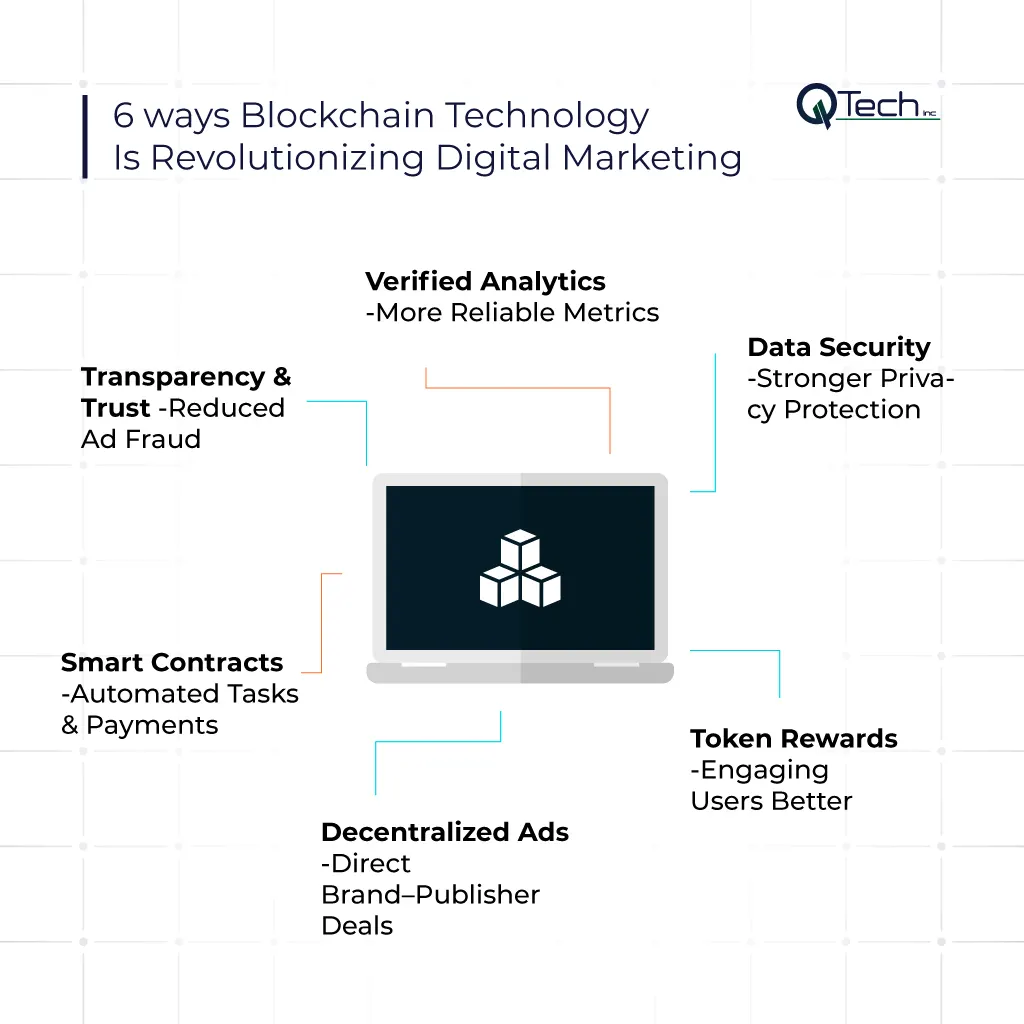
1. Increased Transparency & Trust — Ending Ad Fraud
Ad fraud drains billions from the global ad economy every year. Fake clicks, bots inflating ad impressions, and invisible placements make it hard to know what you are truly paying for. Blockchain shows how it reduces ad fraud by recording each impression and engagement on a shared ledger that cannot be quietly altered.
When your digital ad activity is tracked on-chain, it becomes much easier to combat ad fraud and verify that ads ran on the right sites, to real users, at the right time. Over time, this leads to higher trust between brands and publishers, improves accountability, and makes advertisers far more confident in allocating budget toward channels that deliver measurable value.
2. Smart Contracts — Automating Marketing Deliverables & Payments
Smart contracts in marketing campaigns act like programmable agreements that execute automatically when specific conditions are met. Imagine a campaign where an influencer only gets paid once a certain number of verified conversions or on-chain engagements are recorded. Or a media partner that receives funds the moment an agreed volume of quality traffic is delivered.
Smart contracts remove manual reconciliation, reduce disputes, and help ensure reduced costs by cutting layers of intermediaries. For teams running multi-channel campaigns, this automation frees up time to focus on creative strategy, rather than chasing invoices and checking spreadsheets.
3. Decentralized Ad Exchanges & Direct Brand–Publisher Transactions
Traditional ad buying often passes through multiple ad networks and brokers, each taking a cut and adding opacity. Blockchain-based ad exchanges and decentralized advertising platforms flip that model. They enable brands and publishers to transact directly, using transparent algorithms and on-chain records.
When you adopt blockchain-powered exchanges, you get clearer pricing, better control over where your ads appear, and deeper insight into audience segments across the web3 market. This more open environment reduces dependency on a few dominant platforms and empowers both sides to negotiate fairer, more efficient deals for every marketing campaign.
4. Tokenization & Reward-Based Marketing — Engaging Users Differently
Blockchain also changes how we reward and retain customers. Through tokenization for marketing rewards, brands can issue digital assets that users earn through engagement, referrals, or purchases. These tokenized rewards might unlock exclusive content, discounts, or access to community events.
Loyalty tokenization can also tie to social media engagement, turning likes, shares, and comments into real value for your most active supporters. Instead of generic points systems, you build dynamic, blockchain-enabled loyalty ecosystems where users feel genuine ownership and are more motivated to stay connected to your brand.
5. Enhanced Data Security & Privacy — Protecting User & Campaign Data
Data privacy is no longer optional. Customers expect brands to take data protection seriously and to explain how their information is handled. With data privacy with blockchain marketing, user consent, preferences, and permissions can be stored on an immutable ledger, making it easier to prove compliance and respect user choices.
Combined with strong cybersecurity practices and a focus on data security, blockchain helps reduce the risk of breaches and unauthorized access to marketing data. Users gain more control over what they share, while brands maintain a trustworthy, future-ready foundation for personalization and analytics.
6. Verified Data & Analytics — Reliable Metrics for Marketers
When campaign performance data is captured directly on-chain, marketers can trust that numbers have not been quietly manipulated. Clicks, conversions, and ad impressions can be logged through blockchain technology, giving teams verified metrics to work with. This is especially powerful for cross-channel campaigns where multiple vendors are involved.
Rather than debating whose report is correct, you work from a single, auditable source of truth. Over time, this enables better optimization, smarter budget allocation, and more accurate measurement of ROI for every marketing campaign, from experimental web3 projects to large-scale omnichannel initiatives.
Challenges & Considerations When Using Blockchain in Marketing
While blockchain’s potential in marketing is enormous, it is not a magic switch you flip overnight. Businesses must think through technology choices, user experience, and governance. Choosing the wrong tools or partners can create friction instead of value. Understanding where blockchain-based solutions genuinely outperform traditional advertising infrastructure is critical so you invest wisely and avoid chasing trends for their own sake.
Technical Complexity & Implementation Costs
Implementing blockchain solutions can require specialized expertise, infrastructure, and integration with existing systems. Not every organization has the internal resources to manage nodes, smart contract development, or blockchain-based ad exchanges on its own. Early phases may involve higher upfront investment, but the long-term payoff comes through reduced costs, automation, and more efficient media buying. Partnering with a trusted digital marketing and IT team can significantly smooth the learning curve.
User Adoption and Education
For many customers and even internal teams, concepts like tokens, wallets, and decentralized advertisement platforms are still new. Successful adoption often requires clear education and thoughtful UX design, so users do not feel overwhelmed. Brands need to explain why tokenized rewards or blockchain-driven consent tools benefit the user, not just the business. When people understand the value, they are far more open to engaging with innovative, web3-aligned experiences.
Regulatory & Privacy Considerations
Any system that touches personal data must respect privacy regulations. Blockchain adds unique questions: How do you handle the “right to be forgotten” on an immutable ledger? How do you blend on-chain transparency with compliance? Thoughtful architecture—such as storing sensitive data off-chain while anchoring proofs on-chain—can help balance these concerns. Working with partners who understand both digital marketing and compliance keeps your web3 projects aligned with evolving laws.
How to Get Started — Practical Steps for Marketers & Businesses
You do not have to rebuild your entire stack to adopt blockchain. Instead, start with focused, high-impact experiments that align with your goals. Look for opportunities where transparency, automation, or rewards can meaningfully improve customer experience and campaign performance.
Evaluate Use Cases (Ads, Loyalty, Influencer Deals)
Begin by mapping where blockchain can measurably improve your current efforts: reducing fraud in digital ad placements, creating tokenized rewards for loyal customers, or structuring influencer partnerships with smart contracts. Prioritize use cases where mistrust, manual effort, or lack of clarity are currently slowing you down.
Choose or Develop a Blockchain-Enabled Ad / Marketing Platform
Next, explore platforms that support blockchain-based or decentralized advertising platforms, or consider tailored solutions if you have complex needs. Ensure integrations with your analytics tools, CRM, and existing ad stack, so blockchain layers enhance—not replace—what already works. The goal is to strengthen transparency and control without disrupting your ability to reach your target audience efficiently.
Define Data Privacy & Consent Mechanisms
Before launching, clearly define how you will manage consent, access, and data security. Decide what goes on-chain versus off-chain and how users can update their preferences. Align these mechanisms with your brand promise around data privacy with blockchain marketing, ensuring customers genuinely feel the benefits of more secure, transparent experiences.
Run Pilot Campaigns & Monitor Results
Start small with pilot campaigns focused on one or two specific objectives—such as proving you can combat ad fraud more effectively or launching a simple loyalty tokenization program. Track performance in real time, compare results to traditional advertising baselines, and refine your approach. These pilots create internal proof points and help your team build confidence as you scale into more advanced web3 market initiatives.
Conclusion — Unlock Blockchain Marketing Benefits with Q-Tech Inc
Blockchain is not just a buzzword; it is a practical toolset for reshaping how brands build trust, measure results, and reward loyalty. From verified analytics to tokenized rewards and smarter contracts, its benefits are already transforming forward-thinking marketing teams.
At Q-Tech Inc., we blend strategy, creativity, and technology to help you increase online visibility while future-proofing your campaigns for the next wave of web3 innovation. Whether you are exploring smart contracts in marketing campaigns, loyalty tokenization, or more transparent ad ecosystems, our team can help you design, deploy, and scale solutions that keep you ahead of the curve.
FAQ
Q: What is blockchain marketing?
A: Blockchain marketing uses blockchain technology — decentralization, immutable ledger, and cryptographic security — to make advertising, data collection, payments, and analytics more transparent, secure, and efficient. It replaces intermediaries with direct peer-to-peer or smart-contract-based interactions.
Q: How does blockchain help prevent ad fraud?
A: Because every ad impression, click, or conversion can be recorded on an immutable public ledger, blockchain allows advertisers to verify that engagements are genuine (not generated by bots or fake clicks). This transparency and tamper-proof record significantly reduces the risk of ad fraud.
Q: What are smart contracts — and how do they benefit marketing campaigns?
A: Smart contracts are self-executing digital contracts whose terms are encoded on the blockchain. In marketing, they automate tasks such as influencer or affiliate payments, reward disbursement, and condition-based ad spending, ensuring payments and deliverables happen automatically when agreed conditions are met — boosting accountability and reducing delays.
Q: Can blockchain improve data privacy and security for user data used in marketing?
A: Yes. Blockchain’s decentralized storage, cryptographic encryption, and permission mechanisms make it harder for unauthorized parties to alter or leak user data. This helps marketers comply with privacy laws and build trust with users.
Q: Is blockchain marketing only for large enterprises, or can small businesses benefit too?
A: Small and mid-sized businesses can also benefit. By cutting out middlemen (ad networks, agencies), blockchain can reduce costs, increase transparency, and offer direct-to-consumer marketing. Smart-contract automation and transparent ad metrics help small businesses manage ad budgets more efficiently.
Q: Is blockchain marketing the same as Web3 marketing?
A: They are closely related but not identical. Blockchain is the foundational technology that enables key aspects of Web3. ‘Blockchain marketing’ refers specifically to applications using that ledger technology (e.g., verifiable ads, data wallets). ‘Web3 marketing’ is a broader term encompassing the marketing philosophy and tactics for a decentralized internet, which includes blockchain, but also concepts like DAOs (Decentralized Autonomous Organizations), NFTs, and the metaverse.