
In 2026, small business growth rarely comes from a single “big” marketing move. It comes from consistent execution across the right channels, built on a clear understanding of your target audience and supported by measurable, repeatable systems. The businesses that win are the ones that stop guessing, create a realistic marketing budget, and follow a marketing strategy that aligns to how customers actually search, compare, and buy.
This guide covers must-try digital marketing strategies for small business growth in 2026 using a practical, implementation-focused approach. You will learn how to identify your target market, reduce common pain points in your marketing plans, and apply cost effective tactics that compound over the long term. If you have been looking for digital marketing strategies small business teams can execute without burning out, you are in the right place.
Why Small Businesses Need a Strategic Digital Marketing Plan
Many small business owners market reactively: a post when things are slow, an ad when a competitor shows up, and a website update only when something breaks. This approach is understandable, but it is also expensive—because it spreads effort across too many priorities without a clear return.
A strategic plan gives you structure. It helps you define a target audience, clarify messaging, select the right marketing channel mix, and allocate resources based on outcomes. When you know who you are speaking to and what they need, your content becomes more effective, your ads become more efficient, and your social media content becomes more relevant.
The other advantage is consistency. Strong marketing plans reduce decision fatigue by creating a repeatable process for content, distribution, and measurement. Instead of reinventing the wheel every month, you build momentum—and momentum is what creates predictable growth.
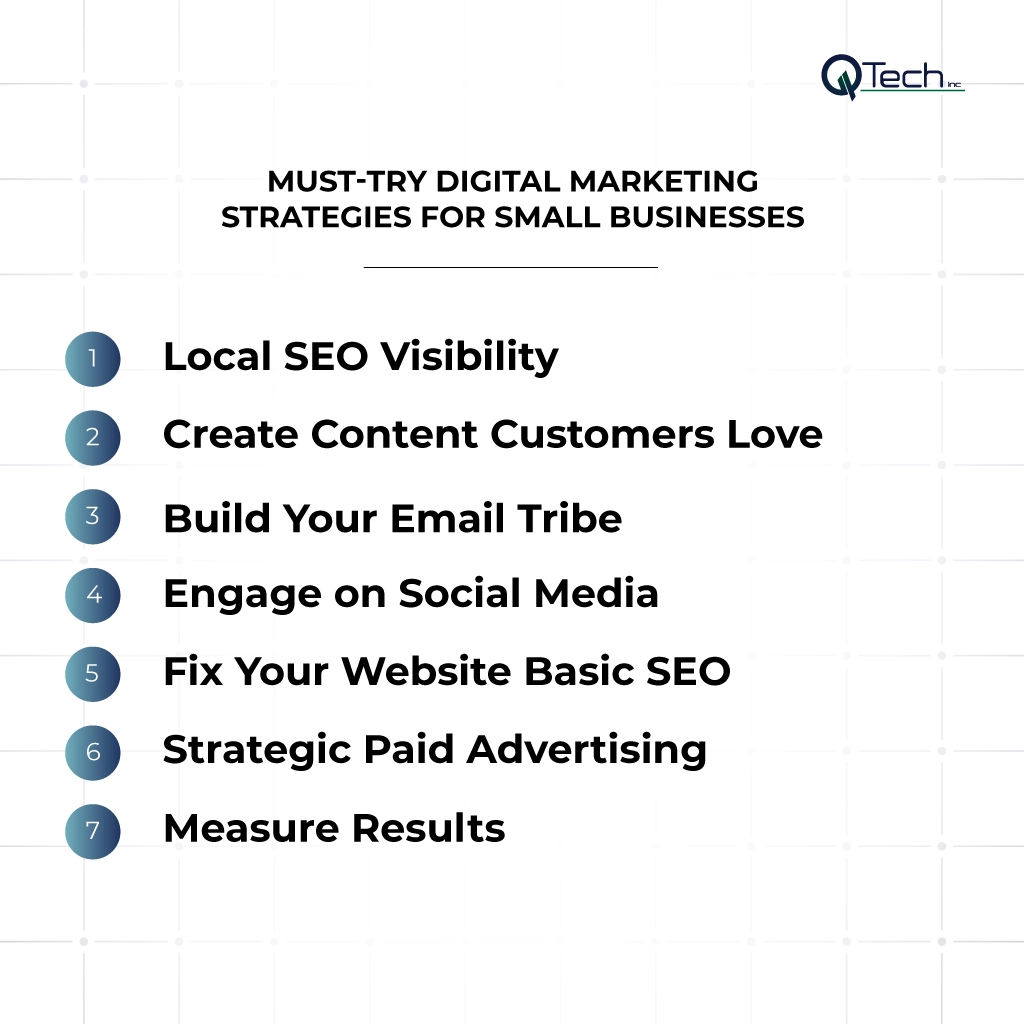
Digital Marketing Strategies for Small Businesses
- Local SEO Visibility
- Create Content Customers Love
- Build Your Email Tribe
- Engage on Social Media
- Fix Your Website Basic SEO
- Strategic Paid Advertising
- Measure Results
Strategy 1: Claim & Dominate Your Local SEO Presence
Local visibility is one of the most valuable advantages a small business can build. When someone searches for your service in your city, that is high-intent demand—and you want your business to show up clearly and credibly.
That is why seo tips for small business should start with local fundamentals: accurate business listings, strong on-page signals, service-area relevance, and review momentum. Local SEO is not about gaming the system. It is about making it easy for search engines—and customers—to trust that you are the right fit.
Optimizing Your Google Business Profile
Google Business Profile is often your first impression. Proper google business profile optimization improves visibility in map results and local search listings, and it helps customers take action quickly through calls, directions, and website clicks.
Complete every field: categories, services, hours, photos, service areas, and business description. Add updates regularly, answer questions, and treat the profile like a live asset—not a one-time setup.
Building Local Citations and Garnering Reviews
Citations—mentions of your business name, address, and phone number—build consistency across the web. The key is accuracy. Even small inconsistencies can weaken trust signals and reduce ranking potential.
Pair citation work with a reliable review process. Make review requests part of your customer journey, not an awkward afterthought. Respond to every review professionally, including negative ones. Over time, reviews reduce buyer hesitation and increase conversions, especially for service-based small business marketing strategies.
Strategy 2: Develop a “Customer-First” Content Marketing Plan
Content marketing still works, but only when it is built around customer intent. Random posts and generic blogs are easy to create—and easy to ignore. A customer-first plan focuses on what your defined target audience actually wants to know before they buy.
Start by documenting the most common pain points your customers bring up: cost concerns, timelines, comparisons, “what happens if,” and trust questions. Then build a content system that answers those questions in the right format and at the right depth.
Blogging to Answer Questions and Build Authority
Blogging is one of the most reliable long-term digital marketing strategies small business teams can invest in—when it is intentional. Each post should answer a specific question, reduce uncertainty, and guide the reader to a practical next step.
Write posts that reflect real conversations: how pricing works, what to expect, common mistakes, and differences between options. That type of content builds authority, improves organic search visibility, and supports your sales team by pre-educating leads before they call.
Creating Helpful Guides and How-To Content
Some customers want more than a blog post. Guides, checklists, templates, and short downloadable resources give people a reason to subscribe and return. This is also one of the best ways to grow email lists with qualified prospects.
The most effective type of content here is simple and actionable. For example, a “2026 marketing strategy checklist” that helps people define their target audience, pick a marketing channel, and track performance will outperform vague “top tips” every time.
Strategy 3: Build a Relationship-Driven Email Marketing List
Email is still one of the most controllable marketing channels available. Unlike social platforms, you own your list and can reach customers without relying on algorithm changes. The key is execution: email marketing strategies should build trust before they push promotions.
If every email is a sales pitch, you will see higher unsubscribe rates and lower engagement. When email is value-driven and segmented, it becomes a long term asset that supports repeat business, referrals, and reactivation campaigns.
Offering Value to Grow Your Subscribers
List growth should be earned. Offer a resource that solves a real problem: a checklist, a seasonal guide, a quick comparison sheet, or a template that reduces customer pain points.
Place sign-up opportunities on high-traffic pages, in blogs, and on service pages. Encourage your team to invite subscribers after positive interactions. The goal is not the biggest list—it is a defined target audience that opens, clicks, and buys.
Crafting Simple, Effective Newsletters and Promotions
Effective newsletters are focused. Choose one topic, one takeaway, and one call to action. This is where subject lines matter: make them clear, human, and relevant to the target audience.
Use segmentation when possible. Customers and prospects should not receive the same offers or the same messaging. Over time, this improves engagement, protects deliverability, and keeps your email lists healthy.
Strategy 4: Execute Targeted Social Media Engagement
Social media is not about being everywhere. It is about showing up consistently where your target market already pays attention. The best social media strategies for small business operators prioritize relevance, community, and consistency—without overwhelming the team.
A small business that posts with intention, responds quickly, and builds relationships will often outperform a brand that posts daily but never engages.
Choosing the Right Platform for Your Audience
Start with finding your target audience and understanding behavior. Are you marketing to local consumers, professionals, parents, property owners, or executives? Different audiences spend time on different social media platforms.
Choose one to two primary platforms where your content style fits and where your team can be consistent. Build content pillars—education, proof, behind-the-scenes, and offers—so your social media content stays structured and on-brand.
The Power of Community Building and Direct Interaction
Engagement is where social becomes a real growth lever. Respond to comments, answer DMs, and participate in local conversations that matter to your audience. This is a cost effective way to generate warm leads while building credibility.
Strategy 5: Implement Basic Technical SEO for Your Website
Great marketing cannot compensate for a weak website experience. If your site is slow, confusing, or hard to use on mobile, your conversions will suffer—no matter how much traffic you generate.
Technical SEO is about removing friction. It ensures your website loads fast, works well across devices, and makes it easy for customers to understand your services quickly.
Ensuring Your Site is Fast, Mobile-Friendly, and Secure
Speed impacts both user experience and conversion rates. Compress images, use caching, reduce unnecessary scripts, and ensure hosting is reliable. Make sure you have mobile-friendly website, with readable text, tappable buttons, and fast loading pages.
Security matters as well. Use SSL, keep plugins updated, and eliminate warnings that undermine trust. These are foundational seo tips for small business websites that want to compete in 2026.
Simple Site Structure and Clear Navigation
Your navigation should be obvious. Group services logically, build pages around customer intent, and avoid burying key information under confusing menus.
Also pay attention to meta descriptions for your most important pages. While meta descriptions do not directly drive rankings, they can significantly impact click-through rate by clarifying what the page offers and addressing pain points immediately.
Strategy 6: Explore Strategic Paid Advertising with a Small Budget
Paid advertising can work for small businesses when it is disciplined. The mistake is spending money without clarity: unclear offers, poor targeting, and no tracking.
When paid is executed correctly, it becomes a controlled testing environment. You learn what messages work, what audiences respond, and what offers convert—then apply those insights across your marketing plans.
Highly Targeted Google Ads or Social Media Ads
Google Ads can capture demand from people actively searching, while social ads can create demand by targeting interests, demographics, and behaviors. The key is focus: one offer, one audience, one landing page goal.
Avoid spreading budget thin across many campaigns. Tight targeting and clear messaging typically outperform broad, generic ads—especially for small business marketing strategies with limited spend.
Setting Clear Goals and Monitoring ROI Closely
Set a goal before you spend: calls, form submissions, bookings, purchases, or consultations. Track cost per lead and lead quality—not just clicks. Review weekly, adjust gradually, and avoid making large changes too fast.
Paid works best when it supports your broader digital marketing strategy, including follow-up through email lists and conversion-focused landing pages.
Strategy 7: Track, Analyze, and Adapt with Simple Analytics
The businesses that improve fastest are the ones that measure consistently. You do not need complicated dashboards. You need a repeatable reporting rhythm that connects marketing activities to outcomes.
Analytics helps you identify which marketing channel drives quality leads, which pages perform best, and where customers drop off in the journey.
Using Google Analytics 4 to Understand Your Audience
Google Analytics 4 helps you see traffic sources, engagement trends, and conversion behavior. Set up events for key actions like form submissions, calls, purchases, or booking confirmations.
Then review monthly. You are looking for patterns: what content attracts the right target audience, what pages convert, and what campaigns are improving over time.
Making Data-Informed Decisions to Improve Campaigns
Use analytics to make decisions one step at a time. Improve one variable, measure impact, then iterate. That process builds confidence in your marketing strategy and helps you justify marketing budget decisions with real data.
When measurement becomes routine, your marketing plans stop being guesswork. They become a system that improves quarter after quarter.
Conclusion — What to Prioritize for Small Business Growth in 2026
The most effective must-try digital marketing strategies for small business growth in 2026 are not about chasing trends. They are about executing fundamentals consistently: strong local visibility, customer-first content, relationship-driven email marketing strategies, focused social media engagement, solid technical SEO, disciplined paid testing, and simple analytics that guide decisions.
When you align these tactics to a defined target audience and a realistic marketing budget, you build sustainable growth that compounds over the long term. If you want help turning these strategies into execution, start by strengthening your local search foundation through SEO and build ongoing engagement with Social Media Management.
Q: What is the most effective marketing strategy for small businesses in 2026?
A: The most effective strategy is a hybrid approach of Local SEO and GEO (Generative Engine Optimization). Businesses must ensure they are visible on local maps while providing clear, structured content that AI models can easily cite in conversational responses.
Q: How can a small business optimize for ChatGPT and Gemini search?
A: To optimize for AI answer engines, use question-based headers, provide direct answers in the first 2-3 sentences of each section, and implement FAQ Schema markup to make your content machine-readable.
Q: Why is short-form video important for SMBs in 2026?
A: Short-form video (TikTok, Reels, Shorts) has become the primary conduit for social commerce. It allows small businesses to build trust through authenticity and provides a friction-less path from product discovery to purchase.
Q: How do I measure digital marketing success?
A: Use metrics like organic traffic growth, conversion rates, email open/click rates, social engagement, ROI from ads, and online reviews sentiment to judge success.