

Migrating to the cloud has become more than a technological shift—it’s a strategic move that drives innovation, scalability, and operational efficiency. But without a structured cloud migration plan, businesses risk costly disruptions and security gaps. This guide outlines a cloud migration strategy: a step-by-step guide to minimize risk, ensuring your organization transitions smoothly while optimizing performance, cost efficiency, and security.
What Is a Cloud Migration Strategy?
A cloud migration strategy is the blueprint for moving an organization’s data, applications, and infrastructure from on-premises or legacy systems to cloud environments. The goal is not just to move workloads but to transform business operations using cloud-based technology that supports agility, scalability, and innovation.
At its core, a successful step-by-step cloud migration for business ensures business continuity, minimizes downtime, and aligns with strategic goals. It involves defining a business case, choosing the right migration strategies, and maintaining continuous monitoring to keep the process secure and efficient.
Whether your goal is to improve performance, reduce costs, or enhance flexibility, having a solid cloud migration checklist helps mitigate risks and streamline execution.
Step-by-Step Cloud Migration Strategy
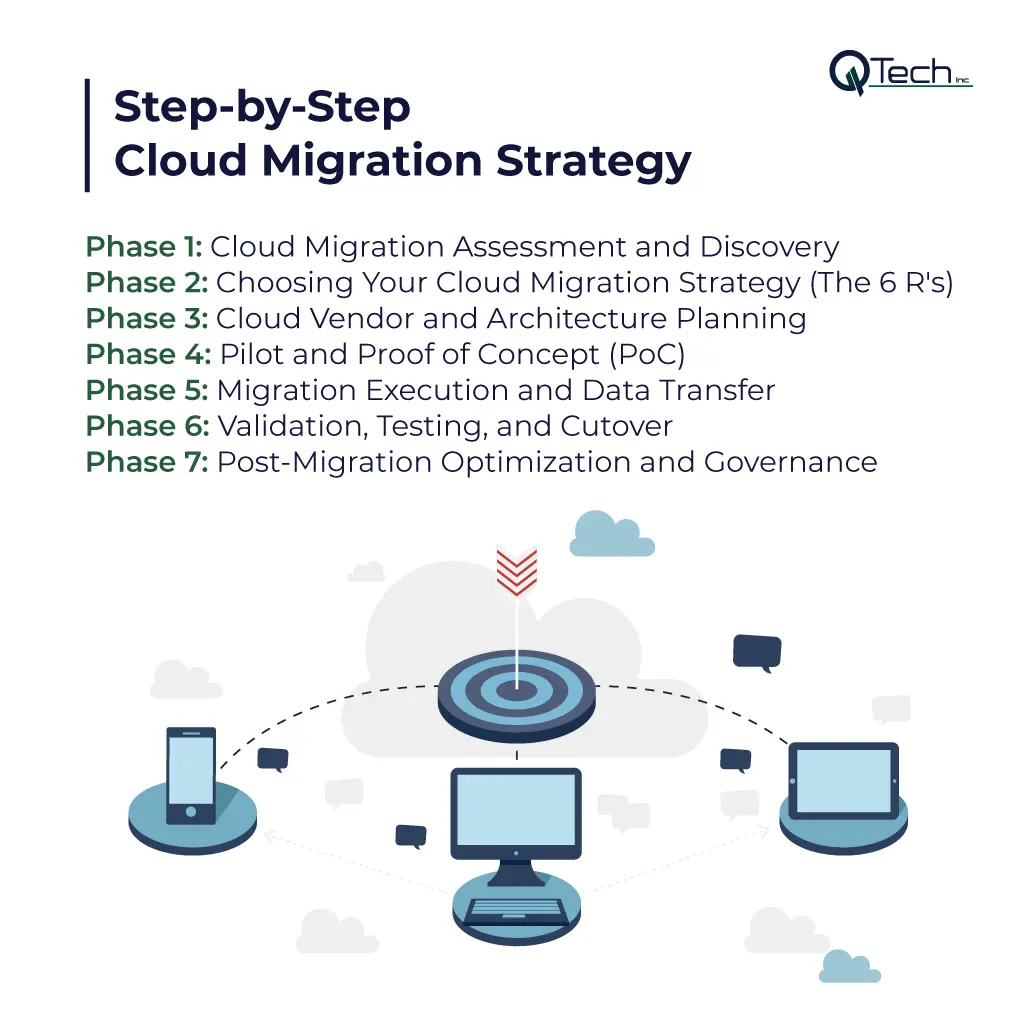
This cloud migration process is divided into seven key phases designed to provide structure and reduce uncertainty. Each phase builds upon the last, ensuring every aspect of your transition to the cloud is well-planned and executed with precision.
Phase 1: Cloud Migration Assessment and Discovery
Defining Business Objectives and KPIs
Before moving to the cloud, define your strategic goals. Are you aiming for better scalability, improved security, or enhanced cost efficiency? Identify the KPIs, such as uptime, latency, or cost savings, that will measure the success of your cloud migration plan. These objectives form the foundation of your entire migration checklist.
IT Environment Inventory and Dependency Mapping
Conduct a detailed inventory of existing applications, workloads, and infrastructure. Mapping dependencies between systems helps you identify which workloads can move first and which require special handling. This step ensures your application migration strategy is both efficient and low-risk.
Cloud Readiness and Total Cost of Ownership (TCO) Analysis
Evaluate how ready your organization is for moving to the cloud. Consider hardware lifecycle, software licensing, and network capacity. A Total Cost of Ownership (TCO) analysis helps you anticipate expenses and build a business case that supports long-term savings and operational improvements.
Phase 2: Choosing Your Cloud Migration Strategy (The 6 R’s)
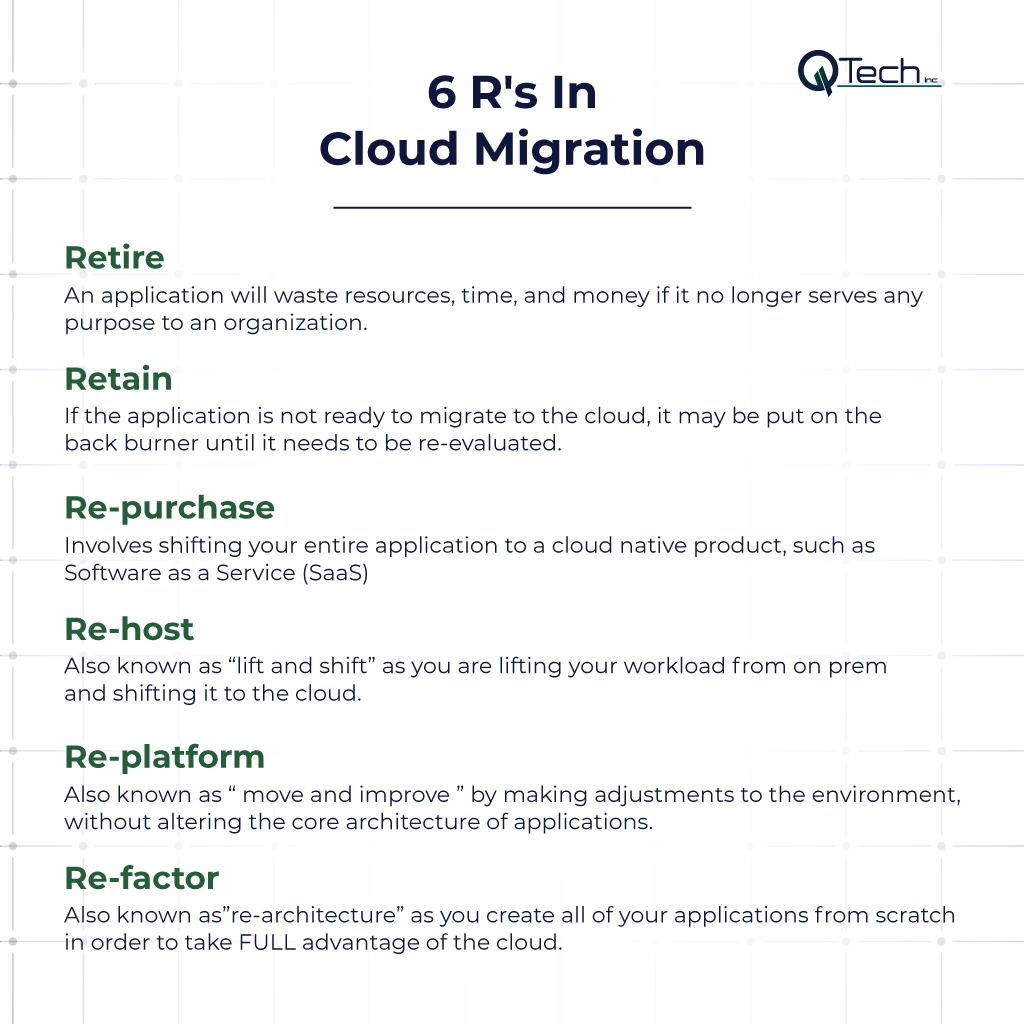
Each workload requires a tailored approach. The cloud migration 6 R’s—Rehost, Replatform, Refactor/Re-architect, Repurchase, Retire, and Retain—offer flexibility for different business scenarios.
Rehost (Lift and Shift)
This approach moves applications to the cloud with minimal changes. Known as lift and shift, it’s ideal for companies seeking quick wins or limited downtime. However, it offers fewer long-term optimization opportunities.
Replatform (Lift, Tinker, and Shift)
Here, minor adjustments are made to optimize applications for a public cloud environment. This balances speed with efficiency and allows for better integration with cloud native tools.
Refactor/Re-architect
Involves reimagining applications to fully leverage cloud solutions, such as microservices or serverless computing. While more resource-intensive, this strategy maximizes scalability and innovation.
Repurchase, Retire, and Retain
Repurchase outdated applications with cloud-based alternatives, retire redundant systems, and retain workloads that don’t yet justify migration. This step ensures that your cloud deployment aligns with business goals and minimizes downtime.
Phase 3: Cloud Vendor and Architecture Planning
Selecting the Right Cloud Provider (AWS, Azure, GCP, etc.)
Choosing the right provider determines the performance and scalability of your cloud migration strategy. Evaluate AWS, Azure, or Google Cloud based on cost, compliance, and service availability. Each offers unique tools to enhance data migration, security, and scalability.
Designing the Target Cloud Architecture
Your cloud architecture should reflect your organization’s priorities: high availability, redundancy, and real-time performance. Plan for hybrid or public cloud deployment models depending on your operational needs and compliance requirements.
Governance and Compliance Framework Setup
Establish a governance model that enforces access control, data compliance, and cost management. This step protects sensitive information during the transition to the cloud and ensures your business adheres to regulatory standards.
Phase 4: Pilot and Proof of Concept (PoC)
Establishing a Minimum Viable Cloud Environment (MVC)
Before scaling, test your cloud migration plan through a Proof of Concept (PoC). Build an MVC to validate architecture, performance, and integration with legacy systems. This phase confirms readiness before full-scale deployment.
Testing the Rollback Strategy
No migration is risk-free. Develop and test rollback mechanisms to ensure systems can revert to on-premises environments if issues arise. This proactive step minimizes downtime and safeguards critical data.
Phase 5: Migration Execution and Data Transfer
Data Migration Strategy (Online vs. Offline Transfer)
Select between online (real-time synchronization) or offline (bulk data upload) transfers. The choice depends on data volume, complexity, and your cloud environments’ connectivity. Always encrypt data during transit to maintain integrity and security.
Workload Migration in Waves
Execute migrations in structured waves. Start with non-critical workloads before advancing to core systems. This phased approach aligns with cloud migration best practices, ensuring minimal impact on daily operations.
Continuous Integration/Continuous Delivery (CI/CD) Implementation
Integrate CI/CD pipelines to automate deployment, testing, and updates. Automation accelerates application migration, maintains consistency, and reduces human error throughout the cloud migration process.
Phase 6: Validation, Testing, and Cutover
Performance and Security Validation
Once workloads are deployed, test their performance under real-time conditions. Validate data integrity, latency, and load balancing while implementing continuous monitoring for threats or vulnerabilities.
User Acceptance Testing (UAT)
Engage end users to validate application performance and ensure that functionality meets business requirements. UAT feedback is vital to fine-tuning usability before final launch.
Final Cutover and Decommissioning of Legacy Systems
Once validation is complete, perform the final cutover and shut down old systems. Decommissioning legacy systems reduces maintenance costs and eliminates redundant processes.
Phase 7: Post-Migration Optimization and Governance
Cost Optimization (FinOps)
After migration, implement FinOps practices to track spending and improve cost efficiency. Cloud resources should scale dynamically to prevent overspending and ensure optimal performance.
Cloud-Native Modernization and Automation
Post-migration, adopt cloud-native tools and services for automation, monitoring, and scaling. Leverage analytics to enhance decision-making and enable proactive management of your cloud solutions.
Ongoing Monitoring and Management
Establish a culture of continuous monitoring to detect anomalies and maintain compliance. Partnering with a provider offering managed support during migration ensures stability and long-term success.
Common Challenges & Risk Mitigation
Legacy systems, dependencies, and data compatibility
Older systems often create migration bottlenecks. Conduct dependency mapping early and ensure data formats are compatible with cloud-based platforms to reduce friction.
Cost overrun, hidden egress charges
Unmonitored data transfers can lead to unexpected costs. A clear cloud migration checklist that includes cost tracking and optimization prevents overspending.
Security & compliance gaps during transition
Security misconfigurations are a major risk. Apply consistent policies across environments, use encryption, and follow cloud migration best practices to stay compliant.
Staff skill gaps, change management
Equip teams with cloud training and create a change management plan. Knowledge gaps can lead to inefficiencies and errors during migration execution.
Conclusion: Partnering with Q-Tech Inc. for a Seamless Cloud Journey
Implementing a step-by-step cloud migration for business requires precision, expertise, and ongoing management. Each phase, from planning and testing to post-migration optimization, plays a critical role in achieving sustainable success.
Our team of IT experts designs customized cloud migration strategies that align with your business goals. With a focus on security, efficiency, and scalability, we guide companies through every stage of the cloud migration process, ensuring your transition to the cloud is smooth, secure, and future-ready.
Partner with us today to unlock the full potential of your digital transformation and experience a reliable, high-performing, and risk-free cloud deployment journey.
FAQ
Can we migrate some applications and not others?
Answer – Yes, and you should. This is called a hybrid cloud approach. It’s common to migrate suitable applications to the cloud while keeping legacy, highly sensitive, or custom applications on-premises. The 6 R’s framework helps identify which applications are the best candidates for migration.
How long does a typical cloud migration take?
Answer – There is no fixed timeline; it depends on complexity. A simple lift-and-shift for a few servers might take weeks, while a full-scale enterprise migration involving refactoring can take 12 to 24 months or more. The key is to break it into manageable waves—often the first 3–6 month wave focuses on easier workloads to build momentum and refine processes.
What is the most common reason for cloud migration failure?
Answer – The most common reasons are poor planning and lack of a clear strategy. Specifically, inadequate discovery and dependency mapping can lead to unforeseen issues, and failure to manage post-migration costs (FinOps) often results in overspending and poor ROI.
What are the 6 R’s of cloud migration?
Answer – The 6 R’s framework helps determine the right migration strategy for each application:
- Rehost (“Lift and Shift”) – Move as-is.
- Refactor (“Lift, Tinker, and Shift”) – Make small platform-level optimizations.
- Revise – Modify or partially re-architect to leverage cloud-native services.
- Rebuild – Rewrite the application completely.
- Replace – Adopt a SaaS alternative.
- Retire – Decommission apps that no longer serve business value.