
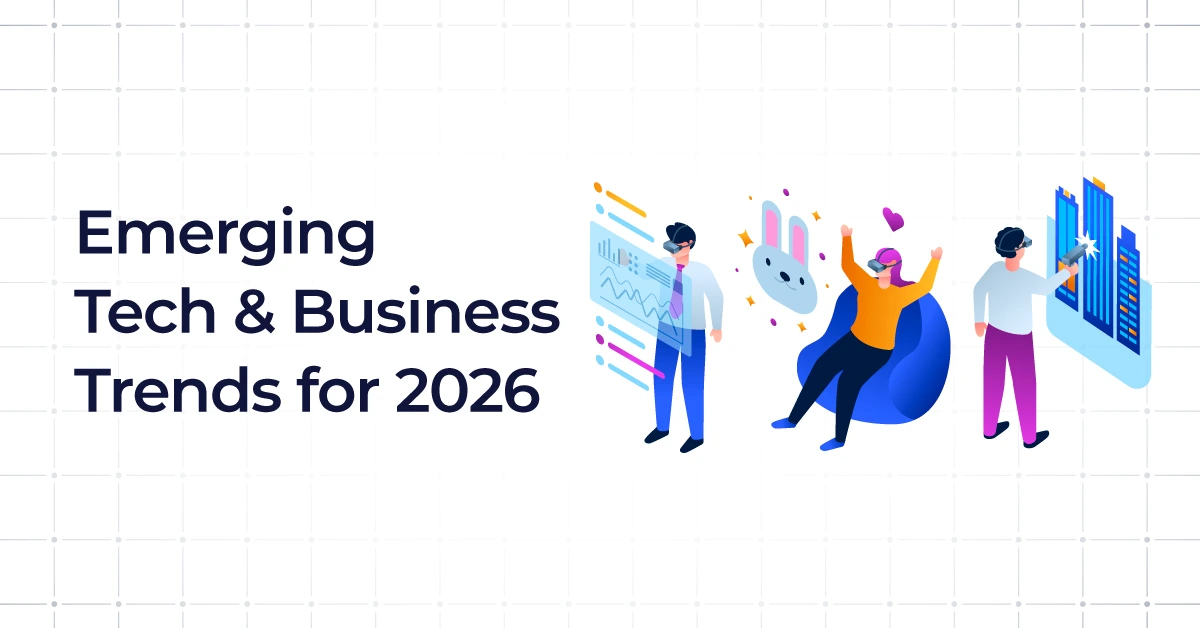
The year 2026 is shaping up to be one of the most transformative yet for the digital landscape. As emerging technologies continue to evolve, businesses are being presented with powerful tools to optimize operations, enhance customer engagement, and strengthen their competitive edge. From Agentic AI and 5G networks to quantum computing and space tech, the world is rapidly entering a new era of intelligent automation and connectivity. Understanding these 2026 technology trends will be essential for companies aiming to thrive in the digital-first economy.
Emerging Tech Trends for 2026
- Agentic AI
- Generative AI
- Hyperautomation
- Predictive Maintenance
- Internet of Things (IoT)
- 5G & 6G
- Zero-Trust Security
- Advanced Robots
- Autonomous Vehicles
- Edge Computing & Distributed Cloud
- Quantum Computing
- Neuromorphic Computing
- Blockchain
- Decentralized Finance (DeFi)
- Extended Reality
- Voice User Interfaces (VUI)
- Brain-Computer Interfaces
- Space Tech

Agentic AI
One of the most impactful emerging tech trends for 2026 is Agentic AI, a new form of artificial intelligence that empowers autonomous agents to make decisions and perform complex tasks independently. Unlike traditional AI systems that require explicit commands, Agentic AI agents can learn goals, plan actions, and adjust based on dynamic real-world feedback. Businesses can use AI agents to automate workflows, streamline supply chains, and respond in real-time to market fluctuations. This capability is transforming industries like finance, logistics, and healthcare, where efficiency and adaptability are paramount.
Generative AI
Generative AI has already proven its creative capabilities in content generation, but in 2026, its applications are expanding into advanced data modeling and customer experience design. Organizations are leveraging generative models to simulate real-world environments, improve product development, and accelerate innovation cycles. For marketers, this technology is enabling dynamic campaign creation and content personalization at scale. By combining creativity with computation, Generative AI continues to redefine how businesses approach automation and human-machine collaboration.
Hyperautomation
Hyperautomation represents the next phase in intelligent process automation, combining AI, machine learning, and robotic process automation (RPA). The goal is to automate every repetitive or rule-based task within an organization. In 2026, hyperautomation systems will be integrated with analytics platforms to make real-time business decisions, helping reduce costs and eliminate human error. This evolution not only boosts efficiency but also frees employees to focus on high-value creative and strategic work.
Predictive Maintenance
Predictive maintenance, driven by AI and IoT sensors, allows organizations to anticipate equipment failures before they happen. By analyzing data from connectable devices and smart sensors, businesses can predict when machinery requires servicing — minimizing downtime and extending asset lifespan. In industries such as manufacturing, logistics, and energy, predictive maintenance is revolutionizing reliability and cost savings while supporting sustainable practices.
Advanced Connectivity
The modern world thrives on interconnection, and 2026 will see exponential growth in global digital links. As IoT devices multiply and 5G networks mature, businesses will be able to harness unprecedented amounts of data to make smarter decisions. Meanwhile, stronger cybersecurity protocols like Zero-Trust Security will safeguard sensitive data against rising cyber threats.
Internet of Things (IoT)
The Internet of Things (IoT) remains at the heart of emerging technology trends for 2026. With billions of smart devices and connected devices communicating seamlessly, IoT technology enables businesses to collect, analyze, and act on real-time data from physical environments. The benefits of IoT are vast — from optimizing resource usage in smart cities to improving customer satisfaction through responsive service systems. Industries are investing heavily in IoT platforms that manage these networks of IoT sensors and IoT applications that connect everything to the internet.
5G & 6G
The global rollout of 5G networks has transformed communication speed and reliability, but 6G is on the horizon. These technologies will drive faster connectivity, lower latency, and greater data throughput. For businesses, this means more powerful IoT devices, seamless data sharing, and a more efficient connection to the internet ecosystem. As automation scales, industries such as autonomous driving, healthcare, and entertainment will benefit from real-time analytics and immersive digital experiences powered by this new generation of connectivity.
Zero-Trust Security
With increased connectivity comes heightened risk. Zero-Trust Security is becoming a cornerstone of cybersecurity strategy in 2026, emphasizing the principle of “never trust, always verify.” Rather than assuming internal users or networks are safe, this model requires strict identity verification for every request. It’s designed to protect sensitive data, especially in environments where employees access systems remotely through multiple devices. For organizations embracing digital transformation, Zero-Trust frameworks are essential to safeguard modern infrastructure.
Advanced Engineering & Robotics
Automation is moving beyond code — it’s entering the physical world. In 2026, advanced robotics and autonomous vehicles are transforming how goods are manufactured, transported, and delivered.
Advanced Robots
Advanced robots are integrating AI-driven perception and motion capabilities that allow them to work safely alongside humans. In manufacturing, these robots are enhancing precision, speed, and consistency while minimizing risk. Service industries are also exploring robotics for logistics, customer service, and even healthcare assistance. As AI agents become more sophisticated, robots are evolving into partners rather than tools — reshaping human productivity.
Autonomous Vehicles
The rise of autonomous vehicles and automated vehicle systems continues to accelerate. These driving vehicles rely on AI, LiDAR, and computer vision to interpret surroundings and navigate without a human driver. By 2026, autonomous fleets are expected to dominate logistics and public transportation, dramatically reducing accidents and fuel consumption. Whether it’s a driving car or a delivery drone, this technology represents the next leap toward mobility efficiency and environmental sustainability.
Advanced Computing
As data volume grows exponentially, new computing paradigms are emerging to handle complex workloads. Edge computing, distributed cloud, and quantum computing are redefining how information is processed and secured.
Edge Computing & Distributed Cloud
Edge computing brings data processing closer to the source — on IoT devices and local nodes — reducing latency and bandwidth costs. Combined with distributed cloud architectures, businesses gain more control and resilience over data infrastructure. These systems enable real-time analytics for applications like predictive maintenance, IoT applications, and smart city networks. Companies focusing on tech infrastructure & support can help organizations optimize these systems for speed, reliability, and scalability.
Quantum Computing
Quantum computing is no longer theoretical — it’s becoming a commercial reality. By 2026, breakthroughs in qubit stability and quantum error correction will enable previously impossible computations. From drug discovery to financial modeling, industries are exploring quantum systems to process complex datasets exponentially faster than classical computers. As part of the most impactful emerging tech trends for 2026, quantum computing holds the potential to redefine problem-solving and innovation across every sector.
Neuromorphic Computing
Inspired by the human brain, neuromorphic computing mimics neural architecture to perform sensory processing, pattern recognition, and decision-making. This technology is energy-efficient and ideal for applications requiring real-time learning, such as robotics and autonomous systems. As neuromorphic chips evolve, they’ll complement quantum computing by enabling adaptive, context-aware devices that learn continuously.
Decentralized & Digital Trust Technologies
The decentralized revolution is reshaping how we manage and verify digital assets. Blockchain and DeFi are creating more secure, transparent systems that promote trust and reduce dependency on intermediaries.
Blockchain
Blockchain continues to expand beyond cryptocurrencies. Businesses are adopting it for supply chain tracking, identity management, and secure data exchange. With immutability and transparency, blockchain ensures trust among multiple parties and helps safeguard digital records from tampering. In 2026, companies leveraging blockchain are gaining competitive advantages through enhanced accountability and streamlined workflows.
Decentralized Finance (DeFi)
Decentralized Finance (DeFi) eliminates the need for traditional intermediaries by allowing peer-to-peer transactions on blockchain networks. By 2026, DeFi platforms will have evolved to include lending, insurance, and asset trading solutions for businesses. The model offers lower transaction costs and increased transparency — paving the way for a more accessible and equitable global financial system.
Immersive Technologies & Human-Machine Interaction (HMI)
The boundary between physical and digital continues to blur through immersive experiences. Extended Reality (XR), Voice User Interfaces (VUI), and Brain-Computer Interfaces (BCI) are redefining how humans interact with machines.
Extended Reality
Extended Reality (XR), encompassing augmented, virtual, and mixed reality, allows businesses to create engaging simulations for training, product demos, and virtual collaboration. With 5G and IoT enable faster rendering is enabled, and XR experiences are becoming more seamless and lifelike — transforming sectors from education to healthcare.
Voice User Interfaces (VUI)
Voice-driven technology is advancing far beyond digital assistants. Voice User Interfaces allow users to control complex systems using natural language, making interactions more intuitive. Businesses are integrating VUI into smart devices and customer service applications to improve accessibility and engagement.
Brain-Computer Interfaces
The most futuristic of all technology trends, Brain-Computer Interfaces (BCIs) establish direct communication between the brain and external devices. In 2026, BCIs are advancing rehabilitation, gaming, and cognitive enhancement. They hold immense potential for accessibility, enabling users with mobility impairments to control IoT devices or even vehicles through thought alone.
Space Tech
Space is no longer the final frontier — it’s the next business frontier. From private space exploration to space tourism, commercial ventures are expanding humanity’s reach beyond Earth’s boundaries.
Space Exploration
Advancements in propulsion and miniaturized satellite technology are making space exploration more efficient and cost-effective. Governments and private companies alike are collaborating to deploy sensors, study planetary environments, and even build lunar bases. This surge in exploration will drive innovation across telecommunications, materials science, and sustainability.
Space Tourism
Space tourism is transitioning from a luxury for billionaires to a viable industry. By 2026, reusable rockets and safer orbital transport systems will bring the dream of traveling beyond the stratosphere closer to reality. The industry also spurs new opportunities for design, safety engineering, and digital infrastructure — all essential for supporting off-Earth experiences.
Conclusion & How Q-Tech Inc. Can Help You Prepare for 2026
The most impactful emerging tech trends for 2026 reveal one clear message — innovation waits for no one. Whether through artificial intelligence, IoT, blockchain, or quantum computing, the pace of transformation demands proactive planning and expert support.
At Q-Tech Inc., we help businesses future-proof their operations through strategic digital transformation planning and reliable tech infrastructure & support. Our team guides companies through the complexities of adopting advanced technologies, ensuring they’re not just keeping up with trends but leading the charge toward a smarter, more connected future.
As we move into 2026, the organizations that embrace these innovations today will define the markets of tomorrow. The future is here — and it’s powered by technology.
FAQ
What is the single biggest emerging tech trend for 2026?
Answer – Agentic AI (Autonomous AI Agents). It’s projected to be the biggest trend as it represents the evolution of Generative AI from simple assistance (copilots) to systems that can plan, reason, and execute end-to-end workflows autonomously.
What is the role of Quantum Computing in business by 2026?
Answer – By 2026, Quantum Computing is expected to enter its first real-world business use cases, particularly in financial modeling, pharmaceutical drug discovery, and logistics/supply chain optimization.
Why is ‘Green Computing’ a business trend for 2026, not just a sustainability goal?
Answer – Green Computing is now a major business trend due to rising energy costs, regulatory pressure, and investor demand for sustainability metrics. It’s no longer just about environmental responsibility — it’s a cost-saving and competitive necessity.
How can a small or medium-sized business (SMB) prepare for these trends?
Answer – SMBs can prepare by:
- Upskilling their workforce in AI literacy and data analysis.
- Adopting a crypto-agile mindset for future encryption upgrades.
- Experimenting with AI tools to automate high-value tasks.
- Improving data quality, as it fuels all AI and analytics.
- Staying agile and ready to adopt new, tech-enabled business models.