

Introduction — Why Obsolete Tech Still Matters
Technology never truly dies — it evolves. The devices and systems that once seemed outdated often carry within them the DNA of modern breakthroughs. From the printing press to the floppy disk, each obsolete invention represents a critical chapter in the history of technology. They serve as reminders that progress isn’t about discarding the old; it’s about transforming ideas that worked into innovations that thrive.
The story of obsolete technologies that define the future is one of reinvention. Much like the stone tools that shaped human survival, these technologies laid the groundwork for today’s technological development. They prove that every spark of progress, no matter how dated it seems, can inspire future revolutions.
Innovation is built on foundations
Innovation doesn’t emerge in isolation. The industrial revolution, powered by inventions like James Watt’s steam engine, paved the way for the personal computer and the digital workplace. Just as the steam engine fueled factories, modern cloud computing drives global industries. Both revolutions share a single truth: progress depends on continuous adaptation.
The future of technology builds on lessons learned from the past. Every “obsolete” tool reflects a previous generation’s brilliance. The same mindset that once crafted the cassette tape or compact disc continues to influence how we store and access data today.
Learning from past failures and successes
Failure often precedes innovation. Consider floppy disks, which once symbolized portability and progress. Their limitations, small capacity, and fragility spurred the invention of the CD-ROM and cloud storage systems. This cycle of trial and improvement defines technology evolution.
The lesson is timeless: innovation is rarely about perfection; it’s about iteration. Each generation learns from the last, shaping new paths forward. Businesses that study lessons from obsolete technologies are better equipped to anticipate the future and adapt with confidence.
Case Studies of Obsolete Technologies & Their Lasting Influence
Printing Press
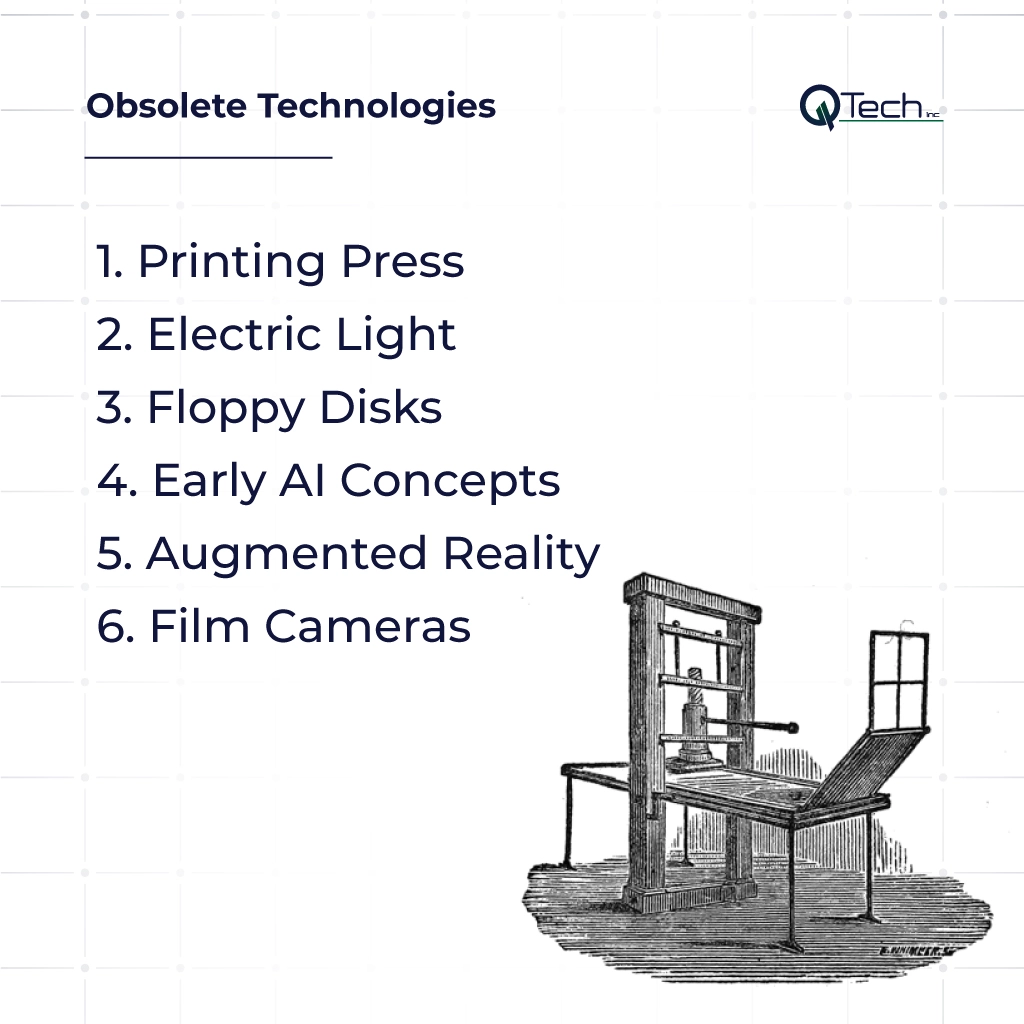
Invented in the 15th century, the printing press by Johannes Gutenberg revolutionized how knowledge was shared. Before it, information was locked within monasteries and handwritten manuscripts. The press democratized learning, leading to scientific revolutions and the birth of modern education.
Its impact endures in today’s World Wide Web, which similarly democratizes information. Just as Gutenberg’s invention accelerated communication, Tim Berners-Lee’s creation of the web connects billions. Both prove that access to information drives progress — whether through ink or code.
Electric Light
When Thomas Edison introduced the electric light, it transformed the United States and the world. Factories could operate through the night, and cities were illuminated, casting entire skylines aglow. Beyond convenience, it symbolized human control over darkness, a triumph of engineering and imagination.
Today’s laser beam technology and LED systems evolved from this innovation. The journey from filament to photon represents how small improvements compound into global revolutions. Electric light is more than an invention; it’s a metaphor for how a single bright idea can illuminate the path forward.
Floppy Disks
Once the backbone of digital storage, floppy disks captured the early dreams of data portability. Their decline ushered in CD players, CD-ROMs, and eventually the cloud — proving that storage innovation is a continuum, not a replacement.
In the digital age, their influence is visible in every USB drive and streaming service. The concept of transferring information quickly and efficiently remains, even as the medium changes. Floppy disks remind us that innovation from obsolete tech is the natural rhythm of progress.
Early AI Concepts
The notion of artificial intelligence began long before chatbots and algorithms. Early thinkers like Alan Turing imagined machines capable of reasoning. Those early frameworks, though limited by hardware, established the logic that drives modern AI systems today.
What was once a theory is now a business-critical technology. From predictive analytics to automation, the old tech influence on modern tech proves that imagination precedes execution. Yesterday’s “impossible” ideas become tomorrow’s essential tools.
Augmented Reality & Analog Visual Tech
Long before AR headsets, analog projection systems, and stereoscopic viewers offered immersive experiences. These early tools blended art and science, laying the groundwork for interactive media.
The evolution from analog to augmented reality shows how innovation thrives when creative vision meets technological advancement. The past’s constraints, bulky hardware, and limited visuals pushed developers toward lighter, more integrated solutions. Today’s AR owes much to those pioneers who experimented with the analog imagination.
Analog / Film Cameras to Digital Imaging
The shift from analog to digital photography symbolizes the tension between tradition and transformation. Film required patience, precision, and artistry; digital cameras offered immediacy and accessibility. Yet both share the same goal, capturing reality.
Modern smartphones merge both worlds: vintage filters emulate analog warmth, while AI sharpens images with precision. This fusion exemplifies innovation inspired by past technologies, where nostalgia and innovation coexist beautifully.
Key Lessons for Innovators & Businesses
Adaptability is essential: the ability to evolve vs get stuck in legacy
Businesses that cling to outdated systems risk extinction. Like the floppy disk or cassette tape, legacy models lose relevance if they fail to evolve. Adaptability ensures survival in a landscape defined by rapid technological development.
Whether upgrading to a modern IT infrastructure or exploring modern marketing strategies, companies must evolve with intention. The winners in every era are those who balance innovation with adaptability.
Incremental improvement often outlasts flashy new features
Progress doesn’t always mean starting from scratch. The steam engine wasn’t born perfect; it was refined over decades, most famously by James Watt. Similarly, small optimizations in existing systems often create long-term value.
Businesses today can apply this mindset by improving current tools rather than chasing every trend. Incremental innovation builds resilience and sustainable growth.
Simplicity & user experience matter
The downfall of many obsolete technologies stemmed not from lack of function, but from poor usability. The personal computer and mobile phones succeeded because they simplified access to complex tools.
In the digital marketplace, clarity and usability remain critical. Companies that prioritize user experience often achieve stronger customer loyalty and brand trust — key components of lasting success.
Use of constraints to drive creativity
Every technological leap is born from limitation. When engineers worked within the constraints of storage, they created the compact disc. When data transfer was slow, they invented compression algorithms. Constraints spark creativity; they don’t hinder it.
For today’s innovators, embracing limits leads to breakthroughs. Tight budgets, small teams, or limited data can all inspire smarter solutions if approached creatively.
How to Apply These Lessons Today
Audit your tech stack & legacy systems for bottlenecks
Businesses should begin by assessing their digital ecosystems. Identify outdated platforms that slow productivity or security. By modernizing these systems, companies align with evolving technologies and enhance long-term performance.
This process is part of future-proofing operations, ensuring today’s tools can adapt to tomorrow’s needs.
Leverage retro design principles for better UX
Minimalism, bold typography, and clean interfaces aren’t new; they’re inspired by early industrial and analog design. Applying these retro design principles improves clarity and engagement in the digital experience.
By learning from past design simplicity, brands can create user journeys that feel intuitive and timeless.
Innovate by combining old & new (e.g., minimalism meets AI)
True innovation blends eras. Imagine AI-driven tools using vintage aesthetics or human-centered design inspired by analog craftsmanship. This approach bridges emotional familiarity with technological advancement.
Companies that embrace this philosophy capture both innovation and authenticity, creating products that resonate across generations.
Future-proofing: design with evolvability
Designing with evolvability means anticipating change. Products and systems should grow with technology rather than resist it. Businesses that build flexibility into their infrastructure ensure they remain relevant through rapid transitions.
It’s about embracing technology evolution, turning adaptability into a long-term advantage.
Conclusion: How Q-Tech Inc. Incorporates Lessons from the Past into Future-Focused Innovation
At Q-Tech, Inc., innovation means respecting the past while engineering the future. Our teams draw on the historical tech innovation that paved the way for digital transformation. From legacy IT systems to advanced cloud and AI solutions, we help businesses bridge yesterday’s lessons with tomorrow’s possibilities.
By studying lessons from obsolete technologies, we empowers clients to build smarter, more resilient systems. Whether upgrading networks, redesigning websites, or crafting modern marketing strategies, we translate old tech influence on modern tech into forward-thinking growth.
Innovation is a continuum, and we stands at its intersection, where the echoes of the past inspire the innovations of the future.forward-thinking solutions.
FAQ
What can we learn from failed or obsolete technologies?
Answer – Obsolete technologies reveal insights about user behavior, market timing, and innovation strategy. They remind us that success isn’t about having the most advanced tech—it’s about solving a real human problem at the right time, in the right way. Each failure serves as a case study in product-market fit, design thinking, and foresight.
Is the cycle of technological obsolescence accelerating?
Answer – Yes. Advances in computing power, global connectivity, and platform-driven ecosystems have sped up how quickly technologies become outdated. Yet, the core lessons about success and failure remain constant—understanding users, timing, and adaptability remain timeless factors in innovation.
What’s the difference between a “fad” and a truly transformative technology?
Answer – A fad addresses a short-term desire or novelty (like Google Glass), while a transformative technology solves a deep, lasting human problem and creates new habits or industries (like the smartphone). The key difference lies in the depth of value delivered and the ecosystem that grows around it.
What is a modern example of an innovation that learned from an obsolete technology?
Answer – The transition from floppy disks to cloud storage illustrates this perfectly. Floppy disks revealed the need for portable, shareable data, but their limits—low capacity and fragility—paved the way for secure, scalable, decentralized storage. Cloud computing is the evolution of that same core need, reimagined for the digital age.