
Marketing is entering a new operating model. The biggest shift behind digital marketing trends 2026 is not a new channel; it’s the rise of AI systems that can plan, create, test, and optimize across touchpoints with minimal friction.
In 2026, artificial intelligence moves from “assist” to “act.” It will draft campaign variations, recommend budget splits, and adapt messaging in near real time, while your team sets the strategy, guardrails, and brand voice.
For growth-minded leaders, this change is practical, not theoretical. Businesses that upgrade their workflows—better targeting, faster content creation, smarter attribution—will outpace competitors still running manual playbooks. That’s the core idea of digital marketing trends 2026.
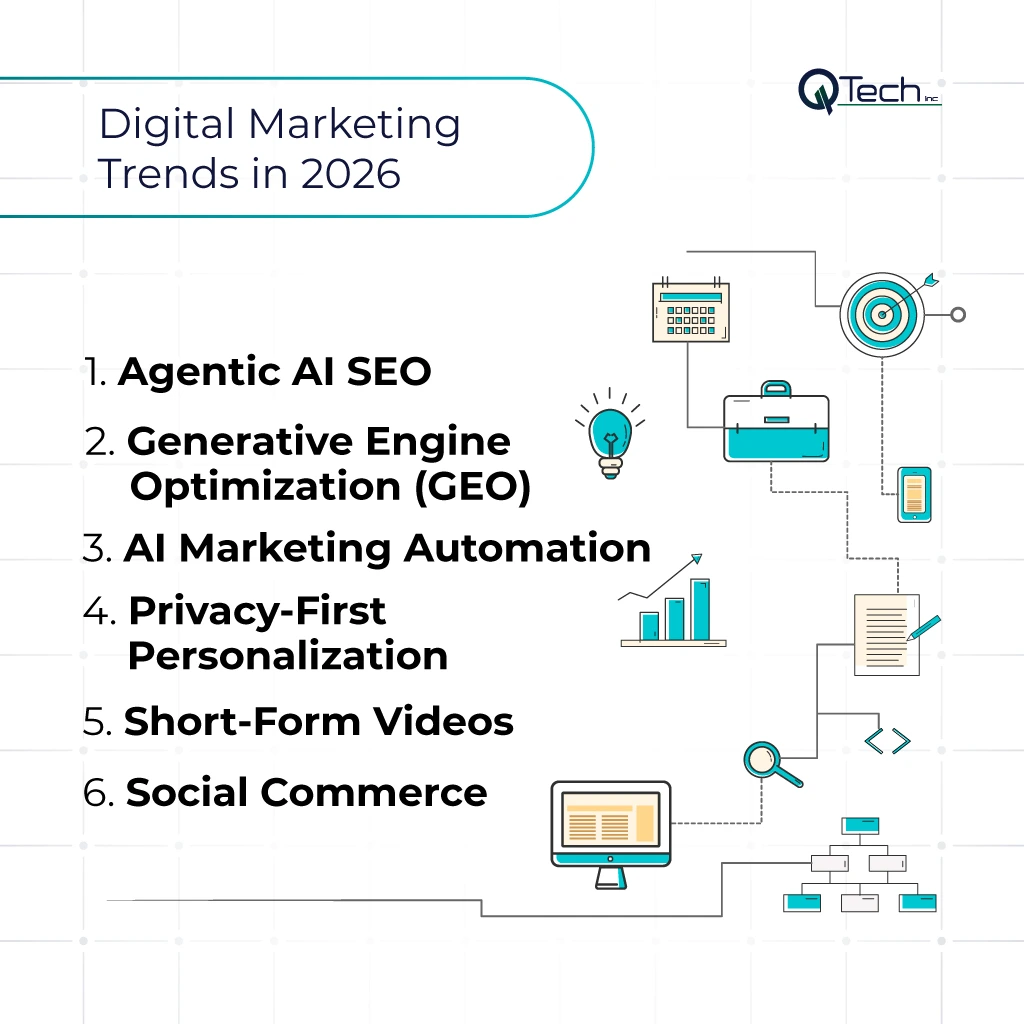
What are the Top Digital Marketing Trends in 2026?
- Agentic AI SEO
- Generative Engine Optimization (GEO)
- AI Marketing Automation
- Privacy-First Personalization
- Short-Form Videos
- Social Commerce
The strongest marketing trends are converging: agentic AI for search visibility, GEO for AI answers, automation for scale, privacy-first personalization, short-form video for attention, and social commerce for conversion. Together, they reshape how brands earn trust and drive customer engagement.
One important note: social media marketing trends 2026 are no longer separated from search, ecommerce, and customer support. The most effective brands will treat every platform as part of one connected journey, from discovery to decision to retention.
1. Agentic AI SEO
Agentic AI SEO refers to AI agents that can execute multi-step SEO work: research intent, cluster topics, recommend internal links, flag technical issues, and monitor ranking changes. It doesn’t replace expertise, but it reduces cycle time from weeks to days.
For service businesses, hyper-local AI SEO becomes a growth lever because people search with urgency and context. Agents can map location pages, refine “near me” intent, and align copy with local pain points and products or services—without losing brand consistency. The goal is not to “game” search; it’s to earn visibility by being the best answer in your market.
2. Generative Engine Optimization (GEO)
Generative Engine Optimization (GEO) is the practice of making your brand discoverable inside AI-generated answers, not just blue links. You still need traditional SEO, but you also need content that models can summarize accurately and confidently.
GEO rewards clarity, entity signals, and proof. That means consistent terminology, direct definitions, structured page layouts, and real evidence such as case studies, FAQs, and original insights. In other words, geo is about being easy to cite and hard to misinterpret.
A practical way to get started is to publish “explainers” your audience actually needs, then reinforce them with supportive assets: short videos, comparison pages, and a clear internal linking path. When your content consistently answers follow-up questions, AI systems have more confidence surfacing it.
3. AI Marketing Automation
In 2026, marketing automation is less about “send this email” and more about coordinating journeys across email, SMS, ads, and web personalization. A strong marketing automation platform uses machine learning to score leads, predict churn, and trigger next-best actions.
The best systems are ai driven but transparent. They document why a customer moved to a new segment, what data was used, and how outcomes are measured—so humans can audit decisions and keep the brand aligned.
4. Privacy-First Personalization
Privacy-first personalization focuses on customer experiences that feel relevant while respecting consent. With less third-party tracking, brands will rely more on first-party data, contextual signals, and preference centers that let people control what they receive.
The winners will earn data by delivering value: useful content, faster service, member perks, and consistent support. When personalization is tied to outcomes—better help, better offers, better timing—it improves trust and shopping experience at the same time.
To do this well, many brands are investing in server-side tracking, consent-aware analytics, and “zero-party” preferences collected directly from customers. Done right, you get relevance without overreach—and reporting you can still trust when cookies fade.
5. Short-Form Videos
Video marketing continues to dominate because it compresses education, proof, and emotion into seconds. Short form videos perform best when they are specific: one problem, one outcome, one clear next step.
The most effective formats blend influencer marketing with user-generated content: customer demos, behind-the-scenes clips, staff expertise, and quick comparisons. With AI tools, marketing teams can repurpose one shoot into multiple edits for different social media platforms without diluting the story.
6. Social Commerce
Social commerce turns discovery into purchase inside the feed. On leading social commerce platforms, people can watch a creator explain a product, tap to see variants, and buy products without leaving the app.
Social commerce strategies depend on trust signals: reviews, creator credibility, live demos, and fast customer support. Features like TikTok shopping raise expectations for a frictionless checkout and a guided shopping experience, especially on mobile.
How Businesses Should Prepare for Marketing in 2026
Preparation starts with your data and your voice. Clean up first-party data, define your brand standards, and make sure your website is technically sound—because AI in marketing performs best when it has clear inputs and consistent messaging to learn from.
Next, align people, process, and platforms. Train marketing teams on prompt hygiene, review workflows, and performance metrics, then connect your CRM, analytics, and automation tooling. When content creation and measurement live in the same ecosystem, you can test faster and learn faster.
Then build an experimentation roadmap. Pick two to three bets per quarter: a GEO content hub, a local landing page refresh, a short-form video series, or a new social commerce flow. Track a few leading indicators—click-through rate, lead quality, repeat visits—so you can scale what works.
Just as important, modernize how you evaluate creative. Use holdout tests where possible, set clear definitions for success, and make sure reporting is shared across sales and marketing teams. The goal is one source of truth, not competing dashboards.
Finally, treat AI as a capability you manage, not a shortcut you chase. When your team combines strategy, creativity, and governance, you get compounding returns from every channel—not scattered wins that fade after one campaign.
Conclusion — Future-Ready Digital Marketing with Q-Tech Inc.
Digital marketing trends 2026 are not about doing more. They’re about doing the right things with more precision: agentic AI SEO and GEO for visibility, automation for scale, privacy-first personalization for trust, and video plus commerce for conversion.
If you want a partner who can connect strategy, systems, and storytelling, Q-Tech Inc. can help you build a future-ready plan that turns innovation into measurable growth—without sacrificing brand integrity.
FAQ
Q: What is the difference between SEO and GEO?
A: SEO focuses on winning clicks from a list of blue links. GEO (Generative Engine Optimization) focuses on getting your brand’s unique data and perspective included in an AI-generated summary. In GEO, being cited as a source is more valuable than a high page rank.
Q: Will SEO still be important in 2026?
A: Yes, but it’s evolving into Answer Engine Optimization (AEO). Success depends on optimizing content to be directly cited by AI models and voice assistants through clear, authoritative, and structured information.
Q: How can a small business keep up with these trends?
A: Focus on foundational trends first: enhance your website’s user experience, create valuable video content, and ensure your business information is accurate for voice search.
Q: What is social commerce and why does it matter?
A: Social commerce refers to shopping directly in social media apps. It matters because it reduces friction in the buying journey, leverages social proof, and combines discovery with purchase — boosting sales.
Q: What does privacy-first marketing mean?
A: Privacy-first marketing focuses on user consent, first-party data collection, and cookieless strategies, responding to tighter data regulations and changing user expectations around data privacy.