

Every business, no matter how exceptional its products or services may be, will eventually face the sting of a negative Google review. While it may feel disheartening at first, a poor review doesn’t have to destroy your business reputation. Instead, when handled strategically, it can actually strengthen customer loyalty, showcase professionalism, and improve customer satisfaction in the long run.
In this guide on how to handle a negative Google review, a guide to protect your reputation, we’ll walk through practical strategies, proven frameworks, and professional approaches to turn criticism into opportunity.
By the end, you’ll not only understand how to handle negative Google review situations but also how to build a positive reputation that fosters long-term customer happiness and trust.
Why Negative Google Reviews Matter
Impact on local SEO, trust, and conversions
Negative Google reviews can directly impact how potential customers perceive your business. Since reviews play a role in local SEO, having unresolved complaints can lower search visibility and reduce conversions. Prospects often compare ratings when deciding where to spend their money, and even a single poor review can influence decision-making. On the flip side, a well-crafted customer complaint response shows transparency, care, and professionalism — qualities that increase customer trust.
Additionally, the way you respond to negative Google review entries influences conversions. A calm, solution-oriented response demonstrates commitment to customer interactions and reinforces that your products or services are backed by integrity and accountability. Businesses that demonstrate improved customer satisfaction through engagement often see higher conversions and stronger customer retention.
Review visibility and consumer behavior
Google reviews are one of the first things people see when searching for a business. Their high visibility means that customer feedback — positive or negative — carries significant weight. Studies show that most people trust online reviews as much as personal recommendations. This means that failing to address poor reviews can erode customer loyalty before you even have a chance to engage.
Conversely, responding well can encourage loyal customers to defend your business, leave positive reviews, and highlight customer happiness. This cycle of open communication not only supports reputation management but also measures customer satisfaction through genuine dialogue. Businesses that embrace reviews as a feedback tool often see increases in customer satisfaction scores and improved net promoter score (NPS) results over time.
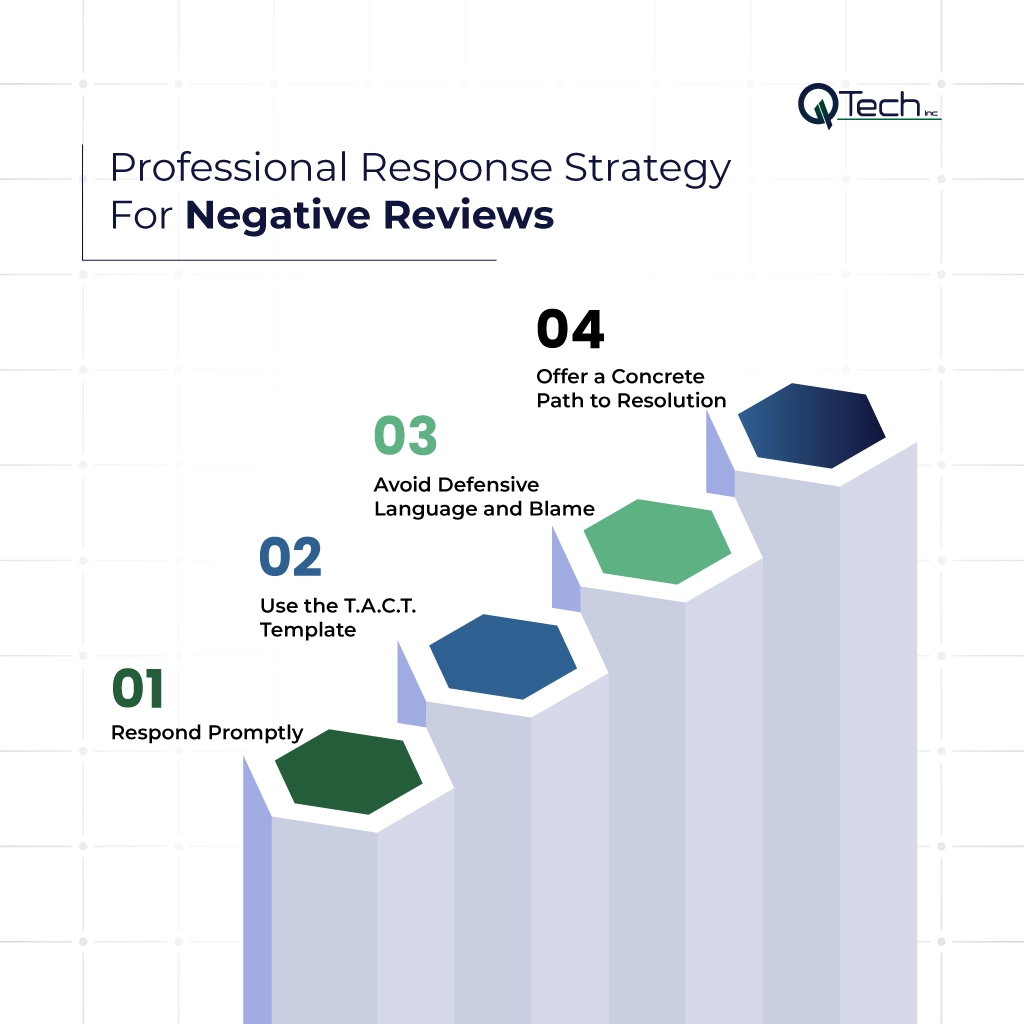
The 4-Step Professional Response Strategy
Step 1: Respond Promptly (Aim for 24–48 Hours)
Timeliness is key. A delayed reply can make a customer feel ignored, which may worsen the situation. Businesses should respond within 24–48 hours to acknowledge the issue.
This shows attentiveness, seriousness, and commitment to customer interactions. Even if you don’t have an immediate solution, responding quickly signals respect and dedication to customer happiness.
Prompt responses also reassure other potential customers that your business prioritizes complaint response and doesn’t shy away from addressing challenges. The faster you reply, the more likely you are to turn an unhappy reviewer into a satisfied customer.
Step 2: Use the T.A.C.T. Template (Thank, Apologize, Clarify, Take Offline)
A proven framework for addressing negative reviews is the T.A.C.T. template:
- Thank: Show appreciation for the feedback.
- Apologize: Even if you’re not at fault, apologize for the inconvenience caused.
- Clarify: Gently provide context or correct misinformation.
- Take Offline: Offer to resolve the issue via phone, email, or private message.
This approach keeps the exchange professional, constructive, and customer-focused. By using email templates or direct outreach, businesses can control the conversation while preserving dignity and respect.
Step 3: Avoid Defensive Language and Blame
When emotions are high, it’s easy to become defensive. However, defensive responses can escalate the issue and harm the business’s reputation. Instead, focus on empathy and accountability.
Acknowledge the customer complaint response without dismissing it, and avoid placing blame on the customer. The goal is to maintain professionalism while showing commitment to improved customer satisfaction.
Businesses that consistently use this approach create positive reputation signals and demonstrate strong reputation management practices. In the long run, this encourages loyal customers and enhances brand credibility.
Step 4: Offer a Concrete Path to Resolution
After acknowledging the problem, provide a clear solution. This could include refunds, product replacements, or direct support for services. Offering tangible resolutions demonstrates accountability and strengthens customer loyalty. It also provides a chance to transform a negative experience into customer happiness.
Encouraging satisfied customers to update or amend their review after resolution is a powerful way to highlight customer retention efforts. When future readers see that your business cares enough to resolve complaints, it reinforces a positive reputation and encourages customer interactions.
Handling Persistent or Repeated Negative Reviews
Monitor if the same review is “bumped” or refreshed
Some dissatisfied individuals may attempt to repeatedly post or refresh their negative review to keep it visible. Monitoring patterns is essential for identifying such behavior. Keeping records of these instances helps your team implement an appropriate complaint response strategy.
Escalate to Google support or legal if the review is harassment
Not all reviews are legitimate. If you suspect harassment or identify a fake review, you can flag fake Google review entries through Google’s platform. In extreme cases, legal action may be necessary for defamation or harassment. Businesses should also explore options for Google review removal when reviews violate platform guidelines.
Maintain logs and evidence
Keeping a detailed log of customer interactions, complaint responses, and review updates ensures that your business is prepared for escalation. Documentation not only strengthens your case for review removal but also demonstrates consistent and fair handling of customer feedback.
Reputation Repair: After the Dust Settles
Encourage satisfied customers to leave genuine reviews (without violating guidelines)
Once the issue has been addressed, focus on balancing the narrative. Encouraging satisfied customers to leave authentic reviews helps outweigh the negative ones. While you cannot incentivize reviews, you can kindly invite happy clients to share their experiences. Simple prompts like, “If you’re pleased with our products or services, please feel free to leave us feedback,” go a long way in boosting customer loyalty and improving customer satisfaction scores.
Monitor future reviews; respond quickly
Reputation repair doesn’t end after one response. Continuous monitoring of reviews across platforms and social media ensures that you maintain control of your online reputation management strategy. Responding quickly to both positive and negative reviews demonstrates dedication to customer happiness and helps measure customer satisfaction consistently.
Highlight improvements made in response to feedback
One of the best ways to build trust is to show how you’ve implemented changes based on feedback. Sharing updates on policy improvements, new training, or upgraded customer complaint response processes highlights accountability. Businesses that openly communicate changes often see increases in customer loyalty and higher net promoter score NPS ratings.
Conclusion: How Q-Tech Inc. Can Help with Review Management
Managing online reviews requires more than quick fixes; it demands a consistent, professional strategy. At Q-Tech Inc, we specialize in digital marketing and reputation management solutions designed to safeguard and strengthen your brand’s online presence. Whether you need guidance on customer complaint response, strategies to flag fake Google review entries, or long-term online reputation management, we’re here to help.
Our team works with businesses to create systems that increase customer loyalty, improve customer satisfaction, and build a lasting positive reputation across digital platforms. With a structured approach, your business reputation can transform from vulnerable to resilient — ensuring that every piece of customer feedback becomes an opportunity for growth.
FAQ
Should you respond to every negative Google review?
Answer – Yes, you should respond to every negative review. A response shows potential customers that you care about feedback and are committed to resolving issues. It turns a one-sided complaint into a public demonstration of your customer service. The only exception might be an obvious, incoherent spam review that you are flagging for removal.
Can you get a negative Google review removed?
Answer – You can only get a review removed if it violates Google’s policies. This includes reviews with hate speech, personal information, conflicts of interest (e.g., from a competitor), or are clearly off-topic. Google will not remove a review simply because it is negative or you disagree with it. You must flag it and clearly state which policy it violates.
Does responding to a negative review affect my SEO or rankings?
Answer – It doesn’t directly boost rankings, but it helps your professional image, trust, and user experience—factors that indirectly impact conversions and credibility.
Should I ask a customer to remove or change a negative review after solving the issue?
Answer – You may politely ask if they’re satisfied and ask if they’d consider updating or deleting their review—but don’t pressure them. Their decision must be voluntary.