

In today’s competitive digital landscape, businesses are no longer just selling products—they are selling experiences. Through sensory marketing in a digital world, engaging all five senses online for enhanced customer experience, brands can evoke emotional connections that last far beyond a single click. By strategically designing every touchpoint to trigger sight, sound, touch, taste, and even smell, companies can elevate their customer experience design and strengthen brand loyalty in ways that traditional marketing cannot match.
What Is Sensory Marketing and Why Does It Matter in Digital Channels
Sensory marketing is the art of engaging consumers through sensory perception, stimulating one or more of the five senses to build deeper emotional connections. In the digital realm, this means using technology to simulate sensations through visuals, audio, and interactive design. Digital sensory marketing is not just about aesthetics; it’s about influencing emotional response, improving user experience, and guiding customer interactions throughout their customer journey mapping.
Businesses adopting a multi-sensory digital experience can differentiate themselves by fostering emotional marketing campaigns that strengthen brand loyalty and customer centricity. When implemented correctly, sensory marketing online transforms a standard website visit into a memorable experience—making customers feel, connect, and remember.
Sense 1: Sight – The Foundation of Digital Experience
Visuals dominate the online world. Sight is the first and most powerful of all sensory elements in digital sensory marketing, setting the tone for how users perceive your brand.
Beyond Aesthetics: Color Psychology and Visual Hierarchy
Colors evoke feelings and influence emotional marketing strategy. Blue conveys trust, while red sparks excitement. Visual hierarchy, achieved through spacing, contrast, and font size, guides the target audience toward desired actions—whether it’s reading more or clicking “Buy Now.” Strategic visual design drives better engagement and reduces sensory overload.
Using Animation and Micro-Interactions to Guide Attention
Motion and micro-interactions bring websites to life. A subtle hover effect, scrolling animation, or icon pulse creates engagement without distraction. These sensory cues help build intuitive customer interactions that feel smooth and responsive.
High-Quality Visuals That Tell a Sensory Story
Strong imagery communicates brand emotion faster than words. From product photos to immersive hero banners, visuals are storytelling tools.
Sense 2: Sound – The Underutilized Digital Superpower
Sound is an often-overlooked but powerful sensory element in shaping emotions and brand recall.
Strategic Use of Background Music and Sound Effects
Music sets the mood and rhythm. From a soft melody on a homepage to a distinct chime after completing a purchase, sound enhances customers’ experience by building emotional continuity.
The Power of Voice and Sonic Branding
Sensory branding extends beyond logos; it includes sound. Sonic logos, like Netflix’s “ta-dum,” create instant recognition. Brands integrating voice technology and audio prompts in chatbots or virtual assistants can humanize digital customer service interactions.
Implementing Sound Responsibly (Auto-play Considerations)
Sound should enhance, not intrude. Auto-play without consent disrupts user experience. Smart brands allow sound opt-ins, reinforcing a sense of control and comfort for users—key factors in effective emotional marketing.
Sense 3: Touch – Creating Tactile Experiences Digitally
Though digital screens limit physical contact, touch can still be simulated using technology and language.
Haptic Feedback and Vibration in Mobile Experiences
Haptic feedback delivers subtle physical cues that mimic touch. Whether it’s a light vibration confirming a tap or a pulse for notifications, this small sensory element enhances engagement and satisfaction.
UI/UX That Mimics Physical Interaction
Buttons that depress visually, draggable sliders, and 3D animations simulate tactile sensations. These mimic the satisfaction of “pressing” or “swiping,” which strengthens the user’s sense of interaction.
Descriptive Language That Evokes Physical Sensation
Words can make users “feel.” Phrases like “smooth navigation” or “crisp visuals” stimulate sensory perception, making digital experiences more immersive even without physical contact.
Sense 4: Smell – The Digital Frontier
While smell is the most challenging sense to replicate online, its psychological power is undeniable.
Using Scent-evoking Imagery and Descriptive Language
A bakery’s website that shows steam rising from warm bread evokes aroma through imagery and text. Sensory marketing online uses these associations to make experiences more vivid and emotional.
The Psychology of Scent Association in Marketing
Smell triggers memory faster than any other sense. Brands that describe scents like “fresh linen” or “ocean breeze” activate imagination, driving stronger emotions brands and increasing brand loyalty.
Emerging Technologies: Digital Scent and the Future
Innovations in virtual reality and scent-emitting devices are bringing smell to digital environments. As digital sensory marketing evolves, expect websites and ads that literally “smell like” their message.
Sense 5: Taste – Creating Flavor Experiences Online
Even taste can be simulated digitally through visuals, words, and imagination.
Mouth-watering Food Photography and Descriptions
High-definition images of food can make viewers salivate. The right copy—“crispy,” “juicy,” “velvety”—creates a multi-sensory illusion of flavor and texture.
The Language of Taste in Non-Food Marketing
Taste isn’t limited to food brands. Describing a luxury product as “refined,” “smooth,” or “bold” taps into flavor-based emotions, enhancing emotional response across industries.
Virtual Tastings and Flavor-focused Content
Brands now host online tasting events and AR experiences. Integrating virtual reality with social media live streams gives customers the feeling of “being there,” enriching the multi-sensory digital experience.
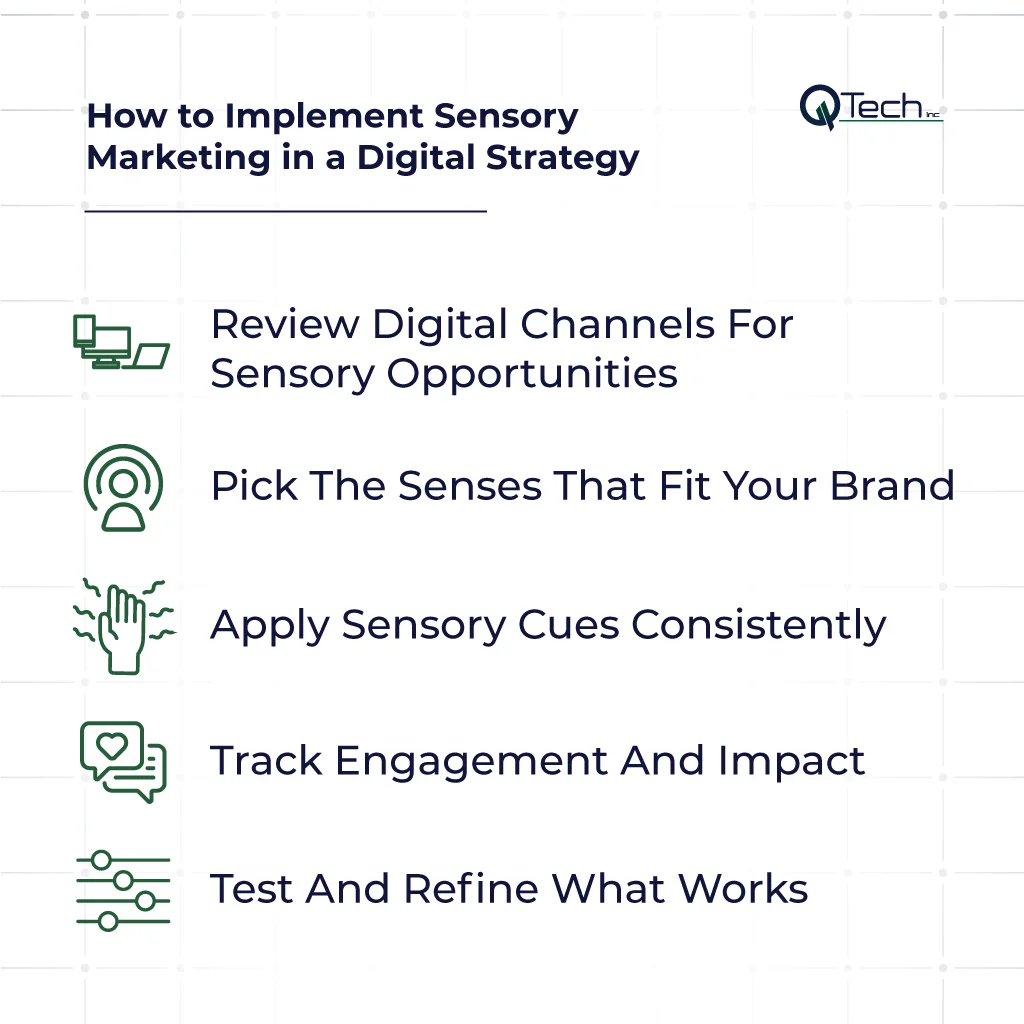
How to Implement Sensory Marketing in a Digital Strategy
Sensory engagement works best when integrated into a holistic digital plan.
Review Digital Channels for Sensory Opportunities
Audit all your touchpoints—website, app, email, and social media—to identify where senses can be engaged.
Pick the Senses That Fit Your Brand
Not every sense applies to every brand. A tech company might emphasize sight and touch, while a coffee brand focuses on smell and taste.
Apply Sensory Cues Consistently
Consistency builds trust. Align all sensory cues—colors, tones, words—across your platforms through unified customer experience design.
Track Engagement and Impact
Monitor metrics like time on page, conversions, and emotional response to measure the ROI of your sensory branding strategy.
Test and Refine What Works
Experiment with new tools, especially virtual reality, video, and UX design for sensory-driven websites
Common Pitfalls & How to Avoid Them
Engaging All Senses Without a Plan
Random sensory elements can confuse users. Focus on the most impactful senses for your brand identity.
Ignoring Digital Limits of Senses
Overcompensating for missing senses can lead to sensory overload. Simplicity often enhances clarity.
Using Inconsistent Sensory Cues
Mixed color palettes, conflicting sounds, or disjointed language weaken your marketing campaign. Keep sensory messages aligned with your values.
Not Measuring ROI of Sensory Efforts
Track how sensory changes affect customer interactions, conversion, and retention to ensure results align with goals.
Conclusion: How Q-Tech Inc. Can Help You Build a Multi-Sensory Digital Experience
At Q-Tech Inc., we believe that technology and creativity should work together to create memorable, emotionally resonant brand experiences. Through digital sensory marketing, our team helps businesses design websites, campaigns, and digital strategies that awaken the senses and inspire loyalty. Whether it’s crafting emotional marketing visuals, integrating haptic feedback, or developing UX design for sensory-driven websites, we deliver a truly multi-sensory digital experience that connects with your target audience—not just through screens, but through feelings.
FAQ
Is sensory marketing only for luxury brands?
Answer – No. While luxury brands often lead in multi-sensory strategies, sensory marketing works at every price point. Everyday brands can use sound, visuals, interactivity, and even haptic feedback to create emotional engagement and enhance brand recall among cost-conscious consumers.
How does sensory marketing improve customer experience?
Answer – Sensory marketing enhances customer experience by:
- Building emotional connections with the brand.
- Increasing engagement time on digital channels.
- Improving retention through multi-sensory learning.
- Creating distinctive brand memories that boost loyalty.
- Reducing perceived purchase risk by making experiences feel more tangible.
What tools can help implement digital sensory marketing?
Answer – Leading tools and technologies include:
- High-quality audio and video platforms (e.g., Dolby.io, Vimeo).
- Interactive design frameworks (e.g., WebGL, Lottie, Three.js).
- Haptic feedback tech for mobile experiences.
- VR/AR platforms (e.g., Unity, Spark AR) for immersive storytelling.
- Analytics and sentiment tools to measure emotional and behavioral engagement.
How do you measure the ROI of sensory marketing?
Answer – ROI can be measured by:
- Engagement metrics (session duration, interaction depth).
- Emotional response tracking (AI sentiment analysis, surveys).
- Conversion lift vs. non-sensory campaigns.
- Brand recall and recognition performance.
- Customer loyalty and repeat engagement indicators.