
If you’re planning your growth strategy this year, you’ve likely noticed one thing: social media changes faster than most marketing teams can document it. The social media marketing trends 2026 conversation is no longer about posting more often. It’s about adapting to how people discover, evaluate, and buy—often without ever leaving an app.
This guide is built for decision-makers who want clarity, not hype. Consider it your practical lens on the future of social media marketing—including what’s working now, what’s losing momentum, and the trends to watch if you want consistent leads and revenue. For the record, yes, we will also address the exact phrase some people are searching: social media marketing trends, what’s hot and what’s not in 2026.
Why Tracking Trends Matters in Social Media Marketing
Trends are not just aesthetic changes or new filters. In 2026, they shape how your brand is surfaced in feeds, recommended in-platform, and discovered through search engines that increasingly index social content. If your strategy ignores these shifts, you may still be “active” online—while quietly losing reach, relevance, and conversion opportunities across major social platforms.
How Algorithms & Platforms Evolve
Algorithms evolve when platforms evolve. As user behavior shifts—shorter attention loops, more in-app purchasing, more creator-driven discovery—platforms adjust ranking systems to protect their user base and monetize engagement. That means your content competes not only against peers, but also against entertainment, creators, and commerce experiences engineered to keep people scrolling and buying.
What This Means for Marketers
For marketers, the implication is straightforward: strategy must be flexible. Rigid templates get punished, while adaptable systems win. The best social media trends for business are the ones that change outcomes: stronger engagement quality, higher intent traffic, and better conversion paths from awareness to a clear product or service offer.
What’s Hot
In 2026, what’s “hot” is less about chasing every new feature and more about building a modern operating system for social media marketing—one that blends creative speed, measurable performance, and authentic connection. The themes below are the clearest signals across categories and commerce trends.
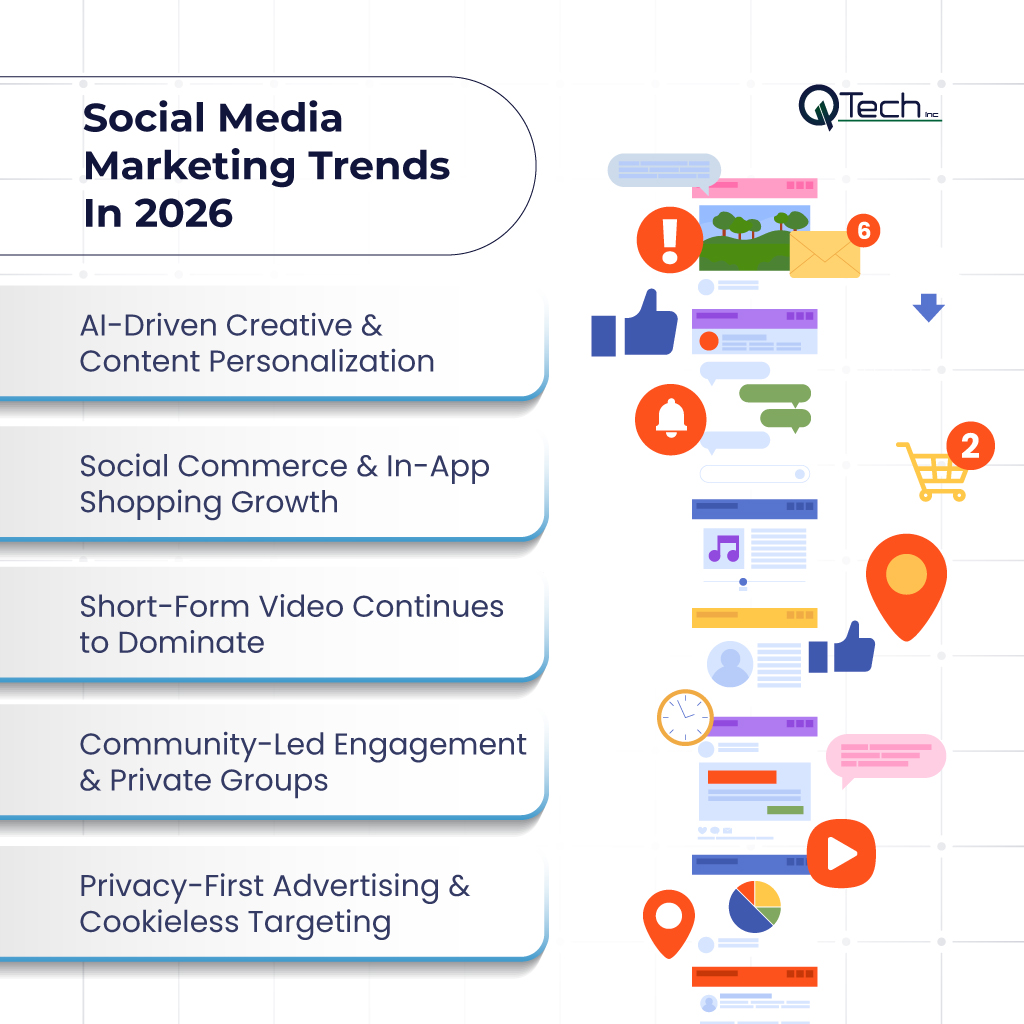
AI-Driven Creative & Content Personalization
AI social media marketing is no longer a novelty; it’s becoming the default engine behind testing, variations, and personalization at scale. High-performing teams are using AI to generate multiple hooks, captions, thumbnails, and creative angles—then using performance feedback loops to refine what resonates for distinct audience segments. The advantage is not “more content.” The advantage is smarter content that matches intent, context, and timing.
The marketers seeing the biggest lift are pairing AI speed with human judgment—brand voice, nuance, and trust-building storytelling. In practice, AI supports rapid experimentation while your team focuses on strategy: what to say, who to say it to, and how to make it feel real rather than manufactured.
Social Commerce & In-App Shopping Growth
Social commerce trends are accelerating because friction is disappearing. Users increasingly expect to browse, compare, and purchase products without leaving the feed. The shopping layer is becoming native across major social commerce platforms, with improved product tagging, better attribution, and smoother checkout flows that reduce drop-off. When executed well, the in-app shopping experience feels less like an ad and more like discovery.
A clear example is TikTok shop, which has normalized buying directly from content—especially when creators demonstrate products in real time. Brands that treat social commerce as a channel (not a side feature) are building repeatable revenue patterns through catalog integration, strong creative, and consistent retargeting.
Short-Form Video Continues to Dominate
The most resilient marketing trend in 2026 is still video—specifically, fast, story-driven clips designed for modern attention spans. Short-form video trends favor clarity and momentum: a strong opening, a simple narrative, and a call-to-action that does not feel forced. This is why short-form video remains the default content format for awareness and top-of-funnel engagement.
Distribution matters, too. A single short-form video platform can perform well, but cross-platform execution is usually where scale happens—think TikTok, Instagram reels plus YouTube Shorts, optimized per channel. Brands that consistently win treat video like a system: weekly creation, fast edits, strong hooks, and a clear path for the viewer to click, call, book, or watch video demonstrations that move them toward purchase. (And yes, the phrase “form video trends” is showing up in searches—proof that even imperfect queries can drive discovery if your content is optimized.)
Community-Led Engagement & Private Groups
Public reach is more competitive, but the community is compounding. Brands are investing in loyalty-driven spaces—private groups, subscriber communities, broadcast channels, and member-only content—because these environments create consistent touchpoints without relying entirely on the feed. In many industries, community-led engagement also improves conversion because prospects can ask questions, see social proof, and interact with real people.
This is also where influencer marketing trends overlap with community: creators are often the most trusted “connective tissue” between a brand and its audience. The most effective influencer marketing partnerships in 2026 focus on credibility, repeated exposure, and measurable outcomes—not one-off posts.
Privacy-First Advertising & Cookieless Targeting
Privacy-first design is no longer optional—it’s the operating reality. As tracking becomes more restricted, teams are leaning into first-party data, on-platform signals, and creative that performs even with limited attribution. “Cookieless” doesn’t mean “data-less.” It means you must be more intentional about measurement, messaging, and how you capture and nurture leads.
Practically, this favors brands that build clear value propositions, strong landing experiences, and content that pre-qualifies the right audience. When your creative does the targeting work—by speaking directly to pain points and desired outcomes—performance becomes more stable even as tracking gets harder.
What’s Not
Some tactics still “work” in the sense that they produce activity, but they increasingly fail to produce business outcomes. Below are five patterns that are losing effectiveness—and why they’re risky if your goal is growth.
1. Static, One-Size-Fits-All Content Calendars
A calendar is helpful, but static calendars that lock you into themes and formats weeks in advance are often misaligned with real-time performance data. In 2026, winning teams use agile planning: they keep a framework, then adjust weekly based on what the audience is actually responding to. Flexibility is the edge.
2. Ignoring SEO for Social Media Profiles & Content
Social search is becoming a primary discovery path. If your profile bios, captions, and titles are not optimized, you are invisible to people actively looking for solutions. This is where social SEO meets search engine behavior: keywords, clarity, and consistency matter—especially for service businesses competing in crowded markets.
3. Treating Social Commerce as an Afterthought
If you post products but do not build an end-to-end path—tagging, catalog integration, remarketing, and optimized checkout—you’re leaving revenue on the table. Social commerce is not just content; it’s infrastructure. Brands that treat it casually struggle to convert even when engagement looks strong.
4. Purely Promotional Brand-Centric Broadcasting
Feeds are not billboards. Content that is always about the brand, always about the offer, and never about the customer’s real questions tends to be skipped. In 2026, the highest-performing brands teach, show, and solve—then earn the right to sell. Helpful content builds trust; trust builds demand.
5. Over-Produced, Inauthentic Video Content
High production is not the problem. Inauthenticity is. Overly polished videos that feel staged can underperform because they don’t match how people consume content today. Audiences respond to clarity, honesty, and relevance—especially in video, where trust signals are immediate. The goal is credibility, not perfection.
Conclusion — Turning 2026 Social Media Trends into Results with Q-Tech Inc.
The headline is simple: the brands winning in 2026 are building modern systems, not chasing isolated tactics. They embrace AI-assisted iteration without losing human voice, they treat social commerce as a revenue channel, they lead with short-form storytelling built for real attention patterns, and they invest in community because trust is the long game.
If you want these trends turned into measurable growth, Q-Tech, Inc. can help you operationalize them. Our team aligns strategy, creative, and performance through professional social media management and conversion-focused content creation—so your brand shows up consistently, connects authentically, and converts reliably across today’s most important social platforms.
FAQ
Q: Why is “social search” becoming so important for marketing?
A: Platforms like TikTok, Instagram, and YouTube are becoming the primary search engines for younger demographics. Users are bypassing traditional search to find products, restaurants, and tutorials via short-form video. Optimizing social profiles and content with keywords, captions, and local tags is now as crucial as website SEO.
Q: What type of social media content is becoming less effective?
A: Overly polished, promotional, and brand-centric content is losing impact. Audiences in 2026 crave raw, authentic, and “in-the-moment” experiences. This includes unedited live streams, behind-the-scenes looks, and content that prioritizes genuine connection over high production value.
Q: How should a small business start preparing for these 2026 trends?
Begin by auditing your current content for authenticity and exploring one new trend. This could mean:
- Using platform-native AI tools for content ideation
- Optimizing your Instagram or TikTok profile for local search
- Partnering with one micro-influencer in your community.
Focus on agile testing over perfect execution.
Q: What is social commerce and why does it matter in 2026?
A: Social commerce refers to shopping directly within social apps (in-app checkout, shoppable posts). It matters because it shortens purchase journeys and increases conversions.