


Voice-enabled devices have trained customers to ask questions out loud, just as they would when speaking to a person. That small behavior shift changes what businesses need to publish, how pages should be structured, and what “good SEO” looks like in practice. If your website still reads like it was written only for typing, you may be missing high-intent opportunities that show up in voice search results—especially for local business discovery and service-based queries.
The good news is that voice search optimization is not a mystery or a gimmick. It is a practical set of improvements that align with what search engines already reward: clarity, relevance, helpful formatting, and a strong user experience—especially on mobile devices. Below are four focused actions you can implement to build content for voice search and strengthen voice search seo performance without sacrificing your broader SEO strategy.
What Is Voice Search Optimization?
Voice Search Optimization (VSO) is the process of tailoring your content so it can be easily discovered, understood, and selected as an answer when people use voice assistants. Instead of competing only for standard blue links, you are also competing to become the spoken answer—often pulled from a featured snippet or a well-structured page that search engines trust.
Practically, voice search optimization blends technical SEO and editorial discipline. It includes writing in natural language, organizing FAQ sections, using structured data and schema markup, ensuring your site is mobile-friendly, and strengthening local SEO signals so you appear for “near me” intent.
How Voice Search Differs from Text Search
Typed searches are often abbreviated. Voice searches are usually full sentences, framed as questions, and tied to immediate intent. A typed query might be “IT support Miami,” while a voice search query is more like, “Who provides managed IT support near me with fast response times?” That difference matters because the page most likely to win is the one that answers the question directly, early, and clearly.
Voice queries also tend to be more specific, which shifts your focus toward long tail keywords and conversational keywords. When your content mirrors how customers actually speak, you help search engines match your page to the intent behind the request—and you increase your odds of being selected as the single spoken answer.
Tips To Optimize Your Content For Voice Assistants
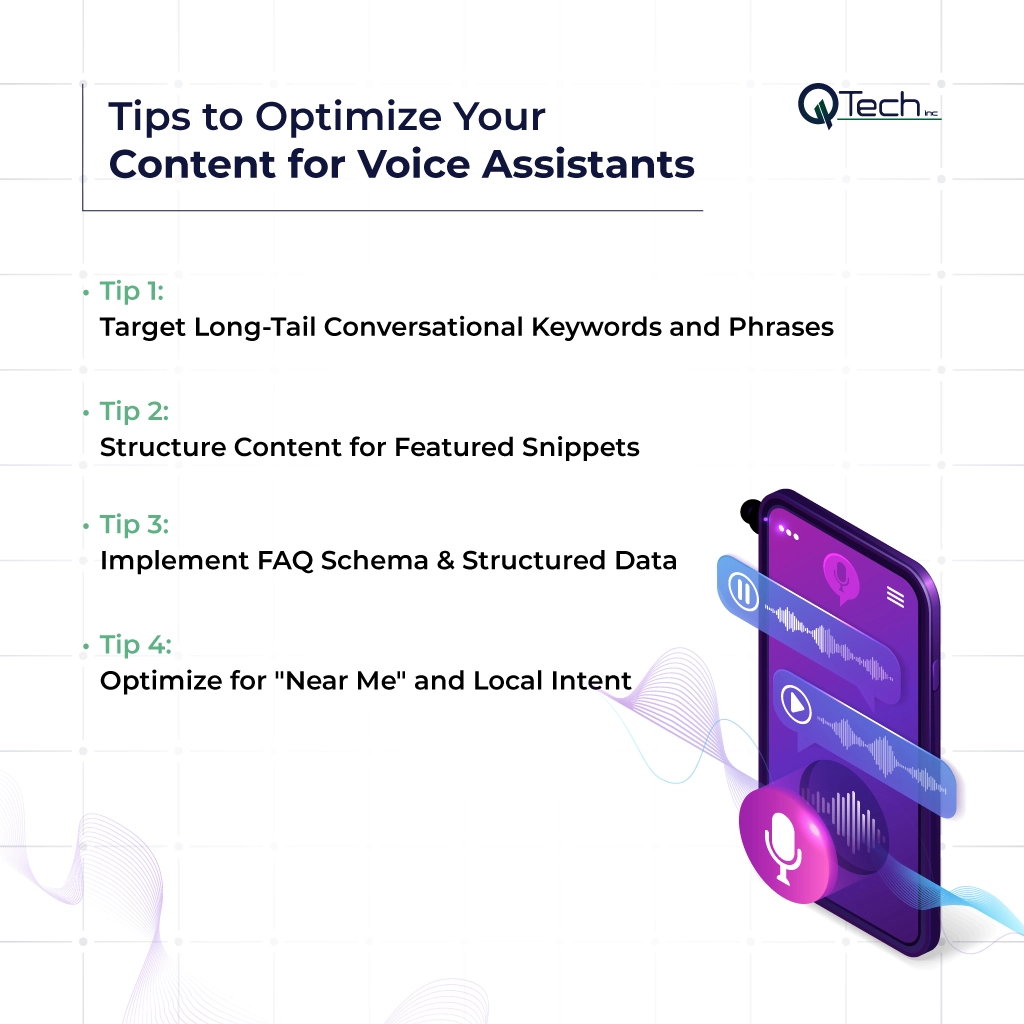
- Tip 1: Target Long-Tail Conversational Keywords and Phrases
- Tip 2: Structure Content for Featured Snippets
- Tip 3: Implement FAQ Schema & Structured Data
- Tip 4: Optimize for “Near Me” and Local Intent
Tip 1: Target Long-Tail Conversational Keywords and Phrases
If your SEO plan is still built around short, high-volume phrases, voice will expose the gap quickly. People do not speak in fragments; they speak in complete thoughts. That is why optimizing for voice starts with capturing the real-world questions people ask and mapping them to pages that provide direct solutions.
Begin by identifying the customer moments that trigger questions: comparing providers, checking availability, asking about pricing, troubleshooting, or finding contact details like phone numbers. Then build content that answers those questions in plain language, with the most important information placed high on the page.
How to Shift from “Keywords” to “Questions”
A useful mindset shift is to stop thinking only about “ranking keywords” and start thinking about “answering questions.” Review customer emails, sales calls, chat logs, and support tickets. Pull recurring phrases exactly as they are spoken, then turn them into headings and short Q&A blocks that fit naturally into your pages and blog posts.
For example, instead of targeting only “IT services,” you might publish content that answers: “What’s the best IT company for small businesses in Miami?” or “How quickly can someone respond if our network goes down?” These question-based formats map cleanly to voice assistants and improve relevance for both voice and traditional google search behavior.
Tip 2: Structure Content for Featured Snippets (Position Zero)
Many voice answers are sourced from position zero—the featured snippet that appears above the standard results. If your page is the snippet, your brand often becomes the voice response. This is one of the most direct paths to measurable gains in voice search results, because it reduces competition to a single “best answer” selection.
To compete for a featured snippet, your writing needs to be scannable and snippet-friendly. This does not mean shallow content. It means that the core answer is concise, with supporting detail below it, so both humans and search engines can quickly interpret the page.
How Voice Assistants Rely on Featured Snippets
When a user asks a question, voice assistants look for pages that resolve that question clearly and confidently. Often, they prefer content that includes a short definition, a list of steps, or a brief comparison. The assistant is effectively reading the “best excerpt” it can find, which is why content formatting becomes a ranking advantage.
This is also where your broader user experience matters. Pages that load quickly, read well on mobile, and present answers without friction tend to perform better across search engines. The same structure that helps a person find the answer fast also helps an algorithm extract it accurately.
Formatting Answers Concisely and Clearly
For each major question you target, include a two-to-three sentence answer directly beneath the heading. Follow it with a short list, table, or step-by-step bullets when appropriate. Keep paragraphs focused on one idea at a time, and avoid burying the answer under a long introduction.
A practical pattern that performs well is: Question heading → direct answer (40–60 words) → supporting explanation → related internal links. Over time, these formats increase your eligibility for the featured snippet while keeping your page helpful and readable.
Tip 3: Implement FAQ Schema & Structured Data
Even well-written pages can underperform if search engines cannot confidently interpret the structure of your answers. That is why structured data is a core component of voice search seo. By marking up your FAQ content with schema, you make your information more machine-readable, which increases the likelihood that your content is understood and used in rich results.
The FAQ schema does not replace good writing—it reinforces it. When your on-page headings, Q&A blocks, and schema align, you reduce ambiguity and help search engines match your page to relevant voice search query variations.
How Schema Markup Makes Your Answers Machine-Readable
Schema markup is a standardized vocabulary that gives search engines explicit context. With the FAQ schema, you are labeling which text is a question and which text is its answer. This improves how your content is parsed, displayed, and potentially surfaced in voice search results.
From a business standpoint, it also supports consistency. Your branded answers are less likely to be misinterpreted, and your site becomes a cleaner data source for voice assistants that prioritize precision.
Tip 4: Optimize for “Near Me” and Local Intent
A significant share of voice searches is local by nature. People ask for nearby services, operating hours, directions, and immediate solutions. If you serve a defined region, local seo becomes a primary lever for optimizing for voice, often with faster wins than broad national keyword competition.
Local optimization is not limited to a location page. It should show up across your site: clear service areas, consistent contact details (including phone numbers), and natural references to neighborhoods, landmarks, and local context that match how customers speak.
The Importance of a Fully Optimized Google Business Profile
A fully built-out Google Business Profile increases your visibility in local packs and supports voice searches that pull business details directly. Ensure your name, address, phone numbers, categories, hours, services, and description are accurate and consistent with your website. Add photos, publish updates, and actively manage reviews to strengthen credibility signals.
Voice assistants often prioritize businesses that appear reliable and complete. When your profile is optimized, and your website reinforces the same details, you improve your chances of being recommended when someone asks, “What’s the best option near me?”
Including Local Landmarks and Natural Language in Content
Local intent is conversational. People do not always say “Miami-Dade County IT provider.” They might say, “near Brickell,” “by the airport,” or “close to downtown.” Where appropriate, integrate local landmarks and service-area language in a natural language style that reads like a human recommendation, not a list of locations.
This approach also strengthens topical relevance across search engines because it connects your services to real-world geographic intent. It is especially effective when paired with pages designed for specific services and industries, supported by internal linking and consistent on-page structure.
Take Away — Optimize for Voice Search with Q-Tech Inc
Voice search is not a future trend—it is a present-day behavior that rewards clarity, structure, and usefulness. When you build content around conversational keywords, format your answers to win the featured snippet, apply schema markup with structured data, and strengthen local seo signals for every local business intent, you give voice assistants what they need to choose your site as the answer.
If you want a practical, end-to-end approach—strategy, technical implementation, and content execution—Q-Tech Inc. can help. If you are ready to connect voice strategy to broader lead generation, campaigns, and conversion improvements start with our voice search optimization approach.
FAQ
Q: What is voice search optimization in SEO?
A: Voice search optimization involves tailoring your content to match how people verbally ask questions to voice assistants using natural language.
Q: How is Voice Search different from traditional SEO?
A: Traditional SEO focuses on short, fragmented keywords (e.g., “SEO tips”), whereas Voice Search focuses on full conversational sentences and questions (e.g., “How do I optimize my website for voice assistants?”).
Q: How do I find the right keywords for voice search?
A: Focus on question-based queries. Use tools like AnswerThePublic, Semrush’s “Questions” report, or even Google’s “People also ask” boxes. Start your phrases with who, what, where, when, why, and how.
Q: Does website speed matter for voice search?
A: Absolutely. Website speed is a critical ranking factor for all search, including voice. Voice search devices aim to deliver answers in milliseconds. Ensure your site loads quickly on mobile.