

Choosing between a static and vs dynamic website can feel like a technical puzzle, but at its core, the decision is about how your business communicates, grows, and serves customers online. As more local businesses and small businesses rely on their website as the “front door” of their brand, the type of website you choose can either accelerate your growth or quietly hold you back.
If you’re wondering “static vs dynamic websites, which one to choose for your business?”, you’re really asking how often your content will change, how interactive your web page needs to be, and how much you are ready to invest in flexibility, automation, and real-time updates. This blog walks you through the pros and cons of each approach, modern hybrid trends, and practical scenarios so you can make a confident, cost-effective decision.
Let’s start with the basics—what is a static website, and what is a dynamic website?
What Is a Static Website?
Definition & How It Works
First, what is a static website? A static website is made up of fixed HTML files that are pre-built and stored on a server. Each time a user visits a web page, the server simply sends back that same static HTML file, no database queries, no complex logic, no on-the-fly scripts to generate content.
Because static sites are so straightforward, they are incredibly reliable. Each page loaded is almost identical for every visitor, with no custom logic or personalized content. For many companies, especially those just starting to build an online presence, this simplicity is a major advantage.
Typical Use Cases
Static sites are ideal when to use a static website for simpler content that doesn’t change daily. Think of company brochures, portfolio pages, event announcements, or basic landing pages that explain your services and invite visitors to contact you.
This type of website works very well for small businesses that want a professional look, but don’t yet need complex features like logins, dashboards, or real-time data feeds. Static sites are also perfect for campaigns that focus on clean, fast, and focused web design with minimal distractions.
What Is a Dynamic Website?
Definition & How It Functions
Next, what is a dynamic website? A dynamic website builds each web page on the fly, usually by pulling information from a database or back-end application. When a visitor lands on a page, the server runs logic and scripts to generate content based on who the user is, what they clicked on, or what data is current.
This allows dynamic sites to adapt in real time, showing different layouts, offers, or features depending on the user. While static sites serve the same HTML to everyone, dynamic sites can tailor the experience and deliver a richer, more interactive user experience.
Common Use Cases
Dynamic websites are used for content management systems (CMS), online stores, membership platforms, and web applications. If your business needs e-commerce features, customer portals, online bookings, or integrated social media feeds, a dynamic site is usually the right foundation.
These sites can handle complex data, support interactive dashboards, and power advanced experiences like SaaS platforms, where each web page may look different for each user and change in real time based on their actions.
Advantages of Static Websites
Speed & Performance
Because static sites send pre-built HTML files with no database calls, they are typically much faster to load. Every page loaded is lightweight, which improves performance on mobile and slower connections.
Search engines and visitors reward this speed, reducing bounce rates and improving engagement. For many local businesses, this performance boost can be the difference between a visitor staying or leaving.
Security Simplicity
Static websites have fewer moving parts. Without a database or complex back-end code, there are fewer entry points for attackers. This reduces common vulnerabilities like SQL injections, making static sites easier to secure.
For organizations with limited IT teams, the reduced attack surface is attractive. You still need secure hosting and good practices, but security management is simpler than for complex dynamic applications.
Low Hosting & Maintenance Cost
Static sites usually require less demanding infrastructure and can run on basic hosting plans or content delivery networks. This makes them very cost-effective, especially for small businesses watching their budgets.
Maintenance is also lighter: without constant plug-in updates or database tuning, your IT team or provider can spend more time on strategy and seo improvement rather than technical firefighting.
Scalability via CDNs and Static Site Generators
Modern static site generator tools can build large static sites from templates and content files, making it easier to manage dozens or even hundreds of pages. Paired with a content delivery network, static sites can handle sudden traffic spikes gracefully.
For campaigns, conferences, or product launches that expect high traffic, static sites make it easier to scale globally while keeping each page loaded quickly and consistently.
Disadvantages of Static Websites
Manual Content Updates
One of the main pros and cons of static website setups is that content updates can be manual. If your site doesn’t use a headless CMS or generator, updating text or images might require editing HTML files or relying on a developer.
If your business publishes news daily or runs frequent promotions, this workflow can slow you down and cause bottlenecks in your marketing and communications.
Limited Interactivity
Static websites are not ideal for complex features like user accounts, shopping carts, or dashboards. While you can add some interactivity with JavaScript, the underlying architecture is still limited.
If your business model depends on interactive tools, calculators, or real-time customer data, you will quickly outgrow a purely static solution.
Not Ideal for Large, Content-Rich Sites
When content grows into hundreds or thousands of pages, a purely static architecture without tooling becomes hard to manage. Complex navigation, tagging, and search features usually require dynamic logic.
At this scale, teams often start to feel the limitations of static or dynamic choices made early, and they look for hybrid approaches that combine the best of both worlds.
Advantages of Dynamic Websites
Interactive & Personalized User Experience
Dynamic websites shine when you need a highly interactive, personalized content experience. They can show different products, messages, or layouts based on user behavior, location, or history.
This enables sophisticated user experience strategies such as product recommendations, tailored dashboards, and targeted promotions that evolve in real time as people engage with your brand.
Easy Content Management via CMS
Most dynamic sites are powered by a CMS that lets non-technical staff update pages through an editor. Instead of editing code, your team can add blog posts, update landing pages, and manage media in a familiar interface.
This is a powerful advantage in the pros and cons of the dynamic website debate, especially for marketing teams that need to move quickly without waiting for developers.
Advanced Functionality: E-commerce, Memberships, Real-Time Data
Dynamic websites support complex features like shopping carts, payment gateways, membership areas, and dashboards with real-time updates. They can pull data from APIs, show inventory levels, and update prices or messages in real time.
If your business model includes online sales, recurring memberships, or data-driven services, a dynamic site provides the flexibility needed to compete and grow.
SEO Benefits of Regular Updates
Search engines appreciate websites that stay fresh and relevant. Dynamic sites make it easier to publish new content, product listings, and blog articles regularly.
By pairing this with structured data and a solid website design, you can create strong signals for search engines. Combined with professional seo improvement, dynamic architectures can deliver powerful organic visibility.
Disadvantages of Dynamic Websites
Slower Load Times Without Optimization
Dynamic sites often require more server processing, querying databases, running scripts, and assembling pages on demand. Without optimization, this can lead to slower page load times.
Performance tuning, caching, and proper hosting are essential to keep dynamic sites fast. Otherwise, visitors may leave before your content even appears.
Higher Hosting & Development Costs
More complex functionality comes with higher development and hosting costs. Dynamic websites generally need more capable servers and ongoing technical oversight.
For some small businesses, this investment is justified, but for others, it may feel like overkill compared to a simpler static solution.
Security Risks
Dynamic sites introduce additional security risks (SQL, XSS) due to user input, databases, and interactive forms. Attackers can exploit vulnerabilities in poorly secured code or outdated components.
Effective protection requires regular security reviews, monitoring, and patching, often as part of a broader IT and cybersecurity strategy.
Maintenance Overhead
Dynamic platforms require ongoing maintenance: CMS updates, plug-in patches, database backups, and performance tuning. This maintenance overhead is part of the pros and cons of dynamic website discussion and should be factored into your planning.
Businesses that underestimate this work may find their sites becoming slow, unstable, or insecure over time.
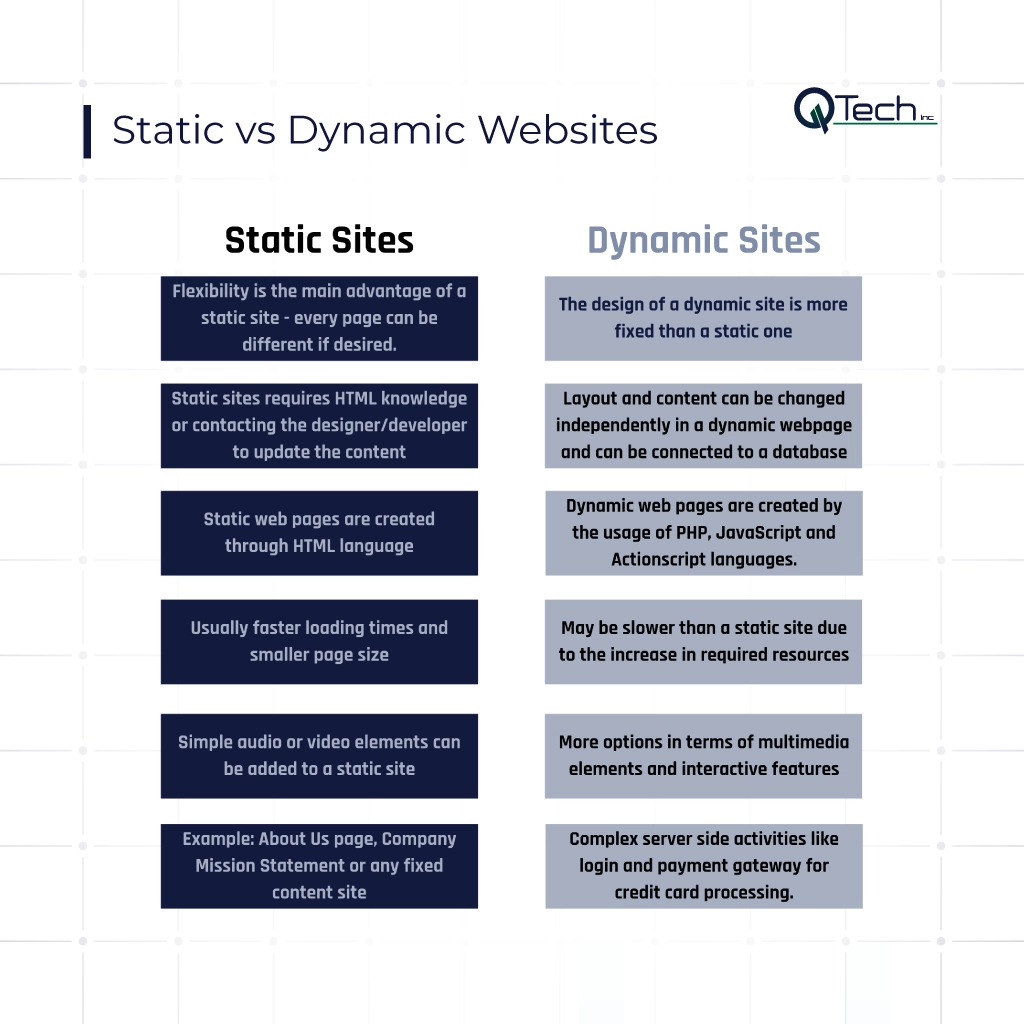
Static vs Dynamic Websites: Key Differences
Speed & Performance: Which is Faster?
In most cases, static sites win on raw speed since they serve pre-built static HTML. There’s no database query between click and page loaded, which makes them feel snappy and responsive.
Dynamic sites can be fast too, but they require smart caching and optimization to keep up. If performance is mission-critical, this difference matters.
Security: Which is More Secure?
A static vs a dynamic website also differs in security exposure. Static architectures have fewer components to attack, while dynamic platforms must secure databases, plug-ins, and application logic.
With the right IT partner, both can be secure, but static sites start with fewer vulnerabilities to manage day to day.
Cost & Maintenance: Budget Implications
Static sites tend to be more cost-effective over time, especially for organizations with modest requirements. Hosting is cheaper, and there are fewer moving parts to maintain.
Dynamic sites usually demand more investment in development, hosting, and long-term maintenance. However, they unlock advanced capabilities that can generate significant ROI when aligned with your business model.
Scalability: Handling Growth and Traffic
Static sites scale easily with CDNs and global hosting. They can handle spikes in traffic with minimal configuration. Dynamic sites scale too, but often need more sophisticated infrastructure planning.
For campaigns or content-heavy sites, many organizations now blend static and dynamic components to balance scalability and flexibility.
Content Management: Ease of Updates
For non-technical teams, dynamic CMS platforms are often easier for daily content updates. Static sites can match this with modern tooling, but require more upfront planning.
The decision comes down to who will update the content and how often. If your marketing team publishes daily, content management may be the deciding factor.
Modern Trends: Hybrid & Jamstack Approaches
Using Static Site Generators + Headless CMS
Modern static site generator solutions and headless CMS platforms blur the line between static and dynamic. Content editors work in a CMS, while the system builds fast, secure static sites for delivery.
This Jamstack-style approach offers many of the performance benefits of static with the editorial flexibility of a dynamic CMS.
When Hybrid Sites Make Sense
Hybrid architectures let you choose static or dynamic per feature. Marketing pages can be static for speed, while e-commerce or dashboards stay dynamic.
This gives businesses a flexible foundation that adapts as they grow, instead of locking them into one extreme or the other.
SEO & Performance Considerations for Static vs Dynamic
How Static Sites Help SEO
Static sites support SEO with fast load times, clean code, and easy crawlability. Search engines can quickly index each web page, improving visibility.
For businesses focused on content clarity and fast experiences, static architectures can provide a strong foundation for organic growth.
How Dynamic Sites Benefit SEO
Dynamic sites excel at frequent updates and rich data structures. They can automatically generate content feeds, product catalogs, and category pages that keep your site fresh.
When combined with structured data and expert seo improvement strategies, dynamic architectures help businesses compete in crowded markets.
How to Decide What’s Best for Your Project
Key Questions to Ask
To choose between static or dynamic, ask: How often will your content change? How interactive does your site need to be? What is your budget and IT capacity?
These questions help you move beyond technology jargon and focus on what will actually support your customers and your long-term goals.
Example Scenarios
A simple portfolio site, brochure site, or small blog for small businesses often works best as a static solution, especially when speed and cost control matter most.
E-commerce platforms, membership portals, and SaaS products usually require dynamic features and personalized content that a static-only architecture cannot deliver.
Final Thoughts: Static or Dynamic — Make the Right Choice with Q-Tech Inc
Whether you choose a static, dynamic, or hybrid architecture, your website is the centerpiece of your online presence. The decision isn’t just technical it’s strategic, shaping how customers experience your brand, how your IT systems scale, and how your marketing performs across search and social media.
At Q-Tech Inc., our IT and web design experts help you evaluate the pros and cons of static websites and dynamic options, align them with your business model, and design a solution that can grow alongside you. We specialize in website design, IT infrastructure, and SEO strategies that give local businesses and established enterprises alike a competitive edge.
If you’re still unsure about static vs dynamic websites, which one to choose for your business, our team can guide you through workshops, audits, and roadmaps to arrive at a clear plan. Together, we’ll design and build a site that feels fast, secure, and future-ready no matter how many users, products, or ideas you bring online next.
FAQ
Q: What is the main difference between a static and dynamic website?
A: The main difference is when and how the web page is generated. A static website serves pre-built, fixed HTML files to every visitor. A dynamic website generates pages in real-time when requested, often pulling content from a database and customizing the page based on user data, location, or behavior. Think of static as a printed brochure and dynamic as a live, interactive application.
Q: Is a WordPress site static or dynamic?
A: A traditional WordPress site is a dynamic website. It uses PHP on the server-side and a MySQL database to generate each page when a user visits. However, WordPress sites can be converted to static HTML files using special plugins for improved speed and security, creating a static version of a dynamically-managed site.
Q: When should a business choose a dynamic website over a static one?
A: A business should choose a dynamic website if it requires frequent, personalized content, complex user accounts (logins/profiles), e-commerce functionality, or if content needs to be managed easily by non-technical staff via a CMS like WordPress or Drupal.
Q: Which type of website is cheaper to build and maintain?
A: Generally, static websites are cheaper to host and maintain. They require less server processing power and have fewer security vulnerabilities to manage. However, if you need frequent content updates without technical skills, a dynamic website with a Content Management System (CMS) like WordPress might have a lower long-term cost for content management, even with higher hosting costs.