
If you have ever searched for “why every website needs https,” the answer comes down to protection, trust, and performance. Today, secure websites are not just for banks or large retailers. Every business website, from a simple brochure site to a service portal, sends and receives data through web browsers, and that information deserves protection.
An HTTPS connection helps keep visitors safe, supports credibility, and strengthens your digital presence from the first click. HTTPS is the encrypted version of HTTP and relies on TLS, the modern successor to SSL, to protect communication between a browser and a server.
What is an SSL Certificate
So, what is an SSL certificate in plain terms? An SSL certificate is a digital credential installed on a server that proves a site’s identity and enables encrypted communication. Although people still say SSL certificates, the security standard in use today is technically TLS, so you will often see the terms SSL, TLS, and SSL certificates used together.
A certificate contains information about the domain, the issuing certificate authority, and the cryptographic tools needed to establish trust. In practice, a domain certificate tells a visitor’s browser that the site is legitimate enough to begin a secure session.
How Does an SSL Certificate Work?
When people ask, “How does an SSL certificate work?” the process is simpler than it sounds. When a visitor sends an HTTP request to a secure site, the browser and server begin a TLS handshake.
The server presents its certificate, the browser verifies it, and the two sides use a public key and a private key to safely exchange information that creates temporary session keys. Those session keys then encrypt the ongoing conversation so login details, contact form entries, and other sensitive data cannot be easily intercepted or altered in transit. This is one reason HTTPS remains a baseline security standard for modern websites.
Why Every Website Needs HTTPS
HTTPS is no longer optional for serious businesses. It protects data, shapes perception, and helps a site operate in line with current technical and user expectations.
Reason 1: Data Protection
The most obvious reason to use HTTPS is data protection. Even if your site does not process payments, it may still collect names, emails, search queries, or form submissions. Without encryption, that traffic can be exposed. HTTPS helps safeguard sensitive data during transmission and reduces the risk that customer information is viewed, changed, or captured by the wrong party.
Reason 2: Customer Trust
Trust is built in seconds and lost just as quickly. Visitors notice whether a site feels secure before they decide to browse, submit a form, or call your business. A valid certificate signals professionalism and care, while an unsecured connection can raise doubts about legitimacy. In a competitive market, that trust signal matters because people are far more likely to stay on a site that feels safe and credible.
Reason 3: SEO Ranking Boost
HTTPS also supports search visibility. Google has said that HTTPS is a ranking signal, and it is also one of the signals associated with page experience. It is not a magic shortcut to page one, but it does strengthen the technical seo foundation of your site.
Reason 4: Compliance Requirements (PCI DSS, GDPR)
Compliance is another major reason every site owner should pay attention to. PCI DSS sets baseline requirements for protecting payment account data, and GDPR is designed to protect personal data. HTTPS alone does not make a business fully compliant, but an encrypted transmission is part of a more responsible security posture. For organizations that handle transactions, inquiries, or account information, HTTPS supports compliance-minded operations instead of leaving security gaps wide open.
Reason 5: Browser Warnings
Modern web browsers do not treat HTTP as neutral anymore. Chrome has progressively labeled insecure HTTP pages as “Not Secure,” especially when users enter information, and Chrome continues to warn users when a connection is not secure. Those warnings can damage conversion rates before your content even has a chance to persuade.
Types of SSL Certificates
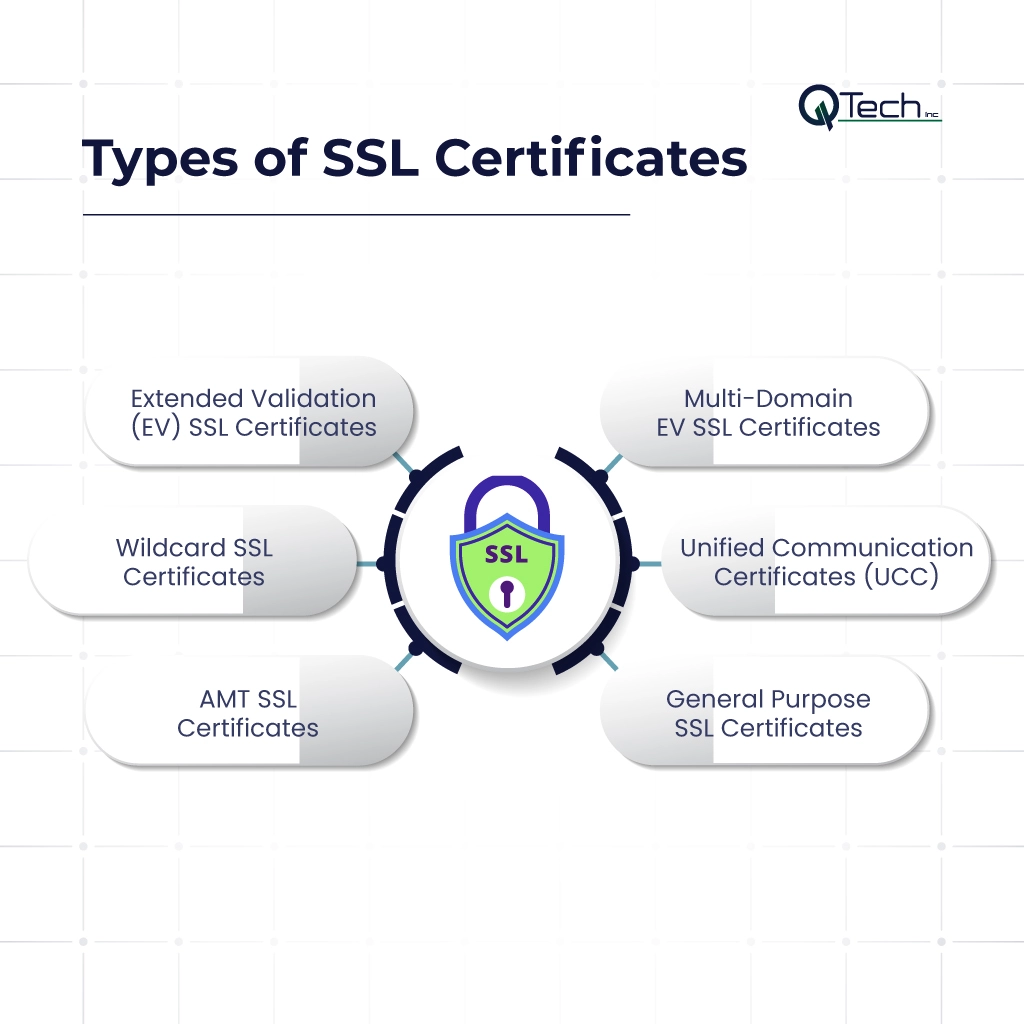
Understanding the types of SSL certificates helps you choose the right fit for your business. There are different levels of validation and different deployment options depending on how many domains or subdomains you need to protect. The right type of certificate depends on your site structure, your trust needs, and whether you manage one domain or multiple websites. The different SSL certificates are:
- Extended Validation (EV) SSL Certificates
- Multi-Domain EV SSL Certificates
- Wildcard SSL Certificates
- Unified Communication Certificates (UCC)
- AMT SSL Certificates
- General Purpose SSL Certificates
Extended Validation (EV) SSL Certificates
Extended validation EV SSL certificates are designed for organizations that want the highest level of identity verification available in a public certificate. An extended validation certificate goes beyond proving domain control and involves deeper checks on the organization behind the site. It is often chosen by brands that want stronger trust signals around high-value transactions or reputation-sensitive interactions.
Multi-Domain EV SSL Certificates
Multi-domain SSL certificates are useful when one business needs to secure several domains under a single certificate. A multi-domain EV option combines broader coverage with stronger identity validation, making it practical for brands managing distinct sites, campaigns, or service portals under one umbrella.
Wildcard SSL Certificates
Wildcard SSL certificates protect a primary domain and its same-level subdomains, such as blog.example.com and support.example.com. They are cost-effective for growing organizations because one certificate can cover many subdomains without requiring separate installations for each one.
Unified Communication Certificates (UCC)
Unified Communication Certificates, often called UCC or SAN certificates, are commonly used in Microsoft Exchange and similar environments. They can secure multiple domain names and host names on one certificate, which makes them a strong option for communication-heavy business systems.
AMT SSL Certificates
AMT SSL Certificates are a specialized option tied to Intel vPro and remote configuration use cases. They are not the usual choice for a standard marketing website, but they matter in enterprise device management environments where secure remote provisioning is required.
General Purpose SSL Certificates
General-purpose certificates are the most common fit for everyday websites. This category may include single-domain SSL certificates for one site and domain validation dv ssl certificates for businesses that want fast deployment and strong encryption without extended identity checks. For many small and midsize companies, this is the most practical starting point.
HTTP vs. HTTPS: What’s the Difference?
The difference between HTTP and HTTPS is encryption and trust. Standard HTTP sends data in plain text, while HTTPS sends it over a TLS-encrypted connection.
That means a normal HTTP page may expose information in transit, while HTTPS helps preserve confidentiality, integrity, and authenticity. From a business standpoint, HTTPS is the professional default. From a user standpoint, it is what people now expect every legitimate website to use.
How to Install an SSL Certificate on Your Website
If you are wondering how to install an SSL certificate, the answer depends on your hosting setup, platform, and technical comfort level. Most companies can choose a hosted option, a free automated option, or a manual server-level installation.
Via Your Hosting Provider (Most Common)
Most hosting providers now make installation simple through a dashboard or control panel. In many cases, the provider issues and renews SSL/TLS certificates automatically, which is ideal for business owners who want security without deep server work. This is usually the fastest route for a standard site built through a managed platform or hosting account.
Using Let’s Encrypt (Free SSL)
Let’s Encrypt is a free, automated certificate authority that helps websites enable HTTPS through the ACME protocol. It is widely used for fast deployment, especially for businesses that want strong baseline encryption without paying for a premium certificate. For many sites, free SSL is a legitimate and secure entry point.
Manual Installation on Your Server
Manual installation makes sense when you manage your own server or need tighter control over configuration. This usually involves generating a certificate signing request, validating the domain, installing the issued files, and updating server settings so all traffic redirects to HTTPS. It is more technical, but it offers flexibility for custom environments and advanced deployments.
Common SSL Myths and Misconceptions
There are still several common SSL myths that prevent businesses from acting. Many of these common myths were shaped by older hosting environments, outdated assumptions, or confusion about cost and performance.
“Only E-Commerce Sites Need SSL”
This is one of the biggest common SSL myths. Any site that collects a form submission, login, email signup, or customer message benefits from HTTPS. Even informational sites build trust more effectively when they protect visitor interactions.
“SSL Slows Down My Website”
That belief is outdated. Modern HTTPS is not the performance burden it once was, and Chrome has noted that HTTPS enables newer capabilities and performance improvements that are not available to plain HTTP pages.
“Free SSL Is Not Safe”
Free does not automatically mean weak. Let’s Encrypt issues domain validation certificates trusted by major browsers, and for many sites, that is more than enough to establish encrypted connections. The better question is not cost alone, but which validation model and coverage pattern your business actually needs.
Conclusion: Secure Your Website with HTTPS Today With Q-Tech Inc.
HTTPS is one of the clearest upgrades a business can make because it improves security, trust, visibility, and professionalism all at once. Whether you need a basic domain certificate, broader protection for multiple websites, or guidance on the right levels of validation, the goal is the same: give visitors a safer experience and give your brand a stronger technical foundation.
If your business is ready to strengthen its site through better website design and development and a smarter digital strategy, Q-Tech Inc. can help you secure your presence and move forward with confidence.
FAQ
Q: Does having an SSL certificate improve my Google ranking?
A: Yes. Since 2014, Google has used HTTPS as a ranking signal. In 2026, it is considered a baseline requirement. Sites without SSL are often filtered out of “Safe Search” results and are less likely to be featured in AI-generated search snippets.
Q: What happens if my SSL certificate expires?
A: Your website will display a “Your connection is not private” warning. This blocks users from accessing your site, destroys your SEO rankings almost instantly, and exposes user data to “Man-in-the-Middle” attacks.
Q: Are free SSL certificates like “Let’s Encrypt” safe for business?
A: Yes, they provide the same level of encryption as paid certificates. However, they only provide Domain Validation (DV). For large enterprises or e-commerce sites, Q-Tech recommends Organization Validation (OV) or Extended Validation (EV) certificates, which provide higher levels of identity verification and consumer trust.
Q: What happens if I don’t have an SSL certificate?
A: Your website will display a “Not Secure” warning in browsers like Chrome, Firefox, and Edge. This scares away visitors, reduces trust, and can hurt conversion rates. Additionally, you may fail compliance requirements (e.g., PCI DSS for payment processing) and risk data interception attacks.