

Introduction – Why AI and Automation Are No Longer Optional
Business expansion once depended mostly on hiring more people, opening more locations, or increasing ad spend. Those tactics still matter, but they no longer guarantee efficient growth. Today, speed, adaptability, and informed decision-making are just as important.
This is where the power of AI becomes practical. Companies using AI for business expansion are not just following a trend. They are building a smarter way to read market trends, reduce friction, and scale with more control. Businesses that delay often find themselves reacting to competitors instead of shaping their own direction.
Automation for business growth matters for a similar reason. As demand increases, repetitive tasks begin to consume time that should be spent on planning, innovation, and relationship building.
Manual data entry, delayed follow-up, and fragmented approvals all slow expansion. By redesigning routine business processes through intelligent automation, organizations can stay responsive without overwhelming their teams. Instead of replacing people, automation makes their work more valuable.
There is also a customer-side reality that businesses cannot ignore. Customer expectations are higher than ever. People want fast answers, tailored communication, and a seamless customer experience across websites, email, and social media. Businesses that leverage AI and automation are better positioned to deliver strong customer service, support good customer service standards, and strengthen customer loyalty while they grow.
How AI Helps In Business Expansion
Predictive analytics for market opportunities
One of the strongest advantages of AI is predictive analytics. Rather than relying solely on historical reports, leaders can use AI to identify patterns that indicate future demand. That helps businesses see where new opportunities may exist, which audiences are most promising, and which products or services are most likely to perform well. Expansion becomes more strategic because decisions are grounded in data rather than guesswork.
This insight is especially valuable when a company is testing a new market, refining pricing, or deciding where to invest resources. Predictive analytics can reveal seasonal patterns, regional demand shifts, and changes in buyer behavior before they become obvious in standard reports. That is a clear benefit of AI for business expansion because it helps organizations act earlier and with more confidence.
AI-powered customer insights and personalization
Growth is easier when communication feels relevant. AI helps businesses understand what customers respond to by analyzing browsing patterns, purchase history, service interactions, and campaign engagement. Those insights allow teams to personalize messaging, offers, and follow-up in ways that feel timely instead of generic. In a crowded market, that kind of relevance helps businesses stand out.
Personalization also supports improving customer retention and overall customer experience. Instead of offering the same message to everyone, companies can use artificial intelligence (AI) and other AI tools to guide website recommendations, email flows, and content decisions. Generative AI can assist with drafting tailored communications or summarizing interactions, while human teams maintain quality control. When businesses are implementing AI thoughtfully, personalization becomes a practical way to deepen trust and increase customer loyalty.
Intelligent lead scoring and sales prioritization
Not every lead is ready to buy, and not every opportunity has the same value. AI can analyze behavior, company data, and engagement signals to rank prospects based on readiness and fit. This helps sales teams focus their time where it is most likely to produce results. During expansion, that kind of prioritization matters because more leads often create more complexity.
AI-driven lead scoring also improves coordination between marketing and sales. Teams spend less time sorting through weak signals and more time engaging qualified prospects. That creates better use of the budget, faster follow-up, and stronger pipeline discipline. It is another major benefit of AI for business growth because the organization can scale outreach without losing focus.
How AI Helps In Business Expansion
Marketing automation
Marketing automation turns strategy into repeatable action. Businesses can automate email nurturing, audience segmentation, campaign triggers, retargeting, and reporting so their marketing stays consistent as they grow. This is one of the most practical examples of automating business because it allows teams to keep momentum across multiple channels without relying on constant manual effort.
When paired with AI, marketing automation becomes even more effective. It can help determine timing, tailor messaging, and identify which campaigns deserve more investment. From lead follow-up to social media distribution, these systems help businesses stay visible and relevant. For companies that want to expand without creating marketing bottlenecks, this is a powerful form of automation for business growth.
Workflow automation
Expansion often exposes weaknesses in internal operations. More requests, more approvals, and more moving parts can overwhelm teams if processes are still manual. Workflow automation streamlines routine tasks such as onboarding, ticket routing, reporting, approvals, and status updates. Instead of chasing people for action, businesses can design systems that move work forward automatically.
This is where business process automation creates measurable value. It reduces delays, limits errors, and frees teams from repetitive work like data entry and manual coordination. The result is not only efficiency, but consistency. That consistency becomes critical when teams are growing quickly, and leadership needs dependable execution across departments.
Leaders gain better visibility into how work flows across departments, and staff can focus on higher-value decisions instead of administrative upkeep.
Supply chain and inventory automation
For businesses managing physical goods, supply chain and inventory automation can make expansion far more stable. AI can help forecast demand, optimize reorder points, and identify patterns that affect inventory levels. As a company enters new markets or adds new product lines, these insights reduce the risk of overstocking, understocking, or delayed fulfillment.
Automation also improves agility. When systems track stock movement and vendor inputs continuously, leaders can respond faster to changes in demand or supply pressure. This lowers disruption and supports a smoother customer experience. It is another strong benefit of AI for business expansion because growth becomes easier to manage operationally.
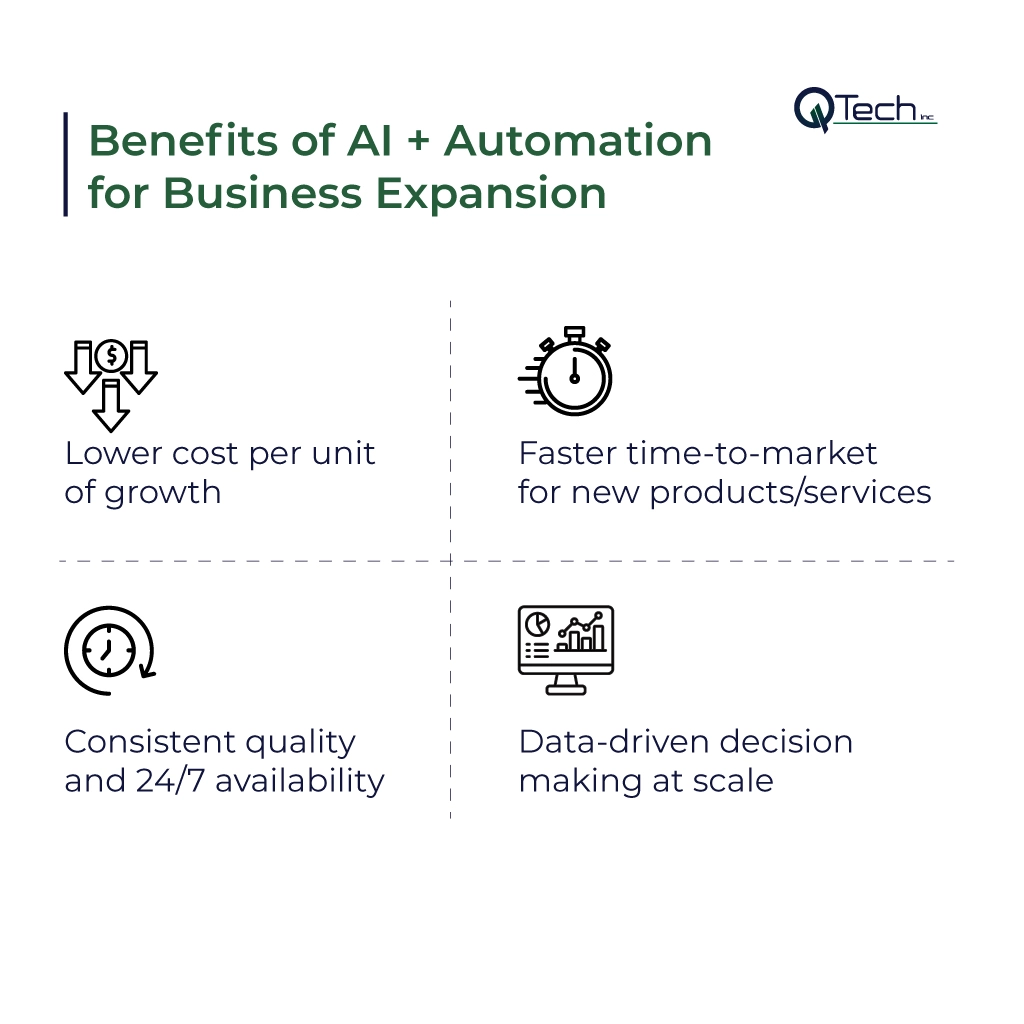
Real-World Benefits of AI + Automation for Business Expansion
- 1. Lower cost per unit of growth
- 2. Faster time‑to‑market for new products/services
- 3. Consistent quality and 24/7 availability
- 4. Data‑driven decision making at scale
Lower cost per unit of growth
AI and automation help businesses handle more work without increasing overhead at the same pace. More leads, transactions, and service requests can move through smarter systems rather than requiring a fully manual response every time. This lowers the cost per unit of growth and makes expansion more sustainable.
Faster time-to-market for new products/services
Speed matters when launching new products or services. AI can surface demand signals, summarize insights, and support faster content development, while automation reduces delays in approvals, routing, and follow-up. Together, these tools help businesses move from idea to execution more quickly and respond faster to changing market trends.
Consistent quality and 24/7 availability
As companies grow, service quality can become inconsistent if every response depends on manual effort. AI and automation help standardize workflows, extend support coverage, and route issues intelligently. That means customers can get quicker responses and more reliable help, even outside normal business hours, while teams focus on the issues that truly require human judgment.
Data-driven decision making at scale
Growth produces more information than most teams can interpret manually. AI helps organize and analyze that information so leaders can make clearer decisions about sales, operations, service, and investment. This is one of the lasting strengths of ai driven systems and intelligent automation: they help businesses scale decision-making, not just activity.
How Q-Tech Inc. Helps Businesses Integrate AI and Automation
At Q-Tech Inc., AI and automation are approached as practical tools for real business outcomes. The goal is not to add complexity for its own sake. It is to help businesses leverage AI in ways that improve efficiency, strengthen engagement, and create a more reliable foundation for growth.
Whether a company is exploring AI tools for the first time or refining more advanced AI models, success depends on aligning technology with business priorities. That alignment matters because the right system should improve decision-making, strengthen operations, and support measurable expansion instead of adding disconnected software.
For organizations focused on growth, outreach, and visibility, we offer marketing AI and automation for business services that support smarter campaigns, personalized communication, and stronger digital workflows. For organizations focused on internal systems and operations, we also provide IT automation for business solutions that streamline infrastructure and reduce manual bottlenecks. Together, these services help businesses connect automation, customer experience, and expansion strategy in a way that is measurable and sustainable.
Conclusion – The Future Belongs to Intelligent, Automated Businesses
The future of growth belongs to businesses that can move with speed, insight, and consistency. That is why AI for business expansion and automation for business growth are becoming core parts of modern strategy. From predictive analytics and personalization to workflow improvements and stronger operational control, AI and automation help companies grow without losing quality or direction.
The benefit of AI for business expansion is not just efficiency. It is better judgment, better timing, and better service as scale increases. The benefit of AI for business growth is that it helps businesses respond to change without being buried by it. For companies ready to grow with clarity and confidence, intelligent automation is no longer a future concept. It is a present-day advantage.
FAQ
Q: How can AI help my business expand into new markets?
A: AI analyzes market data (demographics, competition, demand) to identify the best opportunities. It can also localize marketing content, predict pricing elasticity, and automate customer acquisition campaigns – reducing risk and speeding up expansion.
Q: What’s the difference between AI and automation for business growth?
A: Automation follows predefined rules to execute repetitive tasks (e.g., email sequences, data entry). AI learns from data to make predictions or decisions (e.g., which leads to prioritize). Together, AI decides what to do, and automation executes it – a powerful combination for scaling.
Q: Is AI only for large enterprises?
A: No. Small and medium businesses now have access to affordable AI tools (CRM with AI, chatbots, analytics platforms). Many are subscription-based, so you pay only for what you use. AI levels the playing field, letting smaller companies compete with larger ones.
Q: What are the first processes a business should automate for expansion?
A: Start with high-volume, repetitive tasks that consume employee time but don’t require complex judgment. Examples: lead capture and follow-up, invoice generation, customer support triage, and social media scheduling. These free up your team for strategic work.
Q: How does automation reduce the cost of scaling?
A: Automation eliminates manual effort, so you don’t need to hire proportionally as you grow. For example, an automated customer support system can handle 80% of routine questions without adding staff. This keeps operating costs low while revenue increases.
Q: Can AI and automation replace human employees?
A: Not entirely. They replace repetitive tasks, not strategic roles. The most successful businesses use AI and automation to augment employees – handling boring work so people can focus on creativity, relationship-building, and complex problem-solving.