


A modern medical website must do more than look professional. It must help patients find care, understand services, request information, and trust the practice before they ever call. Yet every digital touchpoint carries privacy risk. A contact form, analytics script, chatbot, or newsletter sign-up can create exposure when it collects or transmits protected health information.
That is why HIPAA-friendly website design is more than a web design topic. It is a business, marketing, and trust issue. The goal is a secure healthcare website design built around careful data collection, approved vendors, documented controls, and clear patient communication.
Does a Medical Practice Website Need to Be HIPAA Compliant?
A website may raise HIPAA concerns when it collects, receives, stores, or transmits protected health information PHI for a covered entity or business associate. A page that lists office hours may be low risk. An appointment request form asking for symptoms, insurance details, medication history, or the reason for the visit is different.
This matters because healthcare website design often blends marketing and operations. The same site that attracts patients through search engines may also collect form submissions, connect to a hipaa compliant patient portal, support patient engagement, and route messages to staff. HIPAA-compliant website design requires a different planning process, especially when online forms, analytics platforms, chat tools, email marketing systems, or hosting providers touch patient data.
What Makes a Website “HIPAA-Friendly”?
A HIPAA-friendly website reduces privacy and security risk. It avoids unnecessary PHI collection, uses secure systems when PHI is involved, and documents how vendors handle sensitive information. It also gives staff clear workflows for what happens after a patient submits information online.
Technical Safeguards (Hosting, SSL, Encryption)
Technical safeguards protect data while it is stored, processed, and transmitted. Every medical website should use SSL/TLS encryption, secure admin access, strong passwords, multi-factor authentication, routine updates, malware monitoring, and reliable backups. When the site handles PHI, practices should evaluate hipaa compliant web hosting and systems built for healthcare data protection.
Encryption matters, but it is not enough. A secure site must also control who can access information, where submissions are stored, how long records are retained, and how data can be recovered after an outage or cyber incident.
Administrative Safeguards (BAAs With Vendors)
Administrative safeguards are the policies, agreements, and procedures behind the technology. If a vendor creates, receives, maintains, or transmits PHI for a medical practice, the practice should determine whether business associate agreements BAAs are required.
This can apply to form platforms, web hosts, CRM systems, call tracking tools, chat vendors, analytics platforms, and marketing automation platforms. A vendor saying it is “secure” is not the same as supporting HIPAA-aligned workflows.
Physical & Access Safeguards
Physical and access safeguards focus on who can reach systems that contain sensitive information. A website may be cloud-based, but people still manage it from laptops, offices, phones, and admin dashboards. Practices should limit access by role, remove accounts when employees leave, and avoid shared logins.
8 Website Elements That Put Medical Practices at HIPAA Risk
1. Standard Contact & Appointment Request Forms
Standard contact forms are one of the biggest risks. Many basic plugins send submissions through regular email or store entries inside a website database without healthcare-grade safeguards. If a patient enters symptoms, diagnosis details, or insurance information, that submission may include PHI. Practices should use HIPAA-compliant contact forms or hipaa compliant forms from vendors that support encryption, access controls, audit logs, and BAAs when needed.
2. Google Analytics 4 Tracking
Analytics can help a practice understand traffic, content performance, and digital marketing results. However, healthcare organizations must be careful with tracking tools that collect identifiers, page visits, click behavior, or data that could connect a person to healthcare activity. HIPAA-compliant analytics requires a review of what data is collected, whether PHI is involved, and whether the vendor relationship is appropriate.
3. Live Chat & Chatbot Widgets
Live chat and chatbot tools can improve response time and patient engagement. They can also collect symptoms, names, phone numbers, insurance questions, and appointment details. A safer approach is to limit what chat collects, use approved vendors, and direct patients to secure channels for clinical or account-specific information.
4. Patient Portals & Login Pages
A hipaa compliant patient portal should be separated from general marketing pages and supported by proper authentication, encryption, session controls, and vendor agreements. The website may link to the portal, but the portal itself must be managed as a secure healthcare system. Practices should avoid placing broad tracking scripts on login pages or portal pages.
5. Email Newsletter Sign-Ups
Email marketing is useful for education, reminders, announcements, and community building. However, newsletter forms should avoid collecting health details unless the email platform is approved for that use. For general content marketing, a name and email address may be enough. If segmentation is based on conditions, treatments, or patient status, the practice should review whether PHI is being used.
6. Third-Party Embeds (Maps, Reviews, Video)
Maps, reviews, booking tools, video players, and social media marketing embeds may load third-party scripts. These scripts can collect device, browser, location, referral, and page activity data. Medical websites should keep third-party tools limited, purposeful, and documented, especially when promoting products or services connected to patient care.
7. Unsecured Hosting Providers
Not all web hosts are appropriate for healthcare. Some shared hosting environments are built for low-cost general websites, not sensitive data. If PHI is stored or processed through the website, the hosting environment must be reviewed carefully. HIPAA-compliant web hosting should include strong security controls, backup options, access management, incident response expectations, and a BAA when applicable.
8. Missing or Incomplete Privacy Policies
A privacy policy should explain what information the website collects, why it is collected, how it is used, and how users can contact the practice. It should not be copied from a generic template without review. Clear privacy notices support building trust because patients understand what happens when they submit information.
HIPAA-Friendly Website Design Checklist
A HIPAA-friendly website helps healthcare providers reduce compliance risks by protecting patient information, using secure forms, encrypted hosting, HIPAA-compliant vendors, and proper privacy practices. While not every medical website must be fully HIPAA compliant, any website that collects or transmits Protected Health Information (PHI) should follow HIPAA requirements.
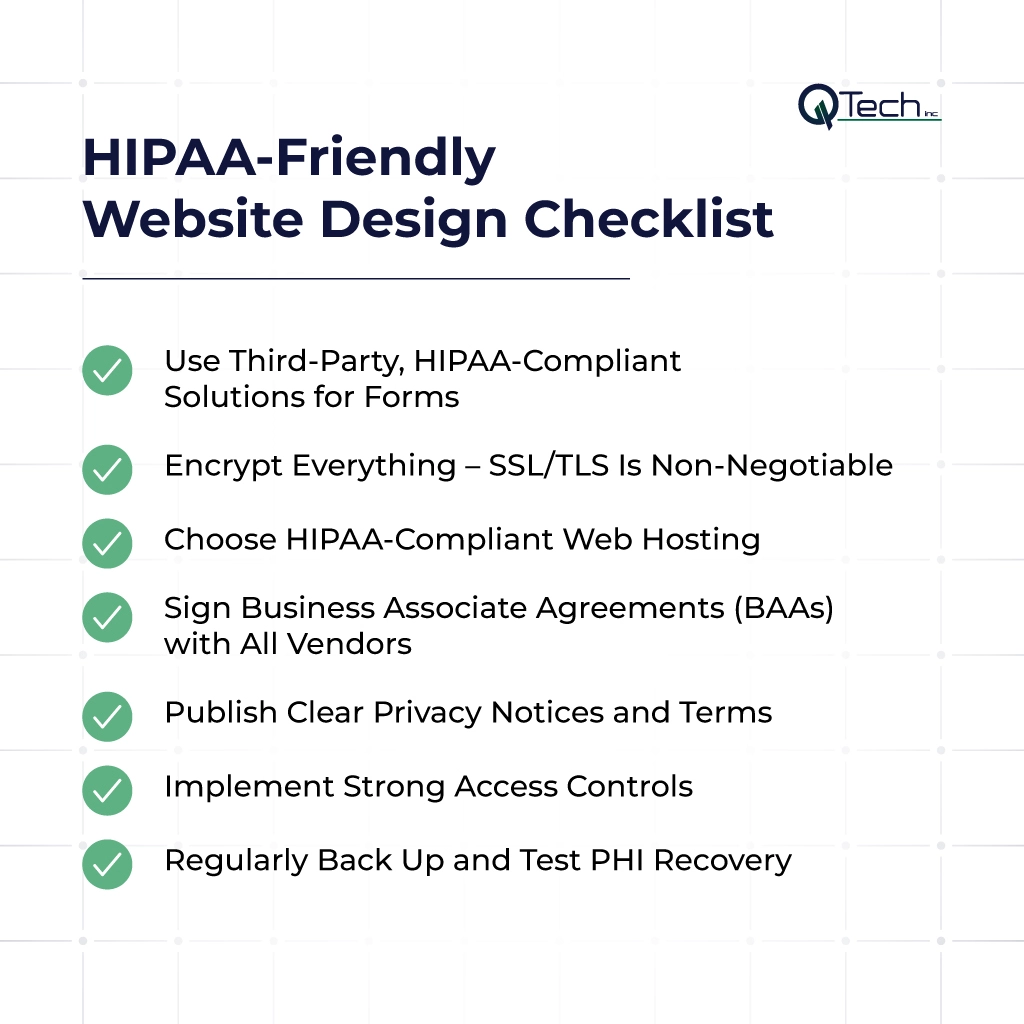
Use Third-Party, HIPAA-Compliant Solutions for Forms
Do not rely on basic web forms for sensitive patient communication. Use form tools that support encryption, controlled access, secure delivery, and BAAs when PHI may be involved.
Encrypt Everything – SSL/TLS Is Non-Negotiable
Every medical website should use SSL/TLS. Encryption protects information in transit and signals professionalism to patients, browsers, and search engines.
Choose HIPAA-Compliant Web Hosting
Select web hosts that understand healthcare requirements, offer strong security features, and can support compliance documentation when the website handles PHI.
Sign Business Associate Agreements (BAAs) with All Vendors
Review vendors before launch. This includes hosting, forms, chat, CRM, analytics, appointment tools, email platforms, and pay per click ppc tracking systems when they may access PHI.
Publish Clear Privacy Notices and Terms
Patients should know how the website uses data. Clear policies reduce confusion around forms, portals, cookies, email, and third-party services.
Implement Strong Access Controls
Use unique logins, multi-factor authentication, limited admin roles, and regular access reviews. Remove old users quickly and avoid shared staff accounts.
Regularly Back Up and Test PHI Recovery
Backups are only useful if they work. Practices should test recovery procedures, document retention rules, and know how they would restore data after an incident.
Common Myths About HIPAA and Websites
“My Website Doesn’t Store PHI, So I’m Fine”
Storage is not the only issue. A website can transmit PHI through forms, chat tools, tracking scripts, integrations, or email notifications. Even if the site does not keep a database of submissions, data may pass through vendors that need review. Practices should map where information goes, including inboxes, CRM records, advertising tools, affiliate marketing links, and reporting dashboards.
“An SSL Certificate Alone Makes Me Compliant”
SSL is essential, but it does not make a website HIPAA compliant by itself. A site also needs secure hosting, compliant forms, access controls, vendor agreements, privacy policies, backups, staff procedures, and ongoing monitoring. Compliance is a long-term operational commitment that connects technology, people, policies, and vendors.
Conclusion & How Q-Tech Inc. Builds HIPAA-Friendly Websites for Healthcare Providers
A medical website should help a practice grow without putting patient trust at risk. The best approach is to design around security, privacy, clarity, and performance from the beginning. That means reviewing forms before launch, choosing the right hosting, controlling vendor access, limiting unnecessary tracking, and creating a digital experience that feels professional and safe.
Q-Tech Inc. brings together website design and development and digital marketing services for healthcare to help providers strengthen their online presence with the right balance of visibility and responsibility. Our team understands that search engine optimization seo, content marketing, social media marketing, pay per click ppc, and patient engagement must be planned carefully in healthcare.
HIPAA-friendly website design for medical practices is not about slowing down growth. It is about building the right foundation so growth is sustainable, secure, and trusted. With the right strategy, medical practices can improve visibility, protect sensitive information, and give patients a better first impression before the first appointment.
FAQ
Q: What is the difference between a HIPAA-friendly and a HIPAA-compliant website?
A: A HIPAA-friendly website is designed to minimize the collection of Protected Health Information (PHI) while maintaining strong security practices — making compliance easier. A HIPAA-compliant website fully meets the Privacy, Security, and Breach Notification Rules. HIPAA-friendly design often means using third-party solutions for forms and keeping PHI off the public-facing marketing site.
Q: Do all parts of my medical practice website need to be HIPAA compliant?
A: No. Only the parts of your website that collect, transmit, or store PHI require HIPAA compliance. Informational pages like services, locations, and team bios generally do not. However, online forms, patient portals, and payment systems do require protection.
Q: What is a Business Associate Agreement (BAA) and why do I need one?
A: A BAA is a contract between you and any vendor that may handle ePHI — including web hosts, form providers, analytics tools, and email services. It ensures the vendor will follow HIPAA Security Rule requirements. Without a signed BAA, even encrypted tools can violate HIPAA.
Q: Does my website need an SSL certificate for HIPAA compliance?
A: Yes. SSL/TLS encryption is non-negotiable for any page that handles ePHI. Your website URL should show HTTPS:// not HTTP://
Q: How can Q-Tech Inc. help my medical practice design a HIPAA-friendly website?
A: Q-Tech Inc. provides end-to-end HIPAA-friendly website services: risk assessments to identify compliance gaps, secure form integration (third-party HIPAA-compliant solutions), SSL/TLS implementation, hosting migration support, BAA management with vendors, and mobile-first, patient-centered design. We help medical practices build websites that protect patient data and build trust.