


To promote a manufacturing business with digital marketing in 2026, combine SEO, LinkedIn, content marketing, email, paid search, and local visibility into one plan built around your buyer’s decision journey — the goal isn’t to appear on every platform, it’s to show the right buyer why your company is a strong fit. Manufacturing still depends on quality, trust, and strong business ties, but the way buyers find and judge suppliers has changed. Many prospects now visit your website and review your capabilities before they ever call.
Key Takeaways
- Buyers research manufacturers online first — your website, search results, and case studies are often the proof they look for before contacting you.
- Referrals and trade shows still matter, but they can’t carry the whole growth plan; digital marketing keeps your brand visible after an event ends.
- Six channels each play a distinct role: SEO, LinkedIn, content marketing, email, pay-per-click, and local search.
- A practical strategy starts with business goals — define your ideal customer, audit your digital presence, choose channels to match your sales cycle, and set measurable goals.
- Audit your website, tracking, and underlying IT before increasing ad spend, so you don’t pay to send traffic to a weak site.
- Manufacturing sales cycles are often long, so channels should support discovery, education, and follow-up, not just immediate clicks.
- Local SEO helps Miami and South Florida manufacturers win regional B2B work by showing they understand and can serve the area.
- Track qualified leads, quote requests, and revenue influenced by marketing — not just traffic.
Why Digital Marketing Is Now Essential for Manufacturing Companies
A strong online presence now supports the sales process itself. Buyers expect proof that a supplier can meet production and business needs, and your website, search results, and case studies provide that proof. A clear marketing strategy can also help you reach new markets and generate qualified leads without depending only on referrals.
How Buyers Research Manufacturers Before Making Contact
Many B2B buyers start with search engines, using terms tied to a product, material, service, location, standard, or industry. Good keyword research helps you understand buyer language and build useful pages around those needs. Organic search can create lasting value here: your website can explain what you make, who you serve, and what makes your process different, and it can answer sales questions before a prospect speaks with your team. The objective isn’t traffic for its own sake — it’s lead generation from people who already have a reason to buy.
Why Word-of-Mouth and Trade Shows Are No Longer Enough
Referrals and trade shows still matter, but a buyer who hears your company name at an event will often research you online afterward. If the site is slow, outdated, or unclear, that first impression can weaken the opportunity. Digital marketing keeps your brand visible after an event ends and lets buyers learn at their own pace — which matters for manufacturers selling into construction, real estate, healthcare, logistics, and other industries with several decision-makers.
Quick Reference: Digital Marketing Channels for Manufacturers
| Channel | Role in the Buyer Journey |
|---|---|
| SEO | Helps buyers find you when searching for what you make |
| Builds trust with engineers, buyers, and plant leaders | |
| Content Marketing | Turns technical knowledge into a sales and visibility asset |
| Email Marketing | Nurtures interest through a long sales cycle |
| Pay-Per-Click | Captures buyers who are ready to act now |
| Local SEO | Wins regional B2B work by showing local capability |
Note on this table: these channel roles reflect widely recognised B2B marketing practice, layered with patterns Q-Tech has observed supporting manufacturing clients. The right mix depends on your market, deal size, and sales cycle — treat it as a starting framework, not a guaranteed outcome.
What Are the Digital Marketing Channels That Work for Manufacturers?
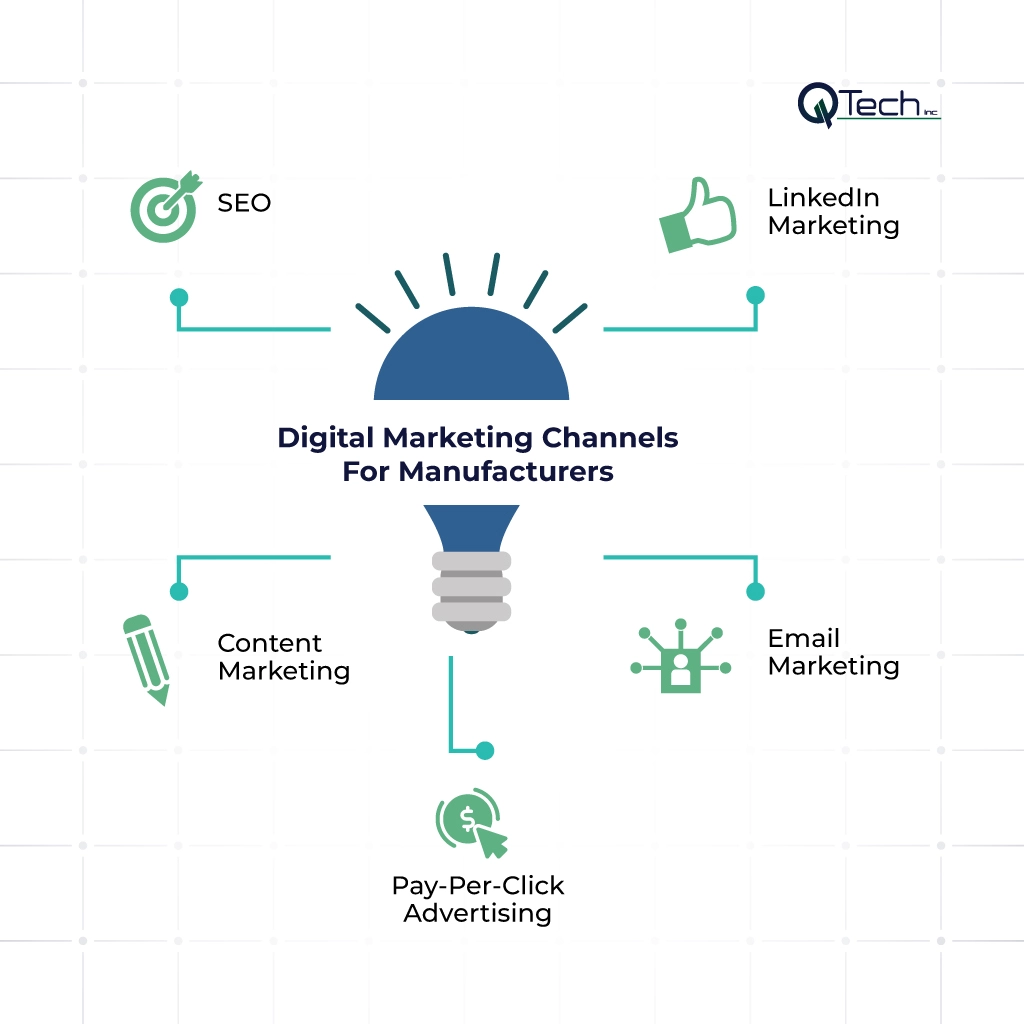
Effective digital marketing for manufacturing business growth usually combines several channels, each with a distinct role in discovery, education, trust, and conversion. Search helps buyers find you, content builds trust, email nurtures interest, and paid advertising reaches people who are ready to act.
SEO for Manufacturing Companies
SEO helps your site appear when buyers search for the work you do. Strong SEO starts with fast pages, clear site structure, useful service pages, relevant page titles, internal links, and helpful content that matches buyer intent. Local visibility can matter too: a company serving Miami or South Florida can improve local SEO with accurate business listings, useful location pages, and content tied to regional demand. Our SEO services in Miami cover this foundation for manufacturers and other B2B firms.
LinkedIn Marketing for Manufacturers
LinkedIn reaches engineers, buyers, plant leaders, owners, and other B2B decision-makers. Strong results usually come from useful information, not constant promotion: project lessons, team knowledge, quality milestones, and answers to common buyer questions. When your team shows how it solves real problems, LinkedIn becomes a channel for building trust before a sales call.
Content Marketing for Manufacturing
Content marketing turns technical knowledge into a sales and visibility asset — case studies, buyer guides, FAQs, videos, checklists, comparison pages, and technical articles. The best content strategies begin with real buyer questions: what do customers ask before they request a quote, what risks concern them, and what facts help them compare suppliers? Strong content makes complex topics easier to understand and guides the reader toward a clear next step.
Email Marketing for Manufacturers
Email works best when the message fits the reader. Build a list from real business contacts, then segment by industry, product interest, customer status, or stage in the sales cycle. Each campaign should have one clear purpose, a direct subject line, and a simple call to action, and you should track open rate, clicks, replies, and conversions. Email can support lead follow-up, product news, customer education, and repeat sales.
Pay-Per-Click Advertising
PPC places your company in front of buyers who are actively searching, and it can give high-value services, competitive terms, new markets, or specialized capabilities faster visibility. Send each ad to a focused landing page that matches the search and makes the next step easy, so a buyer quickly understands what you offer, why it matters, and how to request more information. That also makes paid traffic easier to measure and improve.
How to Build a Digital Marketing Strategy for Your Manufacturing Business
A practical strategy starts with business goals, not whichever platform is popular. Define who you want to reach, what problems they need to solve, and what action should follow once they discover you. For a broader look at the stages involved, our guide to a digital roadmap for manufacturing companies covers how marketing fits alongside the rest of a manufacturer’s technology plan.
Step 1 — Define Your Ideal Customer and Their Decision Journey
List your best customers’ industry, location, company size, order value, technical need, and buying role. Then map the steps they take before selecting a supplier. An engineer may focus on specs and materials, a buyer on price and lead time, and an owner on risk and long-term value. Your strategy should give each the information they need at the right point.
Step 2 — Audit Your Current Digital Presence Before Spending on Marketing
Review your website, rankings, analytics, social pages, forms, and lead process before increasing spend. Look for outdated service pages, broken links, weak calls to action, slow load times, poor mobile usability, or forms that don’t reach the right team. Website speed, hosting, security, analytics, and stable IT all shape the user experience, and fixing those gaps first prevents you from paying to send valuable traffic to a weak site. Our guide to the digital tools you need for your manufacturing business covers the systems behind that foundation.
Step 3 — Choose the Right Channels Based on Your Sales Cycle
Manufacturing sales cycles can be lengthy, especially for custom parts, capital equipment, or complex projects that involve research, quotes, testing, and several approvals. SEO and content support long-term discovery, LinkedIn builds awareness with key roles, email keeps your company visible, and PPC captures immediate demand. Choose the mix that fits your market, average deal size, buyer behavior, and sales process.
Step 4 — Set Goals You Can Measure, Not Just Targets to Aim At
“Get more visibility” is hard to manage unless you define success. Track qualified leads, quote requests, calls, form submissions, sales opportunities, cost per lead, conversion rates, and revenue influenced by marketing. Clear measurement shows what works and gives your team a sound basis for deciding where to invest more and where to change course.
Digital Marketing for Manufacturers in Miami — Local and Regional Strategy
Miami gives manufacturers access to construction, real estate, healthcare, trade, logistics, hospitality, and other active sectors. Local growth starts by making your capabilities, service area, and regional advantages clear to nearby buyers. Your website should connect your expertise with local business needs and explain benefits such as faster service, delivery reach, site access, or hands-on support. A local plan can complement a wider Florida or national campaign.
How Local SEO Helps Miami Manufacturers Win Regional B2B Contracts
Local SEO helps nearby buyers find firms that can serve their area. Keep your business name, address, phone number, service details, and profiles accurate; build useful local pages; publish regional case studies when available; and request customer reviews when appropriate. Local search is about more than map rankings — it shows that your company understands the region and can support buyers who value fast contact, local service, site support, or a regional partner.
What Q-Tech Has Observed Working With Manufacturers
When Q-Tech reviews a manufacturer’s digital marketing, the same issues come up often: service pages that list capabilities without answering buyer questions, slow or outdated websites, forms that don’t route to the right person, thin analytics that make it hard to tell which channel produced a quote request, and LinkedIn pages with little recent activity. These usually reflect strong operations with marketing that hasn’t kept pace.
Note: these observations reflect patterns across the manufacturing clients we’ve supported. They’re a directional signal, not a substitute for an audit of your own site and lead process.
How Q-Tech Inc. Helps Manufacturing Businesses Succeed With Digital Marketing
Q-Tech connects digital marketing with the technology needed to support growth. Services can include SEO, content marketing, website development, lead generation, analytics, and IT services that keep critical systems secure and reliable. That integrated approach matters because a strong campaign can still fail if the website is slow, forms break, tracking is incomplete, or the systems behind the site are unreliable. We align front-end marketing with the IT foundation behind it, creating a smoother path from the first search to sales follow-up.
Explore our digital marketing services for manufacturers in Miami, and see our guide to digital marketing strategies for manufacturing businesses for specific tactics to put into practice.
Conclusion – Digital Marketing Is the New Competitive Advantage for Manufacturers
Buyers still care about quality, price, service, and trust, but the place where they look for proof has changed — in 2026, that proof often begins online. A focused plan that combines SEO, LinkedIn, content, email, paid search, and local visibility can help your manufacturing business reach the right people and earn more sales conversations. The best digital marketing strategy isn’t built on noise; it’s built on clear value, useful information, dependable technology, and steady measurement.