
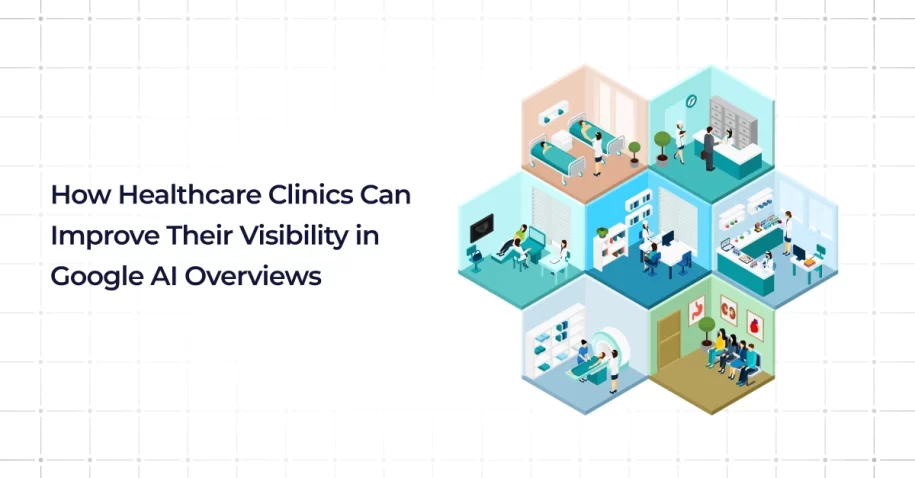
To improve visibility in Google AI Overviews, healthcare clinics need to shift their content focus toward the informational questions patients actually ask — symptoms, conditions, and treatment options — rather than optimizing primarily around “doctor near me”-style searches, while giving Google clear proof of the clinic’s clinical authority behind that content. Because Google applies extra scrutiny to health-related information, given how directly it can affect a patient’s real-world decisions, it consistently favors sources that demonstrate strong E-E-A-T — Experience, Expertise, Authoritativeness, and Trustworthiness — over sources that simply target high-intent local keywords without backing them up. Patients no longer scan a page of blue links to research care; Google AI Overviews can now summarize a question, cite sources, and guide further research before a patient ever visits a website. For healthcare leaders asking how to show up in AI Overviews, the real goal isn’t a trick — it’s building a digital presence Google can confidently verify.
Key Takeaways
- Google AI Overviews are AI-generated summaries drawing from indexed, snippet-eligible pages — Google confirms no special markup is required to appear in them.
- AI Overviews now shape the first stage of patient research, giving clinics another chance to build trust before a patient ever lands on the website.
- Healthcare is one of the hardest industries for AI Overview visibility because of the higher trust burden that comes with YMYL (“Your Money or Your Life”) content.
- Google’s E-E-A-T standard — Experience, Expertise, Authoritativeness, Trustworthiness — applies with extra weight to medical content specifically.
- The strongest approach combines direct patient answers, question-based headings, accurate schema, clean content structure, brand consistency, and genuine clinical expertise.
- FAQ schema is no longer a meaningful AI Overview lever — Google retired FAQ rich results in May 2026 and removed the related documentation in June.
- Thin service pages, missing structured data, weak physician trust signals, and inconsistent local citations are the four most common reasons clinics don’t appear in AI Overviews.
What Is Google AI Overviews
Google AI Overviews is AI-generated summaries that appear when Google determines a synthesized answer would genuinely help the searcher, drawing from related searches and linking out to supporting pages. Google explicitly states that no special markup is required to appear in them. A page still needs to be indexed and eligible for a standard search snippet, and it should follow the same sound practices used in traditional SEO — strong page content, crawlability, internal linking, and genuine user experience all still matter, just as they always have.
Why Do Google AI Overviews Matter for Healthcare Clinics?
For medical practices, AI Overviews can shape the very first stage of patient research. Someone researching symptoms, procedures, specialists, or nearby care may see an AI-generated summary before ever choosing a specific website to visit. A clinic cited within that journey gains an additional chance to build trust early, support qualified organic traffic, and earn later branded searches from patients who remember the name.
How Patients Are Now Using AI Search to Find Medical Care
Patients increasingly search with longer, more natural questions — which doctor treats a specific condition, or what to expect before a particular procedure — rather than short keyword fragments. Clinics need to answer both the main question and the likely follow-up questions a patient would naturally have next. Keyword research still matters, but a modern medical clinic SEO strategy needs to map the full patient journey, from general education through local search and appointment intent, not just a single keyword in isolation.
Why Healthcare Is One of the Most Challenging Industries for Google AI Overview Visibility
Healthcare websites carry a meaningfully higher burden of trust than most other industries, simply because inaccurate medical information can genuinely affect real decisions people make about their health. In our experience providing specialized SEO services in Miami while developing SEO and AEO strategies for medical practices, the hardest issues we encounter go well beyond any single keyword or page.
We consistently see vague service pages, weak physician profiles, poor location data, and generic content compounding on top of each other. A healthcare organisation needs a fundamentally different approach than most other industries, because visibility and trust have to reinforce each other here — one without the other simply doesn’t hold up under Google’s scrutiny for this category.
How Google’s YMYL Classification Affects Healthcare Content in AI Overviews
Health is a classic “Your Money or Your Life” (YMYL) topic because it can directly affect a person’s safety and wellbeing. Google’s quality guidance stresses Experience, Expertise, Authoritativeness, and Trustworthiness — E-E-A-T — especially heavily for high-stakes topics like this one. Medical claims need to be accurate and clearly tied to verifiable expertise, and strong physician bios, credentials, editorial review processes, and reliable external sourcing all help readers — and Google — judge whether the information can actually be trusted.
What Q-Tech Inc. Has Found When Auditing Healthcare Clinic Websites for AI Overview
When Q-Tech Inc. audits a healthcare clinic’s website for AI Overview readiness, the gaps we find most consistently are structural and editorial, not purely technical. Services are often buried several clicks deep, pages frequently repeat the same generic text across multiple locations, and physician expertise rarely connects clearly to the specific conditions they actually treat. We also check Google Business Profiles, internal linking, citation consistency, mobile performance, and structured data as part of every audit — these signals together are what actually help Google understand the clinic and its services as a coherent, trustworthy whole.
Quick Reference: The Core Strategies for Healthcare AI Overview Visibility
| Strategy | Core Focus |
| Direct Patient Answers | Answer the core question within the first 100 words |
| Question-Based Headings | Structure content around real patient questions, in natural order |
| Schema Markup | Use accurate, matching structured data — not an “AI shortcut” |
| Clean Content Formatting | Clear writing, short paragraphs, complete topical sections |
| Brand & Authority Signals | Consistent NAP and identity across directories and profiles |
| Genuine Expertise | Clinician-reviewed, original content over high page volume |
Note on this table: these strategies reflect Google’s own published guidance on AI Overviews and E-E-A-T, layered with patterns Q-Tech Inc. has observed auditing and optimising healthcare clinic websites. The right emphasis still depends on a clinic’s specialty, current site condition, and local competition.
Strategies Healthcare Clinics Need to Improve Google AI Overview Visibility
The strongest plan combines technical SEO, expert-led content, and local authority together — Google’s current AI guidance still centers on solid, fundamental SEO and genuinely useful information, not AI-specific tricks. The practical question isn’t how to write for a robot — it’s how to create pages for patients first, while giving search engines clear, verifiable facts about the clinic, its clinicians, its services, and its location.
1. Answer Patient Questions Directly (Within the First 100 Words)
Open each service page or article with a concise, direct answer to the exact question it promises to solve. If the topic is a procedure, define it clearly before moving into benefits, preparation, or recovery details. This lets readers quickly confirm they’re in the right place, while giving search systems a clear passage to interpret and potentially cite. Direct answers should still preserve necessary medical context and risk information — brevity shouldn’t come at the cost of accuracy.
2. Structure Content with Question-Based Headings
Use headings that reflect real patient questions, moving through a natural order: what the service is, who it may help, what to expect, risks, preparation, recovery, and when to contact the clinic. This structure helps both people and search systems follow the page logically, and it also makes longer content considerably easier to scan on a phone, where most patient research now happens.
3. Leverage Schema Markup
Structured data can clarify the people and entities represented on a page, but it is not a special pass into AI Overviews on its own — it should be used only when it accurately matches the visible content. The right schema type depends on the specific page: options may include Organization, MedicalClinic, Physician, Article, or BreadcrumbList. Names, locations, specialties, authors, and URLs should stay consistent across every instance. Google does not require any special AI-specific schema.
4. Format Content for Clean Extraction
Clean extraction starts with genuinely clear web writing — useful headings, short paragraphs, clear definitions, and key facts stated directly in the text. Don’t break every idea into tiny, unnatural “AI chunks”; Google explicitly says this isn’t required. Build complete sections that answer one topic thoroughly, and add internal links to related services, doctors, locations, and articles so both people and crawlers can follow the clinic’s expertise across the site.
5. Build Brand Mentions and Authority Signals
Authority improves meaningfully when a clinic’s identity stays consistent across the entire web — Google Business Profiles, healthcare directories, professional listings, and local citations should all match exactly. Reputation management should focus on genuinely authentic feedback and accurate business details rather than manufactured signals. A consistent website and local profile together help confirm that the practice is real, active, and relevant to the community it serves.
6. Demonstrate Real Expertise (Not Just Content Volume)
More pages don’t automatically create more authority. Strong healthcare practices publish genuinely useful material — clinician-reviewed answers, original FAQs, procedure guidance, local service details, or ethically handled, de-identified case studies. Google’s current AI guidance favors unique, non-commodity content over mass-produced summaries. A focused library of genuinely useful resources is consistently stronger than hundreds of shallow, interchangeable posts.
What Healthcare Clinic Content Needs to Look Like to Be Cited in AI Overviews
Content built for AI search still needs to feel genuinely built for people. It needs a clear answer, useful supporting detail, and clear proof of who created or reviewed it. Strong healthcare websites make it immediately obvious what’s general education, what’s an actual offered service, and which qualified provider stands behind the information presented.
How to Write Medical Content That Passes Google’s E-E-A-T Standards
Start with a qualified contributor or reviewer, clearly identified — showing their credentials, specialty, and clinical role on a strong, dedicated profile page. Cite trusted external sources where relevant claims call for it, and clearly separate general education from personal medical advice. Time-sensitive content should be reviewed on a defined schedule, not left to go stale indefinitely, and articles should link directly to the relevant physicians and services they discuss. If your site collects patient data, Q-Tech Inc.’s guide to HIPAA-friendly website design for medical practices covers the privacy and security considerations that also need to factor into this content strategy.
Common Reasons Healthcare Clinics Are Not Appearing in Google AI Overviews — And How Q-Tech Inc. Fixes Them
One of the first things we check when a clinic asks why it isn’t appearing in AI Overviews is whether Google can clearly identify the practice, its expertise, and the best specific page for each patient question. Four issues consistently weaken that picture.
Thin Medical Content That Gives Google Nothing to Extract
A short service page with just a definition, a phone number, and a generic call to action gives patients very little real value. Q-Tech Inc. expands thin pages around real patient intent — candidacy, process, preparation, recovery, common questions, provider expertise, and local availability. The goal isn’t simply more words; it’s enough genuinely useful information to fully answer the search without filler padding it out artificially.
Missing Structured Data and FAQ Schema on Service Pages
Structured data is often incomplete or out of sync with what’s actually visible on the page. We correct entity markup so the site consistently describes the same clinic, physicians, locations, and services patients actually see when they land on it.
Worth noting: some older SEO playbooks still stress FAQ schema specifically for medical clinics, but Google retired FAQ rich results in May 2026 and removed the related documentation in June. We don’t treat FAQPage markup as an AI Overview shortcut anymore — instead, we prioritise genuinely visible Q&A content on the page itself, supported by whatever structured data actually remains relevant.
Weak Physician and Practice E-E-A-T Signals That Google Cannot Verify
A provider name listed without credentials, specialty details, a biography, or links to the services they actually provide is a weak trust signal Google struggles to verify. Q-Tech Inc. connects physician profiles directly to relevant medical content, and strengthens the About, editorial, and contact information supporting them. We also compare website claims against reliable external professional profiles, giving both patients and search systems a clearer, more verifiable path to confirming a provider’s actual expertise.
Inconsistent Local Citation Profile That Undermines AI Overview Authority
A clinic can publish genuinely excellent content and still send mixed signals if its name, address, phone number, hours, or specialty differ across directories. Q-Tech Inc. audits key citations against both the website and the Google Business Profile, then corrects the highest-value errors first. This strengthens local SEO overall and reduces confusion about the practice’s identity.
How Q-Tech Inc. Helps Healthcare Clinics in Miami Improve Their Google AI Overview Visibility
As a specialized digital marketing agency for healthcare in Miami, Q-Tech Inc. combines technical SEO, content strategy, local optimisation, and website experience into one coordinated, healthcare-focused process. We start with an AI Overview readiness audit, then map service priorities, patient questions, physician expertise, schema opportunities, citation accuracy, and conversion paths together as one picture.
From there, we strengthen the clinic’s online presence with genuinely expert-led content. Where available, Search Console’s generative AI reporting helps us monitor AI impressions and identify which specific pages are gaining or losing visibility over time. The goal throughout is a durable search foundation — not a short-lived ranking trick that stops working the next time Google adjusts how it evaluates content.
Conclusion: The Future of Patient Acquisition Is AI-Powered
AI Overviews are changing how patients discover medical information, but the core rules underneath that change remain familiar: be useful, be accurate, be accessible, and be easy to verify. Clinics that invest in genuinely trusted content, clear entity signals, local consistency, and a strong overall user experience are better positioned for AI search and traditional search alike — because both ultimately reward the same underlying thing. The best long-term strategy isn’t a shortcut into AI Overviews; it’s a credible digital presence that helps patients make informed choices, and makes a clinic’s real expertise unmistakably clear to Google in the process.
FAQ
Q: What Makes Content Rank in Google AI Overviews?
A: Content is more likely to appear in Google AI Overviews when it is accurate, well-structured, and demonstrates expertise. Pages that directly answer user questions, use clear headings, include relevant schema markup, cite trustworthy information, and provide unique insights are more likely to be selected as AI-generated search sources.
Q: What’s the Difference Between Regular Google Results and AI Overviews?
A: Regular Google search results display a list of individual web pages, while Google AI Overviews generate a summarized answer using information from multiple trusted sources. AI Overviews prioritize content that is authoritative, well-organized, and directly answers the user’s query, making Answer Engine Optimization (AEO) increasingly important.
Q: How to Optimize Healthcare Website Structure for Google AI Search?
A: To optimize a healthcare website for Google AI Search, organize content with clear headings, create dedicated pages for each service, answer common patient questions, use structured data (schema markup), improve page speed, and build strong internal links. A logical website structure helps search engines and AI systems understand your content more effectively.
Q: Can Small Healthcare Businesses Get Featured in Google AI Overviews?
A: Yes. Small healthcare businesses can appear in Google AI Overviews by publishing high-quality, patient-focused content that demonstrates expertise and trustworthiness. Optimizing for local SEO, maintaining an accurate Google Business Profile, answering common healthcare questions, and keeping information current can improve the chances of being cited in AI-generated search results.
Q: What Are the Best Tools for Monitoring Google AI Overview Presence?
A: The best tools for monitoring Google AI Overview visibility include SEMrush, Ahrefs, and Google Search Console. These tools help track keyword rankings, AI Overview appearances, organic visibility, and changes in search performance, allowing businesses to measure the impact of their AI SEO and AEO strategies over time.