
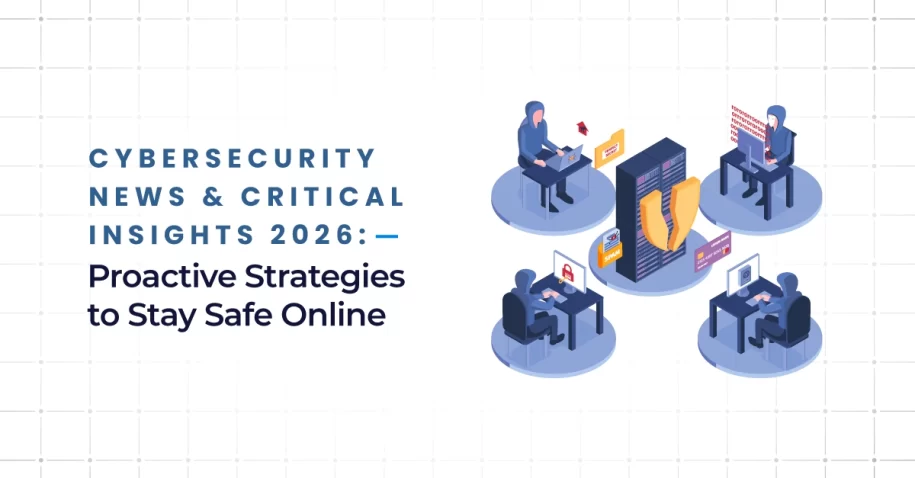
Cybersecurity news is no longer something businesses skim after a breach makes headlines. In 2026, it has become essential operational reading. The threat landscape is moving faster, attackers are using artificial intelligence to improve scale and deception, and even routine business functions now create new exposure. The most useful cybersecurity insights this year all point to the same conclusion: staying safe online requires continuous attention, not occasional cleanup.
Why Cybersecurity Matters More Than Ever in 2026
The latest data makes the urgency clear. Verizon’s 2025 DBIR analyzed more than 22,000 security incidents and 12,195 confirmed breaches, while third-party involvement in breaches doubled to 30% and exploitation of vulnerabilities increased by 34%. For leaders reading cybersecurity news 2026 coverage, the message is simple: cyber risk is no longer confined to large enterprises. Cybersecurity for small businesses is now a board-level issue because attackers are targeting what is easiest to exploit, not just what is biggest.
The Cost of Cybercrime: Key Statistics for 2026
The cost of cybercrime shows up in downtime, lost trust, slower response times, legal exposure, and direct payment demands. Verizon found ransomware in 44% of breaches overall, and in an alarming 88% of breaches affecting SMBs.
The same research showed that organizations took a median of 32 days to fully remediate exploited edge-device vulnerabilities, while leaked secrets found in GitHub repositories had a median remediation time of 94 days. That is why strong ransomware protection for businesses is no longer optional; delay is expensive even before a ransom note appears.
The Biggest Cybersecurity Threats Right Now
The current cyber threat environment is defined by overlap. A phishing attack can lead to credential abuse, stolen credentials can fuel malware ransomware campaigns, and a weak vendor connection can become the entry point for broader compromise. Today’s advanced threats are interconnected, which is why business leaders should follow threat intelligence trends, not just isolated incidents.
Ransomware: The Threat That Will Not Go Away
Ransomware remains stubborn because it works. Attackers keep refining their playbooks, and small business environments are especially attractive when patching, segmentation, and monitoring are inconsistent. Modern endpoint protection platforms and endpoint security solutions can help detect suspicious encryption activity, privilege abuse, and lateral movement in real time, but technology alone is not enough. CISA continues to recommend closing unused remote access paths, enforcing account lockouts, and applying MFA, while NIST emphasizes anti-malware coverage and ongoing monitoring across business devices.
Phishing Attacks: More Sophisticated Than Ever
Phishing emails are becoming more convincing because attackers can now generate cleaner language, better formatting, and more believable context. Verizon reported that synthetically generated text in malicious emails doubled over two years, and Microsoft reported that AI-automated phishing emails achieved a 54% click-through rate compared with 12% for standard attempts. That makes phishing attack prevention a critical discipline, especially when the goal is stealing personal information, enabling identity theft, or launching business email compromise through a single trusted account.
AI-Powered Cyber Attacks: The New Frontier
When companies search for AI cybersecurity threats in 2026, they are really asking how artificial intelligence is changing attacker speed and realism. Microsoft has documented the use of AI-generated voice cloning, real-time voice modulation, deepfake video overlays, and fake professional identities in fraud and hiring-related schemes. At the same time, defenders are being pushed beyond static detection toward behavioral analysis, because neural networks and deep learning can now help attackers create lures that look less like spam and more like normal business communication.
Supply Chain Attacks and Third-Party Vulnerabilities
The supply chain remains one of the biggest structural risks in 2026. IBM reported that major supply chain and third-party breaches have increased sharply over the past five years, effectively quadrupling, while Verizon found third-party involvement in breaches doubled to 30%. The lesson is that your security posture now depends not only on your own controls, but also on vendors, cloud platforms, open-source components, and identity connections. Good cybersecurity insights, therefore, require continuous vendor review and practical cyber threat information sharing across trusted partners.
Insider Threats: The Risk from Within
Insider risk is not limited to malicious employees. It also includes contractors, partners, and compromised user accounts that already have legitimate access. CISA defines insider threat as harm caused by an insider’s authorized access or understanding of the organization, while IBM notes that insiders may misuse access intentionally, accidentally, or through account hijacking. For that reason, restricting sensitive access, improving password management, and using behavioral analysis to flag unusual activity are essential ways to improve detection and shorten response times before damage spreads.
Practical Tips to Stay Safe Online – A Layered Approach
There is no single control that solves cybersecurity. The strongest online security best practices come from layering people, process, and technology together. NIST’s small business guidance consistently emphasizes MFA, strong passwords, software updates, backups, training, and anti-malware coverage as foundational measures that reduce risk across many threat types.
1. Strengthen Your Authentication: Beyond Passwords to MFA
One of the clearest multi-factor authentication benefits is that a stolen password alone is no longer enough to open the door. NIST recommends requiring multi-factor authentication on accounts that offer it, especially for sensitive systems, and its digital identity guidance explicitly favors phishing-resistant methods whenever practical. In plain terms, this means stronger authentication, smarter password management, and less dependence on user vigilance alone.
2. Recognize and Avoid Phishing Attempts (Email, SMS, Social Media)
Employees should be trained to pause before clicking, replying, scanning, or sharing. NIST defines phishing as convincing messages that trick users into opening harmful links or downloading malicious software, while CISA recommends ongoing training, regular reminders, and a reporting culture. Whether the phishing attack arrives by email, SMS, or social media, staff should verify urgency, sender identity, and link destination before taking action.
3. Keep Software and Devices Updated
Outdated software remains one of the easiest openings for attackers. Verizon found that exploitation of vulnerabilities reached 20% of breaches and that edge-device and VPN exploitation grew sharply, while NIST and CISA both stress prompt patching of software and every operating system in use. Businesses should treat updates as routine risk reduction, not maintenance that they can postpone when things get busy.
4. Secure Your Home Network and Wi-Fi
Remote work means the office perimeter now extends into homes. CISA advises users to change default router credentials, and NIST has recommended secure Wi-Fi configurations such as WPA2 with AES instead of weak legacy settings. For home offices, that means strong router passwords, updated firmware, encrypted Wi-Fi, and a habit of keeping work devices off casual or poorly managed networks.
5. Practice Safe Browsing and Social Media Habits
Safe browsing is not just about avoiding obviously bad websites. NIST warns that employees can expose sensitive business details through photos, posts, browser behavior, autofill, and routine sharing habits. A good policy should limit oversharing, encourage caution around unknown links, and reduce passive data collection wherever possible, because criminals can combine small details into a usable attack path.
6. Back Up Your Data Regularly
Backups remain the recovery control that separates disruption from disaster. NIST recommends regular backups and testing them, while CISA’s small business guidance stresses setting a backup cadence and having a restoration plan. Not every system needs real-time replication, but every critical system needs recoverable data, documented ownership, and tested restoration procedures that work under pressure.
Conclusion & How Q-Tech Inc. Helps Businesses Navigate Cybersecurity Challenges
The most important lesson from cybersecurity news and current cybersecurity insights is that modern defense is a discipline, not a one-time project. Businesses need stronger authentication, trained users, updated systems, resilient backups, and layered visibility across endpoints, vendors, and identities. Working with a professional cybersecurity company and pairing that expertise with proactive managed IT services helps turn scattered controls into a practical security program. In 2026, the businesses that stay safest online will be the ones that treat cybersecurity as an everyday business function, not just an emergency response.