
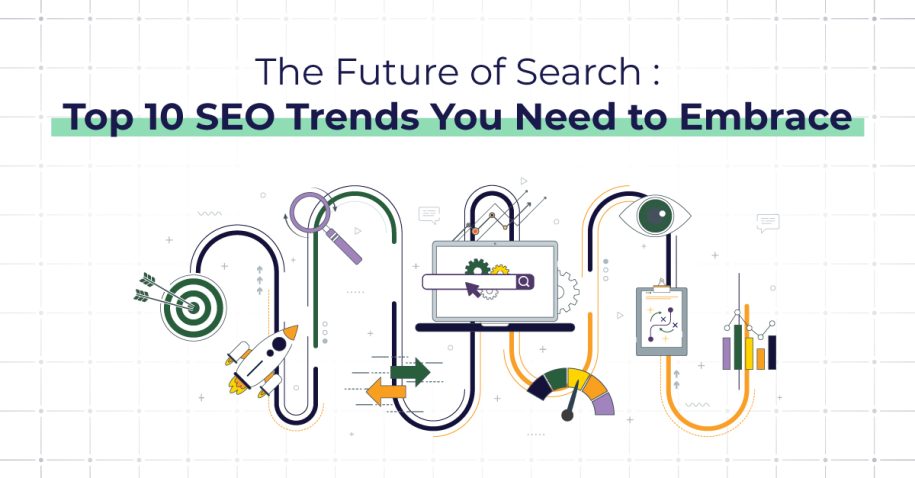
Search engines are evolving faster than ever, and businesses that want to stay competitive must adapt. As we move into 2025, the future of search will be defined by smarter algorithms, user-centric experiences, and advanced technologies. The companies that refine their marketing strategy around these changes will be the ones leading their industries. In this blog, we’ll explore the top 10 SEO trends to dominate search in 2025 and how your business can adapt to maintain visibility, connect with your target market, and ensure sustainable growth.
Top 10 SEO Trends
- GEO / Generative Engine Optimization
- E-E-A-T & Brand Authority (Experience, Expertise, Authoritativeness, Trustworthiness)
- Voice Search & Conversational Queries
- Zero-Click Searches
- Featured Snippet Optimization
- Core Web Vitals
- Intent Optimization
- Semantic Content
- Multimedia Content (Video, Audio, Interactive Content)
- Mobile Optimization

GEO / Generative Engine Optimization
One of the most significant SEO trends in 2025 will be the rise of Generative Engine Optimization (GEO). With AI-driven tools reshaping how people find answers, ai seo is no longer optional—it’s essential. Search engines powered by generative AI provide summarized responses directly on results pages, reducing clicks but increasing demand for structured, in-depth content.
To succeed, businesses must optimize content to align with generative models by providing context-rich answers and leveraging long-tail keywords that mirror conversational queries. This ensures your brand is included in AI-generated results and stays relevant to buyer intent.
E-E-A-T & Brand Authority (Experience, Expertise, Authoritativeness, Trustworthiness)
Building brand authority remains a cornerstone of effective marketing strategies. Google continues to refine its evaluation of experience, expertise, authoritativeness, and trustworthiness (E-E-A-T). In 2025, businesses must highlight credible voices, expert authorship, and strong reputations to maintain rankings.
Consumers want trustworthy brands when choosing products or services, and search engines reward that trust with higher visibility. Conducting regular content audits, publishing thought leadership, and encouraging customer reviews are all vital steps toward establishing brand credibility. This not only strengthens ranking but also increases your brand’s influence as a trusted marketing channel.
Voice Search & Conversational Queries
Voice-enabled devices are now standard, making voice search optimization a crucial part of SEO. People use natural, conversational language when speaking, often framed as questions. Optimizing for these patterns requires using long-tail keywords, FAQs, and conversational phrasing in your content.
For businesses, this means anticipating the type of queries buyer personas will ask when looking for products or services. Voice-driven queries also emphasize local intent, so ensure your Google Business Profile is up to date with accurate details. In 2025, conversational optimization will help you capture both direct voice queries and AI-enhanced search responses.
Zero-Click Searches
Zero-click searches are here to stay. With AI and structured snippets, users often find their answers without needing to leave the results page. Businesses must adapt by optimizing for zero-click search opportunities.
By applying structured data, you increase your chances of being displayed in rich snippets, maps, or knowledge panels. While this reduces direct site traffic, it strengthens brand recognition and ensures visibility where customers search. Pairing this strategy with an effective video SEO strategy and interactive content helps drive engagement even in environments where users don’t immediately click through.
Featured Snippet Optimization
Ranking in a featured snippet remains a fast track to visibility. In 2025, search engines will reward businesses that provide concise, structured answers to key questions. Snippets are not only critical for standard queries but also feed generative search responses.
To succeed, structure content with clear headings, bullet points, and direct answers. Tools like Pagespeed Insights and SERP analysis can help identify which queries already trigger snippets. By tailoring content to answer these queries, you’ll position your brand as a top resource and increase opportunities for indexing and ranking higher.
Core Web Vitals
Google’s Core Web Vitals metrics will play an even bigger role in 2025. Elements like largest contentful paint (LCP), cumulative layout shift (CLS), and interaction to next paint (INP) directly measure user interaction and site performance. If your website doesn’t provide visual stability or loads too slowly, visitors leave, and rankings suffer. Businesses should regularly review their sites with Pagespeed Insights to identify performance gaps. Remember, INP measures responsiveness, and smooth navigation enhances the overall search experience.
Intent Optimization
Search intent will remain central to SEO success. Instead of chasing keywords, focus on aligning content with what users want at each stage of the journey. This includes informational, navigational, transactional, and commercial intents.
When you conduct market research and map buyer personas, you’ll uncover how your target market searches for solutions. Intent-driven strategies improve the alignment between your marketing efforts and customer needs. In 2025, search engines will increasingly favor content that delivers comprehensive, intent-matched answers, reinforcing why effective marketing strategies must prioritize the human side of search.
Semantic Content
With AI advancing, semantic content becomes even more critical. Search engines understand meaning, context, and relationships between topics. Businesses must move beyond keyword-stuffing and instead create content ecosystems that cover entire themes.
Using related concepts, FAQs, and connected resources enhances authority and boosts indexing and ranking. The goal is to build a seamless search experience where your brand consistently appears as the most relevant answer. Semantic strategies also prepare you for evolving AI-driven search, ensuring your business adapts quickly to new SEO trend adaptation techniques.
Multimedia Content (Video, Audio, Interactive Content)
In 2025, multimedia is no longer an optional enhancement—it’s an SEO priority. Videos, podcasts, and interactive tools increase engagement and keep users on your site longer. A strong video SEO strategy improves rankings, especially when paired with structured data and optimized transcripts.
Businesses should also invest in interactive content like quizzes, calculators, or infographics, which enhance user interaction and differentiate them from competitors. With more searches driving toward mixed media, embracing multimedia ensures your content connects with users across multiple marketing channels and devices.
Mobile Optimization
Mobile-first indexing remains at the core of modern SEO. With most users browsing on mobile devices, your site must be responsive, fast, and easy to navigate. Google prioritizes mobile-friendly website, meaning businesses without optimization risk losing visibility. By focusing on mobile speed, accessibility, and responsive design, you enhance both user satisfaction and rankings.
Pairing mobile optimization with strong core web vitals 2025 performance ensures your website thrives. Remember, your mobile presence is not just about ranking—it’s about delivering your products or services in the most accessible way possible to today’s digital-first audience.
Conclusion: The Future of SEO is Human-Centric, Quality-First
The future of search is not about chasing algorithms—it’s about creating meaningful connections with your audience. Businesses that focus on ai seo, zero-click search strategies, voice search optimization, and core web vitals metrics will thrive in 2025.
But at the heart of it all, success comes from understanding your audience, building trust, and delivering value. SEO is no longer just technical—it’s personal, human, and quality-driven. By investing in intent-driven strategies, multimedia experiences, and strong brand authority, your business can lead the way in a rapidly evolving digital landscape.
If you’re ready to transform your digital presence and adapt to these seo trends to dominate search in 2025, Q-Tech Inc. is here to help. From mobile-first indexing to advanced AI strategies, we provide tailored solutions that ensure your marketing efforts deliver real results. The future belongs to businesses that innovate—and with Q-Tech Inc. by your side, you’ll always stay ahead.
FAQ
Is SEO dead in 2025 with the rise of AI?
Answer – No, SEO is not dead. AI is not replacing SEO but rather transforming it. The focus is shifting from simple keyword tactics to creating high-quality, trustworthy content that can be understood and cited by AI models and search engines.
How can I optimize my content for Google’s AI Overviews?
Answer – To optimize for AI Overviews, you should create clear, structured, and scannable content. Use headings to answer direct questions, include bullet points and numbered lists, and provide concise summaries at the beginning of your articles.
Can I use AI to write my blog posts?
Answer – Yes, you can use AI as a tool for content creation, but it should not be the sole author. AI can help with outlines, drafts, and keyword research, but human oversight is crucial to ensure the content is original, accurate, and provides a unique perspective backed by expertise and experience (E-E-A-T).
What is the difference between SEO and GEO (Generative Engine Optimization)?
Answer – SEO focuses on optimizing for traditional search engines. GEO is a newer concept that focuses specifically on optimizing content to be discovered, processed, and cited by generative AI interfaces like Google’s AI Overviews and other AI-powered chatbots, with an emphasis on trust signals and clear, answer-focused content.