The Evolving Role of IT in Business Strategy
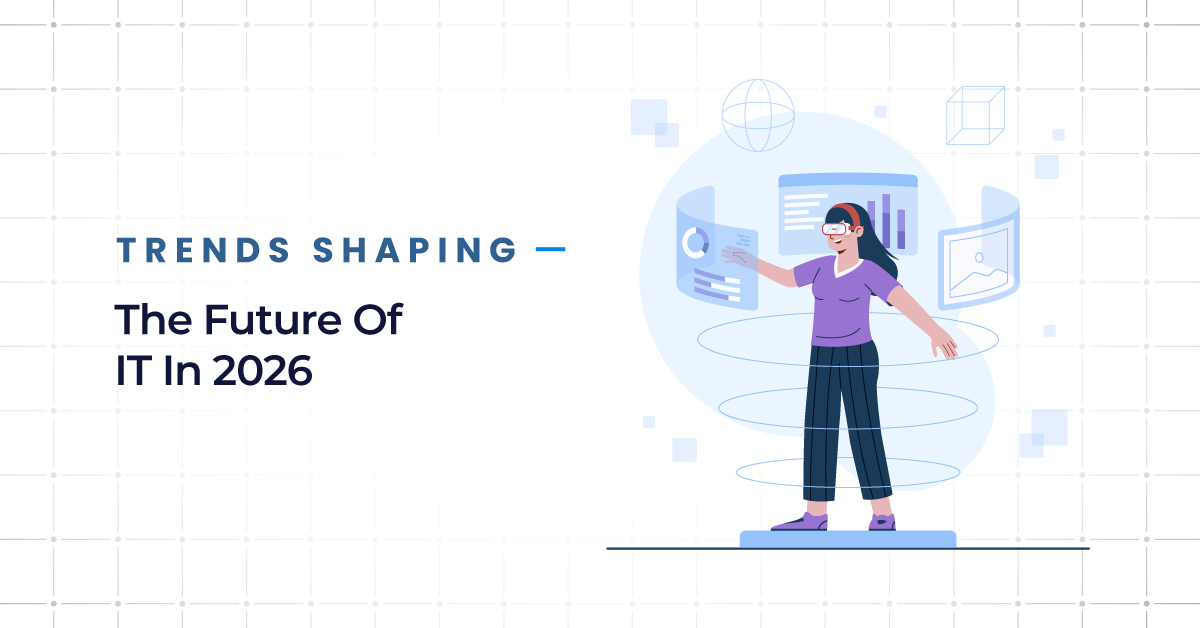
In 2026, the most resilient organizations treat IT as a strategic operating system for the business—not simply a support function. This shift is being driven by faster customer expectations, tighter compliance requirements, and a market that rewards agility. Leaders are using IT to shorten cycle times, improve customer experience, and reduce risk while still controlling spend. As a result, IT roadmaps are increasingly built alongside revenue goals, and technology decisions are evaluated based on measurable business outcomes.
Many it trends in 2026 converge on one idea: technology must be trustworthy and provably effective. Boards and executives want dashboards that show uptime, security posture, project velocity, and user satisfaction. This is why modern service models emphasize standardization, governance, and repeatable delivery. When IT can explain the “why” in business terms—risk reduced, time saved, costs avoided—it becomes far easier to fund transformation and avoid the cycle of reactive fixes that slow the organization down.
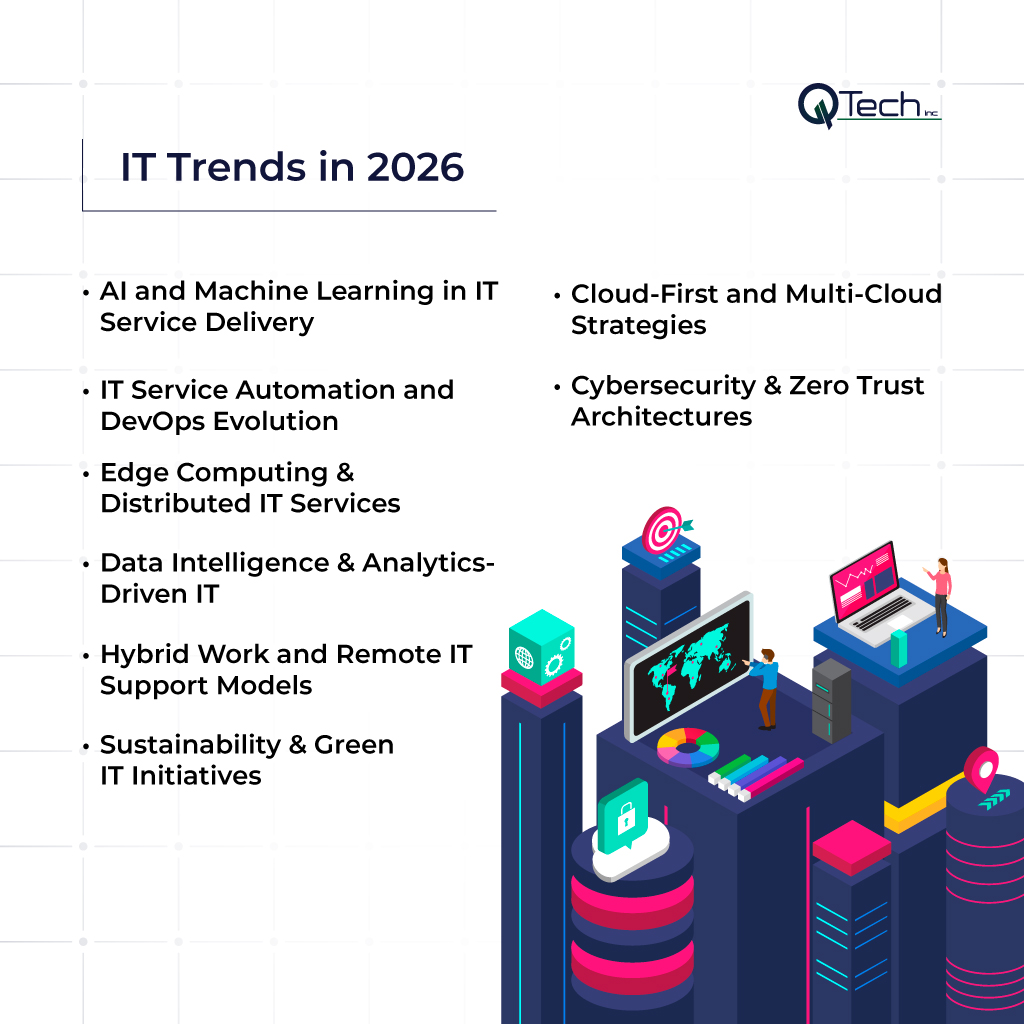
IT Trends In 2026
- AI and Machine Learning in IT Service Delivery
- Cloud-First and Multi-Cloud Strategies
- Cybersecurity & Zero Trust Architectures
- IT Service Automation and DevOps Evolution
- Edge Computing & Distributed IT Services
- Data Intelligence & Analytics-Driven IT
- Hybrid Work and Remote IT Support Models
- Sustainability & Green IT Initiatives
1. AI and Machine Learning in IT Service Delivery
The headline story in the future of it is practical AI adoption. Instead of isolated chatbots, companies are deploying agentic ai and ai agents that can plan tasks, take actions across systems, and escalate when human approval is needed. Think automated onboarding, password resets, account provisioning, and routine endpoint fixes—handled quickly, logged cleanly, and reviewed for compliance. This is also accelerating ai in it support, where triage, root-cause suggestions, and next-best actions reduce time-to-resolution while preserving accountability.
AI works best when it is grounded in your environment and guided by clear governance. The biggest performance gains show up when AI can reference a curated knowledge base: standardized troubleshooting steps, asset inventories, approved configurations, and “known issue” playbooks. When internal context is maintained, AI can assist support teams with accurate answers, consistent procedures, and faster handoffs. The goal is not to replace people; it is to remove repetitive work so specialists can focus on complex incidents, architecture decisions, and risk management—where human judgment remains essential.
2. Cloud-First and Multi-Cloud Strategies
Cloud adoption in 2026 is less about “moving everything” and more about placing workloads where they deliver the best business result. Multi-cloud and hybrid approaches are increasingly common because organizations must balance compliance, latency, vendor resiliency, and cost. With stronger governance, cloud platforms are treated as a portfolio: some applications run in public cloud for scale, others remain close to regulated data, and many live in a hybrid middle. This approach aligns with the cloud computing future—flexibility with control.
As cloud technologies mature, more teams adopt serverless computing for event-driven workloads and bursty demand—especially for integrations, automation jobs, and customer-facing microservices. At the same time, cloud infrastructure must be managed with clear standards: identity policies, network segmentation, encryption defaults, and cost controls. Businesses exploring the future of cloud should focus on landing zones, policy-as-code, and shared services that make it easy to build safely and consistently.
3. Cybersecurity & Zero Trust Architectures
Cybersecurity 2026 is defined by two pressures: attackers are faster, and organizations are more distributed. Zero Trust is no longer a buzzword; it is a practical design pattern: verify identity continuously, limit privileges, segment networks, and assume breach. This model reduces blast radius when something goes wrong, and it improves visibility across endpoints, cloud, and SaaS. For most businesses, a strong starting point is tightening identity controls, implementing strong MFA, and enforcing conditional access across critical systems.
Even with strong tools, many incidents still begin with social engineering. Teams must understand the types of social engineering attacks that appear most often: spear phishing, fake invoice schemes, credential harvesting, and calls that impersonate vendors or executives.
Attackers commonly use malicious websites that imitate login portals to trick users into entering credentials or a credit card. The objective is gaining access, then moving laterally. Effective defense combines training, verification workflows, and technical controls like email authentication, browser protections, and continuous monitoring.
As technological advancements continue, more security leaders are taking post-quantum planning seriously. While quantum risk timelines vary by industry and threat model, the “harvest now, decrypt later” concern is already shaping decisions for organizations handling long-life sensitive data. A practical approach is to begin crypto inventories, upgrade to modern protocols, and plan migrations as standards stabilize. Post-quantum security is best treated as a program: phased, tested, and aligned to business risk rather than driven by hype.
4. IT Service Automation and DevOps Evolution
The most valuable it automation trends focus on consistency: fewer manual steps, fewer configuration drifts, and fewer surprises. Automation is increasingly used to deploy baseline security settings, manage patches, rotate credentials, and validate compliance. DevOps practices extend beyond software teams as infrastructure-as-code and policy-as-code become normal for IT operations. Done well, automation improves auditability, reduces downtime, and makes outcomes predictable—especially when paired with monitoring that detects change early.
Many managed IT trends are converging around platform engineering: internal platforms that provide approved building blocks, automated pipelines, and standardized environments. This reduces fragile, one-off implementations and makes service delivery more reliable.
AIOps adds value when it is applied with discipline: noise reduction, anomaly detection, and correlation across logs, metrics, and traces. The result is faster diagnosis and fewer recurring incidents. The operational rule is straightforward: automation must be versioned, tested, and owned, just like any other production system.
5. Edge Computing & Distributed IT Services
Edge computing matters because more business processes happen outside the data center: retail, logistics, healthcare workflows, manufacturing floors, and field operations. As Internet of Things IoT deployments grow, organizations need low-latency processing, resilient local services, and secure device management at scale. Edge designs often include local compute, secure connectivity, and synchronized data pipelines into centralized analytics. This is also where robotics and smart devices expand the IT footprint, increasing the need for consistent standards and lifecycle management.
Distributed operations require dependable connectivity and consistent security controls. As networks evolve—through better SD-WAN, private wireless, and emerging standards—IT can deliver reliable user experiences across more locations. The practical impact is that IT services must be designed for variation: different sites, different constraints, and different risks. The organizations that win will standardize edge patterns, enforce identity-first access, and monitor performance end-to-end—so distributed work does not mean distributed chaos.
6. Data Intelligence & Analytics-Driven IT
In 2026, IT leaders are expected to justify decisions with evidence: which investments reduce risk, which changes improve performance, and which services users value. Mature teams track service health, response times, security events, and cost efficiency. They also connect technical telemetry to business metrics—like customer churn, conversion rates, or productivity. This is where analytics-driven IT becomes a competitive advantage: the organization can prioritize work based on impact, not intuition.
Data intelligence is only valuable when it is reliable and responsibly managed. Strong governance clarifies ownership, access, retention, and quality. It also ensures sensitive information is handled appropriately and monitored for misuse.
As AI expands, trustworthy data pipelines become essential, because poor data leads to poor decisions—especially when automation acts on those insights. Organizations that invest in clean data, clear policies, and transparent reporting will move faster, because they can trust what they measure.
7. Hybrid Work and Remote IT Support Models
Hybrid work is no longer a temporary model; it is the operating reality for many businesses. That shifts expectations for support: users want help from anywhere, quickly, with minimal disruption. High-performing organizations build standardized service catalogs, self-service options, and proactive monitoring. Remote IT support must also be secure, audited, and aligned with Zero Trust. When device management, patching, and access policies are consistent, IT can scale support without losing control.
This is also where modern it consulting trends emphasize operational maturity: documentation, service ownership, measurable SLAs, and proactive remediation. The objective is to reduce ticket volume through stability and automation while improving the experience when support is needed. In a distributed environment, “good support” is defined by speed, consistency, and security—delivered without friction.
8. Sustainability & Green IT Initiatives
Sustainability is moving from values to requirements, driven by customer expectations and reporting pressures. Green IT programs focus on practical improvements: hardware lifecycle optimization, energy-efficient configurations, cloud cost and carbon awareness, and reduced e-waste. Organizations also rationalize applications and eliminate underused systems, which lowers cost and reduces risk. In many cases, sustainability work is a direct byproduct of modernization—because simpler environments are easier to secure, cheaper to run, and easier to support.
For leadership teams, the takeaway is that sustainability is not separate from strategy. It is increasingly tied to procurement, lifecycle planning, and how workloads are designed. As the future of cloud continues to evolve, organizations will increasingly evaluate platforms based on performance, resiliency, and efficiency—not just raw features.
How Businesses Can Prepare for IT Services Trends in 2026
The challenge is not knowing what is changing; it is choosing what to do first. If you look at it trends for 2026 from agentic ai to post-quantum security, the pattern is consistent: simplify, standardize, automate, and secure. Start by mapping critical services, identifying top risks, and setting measurable targets—uptime, response times, security controls, cost per user. Then select initiatives that reduce risk while improving agility, such as identity modernization, cloud governance, automation baselines, and targeted AI deployments.
Skills, Tools & Governance
To keep pace with technological advancements, businesses need skills development and clear ownership. Prioritize identity and security fundamentals, cloud architecture, automation engineering, and incident response.
Invest in operational maturity: documented standards, change control, and continuous improvement. AI succeeds when governance is explicit—what AI can do, what requires approval, how actions are logged, and how exceptions are handled. This is how AI becomes an operational advantage rather than an uncontrolled experiment.
Governance should not slow teams down; it should make outcomes consistent. Establish principles for architecture, vendor selection, security baselines, and data usage.
Create a repeatable intake process that evaluates new requests based on risk, value, and effort. When teams know the rules and have approved patterns, delivery accelerates. This is the difference between reactive IT and a strategic technology function that can scale.
Investment & Road mapping
A strong roadmap balances modernization with resilience. Fund identity-first security, visibility tooling, endpoint management, and cloud governance early because these unlock everything else. Then prioritize automation and platform improvements that reduce manual work and configuration errors.
Finally, layer in higher-leverage initiatives—AI-driven workflows, advanced analytics, and post-quantum planning where it fits the risk profile. When these investments are coordinated, the organization avoids isolated upgrades and instead builds a cohesive system that gets stronger over time.
Many organizations also execute faster by combining internal ownership with external consulting services that bring repeatable frameworks, specialized expertise, and implementation capacity. This is especially valuable when projects cut across departments or require coordination between security, infrastructure, and application teams.
Conclusion: Turn Your 2026 IT Checklist into Action with Q-Tech Inc.
The organizations that outperform in 2026 will operationalize transformation—moving beyond pilots and into repeatable delivery. That means deploying artificial intelligence where it improves outcomes, adopting cloud models that balance agility and control, strengthening Zero Trust, expanding data intelligence, and preparing for long-horizon security shifts like post-quantum security. It also means building the operating discipline—governance, standards, automation, and measurable service performance—that turns new technology into real business value.
If you want to turn these priorities into an actionable plan, Q-Tech Inc. can help you define the roadmap, implement the right controls, and execute with accountability—so your IT Services strategy supports the business you intend to build next.
FAQ
Q: What is the biggest IT trend for 2026?
A: The most significant trend is the transition to Agentic AI, where AI “agents” move beyond answering questions to independently managing complex workflows across ERP, CRM, and supply chain systems.
Q: How should a small business prepare for these future IT trends?
A: Start with a strategic assessment:
- Audit your current IT stack for flexibility and integration capabilities.
- Discuss future goals with your IT provider to see if they offer strategic consulting and proactive roadmaps.
- Prioritize cybersecurity investments that are continuous and integrated.
- Explore pilot projects with AI-powered tools or cloud services to build internal familiarity.
Q: What is zero-trust security and why is it important for IT in 2026?
A: Zero-trust is an approach where every access request is authenticated and verified continuously. It’s vital due to growing cyber threats and increasingly remote/distributed environments.