
Is Facebook Still Relevant for Business Growth in 2026?
Facebook has changed, but it hasn’t disappeared. In 2026, it’s still one of the most reliable places to reach adults at scale—especially when you pair organic distribution with paid advertising and smart targeting. If your goal is predictable lead generation, stronger brand awareness, and measurable sales, Facebook remains worth taking seriously.
What’s changed is how success is earned. Businesses that treat Facebook like a digital flyer rack get mediocre results. Businesses that treat it like a living channel—built on a clear Facebook marketing strategy, consistent social media content, and disciplined testing—can improve customer satisfaction and revenue over time. This strategic Facebook marketing guide for business growth will show you how.
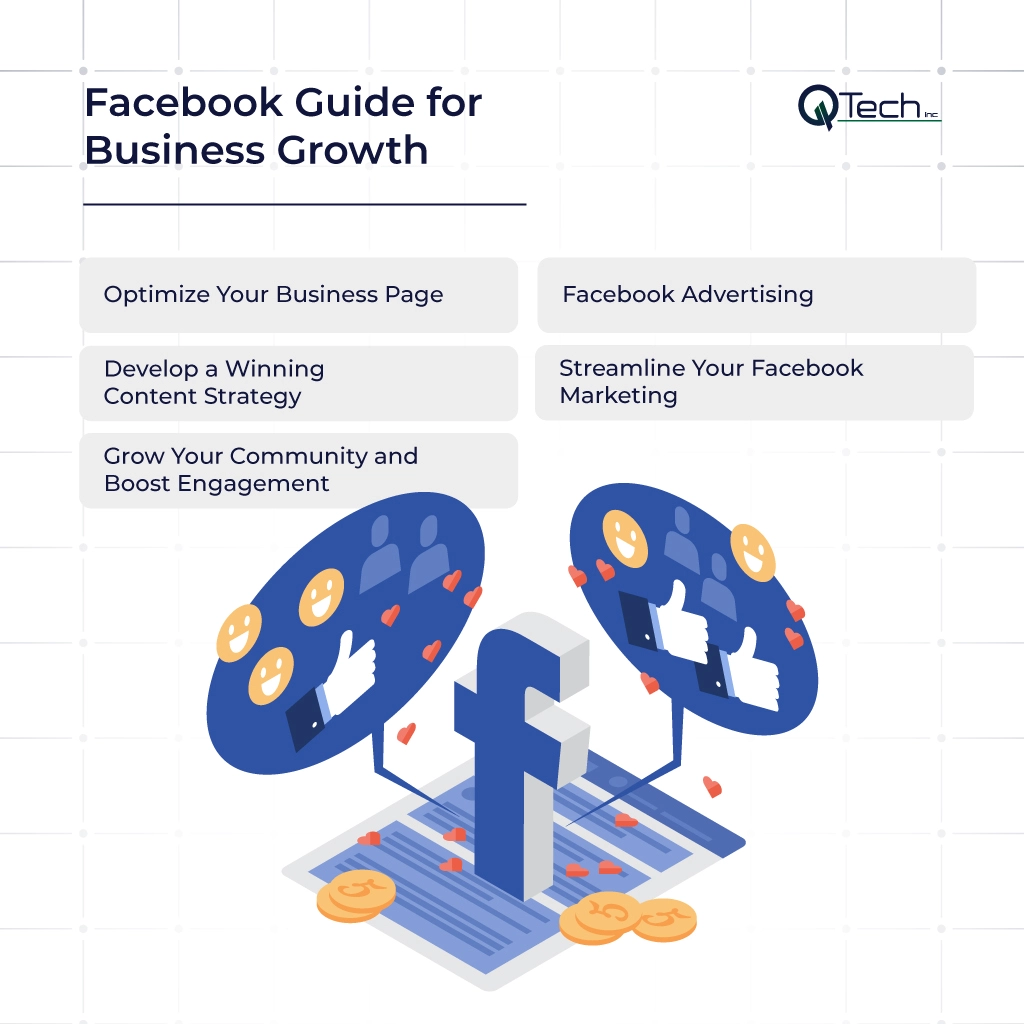
Facebook Guide for Business Growth
- Optimize Your Business Page
- Develop a Winning Content Strategy
- Grow Your Community and Boost Engagement
- Facebook Advertising
- Streamline Your Facebook Marketing
Part 1: Laying the Foundation – Optimizing Your Business Page
Your Page is your storefront, your reputation hub, and often the first stop for someone after they see an ad campaign or post. A well-built Page improves trust, supports customer service, and reduces friction when a prospect is ready to act.
A strong foundation also protects your results. Better Page hygiene can lift your engagement rate and help your ads manager learn faster because visitors behave more consistently once they arrive.
Before you publish anything, complete the basics: categories, service area, hours, and a short username that matches your brand. Add FAQs that answer pricing ranges, turnaround times, and next steps. Set up Messenger with an instant reply so people feel seen, even after hours. Small details like these improve response time, boost trust, and reduce drop-off when someone is comparison shopping.
Crafting a Compelling Brand Story with Visuals and Copy
Start with clarity: who you help, what you deliver, and why you’re different. Write an “About” section that reads like a promise, not a resume, and make sure it reflects your products or services in plain language. This is the core of brand promotion on Facebook—people buy confidence before they buy features.
Make your visuals do the heavy lifting. Use a clean logo, a high-contrast cover image, and pinned content that explains your value in seconds. When your story is tight, you don’t need hype—you earn attention.
Leveraging Key Page Features (Calls-to-Action, Reviews, Shop)
Facebook gives you built-in conversion levers; many businesses don’t use them. Choose a primary CTA that matches intent—Call Now, Book Now, Get Quote, or Learn More—and keep it aligned with the landing experience.
Reviews compress risk. Ask happy clients for feedback, respond publicly, and show great customer service even when issues arise. This is not just reputation management; it’s customer retention in public view and a signal that you take customer experience seriously.
If you sell physical items, activate the Shop and keep listings accurate. If you sell services, treat the Shop as a lightweight catalog with clear offers and next steps. Either way, you shorten the path from interest to conversion rate.
Part 2: Developing a Winning Content Strategy
A content strategy for Facebook works when it’s repeatable. You don’t need to post everything; you need the right mix with the right cadence. Consistency builds familiarity, and familiarity lowers the cost of attention.
Define a few pillars—education, proof, behind-the-scenes, community, and offers—then rotate them. Your Page should feel helpful, not like a constant pitch.
The 3-2-1 Content Rule: Educate, Engage, Convert
Use the 3-2-1 rule to structure your week: three educational posts, two engagement posts, and one conversion post. Education builds authority, engagement builds relationship, and conversion keeps the channel tied to revenue.
Educational posts can be quick “how-to” tips, myth-busting, checklists, or short explainers that answer real questions. This is especially strong for small-business marketing on Facebook audiences that want practical guidance without a sales pitch.
Engagement posts should invite a response: polls, “this or that,” opinion prompts, and community spotlights. The goal is not vanity likes; it’s meaningful Facebook engagement that signals relevance to the algorithm and to real people.
Conversion posts should be clear and simple. One offer, one audience, one next step. Talk about outcomes, include proof, and remove ambiguity.
Harnessing the Power of Video (Reels, Live, Stories)
Video is a fast trust-builder because it carries tone, confidence, and context. Reels help discovery, Stories keep you top-of-mind, and Live sessions create a real-time connection that accelerates loyalty.
Record short “answer one question” videos, demos, client wins, and behind-the-scenes clips that show how you work. When you do run a video ad, make the first two seconds count: hook with the problem, then show the payoff.
Keep each video focused: one idea per clip, captions for silent viewers, and a single CTA. Your best-performing topics become your roadmap for future campaigns and offers.
Part 3: Growing Your Community and Boosting Engagement
Community growth is not just about more followers; it’s about the right followers. When your target audience feels understood, they engage, share, and stay. That’s the engine behind sustainable social media growth.
Think of your Page like a neighborhood business. The most valuable outcome is not a viral post; it’s a steady flow of conversations that lead to quotes, bookings, and purchases.
Proven Tactics to Increase Followers and Build Loyalty
Invite recent customers and warm leads to follow your Page, and make the ask part of your process—after a successful project, after a positive review, or after a support win. When done right, it feels natural.
Collaborate with complementary brands. Cross-post, co-host Lives, or run joint giveaways that align with your values. These partnerships can accelerate growth while keeping quality high.
Pin an evergreen “start here” post, a short intro video, or a helpful guide. When new people arrive, they should understand what you do and why you’re credible.
The Art of Community Management and Conversation
Community management is a discipline. Respond quickly, reply with substance, and treat every comment as a micro touchpoint in the customer journey. This is where customer service becomes marketing—and where customer satisfaction is reinforced daily.
Set a rhythm: daily comment replies, weekly message audits, and monthly content reviews. If you’re flooded with DMs, create saved replies and a simple intake form to route people to the right offer.
Don’t ignore negative feedback. A calm, professional response can increase trust for everyone watching and show leadership under pressure.
Part 4: Facebook Advertising – Strategies for Maximum ROI
Organic reach is helpful, but Facebook advertising is where you buy speed and control. The platform shines for retargeting, local intent, and scaling offers once you know what converts.
Treat Facebook ads as an iterative system, not a one-time blast. Start with a clear objective (traffic, leads, conversions), define your target audience, and build a funnel that matches buying readiness.
A practical way to think about your ad account is by stages. Use top-of-funnel campaigns to introduce your offer, mid-funnel campaigns to retarget video viewers and site visitors, and bottom-of-funnel campaigns to convert high-intent people with testimonials, guarantees, and clear CTAs. Track cost per lead, close rate, and revenue—not just impressions—so every optimization ties back to business outcomes.
A/B Testing Ad Creative for Better Performance
Most performance problems are creative problems. Your targeting can be solid, but if the message and visuals don’t resonate, results stall. That’s why A/B testing ad creative is non-negotiable.
Test one variable at a time: headline, hook, offer, image style, or CTA. Keep budgets controlled, run tests long enough to get a signal, then scale the winners. These are practical Facebook ads tips that protect spend and lift conversion rate.
Social Commerce: Closing the Loop within the App
Friction kills sales. Social commerce reduces steps by letting customers browse, ask questions, and purchase without leaving the app. For many categories, that convenience translates into a higher conversion rate and better retention.
Use product tags, collections, and clear descriptions. For services, use lead forms and instant experiences to qualify prospects, then route them to a booking page or sales call.
The win is feedback. Commerce interactions create data that improves future targeting and creative decisions—especially when paired with clean tracking.
Part 5: Essential Tools to Streamline Your Facebook Marketing
Great strategy still needs execution. The right tools reduce workload, improve consistency, and make performance easier to understand. They also help you spot what’s working before you waste weeks on the wrong approach.
If you’re trying to create a Facebook marketing system that runs weekly without chaos, standardize your tooling and keep it simple.
Scheduling, Analytics, and Design Tools You Need
Start with scheduling. Meta Business Suite is the default, but third-party platforms can help if you manage multiple brands. The goal is to build a calendar, batch content, and publish consistently.
Next, focus on measurement. Use Facebook analytics tools to track engagement rate, reach, saves, clicks, and lead quality—not just likes. Pair platform reporting with analytics tools like GA4 and CRM notes so you can see which posts and Facebook ads drive real outcomes.
For design, use templates that protect your brand. Consistency improves trust and makes your offers easier to recognize in the feed.
Conclusion & How Q-Tech Inc. Helps Businesses Succeed on Facebook
Facebook is still relevant in 2026, but growth requires intention. When your Page is optimized, your marketing strategy is grounded in value, and your content follows a repeatable system, you build momentum that compounds.
The businesses that win are the ones that respect the fundamentals: clear positioning, consistent publishing, responsive community management, and disciplined testing in Facebook advertising. That’s how you turn attention into lead generation and lead generation into long-term customer retention.
Q-Tech Inc. helps businesses execute this end-to-end strategy, page optimization, content production, and ad campaign management focused on ROI. If you want support with ongoing social media marketing for business, or you want creative assets that make your ads perform, our team can step in with a plan and the execution to match.