

In today’s interconnected digital world, cyber threats evolve faster than many organizations can defend against. Traditional security tools that rely on static rules and manual updates are no longer enough to handle the dynamic nature of modern attacks. Businesses need intelligent, adaptive solutions that can continuously learn, detect, and respond to emerging threats in real time. This is where adaptive cyber defense powered by machine learning (ML) steps in—an innovative approach that uses data, automation, and predictive analytics to anticipate and neutralize malicious activity before it causes harm.
Why Traditional Cybersecurity Isn’t Enough Anymore
Traditional security systems depend on signature-based detection and predefined rules to identify known threats. While effective for past attack patterns, this approach struggles against today’s threat landscape, where attackers constantly evolve their tactics to bypass static defenses. Organizations face complex cyber risks from ransomware, phishing, insider threats, and zero-day exploits that traditional security simply can’t keep pace with.
The need to continuously monitor and respond to emerging threats requires a shift toward smarter, adaptive systems. By analyzing network traffic, user behavior, and detecting anomalies, modern cybersecurity can go beyond passive detection to proactive prevention. Adaptive systems use machine learning models that evolve as new threats appear, enabling predictive insight and faster response to potential attacks before damage occurs.
What is Adaptive Cyber Defense?
Adaptive cyber defense combines artificial intelligence (AI) and machine learning (ML) to create security systems that learn and adapt over time. Rather than reacting to attacks after they occur, these systems analyze patterns and behaviors to anticipate them. By leveraging predictive analytics and threat intelligence, adaptive defense continuously evolves, allowing businesses to protect assets across their real-world hybrid IT environments.
Through continuous learning from network traffic, logs, and external threat data, adaptive systems identify potential threats that static defenses would overlook. This intelligence-driven approach enables proactive cyber defense machine learning to act before attackers strike—minimizing downtime, data loss, and recovery costs.
Key Components of an ML-Driven Cyber Defense Platform
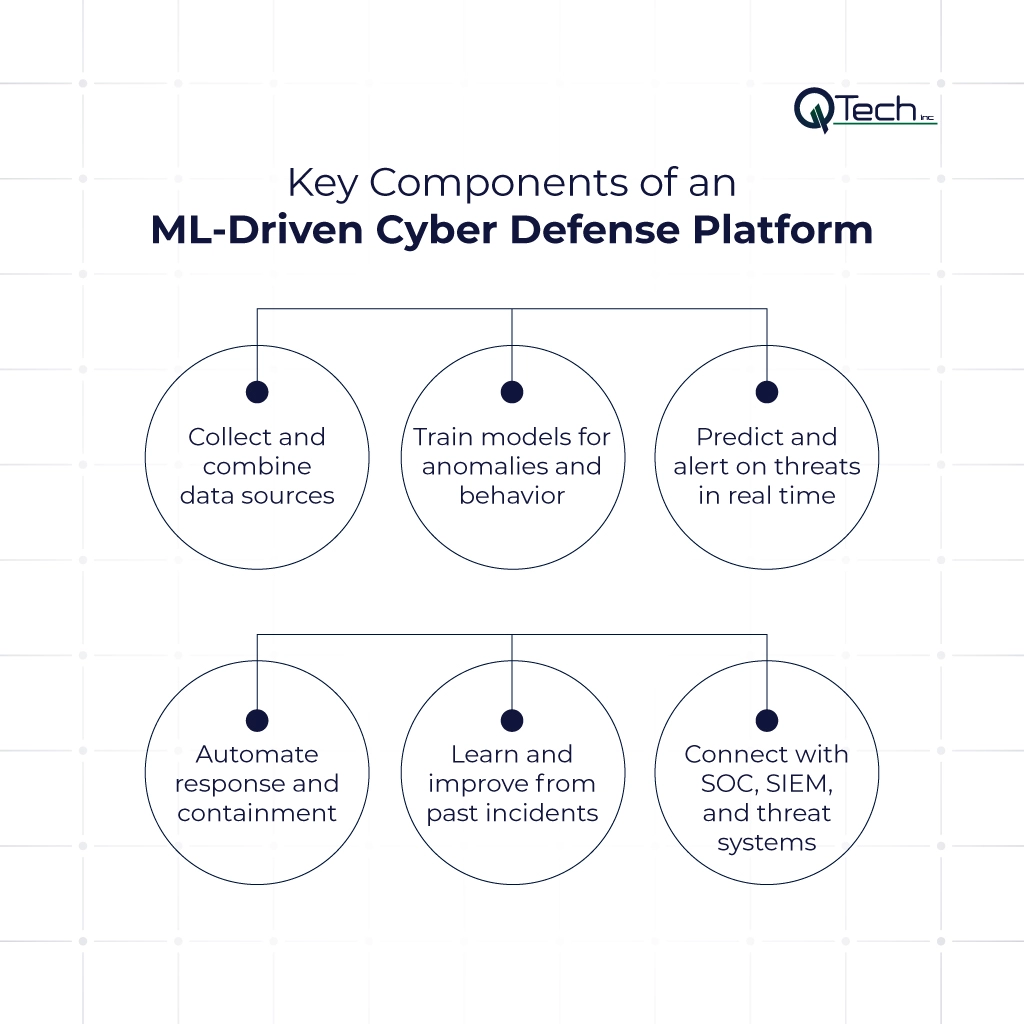
Collect and Combine Data Sources
The foundation of adaptive cybersecurity strategies lies in robust data collection. Machine learning systems rely on diverse inputs—from endpoint logs to network traffic data—to build comprehensive visibility. By combining these sources, AI systems establish baselines of normal behavior, which allows them to detect when anomalies occur.
Train Models for Anomalies and Behavior
A machine learning model must be trained to recognize patterns that indicate cyber threats. By analyzing massive volumes of data, ML identifies user behavior deviations or suspicious activities that might indicate a potential threat. Over time, the model learns to distinguish between harmless fluctuations and genuine malicious activity.
Predict and Alert on Threats in Real Time
One of the major advantages of real-time threat detection machine learning is its ability to alert teams the moment abnormal activity appears. Using ml for threat prediction, systems can flag potential intrusions before they escalate, offering early warning and critical time to act.
Automate Response and Containment
Once a threat is detected, automation ensures a rapid response. Machine learning can trigger containment actions, such as isolating affected systems or blocking suspicious IPs, reducing the response time from hours to seconds. This incident prevention with ML in security minimizes impact while allowing human analysts to focus on higher-priority investigations.
Learn and Improve from Past Incidents
Unlike static tools, adaptive cyber defense improves continuously. Each incident contributes new data that helps refine algorithms, reducing false positives and improving accuracy. This cycle of learning creates a feedback loop where AI becomes smarter with every analyzed event.
Connect with SOC, SIEM, and Threat Systems
An effective adaptive platform integrates seamlessly with existing Security Operations Centers (SOC) and Security Information and Event Management (SIEM) tools. This integration ensures that threat detection, correlation, and response actions occur within a unified ecosystem—maximizing visibility and coordination across teams.
Implementation Roadmap for Your Organization
Assess Cybersecurity and Data Readiness
Before adopting adaptive cyber defense, how machine learning predicts and prevents attacks, organizations must begin with a risk assessment. This step identifies data sources, security gaps, and infrastructure readiness. Understanding the existing cyber risk posture helps prioritize the most critical areas for ML integration.
Set Goals and Key Metrics
Define what success looks like—whether reducing detection time, identifying potential breaches faster, or improving incident prevention with ML in security. Setting measurable KPIs ensures that progress is both trackable and aligned with business objectives.
Choose Models and Pilot Small
Start small by selecting specific use cases such as phishing detection or network traffic anomaly analysis. Pilot programs allow teams to evaluate performance and adjust machine learning ML parameters before scaling up.
Automate Response Workflows
Automation is key to achieving proactive cyber defense through machine learning. By integrating automated playbooks into your SOC, repetitive tasks like log triage, ticket generation, or blocking suspicious URLs can run autonomously—saving time and resources while ensuring consistency.
Monitor, Refine, and Scale
Once implemented, continuously monitor system performance and adjust machine learning models to prevent model drift. Over time, scale the deployment across multiple environments, including on-premises and hybrid cloud infrastructure, to achieve comprehensive protection.
Benefits & Business Impact
Detect Threats and Respond Faster
Adaptive systems powered by machine learning ML can analyze data at speeds no human team could match. They identify emerging threats within seconds, drastically reducing detection and response times.
Cut Alert Fatigue and Focus Better
Automation and predictive analytics help in reducing false positives, allowing cybersecurity teams to focus on genuine alerts. This improves efficiency, morale, and overall accuracy.
Prevent Breaches Proactively
Through ML for threat prediction, organizations can anticipate attacks instead of merely reacting. This proactive cyber defense machine learning approach enhances prevention, minimizes downtime, and strengthens overall cyber resilience.
Strengthen Resilience Across All Environments
Adaptive defense secures assets whether they’re in local servers, private data centers, or hybrid cloud infrastructure. Constantly learning from real-world threats, it creates a multi-layered shield that adapts to any environment or challenge.
Common Challenges & How to Overcome Them
Incomplete or Low-Quality Data
The effectiveness of any machine learning model depends on data quality. Missing or inaccurate data can limit the system’s ability to detect cyber threats. To overcome this, ensure diverse, high-quality data from endpoints, firewalls, and cloud applications is consistently fed into your AI engine.
Model Drift and ML Vulnerabilities
Over time, machine learning ML models can degrade if they aren’t updated. This is known as model drift. Regular retraining and validation of models ensure they stay aligned with the threat landscape and can accurately detect new potential threats.
Finding the Right Human-AI Balance
While automation is powerful, it doesn’t replace human intuition. The best adaptive cybersecurity strategies balance AI automation with expert human oversight to validate findings, interpret context, and make judgment calls in complex cases.
Driving Cultural and Process Change
Transitioning to adaptive cyber defense requires a mindset shift across the organization. Teams must embrace data-driven decision-making, adopt new workflows, and collaborate closely between IT, operations, and management. Building awareness of the benefits helps accelerate adoption and maximize long-term impact.
Conclusion: How Q-Tech Inc. Supports Adaptive Cyber Defense
Cybersecurity today demands agility, intelligence, and foresight. Adaptive cyber defense empowers organizations to move from reactive to proactive protection through machine learning ML and AI-driven insights. By leveraging data, automation, and continuous learning, businesses can predict, prevent, and respond to malicious activity before it disrupts operations.
We specialize in helping organizations implement and manage adaptive solutions tailored to their environments. From initial risk assessment and predictive analytics setup to threat detection automation and incident prevention with ML in security, our experts guide you every step of the way.
Through strategic deployment of adaptive defense support and integration with hybrid cloud infrastructure, We delivers scalable, intelligent security frameworks that evolve as fast as the threats themselves.
FAQ
Q: What is adaptive cyber defense in simple terms?
A: Adaptive cyber defense is a proactive security approach that uses machine learning to continuously learn from an organization’s network, user behavior, and global threat data. Instead of just blocking known bad files (like traditional antivirus), it builds a understanding of ‘normal’ activity and can automatically detect, respond to, and even predict subtle, novel attacks that would bypass conventional defenses.
Q: How does machine learning improve cybersecurity?
A: Machine learning improves cybersecurity in three key ways:
- Speed: It analyzes millions of events per second, far faster than any human team.
- Scale: It can process vast amounts of data from across the entire digital environment.
- Intelligence: It identifies complex patterns and subtle anomalies that indicate a threat, often predicting attacks before they are fully executed, moving security from a reactive to a predictive stance.
Q: What’s the difference between AI and traditional cybersecurity?
A: Traditional cybersecurity is largely rules-based (signature-based). It looks for known patterns of malicious code or behavior. AI-powered cybersecurity is behavioral and predictive. It uses ML models to understand what ‘normal’ looks like for your specific environment and then flags any significant deviations, allowing it to catch never-before-seen (zero-day) attacks and sophisticated, multi-stage intrusions that don’t match a known signature.
Q: What are the benefits of adaptive cyber defense?
A: The primary benefits are:
- Proactive Protection: Shifts from cleaning up after an attack to preventing it.
- Reduced Dwell Time: Catches threats much faster, minimizing damage.
- Efficiency: Automates the analysis of routine alerts, freeing up human analysts for complex tasks.
- Adaptability: The system continuously learns and evolves as new threats emerge, making your defenses more resilient over time.