

HIPAA compliance means following the federal Privacy, Security, and Breach Notification Rules that govern how protected health information is used, stored, transmitted, and disclosed — and for Miami providers, staying compliant requires a repeatable checklist connecting policies, systems, staff training, vendor oversight, and documentation into one ongoing programme, not a one-time project. Miami healthcare providers operate in a high-trust environment where patients expect convenience, privacy, and secure digital care. From small clinics in Coral Gables to multi-location medical practices across South Florida, every healthcare practice handling protected health information needs a clear plan for HIPAA compliance — this checklist helps leaders find gaps, strengthen IT controls, protect patient data, and prepare for an audit before a complaint, breach, or regulator forces the conversation.
Key Takeaways
- HIPAA compliance is a business requirement, not just a legal one — it protects reputation, patient trust, and continuity of care for Miami providers.
- HIPAA applies to covered entities and their business associates alike — a small practice carries the same real compliance stakes as a large health system.
- HITECH strengthened HIPAA’s original framework, expanding enforcement and expectations around EHRs, breach reporting, and business associate accountability.
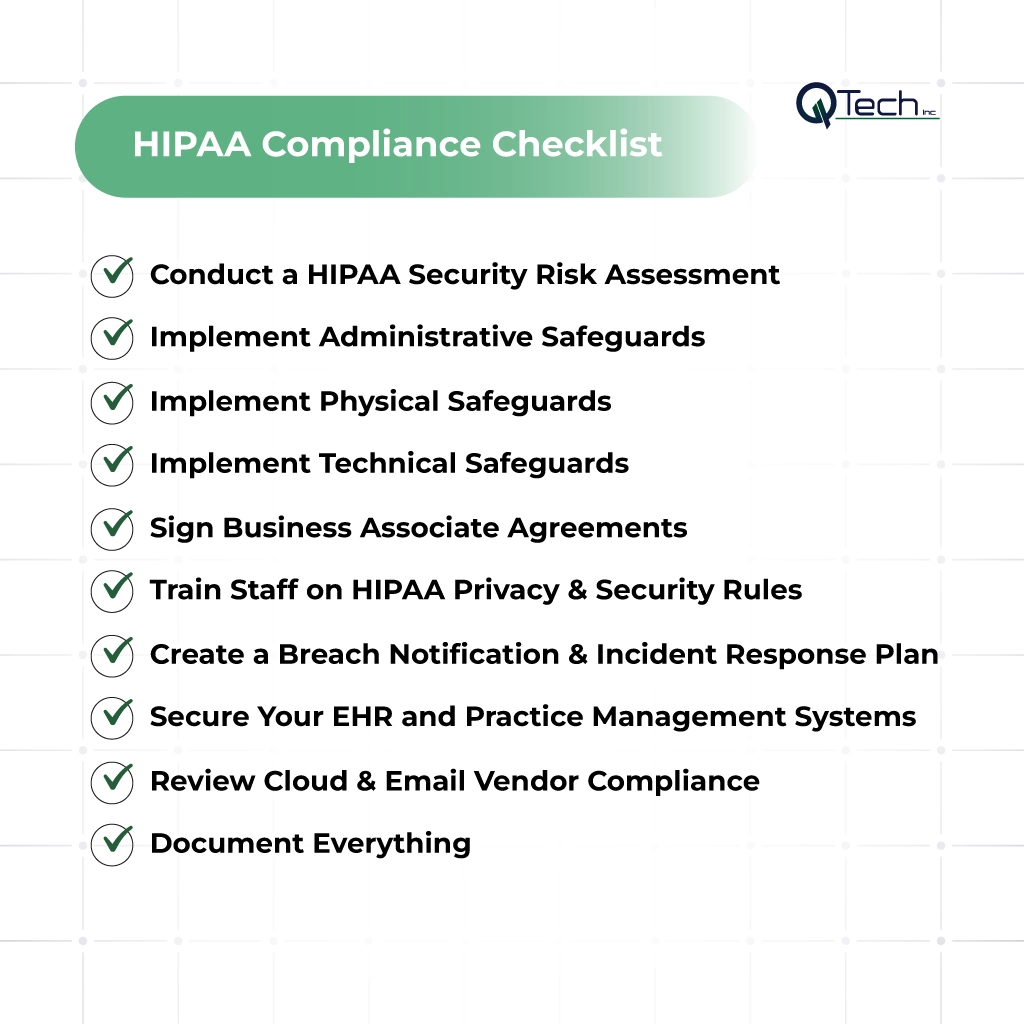
- A complete compliance programme covers ten steps: risk assessment, administrative safeguards, physical safeguards, technical safeguards, BAAs, staff training, breach response planning, EHR security, cloud/email vendor review, and full documentation.
- The most common compliance failures start as small shortcuts — shared passwords, unencrypted attachments, undocumented vendors, and unreviewed policies — that quietly become normal practice.
- 2026 civil penalty tiers range from $145 per violation at the lowest tier to over $2.19 million per violation and calendar-year cap for uncorrected willful neglect.
- Proactive preparation is consistently less costly than reacting to an incident after the fact.
What Is HIPAA Compliance and Why Does It Matter for Miami Providers?
HIPAA compliance means following the federal Privacy, Security, and Breach Notification Rules that govern how protected health information is used, stored, transmitted, and disclosed. For Miami providers, this isn’t only a legal responsibility — it’s a genuine business requirement that protects reputation, patient trust, and continuity of care all at once. A strong compliance checklist connects policies, systems, staff training, vendor oversight, and documentation into one repeatable audit programme, rather than treating each of these as a separate, disconnected task.
Who Needs to Be HIPAA Compliant?
HIPAA applies to covered entities such as doctors, clinics, dentists, pharmacies, psychologists, health plans, and healthcare clearinghouses that transmit certain health information electronically. It also applies to business associates that create, receive, maintain, or transmit protected health information on behalf of those organisations. In practice, HIPAA compliance matters just as much for small medical practices as it does for large health systems — one weak password, one lost laptop, or one misdirected email can create a fully reportable incident regardless of practice size.
HIPAA Compliance vs. HITECH: What’s the Difference?
HIPAA created the baseline privacy and security framework, while HITECH strengthened enforcement and expanded expectations specifically around electronic health records, breach reporting, and business associate accountability. For providers today, modern compliance now includes EHR access, cloud storage, encrypted email, mobile devices, backup systems, and the security and breach notification procedures used when something actually goes wrong — HITECH is what pushed compliance from a paper-based standard into a genuinely digital one.
Quick Reference: The 10-Step HIPAA Compliance Checklist
| Step | What It Covers |
| 1. Security Risk Assessment | Where ePHI lives, who can access it, and what could expose it |
| 2. Administrative Safeguards | Policies, ownership, and workforce access management |
| 3. Physical Safeguards | Securing devices, spaces, and printed records |
| 4. Technical Safeguards | Encryption, access controls, audit logs, MFA |
| 5. Business Associate Agreements | Signed BAAs with every vendor touching PHI |
| 6. Staff Training | Role-specific, repeated, and documented |
| 7. Breach Notification Plan | Detection, reporting, and response procedures |
| 8. EHR & Practice Management Security | User roles, access reviews, backup testing |
| 9. Cloud & Email Vendor Review | Confirming BAA support, encryption, and logging |
| 10. Documentation | Audit-ready records of every safeguard and review |
Note on this checklist: these ten steps reflect the HIPAA Security and Privacy Rules as currently published, layered with patterns Q-Tech Inc. has observed supporting healthcare providers across Miami and South Florida. Specific requirements can vary by practice type and size — this checklist is a starting framework, not a substitute for legal or compliance counsel.
Complete HIPAA Compliance Checklist (Step-by-Step)
This checklist should be reviewed at least annually, and again whenever your practice changes systems, adds vendors, opens a new location, or expands patient communication channels. The goal is building an audit process that identifies risk, assigns clear ownership, corrects weaknesses, and keeps your team genuinely ready — not a document reviewed once and filed away.
1. Conduct a HIPAA Security Risk Assessment
Begin with a formal risk assessment that reviews where electronic protected health information actually lives, who can access it, how it moves through your systems, and what could expose it. A thorough risk assessment must evaluate all deployed healthcare softwares and IT solutions—including EHR platforms, cloud applications, mobile devices, and backup systems—to identify potential data vulnerabilities. Document threats, vulnerabilities, likelihood, impact, and mitigation steps clearly, so leadership can act on real evidence rather than assumptions about where the risk actually sits.
2. Implement Administrative Safeguards
Administrative safeguards are the policies and management controls that guide your overall compliance programme. Assign a security or compliance officer, define workforce access levels clearly, create sanction policies, maintain formal onboarding and offboarding procedures, and review access regularly rather than only when something goes wrong. These controls are what turn HIPAA from a binder sitting on a shelf into an actual operating discipline embedded in daily work.
3. Implement Physical Safeguards
Physical safeguards protect the actual places and devices where patient information can be viewed or stored. Miami practices should secure reception desks, exam rooms, network closets, file storage, printers, backup drives, and workstations specifically. Use screen locks, visitor controls, locked equipment areas, and defined disposal procedures for retired hardware. Physical security is genuinely simple to implement, but it’s one of the most commonly overlooked parts of a compliance programme.
4. Implement Technical Safeguards (Encryption, Access Controls, Audit Logs)
The HIPAA Security Rule requires appropriate technical safeguards to protect electronic protected health information specifically. Review unique user IDs, strong password requirements, multi-factor authentication, role-based permissions, encryption, automatic logoff settings, endpoint protection, firewalls, audit logs, and backup monitoring together as one system. Your IT partner should confirm that access controls actually work as intended, logs are properly retained, alerts are genuinely reviewed rather than ignored, and systems stay patched on a consistent schedule.
5. Sign Business Associate Agreements (BAAs)
Every vendor that handles protected health information for your practice should have a signed business associate agreement in place. This includes IT providers, billing companies, cloud platforms, EHR vendors, answering services, marketing vendors, consultants, and even shredding companies. BAAs should clearly define permitted uses, required safeguards, breach reporting duties, subcontractor requirements, and termination procedures — a missing BAA with even a minor vendor is a real, documented compliance gap.
6. Train Staff on HIPAA Privacy & Security Rules
Staff training should be practical, role-specific, and repeated regularly rather than delivered once at hiring. Front desk employees need clear guidance on identity verification and appropriate conversations at check-in. Clinical staff need specific rules for accessing records, using mobile devices, and sharing information appropriately. Managers need defined escalation procedures for when something looks wrong. Keep attendance records, quiz results, policy acknowledgments, and training content tied to real situations your team actually faces day to day — these records are genuinely valuable evidence during a HIPAA audit, not just a formality.
7. Create a Breach Notification & Incident Response Plan
A breach notification plan should clearly explain how your team detects, reports, investigates, and documents potential privacy or security incidents. It should identify exactly who receives internal reports, who contacts affected vendors, who preserves evidence, who communicates with legal counsel, and who coordinates any required notifications. Include scenarios like ransomware, lost devices, misdirected emails, unauthorized record access, and cloud account compromise in regular tabletop exercises, so the plan has actually been tested before it’s ever needed for real.
8. Secure Your EHR and Practice Management Systems
Your EHR and practice management platforms sit at the center of both clinical and business workflows, which makes them a high-priority focus. Review user roles, inactive accounts, shared logins, remote access permissions, exported reports, API connections, patient portal settings, and audit log retention specifically. Require multi-factor authentication wherever it’s available, and restrict administrative access to only those who genuinely need it. Implementing reliable data backup and disaster recovery for medical practices and testing restore points directly ensures that data availability obligations under the Security Rule are consistently met.
9. Review Cloud & Email Vendor Compliance
Cloud and email tools need to be actively configured for HIPAA compliance, not simply purchased from a well-known, reputable provider and assumed to be compliant by default. Confirm that each vendor supports a signed BAA, encryption, access logging, defined retention policies, account recovery controls, and administrative visibility into activity. Email should be encrypted whenever it contains protected health information. Vendor reviews like this should be a standing part of annual HIPAA compliance planning for Miami healthcare providers, not a one-time check done at vendor onboarding.
10. Document Everything (Audit-Ready Records)
Documentation is what turns good intentions into genuinely defensible compliance. Keep records of policies, risk analysis results, remediation plans, training completion, BAAs, system reviews, incident reports, backup tests, access reviews, and vendor evaluations. During a compliance audit, an organisation has to actually show that safeguards exist and have been maintained consistently over time — clear, organized records are what make that audit process considerably faster and less stressful when it happens.
Common HIPAA Compliance Mistakes Miami Practices Make
Most HIPAA failures begin with small shortcuts that quietly become normal over time: shared passwords, unencrypted attachments, ageing computers, undocumented vendors, informal texting about patients, or policies no one has actually reviewed in years. A useful HIPAA compliance checklist helps teams correct these habits before they turn into genuinely expensive problems.
Unsecured Email and Patient Communication
Patients want quick answers, but convenience can’t be allowed to override privacy requirements. Sending lab results, billing details, or clinical updates through unsecured email can expose protected health information in ways that are hard to undo. Practices using healthcare CRM and marketing tools should clearly define encryption standards, establish patient portal workflows, and verify recipient authorizations before sending any sensitive clinical communications
Outdated or Unpatched Systems
Unsupported operating systems, old firewalls, unpatched EHR workstations, and neglected plugins all increase real risk. Attackers often target known vulnerabilities specifically because they’re easier to exploit than finding something new. Patch management, endpoint monitoring, and lifecycle planning should be part of the same compliance programme as policies and training — not treated as a separate IT-only concern disconnected from compliance.
No Designated Compliance Officer
Without a clear owner, HIPAA tasks get scattered across administration, billing, clinical staff, and IT, with no one actually accountable for the whole picture. A designated compliance officer doesn’t need to do everything alone, but someone needs to coordinate reviews, track remediation progress, maintain records, and make sure leadership actually sees unresolved risk. Clear ownership is what creates real accountability — without it, gaps tend to persist simply because no one owns closing them.
What Happens If You’re Not HIPAA Compliant? (Penalties in 2026)
Noncompliance can lead to corrective action plans, ongoing monitoring, reputational damage, legal costs, breach response expenses, and civil monetary penalties. In 2026, penalties vary by culpability level — ranging from situations where an organisation genuinely didn’t know about a violation, up to willful neglect that was never corrected. The financial impact can grow quickly when the same underlying weakness affects many patient records at once.
Civil Penalty Tiers
Civil penalty tiers are based on knowledge, reasonable cause, and willful neglect. For 2026, the lowest tier of violations can begin at $145 per violation, while the highest tier — willful neglect not corrected within the required period — can reach $2,190,294 per violation, with an equivalent calendar-year cap for identical violations. This tiered structure is exactly why proactive preparation is consistently less costly than reacting after an incident has already occurred.
Criminal Penalties for Willful Neglect
Criminal penalties may apply when protected health information is knowingly obtained or disclosed in violation of HIPAA, especially when the conduct involves false pretenses, personal gain, or malicious intent to cause harm. While most providers understandably focus on civil enforcement, intentional misuse of patient data can create genuinely severe consequences beyond fines alone. Strong access controls, active monitoring, and consistent staff training all reduce this risk meaningfully.
Conclusion & How Q-Tech Inc. Helps Miami Healthcare Providers Stay HIPAA Compliant
HIPAA compliance is not a one-time project — it’s an ongoing discipline that blends leadership, training, documentation, cybersecurity, vendor management, and reliable IT support into one continuous programme. For Miami healthcare providers, the right partner can simplify this process considerably, helping assess risk, secure systems, document safeguards, and prepare for audits without slowing down actual patient care. Q-Tech provides specialized IT services in Miami for healthcare designed specifically to protect patient privacy and safeguard technical infrastructure in clinical environments.. From risk assessments and endpoint protection to cloud configuration, EHR safeguards, backups, monitoring, and vendor reviews, our team helps medical practices strengthen both compliance and resilience together. Learn more about our HIPAA-compliant managed IT services in Miami and build a safer technology foundation for your patients, staff, and business in 2026.