
Introduction to Remarketing in Digital Marketing
In 2026, businesses face a simple reality: getting attention online is hard, but keeping it is even harder. That is where remarketing earns its value. A smart remarketing approach helps brands reconnect with people who already showed intent through interactions with your brand, whether they viewed a product page, clicked an ad, or started a form. For any business refining its online marketing strategy, this guide explains how to use remarketing like a pro to revolutionize your online marketing without sounding repetitive, intrusive, or disconnected from the customer journey.
What Is Remarketing and Why It Matters
Remarketing is the practice of re-engaging people after they visit your website, open an email, browse a service page, or leave items behind in a shopping cart. Instead of starting from zero, it focuses on people who already know your business and may be closer to taking the desired action.
That makes remarketing strategies especially useful for brands that want to improve efficiency, reduce wasted ad spend, and stay visible to the right target audience. When executed well, a remarketing campaign keeps your message relevant and timely while increasing conversions across multiple channels.
Remarketing vs Retargeting
The discussion around remarketing vs retargeting often creates confusion, but the distinction is practical rather than dramatic. Retargeting campaigns usually refer to ad-based follow-up, such as display ads shown to past visitors across websites or social platforms.
Remarketing can include that, but it often extends into email remarketing, customer list outreach, and broader re-engagement tactics. In other words, all retargeting may support remarketing, but not all remarketing is limited to ads alone. On platforms like Meta, Meta remarketing can reconnect with people who viewed content, watched videos, or engaged with a form but did not move forward.
Why Remarketing Improves Marketing ROI
Remarketing improves ROI because it focuses on warmer prospects instead of cold traffic. Someone who has already explored pricing, reviewed services, or added products to a cart is more likely to respond than someone seeing your brand for the first time.
That is why Google Ads remarketing, email remarketing, and abandoned cart recovery continue to play such a strong role in improving conversion rates. These tactics guide people back toward a desired action, whether that means scheduling a consultation, downloading a resource, or returning to complete a purchase after leaving the site too early.
How Remarketing Works in Online Marketing
At its core, remarketing working well depends on data, segmentation, and message relevance. When users visit your website, their actions help shape future outreach. The pages they view, the services they explore, and the point where they leave all create useful signals.
Instead of sending the same message to everyone, marketers use those signals to build a follow-up system that aligns with buyer intent. That is why remarketing is not just about repetition. It is about reaching website visitors with the right message after they visit your website and before momentum disappears.
Tracking Website Visitors
Tracking begins when tools such as pixels, tags, and analytics platforms identify behavior on your site. A business using Google Ads or Meta can connect that behavior to an audience and build a remarketing list based on visits, product views, or form starts.
Inside a Google Ads account, that data helps organize who saw what and when, making it easier to serve relevant remarketing ads later. When a platform targets ads based on real behavior rather than guesswork, the result is a more focused campaign and a better chance of moving users closer to conversion.
Creating Custom Audience Lists
Once tracking is in place, the next step is audience creation. Not all visitors should receive the same follow-up. Someone who read a blog post needs a different message than someone who abandoned a shopping cart or spent several minutes on a service page.
Creating custom segments allows businesses to match offers and creative to specific intent levels. This is where dynamic remarketing becomes especially powerful, because it can show users the exact products or services they viewed. For e-commerce, that supports abandoned cart emails, stronger email remarketing campaigns, and more effective abandoned cart recovery.
Delivering Personalized Ads
Personalization is where strategy becomes persuasive. Instead of serving a generic brand reminder, strong remarketing ads reflect the user’s earlier behavior and current stage in the funnel. A returning prospect may respond to a testimonial, a limited-time offer, or a personalized email that addresses a specific concern.
A user who engaged with a social media campaign may need a different follow-up than a user who checked pricing. Whether through display ads, email, or meta remarketing, the goal is to make the message feel like a useful continuation of the journey, not a random interruption.
Proven Remarketing Strategies to Increase Conversions
The most successful remarketing strategies are not built on volume alone. They are built on precision, timing, and relevance. Businesses that see real gains usually combine behavioral data with strong creative and clear offers.
They also respect the buyer’s attention instead of flooding every channel with the same message. When remarketing becomes part of a larger conversion strategy, it supports brand recall, protects ad spend, and creates better handoffs from awareness to action. The difference between average performance and excellent performance often comes down to how carefully the next step is planned.
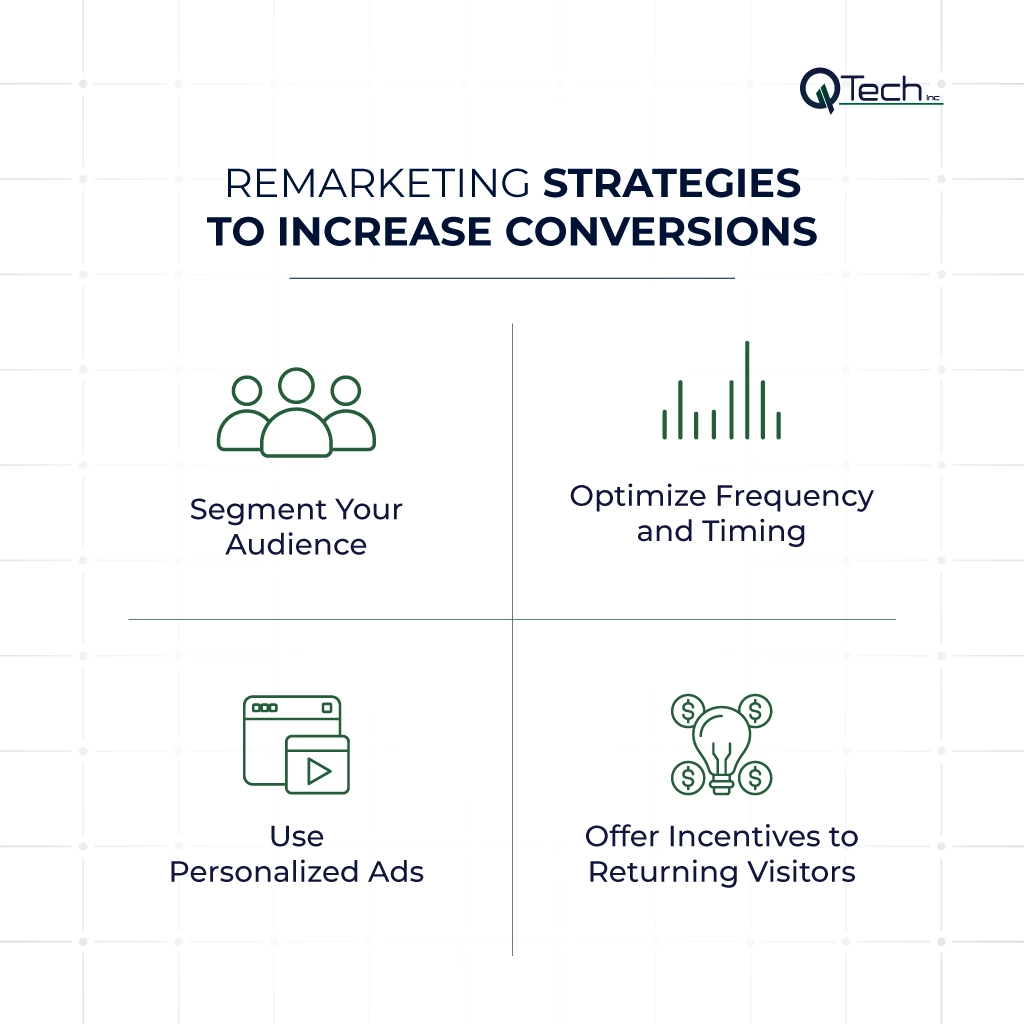
Segment Your Audience
Audience segmentation is the foundation of strong remarketing. A business should separate first-time visitors, repeat visitors, pricing-page viewers, lead-form starters, and past customers into different groups. Each segment has a different intent, hesitation points, and expectations.
When you define your target audience clearly, you stop wasting impressions on generic follow-up and start delivering communication that matches behavior. A precise remarketing list can also help identify where prospects drop off most often, which makes the full funnel easier to improve. Better segmentation does not just sharpen ads; it improves the whole customer journey.
Use Personalized Ads
Generic follow-up tends to get ignored, but relevant follow-up earns attention. Personalized creative should reflect the page visited, product viewed, or service explored. For e-commerce brands, dynamic remarketing can highlight the exact item a shopper considered.
For service businesses, a strong message may reference consultation benefits, case studies, or service outcomes. Personalized remarketing ads are often more persuasive because they reduce friction and remind users why they showed interest in the first place. When the message feels aligned with prior behavior, increasing conversions becomes much more achievable across search, display ads, and social placements.
Optimize Frequency and Timing
Even a great campaign can underperform if it appears too often or too late. Timing matters because user intent cools quickly, especially after an initial visit. Frequency matters because repetition without relevance can create fatigue. The best remarketing campaign uses controlled exposure, showing enough visibility to stay memorable without becoming intrusive.
In a Google Ads account, frequency settings, membership duration, and audience exclusions all help refine delivery. A shopper who left yesterday may respond to one message, while someone inactive for thirty days may need a different approach, a softer offer, or a stronger proof point.
Offer Incentives to Returning Visitors
Sometimes a prospect needs more than a reminder; they need a reason to act now. Incentives can be highly effective when they are used selectively and tied to a clear intent. Discounts, free consultations, bonus resources, or limited-time upgrades can help move hesitant users toward the final step.
This is especially effective for abandoned cart recovery, where abandoned cart emails can reduce hesitation and encourage users to complete a purchase. The key is not to train users to wait for a discount, but to use incentives strategically when they can remove friction, rebuild urgency, and improve conversion rates.
Conclusion: Transform Your Online Marketing with Q-Tech Inc. Remarketing Strategies
Remarketing remains one of the most practical ways to strengthen digital performance in 2026 because it turns prior interest into a second chance to convert. When businesses understand remarketing vs retargeting, build smarter audiences, personalize follow-up, and refine timing, they create a more efficient system for guiding prospects back to action.
From Google Ads remarketing to email remarketing campaigns, the goal is always the same: reconnect with people who already showed intent and help them move forward with confidence. With the right structure, Q-Tech Inc. can help businesses turn remarketing into a measurable advantage that supports stronger growth, smarter spending, and better results.
FAQ
Q: What is the difference between remarketing and retargeting?
A: While often used interchangeably, retargeting usually refers to using paid ads to bring back site visitors (via Display or Social), whereas remarketing is a broader term that includes re-engaging customers via email, SMS, or phone based on their previous purchase history.
Q: What are the best platforms for remarketing?
A: The most powerful platforms are Google Ads (for Display Network and YouTube remarketing) and Meta Ads Manager (for Facebook and Instagram). For e-commerce, dynamic remarketing on these platforms is highly effective. Email remarketing to users who abandoned carts is also a top strategy.
Q: How can I measure the success of my remarketing campaigns?
A: Focus on metrics that show impact on your bottom line: Click-Through Rate (CTR) measures engagement, Conversion Rate shows how many clicked eventually purchased, and Return on Ad Spend (ROAS) is the ultimate measure of profitability, comparing revenue generated to ad costs.
Q: How do I reduce my CPA with remarketing?
A: Use Exclusion Lists. The most effective way to lower Cost-Per-Acquisition (CPA) is to automatically exclude users who have already purchased. This ensures your budget is only spent on “Unconverted” high-intent prospects.