

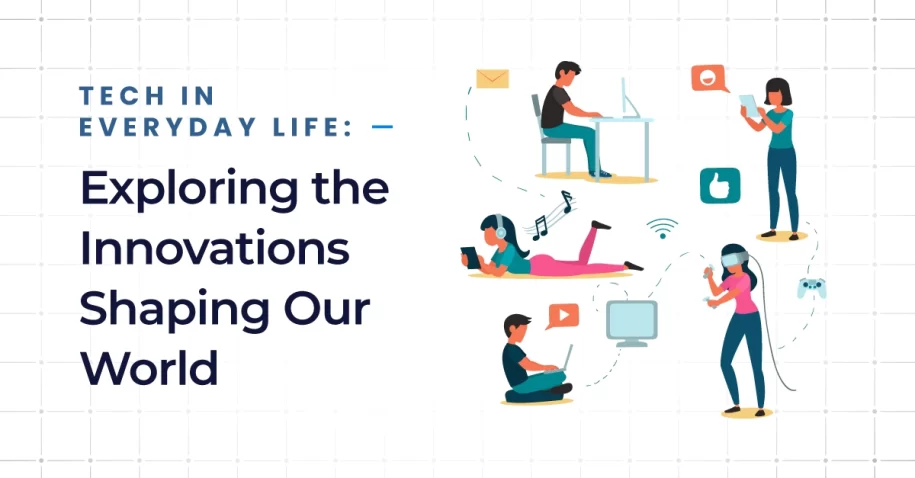
How is Technology Transforming Our Everyday Lives in 2026?
In 2026, technology in everyday life is no longer defined by isolated gadgets or occasional convenience. It has become the infrastructure behind how people communicate, learn, shop, travel, and work.
The idea behind is simple: digital tools are now woven into normal routines so deeply that many people notice them only when they stop working. That shift is central to how technology shapes our world, and it is why tech trends 2026 are less about novelty and more about practical integration, speed, and trust.
What Is Technology in Everyday Life?
Technology in everyday life refers to the digital technology, systems, platforms, and connected tools that support ordinary tasks across home, school, healthcare, transportation, and business. It includes smartphones, wearables, cloud platforms, online banking, smart devices, automation tools, and collaboration software. In other words, technology is no longer separate from daily life; it is the operating layer behind modern routines. For businesses, that same reality has accelerated digital transformation, because customer expectations now reflect the speed and convenience people experience everywhere else.
Key Areas Where Technology Shapes Everyday Life
The clearest way to understand how technology shapes our world is to look at where people rely on it most. From family conversations to business processes, technology continues to influence both personal habits and professional outcomes. These changes are not limited to consumer convenience. They also affect how organizations design products and services, respond to market demand, and build long-term resilience.
Communication and Social Connectivity
Communication is one of the most visible examples of modern innovation. Messaging apps, video conferencing, collaboration platforms, and social media have turned distance into a smaller barrier. Entertainment has also become part of that same ecosystem.
People move between streaming services to watch movies, follow live sports, or share recommendations across platforms such as Apple TV, Fire TV, and services tied to warner bros and HBO Max. The result is a more immediate, always-on form of connection shaped by mobile and digital networks.
Smart Homes and IoT Devices
Homes are becoming more responsive because smart devices can now adjust lighting, temperature, security, and appliances in real time. Smart speakers, connected doorbells, occupancy sensors, and energy monitors show how small pieces of data can create a more comfortable and efficient environment. As emerging technologies mature, the next phase of smart living will depend less on manual control and more on systems that quietly learn patterns, predict needs, and reduce waste through connected automation.
Healthcare and Medical Technology
Healthcare is being reshaped by digital platforms that improve access, visibility, and continuity of care. Telehealth, remote monitoring, patient portals, and wearable sensors allow providers to deliver faster insight while helping patients stay more engaged in their own wellness. The World Health Organization continues to frame digital health as a strategic way to strengthen health systems, expand access, and support better outcomes. That matters because modern healthcare is no longer only about treatment; it is increasingly about proactive, connected, and AI-driven support.
Education and Digital Learning
Education has moved well beyond the traditional classroom model. Online coursework, learning management systems, tutoring platforms, and adaptive software make lessons more accessible and flexible for students with different needs. UNESCO’s recent work on digital education and AI-enabled learning reflects how quickly this area is evolving.
The strongest digital learning environments do more than place content online. They create feedback loops, personalize instruction, and help educators use better information to support student progress without losing the human side of teaching.
Transportation and Mobility
Transportation now relies heavily on software, connectivity, and predictive intelligence. Navigation apps adjust routes in real time, fleet systems optimize delivery schedules, and advanced driver assistance features help improve safety. Public and private mobility systems are increasingly supported by machine learning, analytics, and connected infrastructure that can respond to traffic patterns as conditions change. Research from the U.S. Department of Transportation shows how automation, predictive analytics, and intelligent transportation systems are becoming essential to safer and more efficient travel.
Business and Workplace Productivity
The workplace may be the clearest example of digital transformation initiatives moving from theory into execution. Companies now depend on collaboration suites, workflow platforms, cybersecurity tools, automation layers, and cloud infrastructure to improve decision-making and speed. The organizations seeing the strongest results are not just buying software; they are redesigning business processes around smarter workflows. That is where a clear digital transformation strategy matters most, because technology delivers its best value when it is connected to people, process, and measurable performance.
Top Technology Innovations Transforming Daily Life
The current wave of technological advancements is defined less by single devices and more by interconnected systems. The biggest tech trends are now built around intelligence, mobility, automation, and scale. For businesses and households alike, the real shift is that technology now works across environments, often in the background, shaping experience without requiring constant user effort.
Artificial Intelligence (AI)
Artificial intelligence is one of the most important forces behind modern change. AI in daily life already appears in recommendation engines, virtual assistants, fraud detection, search, smart cameras, and customer service. In the business world, the conversation is evolving from simple prompts to workflow redesign, operational insight, and AI agents that can support multi-step tasks.
McKinsey’s latest AI research also shows that organizations are moving beyond experimentation, even while many are still learning how to scale value responsibly. AI is becoming more useful when it is practical, secure, and tied to outcomes.
Cloud Computing
For businesses seeking agility and resilience, cloud computing is now foundational. It supports remote access, centralized collaboration, backup strategies, scalable infrastructure, and faster deployment of digital tools. Cloud platforms also make it easier to unify data, support cybersecurity controls, and adapt to changing demand without rebuilding everything from scratch.
As organizations modernize, the cloud is no longer just a storage solution. It is a core enabler of innovation, operational flexibility, and sustainable growth across distributed teams and service environments.
Mobile Applications
Mobile applications have become the front door to modern convenience. People use them to order food, access healthcare, manage finances, shop online, monitor travel, approve business tasks, and communicate in real time. The mobile ecosystem now supports a vast range of consumer and enterprise experiences, which is why app performance and usability matter so much. When mobile tools are well designed, they reduce friction, improve trust, and make digital access feel immediate rather than complicated.
Automation and Smart Systems
Automation is where efficiency becomes tangible. Smart systems can handle repetitive tasks, trigger alerts, route approvals, update records, and reduce manual errors across departments. For growing organizations, IT automation can help standardize operations while freeing teams to focus on higher-value work. This is especially important as companies adopt more connected tools and data sources. The goal is not to remove people from the process. It is to remove bottlenecks, improve consistency, and make decision-making faster and more reliable.
Benefits of Technology in Everyday Life
The main value of innovation is not complexity. It is useful. When technology is implemented well, it simplifies actions that once took more time, effort, or cost. That is why both households and businesses continue investing in tools that improve access, insight, and execution.
Improved Efficiency and Productivity
One of the clearest benefits of digital systems is speed. Teams can collaborate faster, automate routine work, track performance, and make decisions with fewer delays. On the personal side, the same principle applies to scheduling, payments, navigation, communication, and home management. Productivity gains come from small moments saved over and over again. That is why the most successful tools are often the ones that feel invisible while quietly improving efficiency in the background.
Better Access to Information
Technology gives people faster access to education, healthcare guidance, financial tools, and professional resources. A student can learn remotely, a patient can review test results online, and a business leader can monitor key metrics from a mobile dashboard. Better information does not automatically guarantee better decisions, but it creates the conditions for smarter action. In a data-driven environment, access to timely, organized, relevant information is a competitive advantage.
Global Connectivity
Global connectivity has changed how people live and how companies grow. Mobile networks, cloud platforms, and digital communication tools now support communication, commerce, collaboration, and service delivery across borders. The mobile economy itself underpins billions of wireless connections worldwide, which shows how central connected infrastructure has become to modern society. This level of access allows businesses to reach wider audiences while enabling people to participate more fully in the digital economy.
Enhanced Business Opportunities
For organizations, technology opens new revenue paths, service models, and customer experiences. Businesses can launch faster, test ideas earlier, personalize communication, and improve margins through smarter operations. Stronger systems also help companies align internal workflows with customer expectations. When leaders connect technology choices to measurable goals, they create stronger foundations for growth. In that sense, digital maturity is not just about modernization. It is about building a business that can adapt, compete, and scale with confidence.
The Future of Technology in Everyday Life
The future of technology will be shaped by systems that are more intelligent, more connected, and more embedded in ordinary experience. Expect to see more personalized services, stronger automation layers, better use of real-time data, and greater collaboration between people and software. At the same time, businesses will need clearer governance, stronger cybersecurity, and more disciplined execution. The next phase of tech trends 2026 will not be driven by hype alone. It will be driven by whether organizations can turn innovation into trustworthy outcomes that genuinely improve work and life.
Conclusion: Embracing Technology for a Smarter Future
Technology has become one of the defining forces behind modern life, influencing how people communicate, learn, travel, heal, and grow businesses. From cloud platforms and automation to connected homes and intelligent apps, the strongest tools are those that solve real problems with clarity and consistency. For organizations looking to strengthen their digital presence, the opportunity is clear: invest in systems that support people, improve service, and scale with purpose. As technology continues to evolve, the smartest path forward is not to resist change, but to shape it with intention.
FAQ
Q: What is the most significant technological innovation of 2026?
A: The most significant innovation is Agentic AI. Unlike previous models that only answered questions, Agentic AI can reason and act on your behalf—such as negotiating a service contract or managing your household energy consumption based on real-time market prices.
Q: What is the impact of artificial intelligence on daily life?
A: AI powers many everyday experiences: personalized recommendations on streaming services, smart email filtering, navigation apps that predict traffic, voice assistants like Siri and Alexa, and even fraud detection for your bank transactions, often working behind the scenes.
Q: How can I stay updated on the latest tech innovations?
A: Follow reputable technology news sites and blogs, listen to tech-focused podcasts, explore online communities and forums, and consider resources from established technology consulting firms like Q-Tech, which track innovations to help businesses adapt and thrive.