
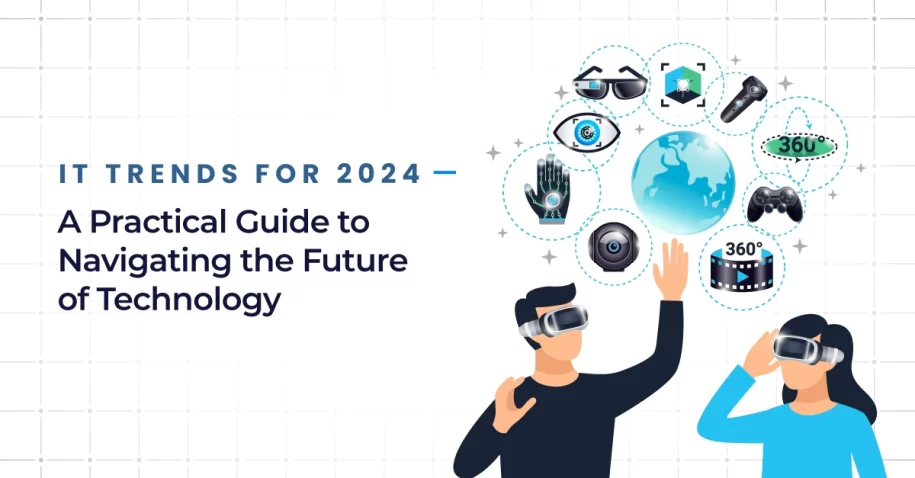
Business leaders are no longer asking whether technology will change their markets—they are deciding how quickly to adapt. In 2024, the most valuable upgrades are not shiny tools; they are practical capabilities that improve speed, resilience, and customer experience. Treat technology as a growth strategy, and you get clearer operations and stronger trust with clients.
This guide covers the IT trends 2024 that matter most and explains where to start. Think of it as a way that is realistic for budget, staffing, and timelines. With the right roadmap, fast-moving change becomes manageable and measurable.
IT Trends for 2024
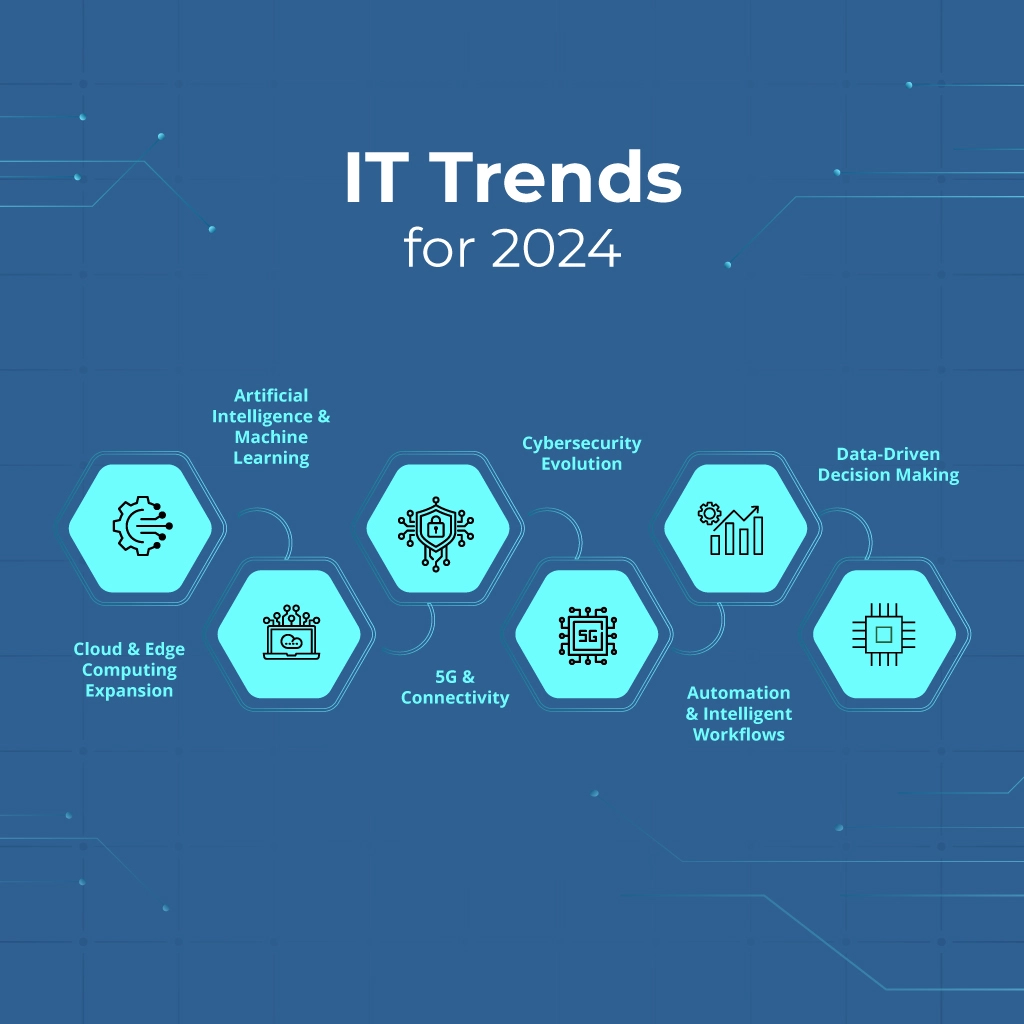
1. Artificial Intelligence & Machine Learning
Artificial intelligence is shifting from “pilot projects” to production use, especially through generative ai that supports content creation, customer support, and internal knowledge search. At the same time, machine learning helps teams forecast demand, spot anomalies, and personalize experiences using real time data. To scale responsibly, many organizations are adopting ai trism—governance practices that reduce risk, protect data, and support regulatory compliance when AI outputs influence customers or financial decisions. This includes testing for bias, securing model access, and documenting how outputs are created and reviewed.
The most practical move is to pick one workflow where AI improves throughput without compromising quality, then build guardrails. That includes role-based access, logging, human review for high-impact outputs, and security measures that protect prompts, training data, and model connections. Done well, this discipline ensures ai is useful, transparent, and aligned with business goals.
2. Cloud & Edge Computing Expansion
Cloud computing adoption continues as companies modernize legacy apps and migrate workloads to the public cloud for flexibility and cost control. Yet the bigger shift is how cloud adoption pairs with edge computing solutions—processing data closer to where it is generated. That mix supports faster applications, smoother user experiences, and stronger uptime when internet connectivity is inconsistent.
This is where 5g and edge computing becomes a practical advantage. By moving select data processing to the edge, businesses can achieve reduced latency for monitoring, point-of-sale, video, and field operations. A smart architecture blends private environments with the public cloud, then decides which workloads stay centralized and which run at the edge.
3. Cybersecurity Evolution
As attack methods mature, cybersecurity trends are moving toward proactive defense: continuous monitoring, identity-first security, and faster incident response. The goal is not only to block threats, but to minimize business disruption when something slips through. That means improving security measures across email, endpoints, and cloud computing environments, and designing systems that assume compromise is possible.
In 2024, pressure is also rising around regulatory compliance, vendor risk, and third-party exposure. Many organizations are tightening controls across supply chains, enforcing multi-factor authentication everywhere, and prioritizing security awareness that reduces social engineering success. Businesses that treat security as a daily discipline recover faster and protect reputation.
4. 5G & Connectivity
A stronger 5g network is enabling richer mobile experiences, more connected field teams, and more reliable remote operations. For businesses, 5G is not just “faster internet”; it is new capacity for internet connectivity in locations where wired options are limited or slow to deploy. That is valuable for logistics, construction, education, and multi-site operations that need predictable performance.
When you combine 5g and edge, you gain the ability to respond in real time. This supports video analytics, augmented training, and connected sensors—without the delays that frustrate users. For companies investing in iot technology, 5G improves stability while edge computing solutions keep critical workloads running, even during disruptions.
5. Automation & Intelligent Workflows
IT Automation is becoming the connective tissue between systems, teams, and customers. Intelligent workflows reduce manual steps, route approvals, sync data, and trigger alerts so employees can focus on higher-value work. In many organizations, automation improves accuracy by reducing re-keying, a common source of operational errors.
The best automation projects start with a mapped process and a clear success metric. Look for tasks that repeat daily, involve multiple handoffs, or slow down customer response. When automation is paired with AI, teams can triage tickets and summarize updates—while governance keeps workflows consistent and auditable.
6. Data-Driven Decision Making
Data is only valuable when it is timely, trusted, and accessible to the people who need it. In 2024, leaders are investing in analytics pipelines that turn scattered systems into one view of performance. This is critical for forecasting, budgeting, staffing, and customer retention.
The rise of iot devices adds another layer of opportunity. A well-designed iot system can capture operational signals—from facilities to fleets—and transform them into real time dashboards. As data processing becomes more distributed across 5g and edge, businesses can act faster, prove outcomes, and plan with confidence.
How These Trends Benefit Your Business
Taken together, these emerging technologies help businesses move faster with less friction. AI and automation streamline delivery; cloud adoption improves scalability; and cybersecurity trends protect trust while meeting regulatory demands. Meanwhile, 5G expands what teams can do on the go, and edge computing solutions keep critical services responsive.
The bigger win is alignment: when technology decisions support revenue, customer experience, and operational resilience. That is also where digital marketing services perform better. With cleaner data, faster sites, and stronger security, campaigns convert more reliably—and the brand experience feels consistent across every channel.
Conclusion — Turning 2024 IT Trends into Results with Q-Tech Inc.
Trends only create value when they become execution. You do not need to chase everything. Prioritize two or three initiatives that improve outcomes this quarter, then build a roadmap that scales over 12 months. If you are watching quantum computing, track business-ready use cases; most organizations gain value sooner by strengthening cloud, security, and automation foundations.
Q-Tech Inc. helps organizations turn strategy into action—whether that is stabilizing infrastructure, improving performance, or protecting users. For organizations that want stronger defenses against modern threats, our advanced cyber security solutions can help you assess risk, close gaps, and build a security program that scales with your business.
FAQ
Q: What is AI TRiSM?
A: AI TRiSM (Artificial Intelligence Trust, Risk, and Security Management) is a framework, popularized by Gartner, for governing and managing AI systems to ensure they are reliable, fair, secure, and trustworthy, focusing on aspects like bias mitigation, data privacy, explain ability, and security against attacks, ensuring responsible and compliant AI deployment.
Q: What does “Zero Trust” mean for cybersecurity?
A: Zero Trust is a security model based on the principle “never trust, always verify.” It assumes no user or device inside or outside the network is trustworthy by default. Every access request must be authenticated, authorized, and encrypted before granting access to applications or data. This approach is essential for protecting distributed workforces and hybrid cloud environments against sophisticated threats.
Q: How is cloud computing changing in 2024?
A: The trend is moving from simple migration to strategic optimization of hybrid and multi-cloud environments. Businesses are choosing best-fit cloud services for specific workloads (e.g., public cloud for scalability, private for sensitive data) and leveraging industry-specific cloud solutions (like healthcare or finance clouds) that offer built-in compliance and tools, maximizing performance, cost-efficiency, and agility.