
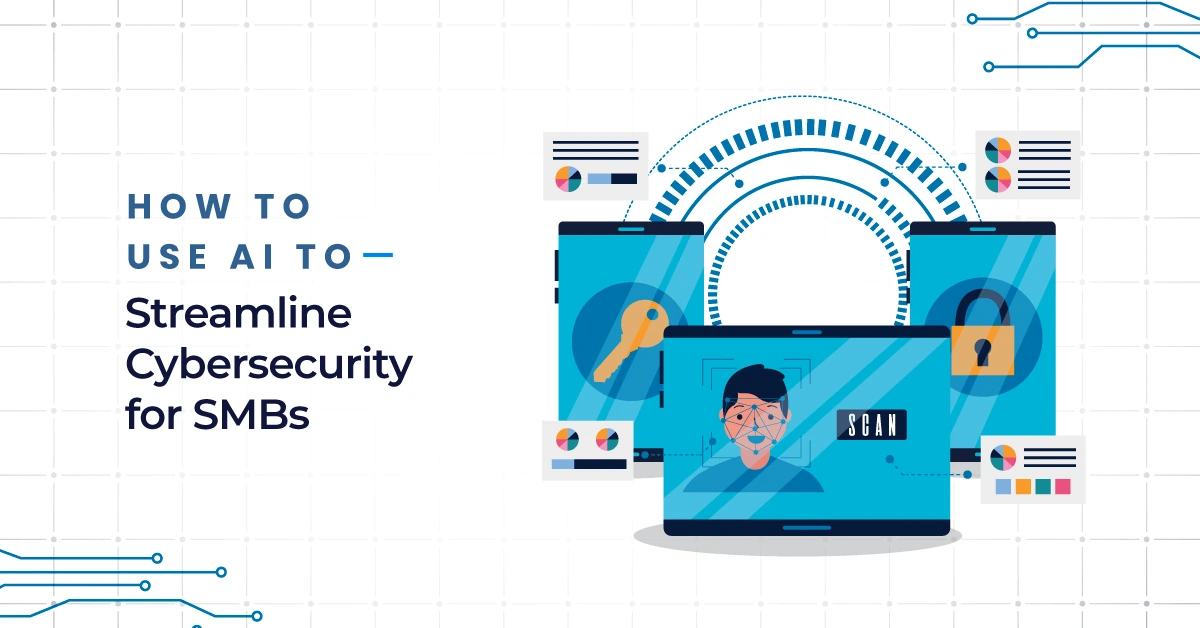
For small and medium-sized businesses (SMBs), the digital landscape has become both an opportunity and a battlefield. As technology grows more sophisticated, so do cyber threats, making it critical for SMBs to adopt defenses that can keep up with attackers. Yet with limited budgets, small teams, and growing IT complexity, traditional approaches to cybersecurity often fall short. This is where AI in cybersecurity reshapes the game—offering automation, intelligence, and scalability that used to be reserved for large enterprises.
In this guide, we’ll explore how AI streamlines cybersecurity for SMBs, showing practical applications, steps to get started, pitfalls to avoid, and how Q-Tech Inc. helps businesses bring enterprise-grade protection within reach.
Why SMBs Need AI in Cybersecurity Now
SMBs are increasingly becoming prime targets for cybercriminals. Hackers know smaller organizations often lack the dedicated security teams and enterprise budgets of Fortune 500 companies. Data breaches, ransomware, and insider misuse can devastate SMBs, leading to financial losses, reputational harm, and even regulatory fines for mishandling sensitive data.
AI cybersecurity for small businesses offers a way out of this trap. By applying machine learning models, neural networks, and behavioral analytics security, SMBs can detect threats faster, reduce alert fatigue, and automate critical defenses. Unlike static, rule-based systems, AI tools learn patterns, adapt in real time, and help identify anomalies that would slip past traditional controls.
The need is urgent: cyber threats are not slowing down. Without adopting AI-powered cybersecurity, SMBs risk being left behind in a world where attackers are already leveraging automation and even generative AI models to scale their attacks.
Key AI Use Cases for SMB Cybersecurity
AI-powered threat detection & anomaly detection (network, endpoint)
One of the most impactful uses of AI is anomaly detection across networks and endpoints. Machine learning models trained on historical user activity can quickly flag irregular behaviors—such as unauthorized logins, sudden data transfers, or malware signatures. Neural networks can be fine-tuned to distinguish between normal business operations and cyber threats, reducing false positives.
Automated incident response & containment
When a cyber attack occurs, speed is everything. AI-driven cybersecurity automation enables automated incident response, such as quarantining infected devices, blocking malicious IP addresses, or halting compromised accounts. This minimizes damage while security experts investigate root causes.
User & Entity Behavior Analytics (UEBA) to spot insider or credential misuse
UEBA systems apply behavioral analytics security to detect risky patterns. For example, an employee accessing sensitive data at odd hours or downloading large amounts of files can trigger automated alerts. By continuously learning user activity, AI tools help stop credential abuse and insider threats before they escalate.
Predictive risk modeling (which assets are likely to be attacked)
AI doesn’t just react—it predicts. Using advanced algorithms and threat intelligence, AI tools highlight which digital assets are most vulnerable. This empowers SMBs to prioritize defenses, allocate resources efficiently, and adopt proactive strategies such as vulnerability management AI.
Automating patch management, feedback loops, and repetitive tasks
Keeping systems updated is one of the simplest yet most neglected security practices. AI can automate patch management, close gaps quickly, and handle repetitive tasks like log analysis. This allows SMB security teams to focus on high-value activities such as threat hunting, while reducing human error in day-to-day cybersecurity operations.
Steps to Implement AI in Your SMB’s Cybersecurity Stack
Begin with a solid foundation: good logging, monitoring, and basic security hygiene
AI thrives on data. Before adopting AI tools, ensure your business maintains quality logs, monitors endpoints, and enforces basic practices like strong passwords and multi-factor authentication. Without this foundation, AI models may miss critical context.
Define what you need: detection, automation, response tiers
Not all SMBs face the same risks. Start by defining your requirements: Do you need better detection, automated containment, or managed detection and response (MDR services)? Understanding your needs helps in selecting the right AI cybersecurity solutions.
Choose AI tools (EDR, SIEM, SOAR, MDR) suited for SMBs
Today’s market offers a range of AI-powered security services: Endpoint Detection and Response (EDR), Security Information and Event Management (SIEM), and Security Orchestration, Automation, and Response (SOAR). Pairing these with MDR solutions provides SMBs with enterprise-grade monitoring and incident response without the overhead of hiring large security teams.
Pilot & monitor, calibrate false positives & tuning
AI systems need ongoing calibration. During implementation, monitor outcomes, adjust thresholds, and fine-tune detection to reduce noise. This iterative process builds confidence in AI tools and ensures real-time accuracy.
Combine AI with human oversight
AI is powerful, but not infallible. Over-reliance without human validation can create blind spots. The best results come from pairing automated defenses with experienced security experts who can interpret context, assess adversarial risks, and make informed decisions.

Pitfalls to Watch Out For
False positives / alert fatigue
Even the best AI can generate false alarms. Too many alerts overwhelm SMB security teams, leading to missed incidents. Balance is achieved by refining machine learning models and aligning thresholds to your business environment.
Data quality issues, incomplete logs
AI is only as good as the data it analyzes. Incomplete logs or poor data quality undermine its effectiveness. SMBs must invest in reliable logging and monitoring practices to maximize AI performance.
Over-reliance / lack of human validation
Cybersecurity automation is powerful, but it cannot fully replace human oversight. Blind reliance on AI leaves businesses exposed to novel or complex threats. A hybrid model—AI plus human expertise—remains essential.
Model bias, adversarial attacks on ML models
Attackers are becoming more sophisticated, using text-based and image generation techniques to exploit vulnerabilities in generative AI models. SMBs must be aware of adversarial attacks that trick algorithms into misclassifying cyber threats. Regular updates and fine-tuned controls are key defenses.
Costs, integration overhead
While AI tools and MDR services bring immense value, SMBs must consider cost and integration challenges. Managed security for SMBs helps mitigate these concerns by offering scalable packages tailored to smaller organizations without the heavy overhead.
Conclusion: How Q-Tech Inc. Helps SMBs Bring AI into Cybersecurity
Implementing AI cybersecurity for small businesses is no longer optional—it’s a necessity for survival and growth in today’s digital economy. By leveraging threat intelligence for SMBs, real-time detection, and predictive risk modeling, companies can gain enterprise-grade protection at an affordable scale.
Q-Tech Inc. provides AI-powered cybersecurity solutions that integrate MDR solutions, behavioral analytics security, and vulnerability management AI into one cohesive strategy. With our team of seasoned security experts, we help SMBs reduce cyber risks, protect sensitive data, and achieve compliance with ease.
Our approach blends cybersecurity automation with human intelligence. From managed security for SMBs to incident response, threat hunting, and fine-tuned machine learning models, we ensures your defenses are always evolving. Whether your priority is protecting user activity, strengthening patch management, or building resilience against future data breaches, we tailor solutions to your business needs.
The message is clear: SMBs that embrace AI in cybersecurity gain the agility, intelligence, and confidence to thrive in an increasingly hostile digital world. We makes it possible—helping you stay secure, compliant, and ahead of cyber threats.
FAQ
Q: What’s the difference between AI cybersecurity and traditional antivirus?
Answer – Traditional antivirus relies on known signatures (like a list of wanted criminals). AI cybersecurity uses behavioral analysis to identify suspicious activity, even from never-before-seen threats (like spotting suspicious behavior instead of checking a list). It’s proactive and adaptive, not just reactive.
Q: What types of AI tools are suitable for SMB cybersecurity?
Answer – Tools include:
- EDR (Endpoint Detection & Response) with AI
- SIEM platforms with built-in ML
- SOAR / MDR services for automated response
- UEBA modules
- AI-powered email / phishing filters
Q: Is it difficult to implement AI security tools in a small business?
Answer – No. Modern AI cybersecurity tools are often delivered as cloud-based or Managed Detection and Response (MDR) services, meaning they require minimal on-site configuration and maintenance. Partnering with an expert provider streamlines implementation and management, making advanced security accessible.
Q: How should I measure whether the AI is working well?
Answer – Track metrics such as:
- Mean Time to Detect (MTTD)
- Mean Time to Respond (MTTR)
- Number of prevented incidents
- Reduction in manual alerts
- False positive rate
- Cost/time saved
Q: Can AI fully replace human security staff?
Answer – No. AI is best used as an augmenting tool. Human expertise remains crucial to validate alerts, guide responses, tune models, and handle novel or contextual decisions.