
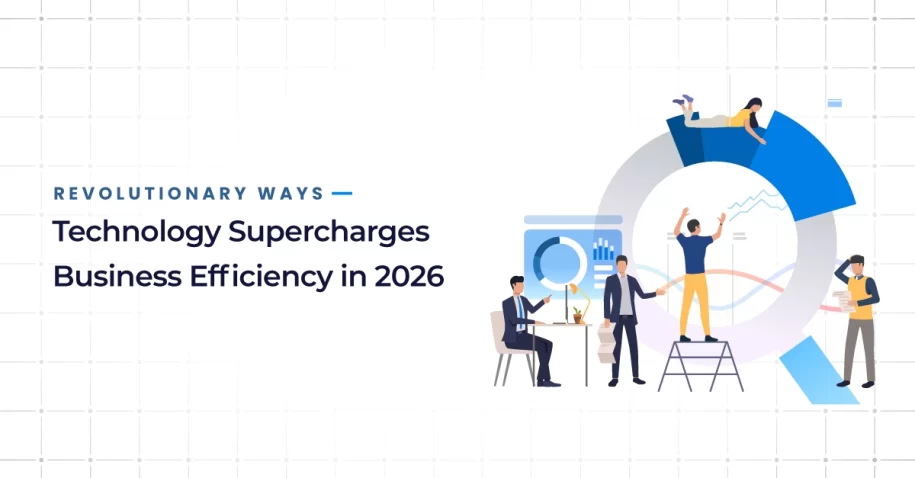
In 2026, “efficient” no longer means doing the same work faster—it means redesigning the business process so work happens with fewer handoffs, fewer errors, and clearer accountability. The biggest gains are coming from emerging technologies that connect people, platforms, and data into a single operating rhythm. When those systems work together, your organization stops reacting to problems and starts preventing them.
That shift is the core of revolutionary technologies that will transform operations. The winners aren’t just buying new software; they’re aligning technological advancements to measurable outcomes: cycle time, cash flow, service quality, and customer trust. Think of business efficiency technology 2026 as a playbook: automate what’s repetitive, modernize where speed matters, and secure everything you rely on.
How Does Technology Improve Business Efficiency in 2026?
Technology to improve business efficiency works best when it removes friction at the moments where work slows down: approvals, manual data entry, long “status check” meetings, and the constant switching between tools. Modern platforms integrate workflows, standardize data, and create a shared source of truth, so decisions happen with confidence instead of guesswork.
What’s different in 2026 is the pace and precision. AI systems can interpret unstructured information, cloud platforms can scale instantly, and connected devices can surface issues before they become downtime. The result is operational leverage—more output without burning out your people—because the “busywork” is handled by systems designed to be consistent, measurable, and auditable.
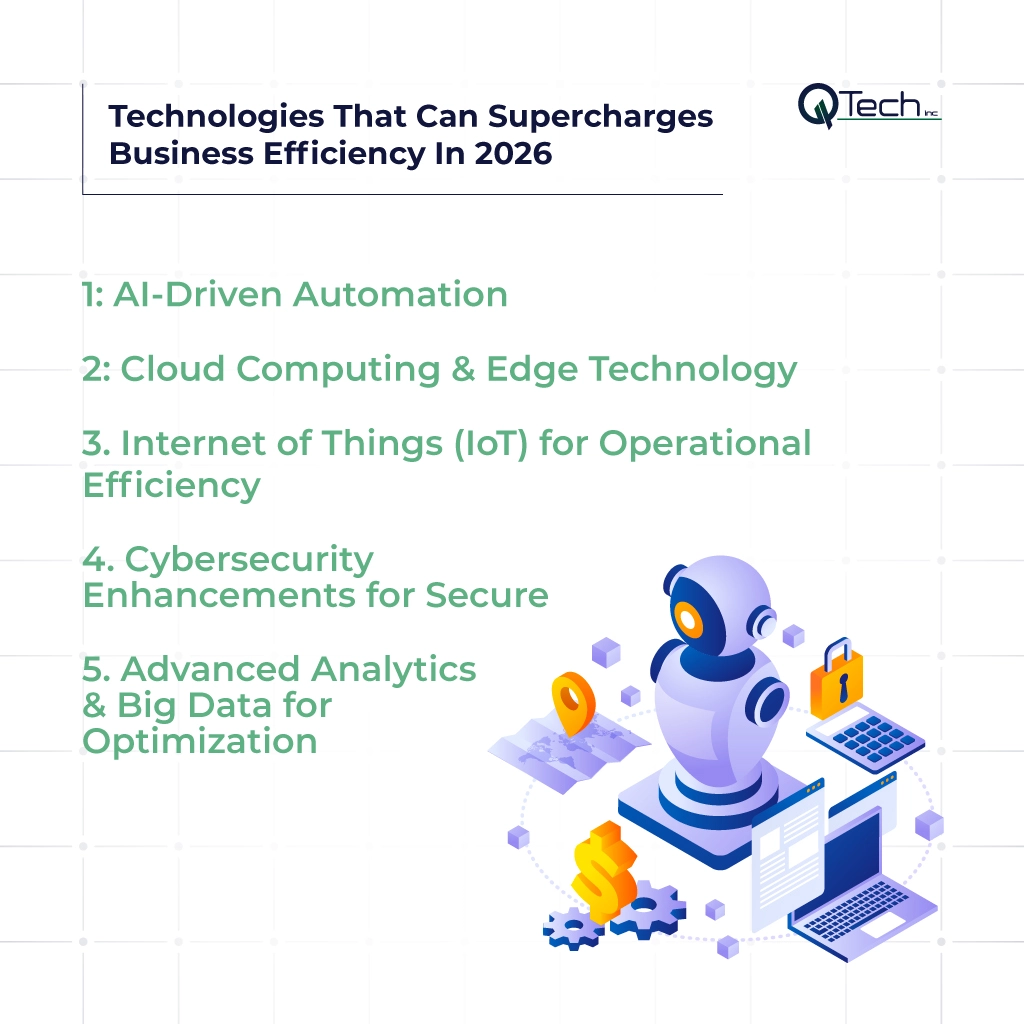
Technology That Supercharges Business Efficiency in 2026
- 1. AI-Driven Automation
- 2. Cloud Computing & Edge Technology
- 3. Internet of Things (IoT) for Operational Efficiency
- 4. Cybersecurity Enhancements for Secure Efficiency
- 5. Advanced Analytics & Big Data for Optimization
1: AI-Driven Automation
AI-driven automation is the fastest path to eliminating repetitive tasks that keep teams stuck in “urgent mode.” With AI automation, routine requests—ticket triage, invoice matching, lead routing, and reporting—shift from manual steps to rules and learning-based logic. Decision trees still matter for governance and compliance, but now they’re paired with an AI agent that can execute actions across apps, follow policies, and escalate exceptions to humans.
Generative ai adds a second layer of acceleration by turning information into output. It can draft knowledge-base articles, summarize calls, propose email sequences, and accelerate image generation for campaign concepts and landing-page layouts. Used well, it improves customer service with faster responses and consistent tone, while keeping your team focused on complex work. This is AI for operational efficiency: reducing time-consuming work, not replacing expertise.
To make automation sustainable, treat it like operations engineering. Define the “happy path,” monitor failures, and standardize handoffs so humans know exactly when to step in. When teams view automation as a living system—measured and maintained—ai systems become a reliable teammate instead of a fragile shortcut.
2: Cloud Computing & Edge Technology
Cloud computing and edge technology turn infrastructure into an on-demand resource. Instead of waiting on hardware purchases or capacity planning, teams can scale environments in minutes and standardize deployments across locations. Edge compute pushes processing closer to the action—ideal for ai capable sites, warehouses, retail floors, and clinics where latency matters. When workloads run where they’re needed, you gain speed, resilience, and better control of energy consumption.
Cloud modernization also creates cleaner guardrails for how work gets done. With consistent templates, policy-based access, and automated patching, you reduce configuration drift and shorten recovery time when something breaks. That stability is what lets teams innovate without constantly “babysitting” infrastructure.
3. Internet of Things (IoT) for Operational Efficiency
The Internet of things iot is no longer a futuristic add-on; it’s a practical way to see what’s happening across facilities, fleets, and customer environments. With IoT systems and IoT devices monitoring temperature, vibration, location, and usage, teams can predict maintenance needs and reduce unplanned downtime. The goal isn’t more dashboards—it’s IoT solutions that connect signals to action, so operations can predict maintenance, reorder parts, or dispatch technicians before a failure disrupts service.
In iot in business operations, the most valuable metric is early warning. When sensors detect drift, your predictive models can flag risk and recommend next steps. That data supports better customer experiences—accurate ETAs, proactive notifications, and fewer surprises—because operations and customer service share the same reality.
4. Cybersecurity Enhancements for Secure Efficiency
Efficiency collapses the moment a breach, ransomware event, or data loss incident forces the business into emergency mode. In 2026, cybersecurity is an operational strategy, not a compliance checkbox. Strong identity controls, modern endpoint protection, and continuous monitoring reduce the odds that one compromised account becomes a full outage—and they reduce the “shadow IT” behavior that happens when secure tools feel slow.
Secure efficiency is also about trust in automation. As AI systems and integrations expand, you need guardrails: least-privilege access, segmented networks, tested backups, and clear incident playbooks. When security is built into daily workflow, leaders can greenlight innovation without fear.
A practical benchmark is “zero-friction security.” If multi-factor authentication, device management, and data-loss controls are built into the workflow, users stop looking for shortcuts. That matters when operations and digital marketing share customer data, because speed only creates value when trust remains intact.
5. Advanced Analytics & Big Data for Optimization
Advanced analytics turns raw activity into decisions that improve margins and service levels. With big data pipelines pulling from finance, CRM, operations, and IoT-enabled sources, leaders can see the real drivers of cost and performance—without waiting for end-of-month reports. This is where predictive analytics business becomes practical: forecasting demand, spotting churn risk, and optimizing staffing with data you can defend.
The best analytics stacks blend classic decision trees with machine learning and business context. Your predictive models should be transparent enough for leaders to trust, and flexible enough to adapt as conditions change. When analytics is embedded into workflows, optimization becomes routine.
Analytics is also the bridge between “automation” and “better decisions.” When models reveal patterns—like which delays trigger cancellations, or which ticket types predict churn—teams can update workflows, refine playbooks, and tune ai automation to trigger next-best actions. Over time, that feedback loop reduces waste and raises service quality, because improvement is based on evidence, not instinct.
How Businesses Can Prepare for Tech-Driven Efficiency Gains
Adopting new tools without a plan creates noise, not efficiency. Preparation means choosing a few high-impact processes, defining success metrics, and building an architecture that can scale. Done right, tech becomes a compounding advantage: each improvement makes the next one easier.
Tech Audit & Roadmap
Start with a tech audit that maps where work gets stuck and why. Look for bottlenecks caused by manual handoffs, duplicate data, outdated permissions, and inconsistent standards across departments. Then build a roadmap that sequences changes in a way your team can absorb: foundational cybersecurity, cloud modernization, workflow automation, and data visibility. Q-Tech’s 2026 IT planning checklist is a practical framework for prioritizing initiatives, aligning budgets, and setting realistic timelines.
A solid roadmap should also connect IT and Digital Marketing Services, because operational efficiency and customer experience are linked. When campaigns, sales follow-up, and service delivery share reliable data, you reduce rework and improve outcomes from the first click to the final invoice. Set clear owners, define the KPIs you’ll monitor, and run small pilots to prove value before scaling.
Skill Development & Training
Technology only delivers value when people know how to use it—and when leadership changes the operating model to match. Invest in training on automation design, data literacy, and security habits, especially for teams that manage customer service, finance, and operations. The goal is to create an AI-capable culture where teams understand when to trust automation and when to intervene.
Conclusion — Powering Business Efficiency in 2026 with Q-Tech Inc.
Business efficiency in 2026 isn’t a single tool—it’s the integration of AI-driven automation, cloud, and edge platforms, IoT, cybersecurity, and analytics into one coherent operating system. These technological advancements work best when they’re designed around outcomes: fewer outages, faster cycle times, lower energy consumption, and a better customer experience. That’s how efficiency becomes a brand advantage: faster delivery, clearer communication, and higher confidence at every step.
Q-Tech Inc. helps businesses turn these capabilities into an execution plan—so technology to improve business efficiency becomes measurable progress, not a pile of subscriptions. When you align strategy, systems, and people, revolutionary technologies that will transform operations become the engine for smarter growth in 2026.
FAQ
Q: How will AI actually “predict” problems in my business?
A: Through predictive analytics powered by machine learning. By analyzing vast amounts of historical and real-time data from your operations, AI models can identify patterns that precede a failure, a surge in demand, or a customer churn event.
Q: What role does cloud computing play in business productivity?
A: Cloud computing enables scalable operations, remote collaboration, lower infrastructure costs, and rapid deployment of services — all of which boost organizational efficiency and flexibility.
Q: How does IoT help operational efficiency?
A: IoT connects devices and systems to collect real-time data, enabling predictive maintenance, optimized resource usage, and better operational oversight — reducing downtime and improving outputs.
Q: Why is cybersecurity important for tech-driven efficiency?
A: Cybersecurity protects critical systems, data, and operations from breaches and disruptions. Efficient operations rely on secure infrastructure to maintain uptime, trust, and business continuity.