

Businesses no longer struggle because they lack information. They struggle because they collect too much of it and fail to turn it into an informed decision. That is where D3M comes in.
At its core, which is about using facts, patterns, and context to guide the decision-making process instead of relying only on instinct. When leaders combine data collection, data analysis, and a clear data-driven strategy, they build a business that can move faster, respond smarter, and grow with greater confidence.
What is Data-Driven Decision-Making (D3M)?
Data-driven decision-making is the practice of using relevant information, historical data, and measurable outcomes to guide choices across operations, marketing, finance, and customer service. It is not about replacing human judgment. It is about strengthening judgment with evidence.
A mature D3M approach uses data integration, analytics tools, and clear business questions to identify patterns, reduce guesswork, and create actionable insights. In simple terms, d3m business excellence happens when leaders stop asking, “What do we think is happening?” and start asking, “What is the data showing us, and what should we do next?”
5 Key Benefits of D3M for Business Excellence
1. Reduced Risk and Uncertainty
One of the clearest advantages of data-driven decision-making is its ability to reduce uncertainty. When a company studies customer behavior, operational trends, and past results, it can forecast outcomes with more confidence. Predictive analytics does not eliminate risk, but it gives leaders a sharper view of what may happen next. That makes strategic planning more disciplined and less reactive, especially when budgets, hiring, or expansion decisions are on the line.
2. Faster, More Accurate Decisions
Speed matters, but speed without clarity creates expensive mistakes. Modern BI platforms are built to help teams connect data, visualize performance, and share insights across departments quickly. With the right dashboards and governed metrics in place, teams can access real-time or near-real-time signals instead of waiting for manual reports. That shortens the gap between question and action and leads to a more accurate decision-making process.
3. Increased Operational Efficiency
D3M also improves the way work gets done. When organizations are analyzing data across workflows, they can spot bottlenecks, duplicate efforts, and wasted spend more easily. This is where data science and business process thinking begin to overlap.
A company may discover that a delayed approval step is hurting fulfillment, or that one service line is consuming resources without delivering margin. Those findings help leaders streamline systems and build a stronger analytics strategy tied to day-to-day execution.
4. Improved Customer Experience
Better decisions create better customer experiences. When companies understand customer behavior, buying patterns, support trends, and engagement signals, they can serve people in a more timely and relevant way. D3M helps businesses see where friction exists, what clients value most, and how service can improve. Instead of reacting after dissatisfaction appears, companies can use data analysis to design more responsive experiences from the start.
5. Higher ROI from Marketing and Product Investments
Marketing and product teams often face the same challenge: too many ideas and too little certainty. D3M helps them allocate resources where they matter most.
By tracking campaign performance, conversion paths, and usage behavior, businesses can invest in what is working and cut what is not. This is the heart of business analytics for growth. It turns experimentation into a measured, repeatable system and supports a stronger, driven strategy across every major investment.
The D3M Framework: A Step-by-Step Guide for Businesses
A successful D3M framework is not complicated, but it does require discipline. The goal is to move from raw information to business action in a repeatable way. That means asking better questions, organizing trustworthy inputs, choosing the right tools for data-driven decision-making, and measuring what happens after the decision is made.
Step 1: Define Key Business Questions (KPIs)
Every strong D3M system starts with business questions, not software. Leaders should define the KPIs that matter most to revenue, retention, service delivery, efficiency, or growth.
If the question is vague, the analysis will be vague too. A useful starting point is simple: What outcome are we trying to improve, and what metric will prove progress? That is how a data-driven strategy stays grounded in business value.
Step 2: Identify and Clean Relevant Data Sources
Once the question is clear, the next step is gathering the right inputs. This may include CRM records, ERP data, website analytics, service tickets, sales reports, and customer feedback. Good D3M depends on clean, connected, relevant data, not just more data. Strong data integration and careful validation help prevent reporting errors that lead teams in the wrong direction.
Step 3: Choose the Right Analytics Tools (BI, ML)
Not every company needs a full data science program on day one, but every company does need tools that fit its size and goals. Some teams need dashboards and reporting. Others need forecasting, anomaly detection, or predictive models.
A data scientist may help with advanced use cases, while business users may rely on self-service reporting. The right mix of analytics tools should support clarity, adoption, and scale rather than technical complexity for its own sake.
Step 4: Analyze, Visualize, and Interpret
Data only becomes useful when people can understand it. This step is about analyzing data, comparing outcomes, and presenting the results in a form that decision-makers can use.
Dashboards, scorecards, and trend views are helpful, but interpretation matters just as much. Teams must ask what the numbers mean, what changed, and whether the pattern is signal or noise. That is how raw reporting becomes actionable insights.
Step 5: Make Decisions and Take Action
This is the moment many businesses miss. They build reports but fail to act. D3M is valuable only when insight leads to execution. Once teams understand what the data is saying, they must translate it into operational, marketing, or financial action.
That could mean adjusting pricing, changing staffing levels, refining campaigns, or redesigning a workflow. The point is not to admire the dashboard. The point is to make a better-informed decision.
Step 6: Measure Outcomes and Close the Loop
A complete D3M model includes follow-through. After action is taken, the business must measure results and compare them against the original KPI.
Did response time improve? Did conversions increase? Did churn decrease? This feedback loop strengthens future decisions and helps build a true data-driven culture. Over time, teams learn not only what works but why it works.
Tools and Technologies Powering D3M in 2026
In 2026, the D3M stack is becoming more connected, more visual, and more intelligent. Businesses now expect platforms that combine reporting, collaboration, governance, and AI support in one workflow. The most useful tools for data-driven decision-making are the ones that help teams move from visibility to action without losing trust in the numbers.
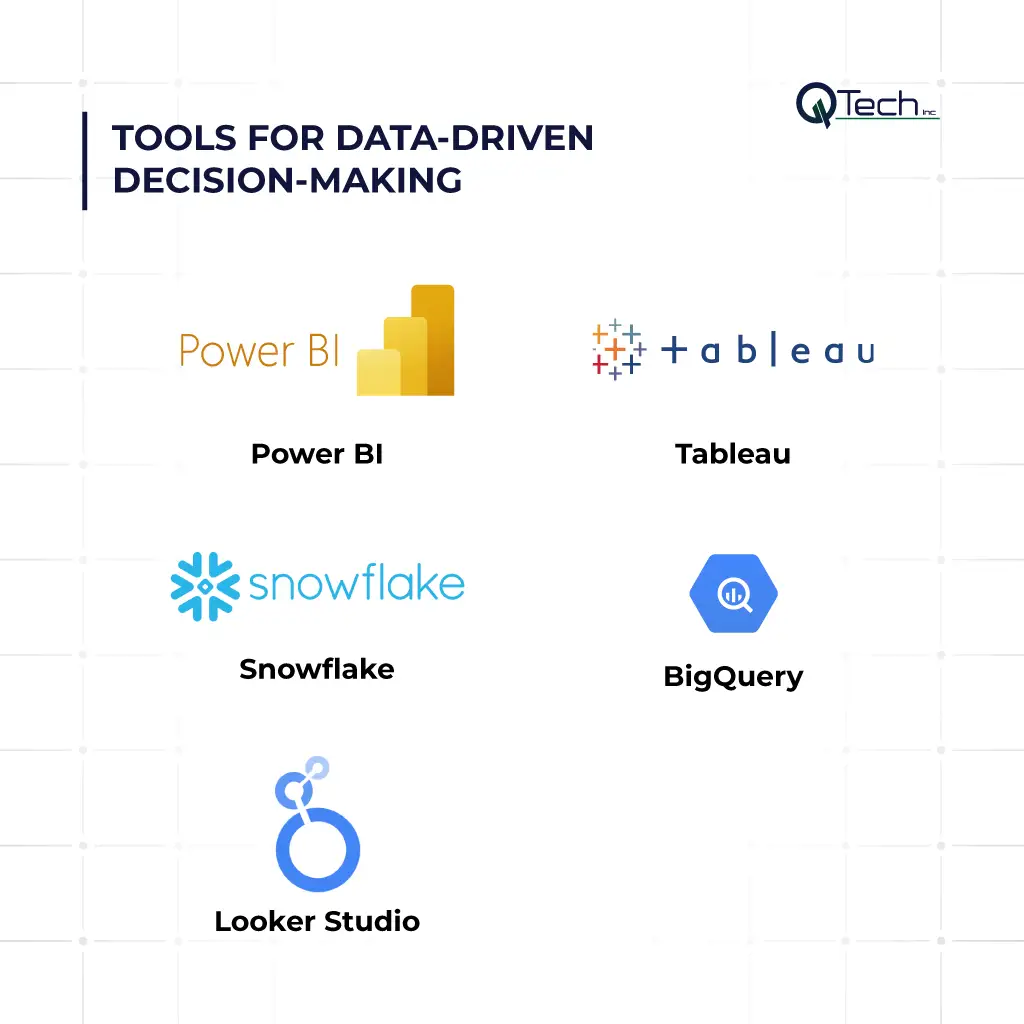
BI platforms (Power BI, Tableau, Looker)
Power BI, Tableau, and Looker remain central to modern D3M because they help organizations connect, visualize, and share business information more effectively. Microsoft describes Power BI as a business analytics platform built to turn data into actionable insights. Tableau focuses on helping users see, understand, and act on data, while Looker emphasizes governed, consistent views across the organization. Together, these platforms support better visibility and stronger alignment across teams.
Data warehousing (Snowflake, BigQuery)
Behind every reliable D3M practice is a trustworthy data foundation. Snowflake and BigQuery are widely used because they support scalable storage, flexible analysis, and faster access to large datasets. Snowflake positions its platform around integrated storage, processing, and analytics, while BigQuery offers a fully managed, serverless environment for analytics at scale. For businesses that want dependable reporting and near-real-time insight, the warehouse layer is no longer optional.
AI/ML for predictive analytics
AI and machine learning take D3M beyond description and into prediction. Instead of only explaining what happened, businesses can forecast demand, flag anomalies, score leads, and estimate risk.
That is especially useful for finance, operations, and customer growth planning. A well-scoped machine learning initiative does not replace leadership. It extends leadership by making future-oriented analysis more practical and more precise.
Conclusion – D3M Is Not a Project; It’s a Cultural Shift
The real value of D3M is not in a dashboard, a warehouse, or a report. It is in the habits a business builds around evidence, accountability, and continuous improvement.
When leaders commit to better questions, cleaner systems, and smarter interpretation, they create a culture where decisions are more deliberate and outcomes are more measurable. That is why data-driven decision-making is not a one-time initiative. It is a long-term operating mindset, and one of the clearest paths to sustainable business excellence.
FAQ
Q: What is data-driven decision-making (D3M) in simple terms?
A: D3M means making business choices based on verifiable data and analysis, not just intuition or seniority. It follows a cycle: collect data, analyze it, decide, act, and measure the outcome – then repeat. It reduces guesswork and improves results.
Q: How does D3M differ from business intelligence (BI)?
A: BI focuses on reporting and visualizing past/historical data. D3M is broader – it includes BI but also predictive analytics, experimentation (A/B tests), and continuous feedback loops. D3M is the culture; BI is one tool within it.
Q: What are the first steps to become a data-driven organization?
A: Start small: pick one business question (e.g., “Which marketing channel gives the best ROI?”). Collect clean data for that question, use a simple tool (Google Analytics, Excel), make a decision, and track the impact. Then expand gradually. Don’t try to boil the ocean.
Q: Can small businesses afford D3M?
A: Yes. Many free or low-cost tools exist: Google Analytics, Google Looker Studio (free), Tableau Public, and even Excel with Power Query. Focus on one or two high-impact decisions first. As you see ROI, invest in more advanced tools.
Q: What is the biggest mistake companies make with D3M?
A: Collecting data without a clear question. Many organizations gather massive amounts of data but don’t know what decision they’re trying to inform. This leads to “analysis paralysis.” Always start with the business question, then find the data to answer it.