

Cybersecurity matters for service businesses because their entire model runs on trust — customers hand over payment details and personal information expecting it to stay safe, and a single data breach can stop service, expose sensitive data, cause direct financial losses, and damage that trust in a way that’s hard to rebuild. As service operations increasingly move to cloud apps, mobile devices, payment platforms, and booking tools, data protection has become a continuity issue for these businesses, not just an IT task sitting off to the side. Security has to keep pace with how fast the threats themselves keep evolving.
Key Takeaways
- Service businesses are specifically targeted because they store valuable payment data, customer records, and vendor access, while depending heavily on uptime — a pressure attackers deliberately exploit.
- The most common threats in 2026 are phishing, POS system attacks, ransomware, business email compromise, insider error, and third-party/vendor attacks — no single tool stops all of them.
- Cybersecurity needs differ by sector — food service, hospitality, retail, and healthcare each carry different systems, data types, and risk points.
- MFA, employee training, tested backups, secure payment processing, network segmentation, vendor reviews, and incident response planning form the practical baseline every service business should have.
- Excess access — old accounts and unnecessary permissions — is one of the most common gaps found during service industry security audits.
- Cyber insurance can help cover breach-related costs, but it doesn’t replace actual security controls, and insurers increasingly require proof those controls exist.
Why Cybercriminals Specifically Target Service Businesses
Service companies store valuable payment data, customer records, employee files, credentials, and vendor access — a combination that makes them a genuinely attractive target. They also depend heavily on uptime: if a POS system or booking platform goes down, the impact is immediate and visible to customers right away. Attackers deliberately use that pressure to force rushed decisions, knowing a business under active disruption is more likely to pay or comply quickly just to get back online.
Many service firms connect vendors, guest Wi-Fi, remote users, cloud tools, and multiple physical locations — and each of those connections adds its own layer of risk. Protecting customer data in this environment calls for real data encryption, secure configuration, strong identity verification, and clear ownership of who’s responsible for what. A sound customer data security plan for a service business has to protect both the information itself and the systems that keep service running.
What Q-Tech Inc. Finds When We Assess Cybersecurity for a New Service Industry Business
When Q-Tech assesses cybersecurity for a new service industry client, we consistently find that technology adoption outpaced security investment — a common pattern as businesses grow quickly. We regularly find missing multi-factor authentication, overly broad admin rights, outdated software, weak Wi-Fi passwords, unmanaged devices, open vendor access, loose cloud sharing settings, and untested backups. This is the same structured process we cover in more depth in our cybersecurity risk assessment guide for small businesses, if you want to walk through exactly how a full assessment identifies and ranks these gaps.
One of the very first things we find when auditing a service business is excess access. Old employee accounts may still work long after someone has left. Current staff often have access rights they no longer need for their actual role. Strong access controls and regular account reviews help prevent unauthorized access directly, and they also reduce the risk that one stolen login ends up spreading across multiple connected systems.
Most Common Cybersecurity Threats For Service Industry Businesses in 2026
In 2026, service businesses primarily face stolen credentials, social engineering, ransomware, software vulnerabilities, and third-party attacks — and no single tool can stop every one of these on its own. Real defense requires layers across people, devices, accounts, networks, vendors, and recovery plans working together.
1. Phishing Attacks
Phishing targets people directly, through messages designed to look familiar or urgent. An email might convincingly copy a manager, a vendor, a bank, or a cloud provider — asking for a login or a download that seems routine. Staff training, email filtering, MFA, and a clear internal reporting process can all stop one bad click from spreading further into the business.
2. Point of Sale System Attacks
Restaurants, retailers, and hotels all rely heavily on point of sale systems, which makes them a specific, recurring target. Attackers may go after old terminals, remote support tools, payment applications, or weak network configurations. Secure payment processing needs supported software, limited admin access, current patching, and clear network separation — payment systems should never share open access with guest devices on the same network.
3. Ransomware
Ransomware can lock files, steal data, disable systems, and halt service outright — and downtime from an attack like this can quickly hurt both revenue and customer trust. Protected backups, endpoint security, consistent software updates, network segmentation, and continuous monitoring can help contain a single infected device before it spreads further. Recovery testing matters just as much as prevention itself — a backup that’s never been tested to actually restore is a false sense of security.
4. Business Email Compromise
Business email compromise uses a trusted name to trigger fake payments or unauthorized data transfers. Attackers may pose as an owner, a vendor, a payroll contact, or even a customer. Firms should verify any payment change through a completely separate communication channel, use strong passwords and MFA consistently, and question unusual urgency or unexpected new banking details before acting on them.
5. Insider Threats and Employee Error
Security incidents often start with simple, honest mistakes rather than malicious intent. An employee might share a file publicly by accident, reuse a password across systems, lose a device, or send sensitive data to the wrong recipient. Clear rules, role-based access, safe data collection practices, device management, and regular training all reduce both mistakes and any deliberate misuse.
6. Third-Party and Vendor Attacks
Service firms depend heavily on payment processors, booking tools, payroll systems, cloud providers, and IT vendors — and a weak link at any one of those partners can create real security risk for many of that vendor’s customers at once. Vendor reviews should cover access levels, data handling practices, breach notification history, backup procedures, and relevant data protection regulations. This review should happen before a third party ever reaches key systems, not after.
Why Cybersecurity Is Especially Critical for These Service Industry Sectors
Each service sector runs on different systems, but the core goal stays the same across all of them: keep service available while protecting customer and business data. Controls should be matched to the specific data involved, the daily systems in use, applicable legal duties, and the real cost of downtime for that particular business.
Cybersecurity for Food Service Businesses
Food service businesses run on POS terminals, online ordering, delivery apps, loyalty tools, Wi-Fi, and staff systems — and none of these should sit on one open, shared network. One practical tip worth acting on immediately: treat every connected device as part of the security perimeter, including tablets, cameras, printers, kiosks, and ordering devices, not just the core POS terminal itself.
Cybersecurity for Hospitality and Hotel Businesses
Hotels manage reservations, payment data, identity records, guest Wi-Fi, door access systems, and a large number of connected devices all at once. In our experience securing IT systems for restaurants, hotels, and retail businesses, that added complexity is exactly what raises risk. Strong identity controls, segmented networks, vendor oversight, detailed logging, and tested incident response steps all help limit real damage when something does go wrong.
Cybersecurity for Retail and Consumer Service Businesses
Retailers, salons, repair shops, agencies, and similar businesses often store customer profiles, appointment history, and transaction records. Data security here should cover the full lifecycle — collection, storage, sharing, and deletion. Keeping only the data actually needed, and limiting who can access it, meaningfully reduces exposure if a compromise does happen.
Cybersecurity for Healthcare
Healthcare providers need to protect clinical, billing, insurance, identity, and general business data simultaneously, all while keeping key systems online for patient care. Strong access controls, encryption, secure endpoints, backups, and ongoing monitoring are all essential here. The same fundamentals matter for mission-driven nonprofit organisations using cloud services to accelerate their growth — these teams also depend on secure files, identities, payments, and communications, even though their day-to-day work looks very different from a healthcare practice.
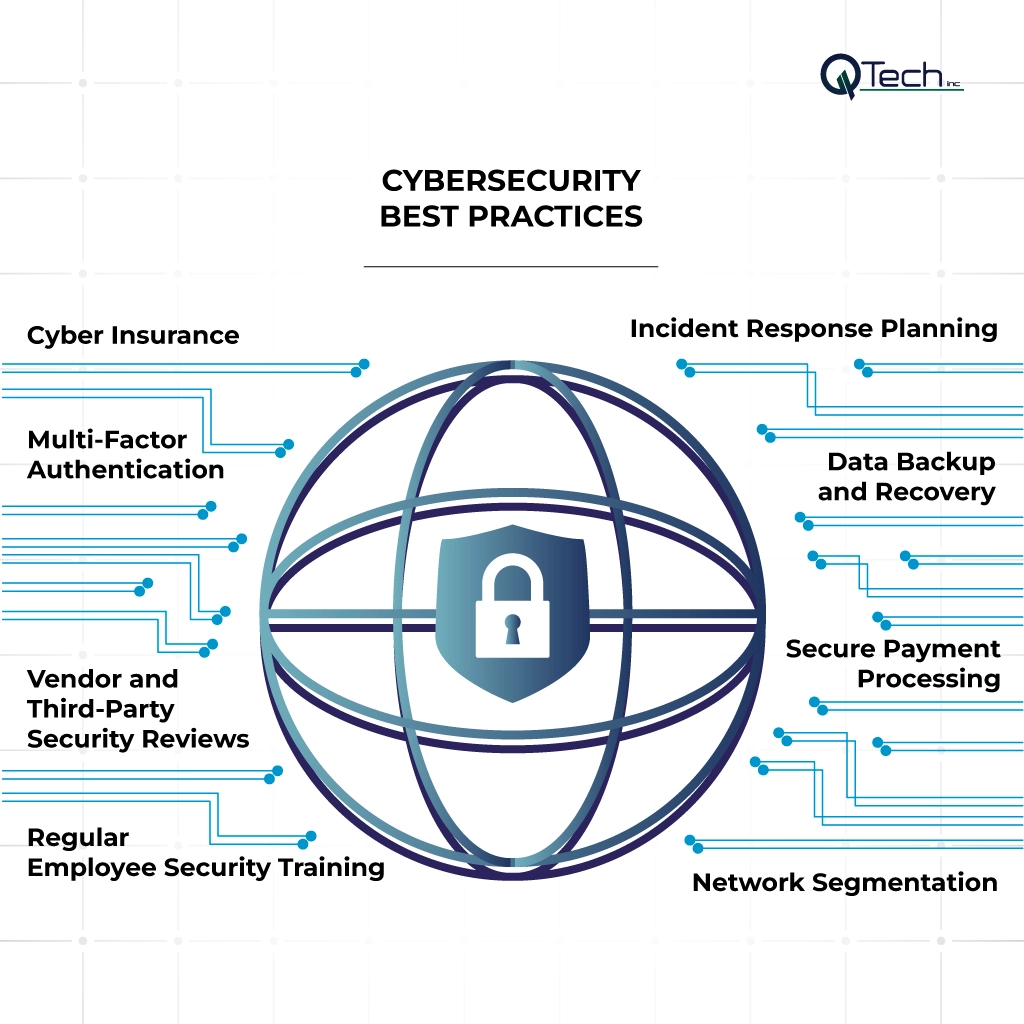
Quick Reference: Cybersecurity Best Practices Every Service Business Should Have
| Practice | Core Purpose |
| Multi-Factor Authentication | Weakens the value of a stolen password |
| Employee Security Training | Helps staff spot phishing and scams before they succeed |
| Data Backup and Recovery | Enables fast recovery after ransomware or data loss |
| Secure Payment Processing | Limits exposure and scope under PCI requirements |
| Network Segmentation | Prevents one compromised device from reaching everything |
| Vendor and Third-Party Reviews | Closes access gaps introduced by external partners |
| Incident Response Planning | Defines who acts, and how, during a real event |
| Cyber Insurance | Covers some cost impact — doesn’t replace actual controls |
Note on this table: these practices reflect widely recognised cybersecurity fundamentals for service-based businesses, layered with patterns Q-Tech Inc. has observed auditing and securing service industry clients across South Florida. The right depth and priority order still depends on your specific sector, systems, and size.
Cybersecurity Best Practices Every Service Business Should Have
Cybersecurity works best when basic controls are used every day, not pulled together only after an incident forces the issue. These practices form a practical baseline that can scale as staff, locations, systems, and vendors grow.
Multi-Factor Authentication
MFA adds a second verification step during sign-in, and should be used for email, cloud platforms, remote access, admin accounts, financial systems, and any other key application. MFA won’t stop every possible attack, but it significantly weakens the value of a stolen password on its own.
Regular Employee Security Training
Training should show staff how to spot phishing attempts, fake login pages, payment scams, unsafe links, and unusual device behaviour. Short, regular sessions throughout the year build genuinely good habits over time, more effectively than one long annual session. Employees should also know exactly where to report a suspected security incident immediately, without hesitation or uncertainty about who to tell.
Data Backup and Recovery
Backups should run on a defined schedule, stay isolated from normal user accounts, and be actively checked for failure rather than assumed to be working. They also need real restore testing — not just a scheduled backup job that’s never actually been used to recover anything. The service businesses that recover fastest from a cyber incident are the ones who already know exactly what to restore first, who leads recovery, and how work continues in the meantime.
Secure Payment Processing
Payment systems should use supported tools, data encryption, restricted access, and processes aligned with PCI requirements. Businesses shouldn’t store payment data they don’t actually need to retain — less stored card data directly means less to steal, and a smaller overall security scope to manage.
Network Segmentation
A flat, unsegmented network lets one compromised device potentially reach unrelated systems across the entire business. Segmentation separates payment devices, servers, workstations, guest Wi-Fi, cameras, and other technology into distinct, controlled zones. Firewall rules can then limit traffic between those zones, making suspicious activity considerably easier to spot early.
Vendor and Third-Party Security Reviews
Any vendor with remote access, customer data, cloud rights, or integration access should go through a formal review. This means confirming login methods, actual user rights granted, software support status, breach notification history, and data retention practices. Unused integrations and inactive vendor accounts should be removed promptly, so old access paths don’t sit around as an unmonitored risk indefinitely.
Incident Response Planning
An incident response plan defines who makes key decisions, who isolates affected systems, how evidence is preserved, and how work continues during an active incident. It should also cover customer or regulatory authority notification requirements where applicable. Tabletop exercises — walking through a simulated incident before a real one happens — reveal weak points in the plan early, and help leaders act clearly and quickly when it actually matters.
Cyber Insurance
Cyber insurance may cover some costs stemming from a breach, ransomware event, downtime, legal response, or recovery process, depending on the specific policy. It does not replace real security controls — insurers increasingly ask for proof of MFA, tested backups, endpoint protection, staff training, patching, and written risk controls before issuing or renewing a policy at all.
What Q-Tech Inc. Finds When Auditing Service Industry Businesses
Service businesses we support across South Florida consistently tell us the same thing: technology expanded quickly as they grew, and security didn’t always keep pace with that growth. During audits, Q-Tech Inc. commonly finds missing MFA, excess user rights, broad admin access, outdated software, missing patches, and weak network or Wi-Fi passwords. We also frequently find cloud sharing settings that expose considerably more data than intended.
Beyond that, we regularly find unmanaged endpoints, limited phishing training, untested backup and disaster recovery plans, weak account management practices, and poor vulnerability management overall. These recurring gaps are exactly why continuous monitoring matters — security means actively checking accounts, devices, patches, alerts, vendors, and recovery readiness as the business itself keeps changing, not confirming it all once and moving on.
How Q-Tech Inc. Helps Service Industry Businesses Stay Secure
Q-Tech Inc. helps service companies turn general security needs into a practical, working program. Our work can include risk reviews, identity checks, endpoint protection, patching, network security, secure cloud configuration, backups, monitoring, staff training, and incident planning. Businesses can use Q-Tech Inc.’s managed IT services for the service industry in Miami for ongoing IT and security support built around their specific operations.
For firms that need stronger prevention, detection, and response capability, Q-Tech Inc. provides cybersecurity solutions built around how the business actually operates day to day. The goal throughout is closing real gaps, improving visibility, protecting customer data, and scaling controls as systems, locations, and vendors continue to change over time.
Conclusion – Cybersecurity Is Not Optional – It’s Essential
Service businesses compete on trust, uptime, and response time — and cybersecurity protects all three at once. MFA, training, tested backups, secure payments, network segmentation, vendor reviews, ongoing monitoring, and a real incident response plan all work together to make any single weak point considerably harder to exploit. The strongest approach is proactive and continuous, not reactive. Leaders should know exactly where sensitive data lives and who can access it, which vendors connect into their systems, how quickly flaws actually get fixed, and how the company will recover if something does go wrong. Making security part of daily operations — not a once-a-year project — helps protect customers, reduce real risk, and support confident, sustainable growth.